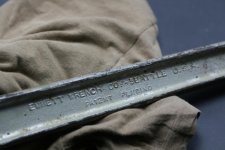
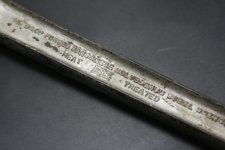
Here's an unusual one I stumbled onto this weekend in Washington State. Normally I stay away from odd patent, obscure tool company wrenches. But this one was too cool to pass up. This 18" 6 lb. wrench doesn't need an adjustable screw. It's got an internal gear and ratchet setup to make instantaneous adjustments just by pushing the jaw to the desired spot. A push button on the side springs the jaw back to the fully open position. There's no play in the jaws once you set it like with a regular Crescent and the cleverness of the design allows miniscule adjustments while (theoretically at least) not sacrificing strength. This one seems to work perfectly. Maybe a criticism might be that you'd expect a little bit bigger opening ( this has a 2" limit) and depth for the size.

You are using an out of date browser. It may not display this or other websites correctly.
You should upgrade or use an alternative browser.
You should upgrade or use an alternative browser.
Massive adjustable wrench 1932 Pat. 1,870,326
- Thread starter MR.X
- Start date




woody 73
Well-known member
Mr. X can you tell me anything about Milton W. Emmett, perhaps date of birth or date of death? Any information about him at all?
Cool. Here's a link to some drawing pics and ....
http://www.datamp.org/patents/displayPatent.php?pn=1870326&id=56111
http://www.datamp.org/patents/displayPatent.php?pn=1870326&id=56111
Private Lugnutz
Well-known member
Nice find, MR. X. Never seen one or heard of it before. The operation, with no thumbscrew, reminds me of the SPEEDNUT wrenches. EDIT: Also, I see that it was patented in 1929, and the wrench is marked patent pending, but that Manganese Molybdenum steel composition is unusual for that time period. AISI 13XX was a popular substitute for some mfgrs (e.g., Herbrand) in WWII. What does that finish look like to you?
Last edited:
Thanks. Me neither. When I picked it up I assumed that it wasn't going to work and that's why it was where I found it, but the action was so surprisingly tight and efficient It forced me to take it home. I've seen Speednut wrenches before but never really investigated their engineering, I'll have to take a look.Nice find, MR. X. Never seen one or heard of it before. The operation, with no thumbscrew, reminds me of the SPEEDNUT wrenches.
Mr. X can you tell me anything about Milton W. Emmett, perhaps date of birth or date of death? Any information about him at all?
Hi. Sorry Bro, I got nothing.
Cool. Here's a link to some drawing pics and ....
http://www.datamp.org/patents/displayPatent.php?pn=1870326&id=56111
Hi. Thanks. Clicked on dude's name and it showed he has 3 patents spanning like 20 years.
Private Lugnutz
Well-known member
Speednuts used a rack-and-pinion mechanism. I didn't mean to suggest there was a connection between Emmett and Cochran, Speednut, or any of the other Cochran copycats. But they do operate similarly (no thumbscrew) and with similar precision and smoothness. Your purchase rationale resonates with me, because I pretty much said the same thing when I found a SPEEDNUT. I was so shocked how well the dang thing worked I wondered how such a marvelous thing did not last! Link here.TWhen I picked it up I assumed that it wasn't going to work and that's why it was where I found it, but the action was so surprisingly tight and efficient It forced me to take it home. I've seen Speednut wrenches before but never really investigated their engineering, I'll have to take a look.
Private Lugnutz; but that Manganese Molybdenum steel composition is unusual for that time period. AISI 13XX was a popular substitute for some mfgrs (e.g. said:Yeah, that Manganese bit caught my eye too.....I think it's just a silver/grey paint on the steel. Doesn't feel like cadmium. BTW, it is marked BS Co. as if a forge mark on the body and one of the jaws.
Farmall450
Well-known member
That's pretty neat.
Speednuts used a rack-and-pinion mechanism. I didn't mean to suggest there was a connection between Emmett and Cochran, Speednut, or any of the other Cochran copycats. But they do operate similarly (no thumbscrew) and with similar precision and smoothness. Your purchase rationale resonates with me, because I pretty much said the same thing when I found a SPEEDNUT. gI was so shocked how well the dan thing worked I wondered how such a marvelous thing did not last! Link here.
Right?! After I played around with it I was immediately trying to come up with the main reason such a seemingly cool design didn't last.....too heavy? mechanism unreliable? too expensive? I even went conspiracy...bought out and buried by Crescent? who knows?
Private Lugnutz
Well-known member
Interesting.BTW, it is marked BS Co. as if a forge mark on the body and one of the jaws.
The gears are still spinning on the Manganese Molybdenum composition. Most triple alloys, invented in 1942, had a fairly good amount of manganese (which allowed steel mills to reduce the amount of nickel, chromium, and molybdenum). But I wasn't aware of it being used with Moly in AISI 13xx formula until the war as a sub for high content Chromium-based double alloys. I suppose that's where Herbrand got the idea from, mfgrs like Emmett that were using it earlier, probably for economical reasons.
3baygarage
Well-known member
Cool. That’s an unusual find for sure.
Cool. That’s an unusual find for sure.
Thanks bro.
twertsy
Well-known member
Mr. X can you tell me anything about Milton W. Emmett, perhaps date of birth or date of death? Any information about him at all?
1925 Seattle Directory - President, Roberts Wrench Co.
5/7/1932 - Married Gertrude M Stauber
Likely born 12/1892 (Poss. '93) in Merrill, Wisconsin to Edward Emmett and Myra Mclean
1900 Census - Living with Grandfather & Mother in Spokane, WA
1910 Census - Living in Kellogg, Shoshone, Idaho (Notes father born in England and Mother born in Canada)
1914 - Miner in Idaho
Definitely served in WWI
The only conclusion I can come to is that BS Co. is Barde Steel Co.
Also, none of his patents in DATAMP appear to be this wrench.
Private Lugnutz
Well-known member
Good catch. The 1,870,326 patent is very similar, but there is an extra screw holding the housing together, the throat is not square, and much more importantly, there is no release button.Also, none of his patents in DATAMP appear to be this wrench.
eschoendorff
Well-known member
That a pretty cool old find!
twertsy;7758637 Also said:Good catch. The 1,870,326 patent is very similar, but there is an extra screw holding the housing together, the throat is not square, and much more importantly, there is no release button.[/QUOTE
...well somebody was patient enough to analyze that patent. Good call.
Now, I'm gonna have to open it and see how they attached the external lever button to the pawl release.
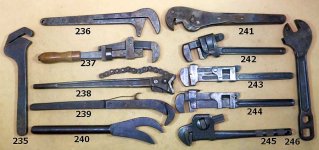
BTW, I found this link and picture of a similar Emmett Wrench #246.
http://wrenchingnews.com/2017-york-auction/catalog.html
Attachments
woody 73
Well-known member
Twertsy thank you again for finding that information about Mr. Emmett, another American company to be added to the list, Good Job.

Good catch. The 1,870,326 patent is very similar, but there is an extra screw holding the housing together, the throat is not square, and much more importantly, there is no release button.
I'm having trouble deciphering the patent as usual but fig. 2 appears to show a recess(1h) with a lever(15) on the opposite end of the wrench head from where my example has it located. It's confusing (to me) because I don't see it (15) in Fig. 1. Anyway, I'm thinking this lever IS the same thing as the "button", just on the opposite side and end of the wrench head. ....Whatcha think?
Private Lugnutz
Well-known member
It clearly serves the same function. See lines 55 through 64 in the patent application.
There are a couple possible scenarios here:
(1) The "PATENT PENDING" on the handle could still refer to 1,870,326, if your wrench was built before the patent was granted, and some time between the application and receiving the patent, he changed the design for the pawl release from a lever to a button. There is a lot of precedence for minor changes like that in the tool patent world.
(2) The "PATENT PENDING" could refer to a subsequent patent, patent number unknown, precisely aimed at an improvement on the pawl release, replacing the open lever with an enclosed button, and moving it to the other side of the head.
I like #2, if only because the follow-on patent could've been several years after 1932, perhaps in the early 1940's, which puts my inkling on the strange steel composition back into play.
There are a couple possible scenarios here:
(1) The "PATENT PENDING" on the handle could still refer to 1,870,326, if your wrench was built before the patent was granted, and some time between the application and receiving the patent, he changed the design for the pawl release from a lever to a button. There is a lot of precedence for minor changes like that in the tool patent world.
(2) The "PATENT PENDING" could refer to a subsequent patent, patent number unknown, precisely aimed at an improvement on the pawl release, replacing the open lever with an enclosed button, and moving it to the other side of the head.
I like #2, if only because the follow-on patent could've been several years after 1932, perhaps in the early 1940's, which puts my inkling on the strange steel composition back into play.
It clearly serves the same function. See lines 55 through 64 in the patent application.
There are a couple possible scenarios here:
(1) The "PATENT PENDING" on the handle could still refer to 1,870,326, if your wrench was built before the patent was granted, and some time between the application and receiving the patent, he changed the design for the pawl release from a lever to a button. There is a lot of precedence for minor changes like that in the tool patent world.
(2) The "PATENT PENDING" could refer to a subsequent patent, patent number unknown, precisely aimed at an improvement on the pawl release, replacing the open lever with an enclosed button, and moving it to the other side of the head.
I like #2, if only because the follow-on patent could've been several years after 1932, perhaps in the early 1940's, which puts my inkling on the strange steel composition back into play.
Interesting.
Private Lugnutz
Well-known member
There is a third possibility. The button could be an improvement on the lever, and your wrench could be later production, and Emmett may have just never bothered changing the dies to include the patent number.
There is precedence for that. Three successive variants of the ratchet New Britain famously made between 1937 and 1946 or thereabouts for their house brand, for their NONE BETTER brand, for their Husky brand, and for Craftsman BE and (H) under the Costello patent (2,206,943) all say "PAT. PEND." on the face plate, long after the patent was granted. As far as I know, we have never seen an example of the first variant (long selector lever with Frankenstein buttons through the handle), the second variant (long selector lever in a channel of the handle, no buttons) or third variant (short selector) with the actual patent number on it. It appears as if they just never bothered to swap out the dies.
There is precedence for that. Three successive variants of the ratchet New Britain famously made between 1937 and 1946 or thereabouts for their house brand, for their NONE BETTER brand, for their Husky brand, and for Craftsman BE and (H) under the Costello patent (2,206,943) all say "PAT. PEND." on the face plate, long after the patent was granted. As far as I know, we have never seen an example of the first variant (long selector lever with Frankenstein buttons through the handle), the second variant (long selector lever in a channel of the handle, no buttons) or third variant (short selector) with the actual patent number on it. It appears as if they just never bothered to swap out the dies.
Scenario 1 variation...the "button" might just be a curved portion of the lever I can see that was changed to the opposite side with the pawl. I started to take the plate off but 2 frozen screws put that on hold.
If this wrench was being produced from 29ish to war era where are the other examples?
If this wrench was being produced from 29ish to war era where are the other examples?
Private Lugnutz
Well-known member
Yes, that is a long duration for an exotic tool.
davethorik
Well-known member
I would guess that's exactly why there aren't many. Exotic status. Perhaps geography plays a role here too.
Very cool wrench btw, nice find.
Very cool wrench btw, nice find.
twertsy
Well-known member
His patent drawings remind me of the Eifel plier wrenchesI would guess that's exactly why there aren't many. Exotic status. Perhaps geography plays a role here too.
Very cool wrench btw, nice find.
Sent from my Pixel 2 XL using Tapatalk