To avoid these ads, REGISTER NOW!

Oil tank firestop petcock/valve: How to replace?

anythingyoucanimagine

Well-known member
Joined
Feb 6, 2019
Messages
425
Location
New England
I posted a little while back about how best to move an oil tank (with oil in it). When I moved it I noticed a small tray with kitty litter under the bottom shut-off valve. I've been watching it. Looks like it drips maybe one drip every week or so. Maybe one drip every 5-6 days... When I moved it I put a little glass bowl under it so I could really see how often it drips. It's been several days and there's a drop hanging on that's getting ready to drip --maybe today... maybe tomorrow... maybe next week...


Long story short, it's not oozing out or dripping like a flood. Just one drip every several days/weeks.


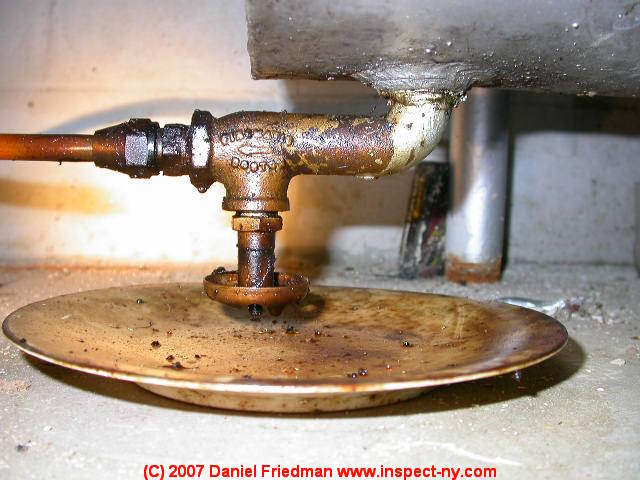
I didn't take a picture of exactly my setup but it looks like this:
oiltankvalve010DFs.jpg


Except mine has a small section of (what looks like NPT) going from the shutoff valve into the filter. Then the copper supply line to the boiler.


I'm painting the floor, ready to put the oil tank back (sometime over next few days/week) and want to deal with this now while it's much more accessible.


Is it OK that these things weep a little? Is that normal? I have had the heat cranked up a bit and have the tank tilted on an angle to drain (burn) as much as I can. Yes I know about water/sludge in the bottom --when it was half-3/4 full I could shine a light down and see shiny metal at the bottom of the tank. No rust or sludge. Also yes, I burned about half-3/4 tank in a week or so, I put a bigger nozzle in the burner, turned up the hot water temp a bit and put a hold on the heat in the house at 74 degrees. Was just easier this way. I really didn't want to deal with pumping out 100+gal of #2.


So what do I do? It's a fire valve. Can they be re-packed? It's threaded into the bottom of the tank. Do I use normal pipe dope? What do I seal it with?


Plan is to service the boiler and work backwards to the oil tank. Change out filter (screen) at the burner, put in correct nozzle, set gap & angles for ignition electrodes, it's probably going to need some kaowool in the firebox, check control board/springs/contacts, set draft, staple the numbers to the card (for the next guy), etc.

Then because I drained the tank down as much as I could, I'll blow out the line (just because), clean filter housing and change filter at tank... then somehow I'd like to stop the drip coming from the tank shutoff valve.


I've rebuilt ball-valves and replaced packing screw type spigots/valves but I know nothing about these heat/fire activated valves. The valves are cheap enough so I'm thinking I'd rather replace it but I'm also concerned with how to seal the threads. The tank will be empty. I don't mind buying a couple gallons of acetone and pouring it down into the tank. Just don't know how to get it clean and don't know what to seal the new valve/threads with.


Thanks.
 
To avoid these ads, REGISTER NOW!

TommyK

Well-known member
Joined
Mar 29, 2011
Messages
546
Location
CT
I think you should strongly consider just installing a new tank.
 

APEowner

Well-known member
Joined
Oct 2, 2009
Messages
4,166
Location
Sunny, New Mexico
When I changed mine I just waited till the level was low and then lifted up the valve end of the tank until the outlet was above the fuel level.
 

Kaizen

Well-known member
Joined
Jan 9, 2015
Messages
6,948
Location
New England
No should not be dripping. Mine is tapped an inch or so up on the side so I don’t get all the garbage in the bottom. Also my shutoff is not upside down like that


Sent from my iPhone using Tapatalk
 

shelteredV

Well-known member
Joined
Sep 3, 2015
Messages
532
Location
The Rock
We have replaced firematic valves with up to 3/4 tank in a 275. First, plug the vent really well, then take a good shop vac and tape it up to the fill very well. Prep your new valve with wicking and dope. Have a helper fire up the vac and modulate the vac to keep it to JUST not pull the oil through the fill pipe by barely squeezing the vac hose to control suction. When your confident you have control, unscrew the valve and really quickly get the new one on. We have done this without spilling a drop of oil. It takes balls to do and may not be your comfort zone, but it works.
 
OP
A

anythingyoucanimagine

Well-known member
Joined
Feb 6, 2019
Messages
425
Location
New England
When I changed mine I just waited till the level was low and then lifted up the valve end of the tank until the outlet was above the fuel level.

What did you use on the threads? Just plumbers tape? Pipe dope? Both? I was planning on lifting it up like you did. Just wasn't sure how crazy I needed to be about getting the threads clean, etc.


I don't know what the threads are. I guess if I looked at a new/replacement valve that would tell me a lot. But also need to confirm the threads I have at bottom of my tank.
 

Caddybill

Well-known member
Joined
Apr 21, 2014
Messages
314
Location
Long Island, New York
I do not believe you can rebuild a firmatic valve.
A tank that has a tapping at the bottom is old enough that it should be replaced. I believe that code has been to have a side tapping for a while now.
Take a real good look at the bottom of the tank. Tanks thin out at the lowest point from rust.
If you do replace the valve do not use teflon use dope.
 
OP
A

anythingyoucanimagine

Well-known member
Joined
Feb 6, 2019
Messages
425
Location
New England
We have replaced firematic valves with up to 3/4 tank in a 275. First, plug the vent really well, then take a good shop vac and tape it up to the fill very well. Prep your new valve with wicking and dope. Have a helper fire up the vac and modulate the vac to keep it to JUST not pull the oil through the fill pipe by barely squeezing the vac hose to control suction. When your confident you have control, unscrew the valve and really quickly get the new one on. We have done this without spilling a drop of oil. It takes balls to do and may not be your comfort zone, but it works.

Thanks. That is exactly what I was asking about. This is a mfg. date 11/2009 Granby brand, 275-gal (upright) tank. It's about 1/4 to 1/8 full (3/4-7/8 empty). I've been feeding it with pump #2 5-gal at a time because I want it to be empty. I was/am planning on lifting up one side of the tank like APEowner said. That vacuum trick is badass but not sure that's within my comfort zone...


Really all I was asking was about sealing it. Just wicking and dope? Will a supply house sell the valve to me or should I order it online?


Thanks again. Your reply/info is exactly what I was looking for.
 

shelteredV

Well-known member
Joined
Sep 3, 2015
Messages
532
Location
The Rock
Wicking and petroleum dope is what I was taught and installed more than a couple hundred with zero leaks. A good supply house will have what you need.
 

Jlbc212

Well-known member
Joined
Dec 7, 2013
Messages
1,530
Location
Northeast MA
Go to SupplyHouse.com and search on Firematic. Or use this link:

https://www.supplyhouse.com/Firomat...-8-MPT-******-Outlet-90deg-Fusible-Tank-Valve
 

brewchief

Well-known member
Joined
Sep 20, 2008
Messages
2,371
Location
Michigan
Every one I've see that's NPT on both sides is 3/8", I'm sure there are other sizes out there but that's the most common in my area by far.

I use rectorseal true blue on almost everything, have done plenty of oil fittings with it with no issues, I've never worried about cleaning the threads beyond wiping them with a paper towel.

We mount a spin on filter at the furnace in most cases so I mount a second firomatic valve right at the filter to make service easier.

Sent from my SM-G965U using Tapatalk
 
OP
A

anythingyoucanimagine

Well-known member
Joined
Feb 6, 2019
Messages
425
Location
New England
We mount a spin on filter at the furnace in most cases so I mount a second firomatic valve right at the filter to make service easier.

Thanks. In this case the filter is at the tank (westwood f100-10, probably what is in half the homes in usa). Spin on/off (like car) as you mentioned. Does it matter which end of the supply line the filter is on? There is a (firomatic brand) valve at the burner and also one at the boiler. All I want to do is clean/service and get the system to a baseline and then (document it) go from there. I understand that I don't have a licence --but my documentation (every year staple flue exhaust numbers & notes to old service card) should make the next guy halfway comfortable if I were to ever get hit by a bus.
 
To avoid these ads, REGISTER NOW!

TommyK

Well-known member
Joined
Mar 29, 2011
Messages
546
Location
CT
Why? Why spend $500 on an oil tank when all it needs is a $30 part? I stated clearly that there is no surface rust on the interior or exterior of the tank.

Because they are relatively cheap, they don't last forever and it would make it very easy to transfer the fuel from the old tank to the new tank. I don't think you can assess the condition of the inside of the tank bottom by looking inside with oil and sludge still in there. I was an operations manager for a large retail fuel oil dealer for 5 years and have some experience dealing with failed tanks. My wife has worked there for 20. It is not uncommon for tank bottoms to begin to fail after 10-15 years.

To me it would be worth the extra dollars knowing that it was new just for piece of mind.

Just my .02.
 

Bretny

Well-known member
Joined
Jul 31, 2017
Messages
3,918
Location
Dutchess county NY
Personaly i wouldnt change it. You seam more than capable of doing the job when/if you start to see a wet spot on the out side of the tank. These tanks seep before they dump 230gal of fuel in your basement.

No its not suposto leak and you should change that valve. All it takes is 1 drop of fuel oil to make the whole house stink.

If you do decide to change the tank. Get a roth plastic tank.
 
OP
A

anythingyoucanimagine

Well-known member
Joined
Feb 6, 2019
Messages
425
Location
New England
I don't think you can assess the condition of the inside of the tank bottom by looking inside with oil and sludge still in there. I was an operations manager for a large retail fuel oil dealer for 5 years and have some experience dealing with failed tanks. My wife has worked there for 20. It is not uncommon for tank bottoms to begin to fail after 10-15 years.

OK that makes more sense. I appreciate your suggestion, especially with your experience. Thanks.

So here's the deal: Tank was new in November 2009. It's just approaching 10yo. I'm on a bbq competition team with a few fools/idiots (friends). I've taken several (15+) tanks from people's homes for bbq smokers. I've walked into people's houses/garages and then turned around and walked out. (without the tanks, they were that scary)


What I don't understand with this tank is there is NO RUST. I can see the weld lines where the feet angle brackets were welded on. The bottom of the tank is shiny and there is no sludge. NONE. It's like the thing is brand new. (yes for the past six years I've been putting fuel conditioner and water remover into the tank...)


Home heating oil is red right... and No.2 from the pump isn't dyed. I've been intentionally burning down the fuel in this tank so it would be close to empty when I changed out the bottom valve. During that process I went a little nuts --I put a bigger nozzle in the burner, cranked the house heat to 70-74 and let it rip. When it started to get (really) low I started adding 5-gal of No.2 from the pump every once in a while. It's pretty much all pump diesel in there now. And it's so empty I can lift up half/two legs of the tank with one hand.


I can tip it one way and see clear, shiny, not rusty metal on one side --then I can tip it the other way and see the same on the other side. When I shine a bright flashlight down into the top holes I can see the weld lines through the fuel but I cannot see any imperfections in the metal anywhere else in the tank.


The bottom of the (inside) tank has zero rust. Exterior is fine too. (other than it looks like someone dragged it into the garage and scratched the **** out of the back side of it) I don't know what else to say. I feel like buying a new tank would be a waste of $500.


Hope that makes sense. Thanks for the recommendation. I appreciate the comment. I'd probably say the same to someone I don't know.
 

Jlbc212

Well-known member
Joined
Dec 7, 2013
Messages
1,530
Location
Northeast MA
The 275 gallon tank in my brother's basement is 53 years old. It hasn't leaked yet. I wouldn't waste my money on replacing a tank because the shut off piping connection at the bottom of the tank is seeping a bit of oil.
 
OP
A

anythingyoucanimagine

Well-known member
Joined
Feb 6, 2019
Messages
425
Location
New England
Personaly i wouldnt change it. You seam more than capable of doing the job when/if you start to see a wet spot on the out side of the tank. These tanks seep before they dump 230gal of fuel in your basement.

No its not suposto leak and you should change that valve. All it takes is 1 drop of fuel oil to make the whole house stink.

If you do decide to change the tank. Get a roth plastic tank.

Thanks. I'm not going to change it. Tank is in garage. I'm not sure what would be worse: 200gal in the basement or 200gal spilling down the driveway and onto the street. I guess I'd be screwed either way :mad:

I bought everything I need last night (amazon) and today. It'll be fine. The tank is so empty I might just completely drain it just so I can shine a light down there and take some pictures. If you think a drop or two of No.2 stinks, you should smell burning cutting fluid!
 

86turbodsl

Well-known member
Joined
Jul 1, 2005
Messages
6,558
Location
Michigan
Don't worry, they don't start leaking that fast. Once you find it's starting to leak, you'll have years to deal with it. I just threw one out of the shop that's been leaking a few drops from pinholes for at least 5 years. No flood.
 

LS6 Tommy

Well-known member
Joined
Dec 27, 2013
Messages
26,162
Location
Northern NJ
We have replaced firematic valves with up to 3/4 tank in a 275. First, plug the vent really well, then take a good shop vac and tape it up to the fill very well. Prep your new valve with wicking and dope. Have a helper fire up the vac and modulate the vac to keep it to JUST not pull the oil through the fill pipe by barely squeezing the vac hose to control suction. When your confident you have control, unscrew the valve and really quickly get the new one on. We have done this without spilling a drop of oil. It takes balls to do and may not be your comfort zone, but it works.

Pulling any type of fuel vapors through a shop vac is a great way to start a fire...

Tommy
 

LifeLongWNYer

Well-known member
Joined
Oct 23, 2013
Messages
1,231
Location
South of Rochester, NY
I have an oil tank in my cellar which has been there since at least 1954, when my Dad bought the house, and it is fine. About 10 years ago, the oil burner servicemen, on his annual cleaning trip said the tank was leaking and I needed to replace it. He gave me a price of several thousand dollars for his firm to do that, but I saw nothing wrong with the tank, so I decided to leave it. The problem came up when he mentioned the "leaking" tank to my wife, sooo, you guessed it, I was in the market for a tank.

I bought a new tank from a Sid Harvey branch, and added it to the cellar. I plumbed it, got it inspected, and that was that. HOWEVER, the old tank was put in such a location that it was/is impossible to get it out, without removing some flooring and lifting it up, and out of the cellar, OR sawing it into 1/3's so it will fit around the corners and out the cellar door. I decided to leave it, but monitor for leaks. I lined the floor with paper, to check for drips, and after a year of watching, with not one drop, decided to leave it there. I now have two tanks, so I can go twice as long between fill ups.


.
 

MBfreak

MEMBER EMERITUS
Joined
Dec 10, 2010
Messages
2,301
Location
Linkoping , Sweden
+1 for sheltered V.
I have been around several very large power transformers with leaks from valves and pipes, that were repaired like that by transformer specialists.
They used vacuum pup designed for almost total vacuum, needed when recycling the transformer oil from water content (low ppm range) and some air , acetylene bubbles. The tank is totally filled and has a conservator connected to the top , that contains a couple of tons oil

Outlet usually a 4 " pipe flanfe with 6 screws.
A moderate vacuum is applied, then two screws removed and the rest loosened a couple of turns. A 2 mm sheet metal wider than the flange hole is wiggled in , the remaining 4 screws removed and the valve is removed,
There are no gaskets, mating surfaces are machined and the valve has a crush ring in copper machined in.
New valve installed , sheet metal part witdrawn and the valve is reattached with all 6 screws.
Clean and simple, for those who can,
 

Chilliwack Murray

Well-known member
Joined
Dec 10, 2012
Messages
1,507
Location
Chilliwack BC
The trick with the shop vac is well proven and common practice. Just make damn sure everything is sealed up tight. It works better the fuller the oil tank is. We always used Permatex black on oil https://www.zoro.com/permatex-pipe-...MIxOeU_4aJ4QIVRT0MCh3clwCWEAQYAiABEgKz8vD_BwE

True, this is common practice and I've done it literally hundreds times on large cooling systems sometimes with 4-500 gallons to avoid draining and refilling, and on diesel tanks probably 30 times. With fuel you need to take a few precautions though.

First, and this should be obvious, don't try this with gasoline or anything similar. Second, the diesel or oil must be cool, hot diesel produces flammable vapour and can ignite in the shopvac. Room temperature or below, diesel and heating oil is well below it's flashpoint and does not produce significant vapour.

Second, start by blowing air into the tank and out the vent to purge as much fuel vapour as possible. There is always a risk of buildup remaining from the fuel being hot on a previous occasion.

Third, do not attempt this if you are not 100% sure of the contents of the tank. It's not unheard of for small amounts of gas, naptha or other more flammable fuels to get dumped into heating oil or diesel to improve cold weather ignition. These don't really help in the long run since they evaporate out an fairly short order but when they evaporate they create a more flammable vapour than would normally be produced.

Last, be sure you put the vacuum in a location where is is impossible to pick up any liquid. If you pull liquid fuel into a running vacuum, all bets are off.

It never hurts to be prepared for an emergency. Have a good fire extinguisher, put the vacuum where it won't instantly ignite anything else and can be easily unplugged. If a fire started, it would not sustain itself once the air and fuel supply were stopped.
 

Beanscoot

Active member
Joined
Jul 25, 2018
Messages
41
Location
Vancouver Island, Canada
I bet the reason that the tank has no rust or sludge in it is because the fuel outlet is at the very bottom, so any debris or water will leave the tank and instead be caught in the filter. I like this idea better than tapping the fuel a couple inches from the bottom, and leaving the water to sit there forever.

New tanks are not necessarily better. There was a batch made near me about fifteen years ago that are notorious for leaking after ten to fifteen years. This was what was presented at a "leaky oil tank" town hall meeting a couple years ago which I attended. And typically newer tanks are made from thinner metal.

My furnace oil burner has had a slow drip ever since I've owned the house, about twenty years. I have a small drip tray under it and every few months I wipe out the tray.
 
To avoid these ads, REGISTER NOW!
Top Bottom