To avoid these ads, REGISTER NOW!

Open cell vs batts for garage roof/ceiling

alxmlr789

Well-known member
Joined
Jan 1, 2016
Messages
62
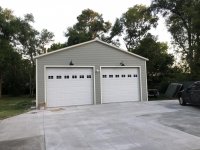
I am located in Orlando, FL. I just got wrapped up with my 35x30 stick frame build and I am ready to insulate the roof/ceiling. I had planned to spray foam the entire underside of the roof decking, and do R19 batts on the walls for cost savings, as i have 2x6" walls. Now i am second guessing.

I got a quote to do the whole underside of the roof for 1700, pretty reputable company here in central FL. When he was explaining, he mentioned that he would be covering up my full length ridge vent and soffits as they are not needed with spray foam. That spooked me a little bit as i know how important venting is. He also said it needs to be conditioned at all times which also bugs me because this is a auto hobby garage and will be AC'd (no heat for obvious reasons) with a mini split however only when i am using it, was not planning to run the AC at all times. I can if needed keep it in the mid 80's when not in use and bump it down when needed.

So i got into looking at R19 batts. I am going to use metal roof panels instead of drywall for the ceiling, and can install the insulation from the top as I install the panels quite easily. This option saves me about 1100 dollars. If i am thinking about this correctly this option would actually require less cooling as now i don't have to condition the rafter or "attic" space... Just the 35x30x12' box.

If anyone has any questions about my situation feel free to ask, as i know these are not straightforward topics and more goes into play here.
 
Last edited:
To avoid these ads, REGISTER NOW!

Kaizen

Well-known member
Joined
Jan 9, 2015
Messages
6,948
Location
New England
So you are talking about hard insulation going between your roof sheathing and metal roof?
Is the installer just doing an air seal one inch thick? Cause that sounds really cheap for a 2x4 fill at that size.

If you have the money I would air seal the entire thing and use r13 batts. Suppose you could have him seal the ceiling and still have roof vented. His comment about always needing to be conditioned space should be answered by locals who understand better the climate/humidity and its affects. I would not need to condition it up here in cold country if I did not want to.


Sent from my iPhone using Tapatalk
 
OP
A

alxmlr789

Well-known member
Joined
Jan 1, 2016
Messages
62
So you are talking about hard insulation going between your roof sheathing and metal roof?
Is the installer just doing an air seal one inch thick? Cause that sounds really cheap for a 2x4 fill at that size.

If you have the money I would air seal the entire thing and use r13 batts. Suppose you could have him seal the ceiling and still have roof vented. His comment about always needing to be conditioned space should be answered by locals who understand better the climate/humidity and its affects. I would not need to condition it up here in cold country if I did not want to.


Sent from my iPhone using Tapatalk

I may not be saying it right, my building is stick frame, so the 1700 for the roof spray was for R19 5" thick (open cell) on the underside of my roof decking. The walls will also be R19 due to them being 2x6" My ceiling is going to be metal roof panels, and i can do r15-R19 on top of the metal panels instead of spray foam.
 

Kaizen

Well-known member
Joined
Jan 9, 2015
Messages
6,948
Location
New England
I may not be saying it right, my building is stick frame, so the 1700 for the roof spray was for R19 5" thick (open cell) on the underside of my roof decking. The walls will also be R19 due to them being 2x6" My ceiling is going to be metal roof panels, and i can do r15-R19 on top of the metal panels instead of spray foam.


Still not clear on “r15-19 on top of the metal panels”?
Wow I think I paid 400 for 144sq ft. So the 1700 is a great price. I would get it and have him spray the walls with at least an inch to air seal the building.
I still can’t answer the question on it needing conditioning all the time


Sent from my iPhone using Tapatalk
 

kelpaso1

MEMBER EMERITUS
Joined
Sep 28, 2009
Messages
3,962
Location
New Brunswick
I don't see what's not clear. Put up vapor barrier plastic on the bottom cord of the rafters and then your metal panels and use batts in between the rafters laying on top of the metal, and keep the venting in the "attic" the way it is.
 

Kaizen

Well-known member
Joined
Jan 9, 2015
Messages
6,948
Location
New England
I don't see what's not clear. Put up vapor barrier plastic on the bottom cord of the rafters and then your metal panels and use batts in between the rafters laying on top of the metal, and keep the venting in the "attic" the way it is.


He says roof decking in first post. So is there ply or not is the question


Sent from my iPhone using Tapatalk
 
OP
A

alxmlr789

Well-known member
Joined
Jan 1, 2016
Messages
62
I don't see what's not clear. Put up vapor barrier plastic on the bottom cord of the rafters and then your metal panels and use batts in between the rafters laying on top of the metal, and keep the venting in the "attic" the way it is.

Exactly! isn't the vapor barrier considered the faced paper on insulation rolls? I was just thinking of putting the paper side down for vapor barrier

He says roof decking in first post. So is there ply or not is the question


Sent from my iPhone using Tapatalk

Roof decking, it's what is under the shingles. The spray foam would be sprayed on the underside of the roof decking/plywood above the rafters.
ie: https://images.app.goo.gl/TCXbfDp8TR16jhi29

Or the other scenario is put my metal panels up as the ceiling (instead of drywall), and lay bats in between the rafters after the metal panels are up.
 

Kaizen

Well-known member
Joined
Jan 9, 2015
Messages
6,948
Location
New England
When you say you are wrapped up on the build i assumed the roof was on. If you do not have a roof you can go either way. foam will pay off if you are going to condition the space. If not savings will be marginal over the life of the product. Either way will work
 
OP
A

alxmlr789

Well-known member
Joined
Jan 1, 2016
Messages
62
When you say you are wrapped up on the build i assumed the roof was on. If you do not have a roof you can go either way. foam will pay off if you are going to condition the space. If not savings will be marginal over the life of the product. Either way will work

The roof is quite on. The metal panels will be my ceiling
 

Attachments

  • C2CD9FA4-3638-4E0A-8AD8-41213D1B2382.jpg
    C2CD9FA4-3638-4E0A-8AD8-41213D1B2382.jpg
    153.2 KB · Views: 31

DC73

Well-known member
Joined
Dec 27, 2014
Messages
1,627
Location
Lubbock TX
When he was explaining, he mentioned that he would be covering up my full length ridge vent and soffits as they are not needed with spray foam. That spooked me a little bit as i know how important venting is.

Unvented attics are becoming more and more common and are perfectly acceptable when done correctly. Visit GreenBuildingAdvisor.com and search for unvented attics. You'll find plenty of good info. You might visit their Q&A forum and pose your questions there. They have some building science gurus who hang out on the forum. I'd be interested in hearing what they say about open cell foam vs closed cell foam for your climate. R19 ceiling or under the roof insulation for your climate is not enough.

DC
 
To avoid these ads, REGISTER NOW!

RegeSullivan

Well-known member
Joined
Mar 30, 2014
Messages
695
Location
Canonsburg Pennsylvania (South of Pittsburgh)
Unvented attics are becoming more and more common and are perfectly acceptable when done correctly. Visit GreenBuildingAdvisor.com and search for unvented attics. You'll find plenty of good info. You might visit their Q&A forum and pose your questions there. They have some building science gurus who hang out on the forum. I'd be interested in hearing what they say about open cell foam vs closed cell foam for your climate. R19 ceiling or under the roof insulation for your climate is not enough.

DC
I too am interested to hear more about the open cell on the ceiling. In my neck of the woods if open cell is used it is always in conjunction with closed cell. The closed cell is used as the vapor barrier and the cheaper open cell is used to increase the r-value at a slight cost savings.

Sent from my SM-N950U using The Garage Journal mobile app
 

Voi

Well-known member
Joined
Oct 10, 2010
Messages
5,148
Location
Western South Dakota
I'd also be curious to hear about the constant conditioning requirement. I'm guessing with the open cell they want air moisture constantly removed so the amount of moisture reaching the roof deck is minimized.

OP is there anything on your roof deck currently acting as a vapor barrier? Like a self adhesive ice & water shield type product or a radiant barrier?
 

yeldogt

Well-known member
Joined
Jan 2, 2012
Messages
18,184
Your foam guy sounds like he knows what he is doing .... the reason he may be saying you will need constant circulation is because foam stops air leakage. Without air leaking there is no air change and often the humidity level can rise .. the flip side is with foam the energy required to do this will be low.

There is no need to ventilate attics or crawl spaces -- all problems are eliminated with sealed condition spaces.

In colder climates we don't typically use open cell. Open cell will allow some water vapor to pass .. winter time and heated building -- moisture can be forced up with heated air and migrate through the foam and condense on the underside of the roof deck.

This is not a problem in warmer climates or with thick enough foam ... 5" is typically used.

I have never had any issues with a ceiling in the upper level and foamed underside of roof deck -- there is plenty of leakage to keep the space above conditioned. Are you going to use it for storage? Door ? You should always leave some form of hatch to get into that area.

Again -- with ether type of foam you are creating a superior building. Unless you have lived in a foamed building --- one can't grasp how good they are. I would find the money to foam the walls if you plan on staying for a long time. Seal the doors well.

I have been using foam in all my projects since the early 90's ... closed attics and crawl spaces. Also, be very careful with using plastic VB. It was thought to be superior because it also stopped air movement .. but, in many situations it causes a lot of problems (moisture) and rot when it was first widely used starting in the 70's -- I never see it recommended anymore.

gGood luck
 
Last edited:
OP
A

alxmlr789

Well-known member
Joined
Jan 1, 2016
Messages
62
Your foam guy sounds like he knows what he is doing .... the reason he may be saying you will need constant circulation is because foam stops air leakage. Without air leaking there is no air change and often the humidity level can rise .. the flip side is with foam the energy required to do this will be low.

There is no need to ventilate attics or crawl spaces -- all problems are eliminated with sealed condition spaces.

In colder climates we don't typically use open cell. Open cell will allow some water vapor to pass .. winter time and heated building -- moisture can be forced up with heated air and migrate through the foam and condense on the underside of the roof deck.

This is not a problem in warmer climates or with thick enough foam ... 5" is typically used.

I have never had any issues with a ceiling in the upper level and foamed underside of roof deck -- there is plenty of leakage to keep the space above conditioned. Are you going to use it for storage? Door ? You should always leave some form of hatch to get into that area.

Again -- with ether type of foam you are creating a superior building. Unless you have lived in a foamed building --- one can't grasp how good they are. I would find the money to foam the walls if you plan on staying for a long time. Seal the doors well.

I have been using foam in all my projects since the early 90's ... closed attics and crawl spaces. Also, be very careful with using plastic VB. It was thought to be superior because it also stopped air movement .. but, in many situations it causes a lot of problems (moisture) and rot when it was first widely used starting in the 70's -- I never see it recommended anymore.

gGood luck

Thank you, this clears alot up for me. Since i do plan to run a mini split, i may do the spray foam now that you've cleared this up.

So, if i have a foam building and say keep my mini split at 85 degrees when i am not using it, is that enough to "condition" that air? Or do i need another method as well as air conditioning?

Also, if i do the whole building in spray foam, it will be around 2900 (1700 roof, 1200 walls), that is R19 (5inch) on the ceiling and gable ends, and R13 on the walls. If i do the whole building in R19 batts it'll run me around 1200 for everything. Still thinking of just doing the roof in spray, and the walls in R19 batts.
 

yeldogt

Well-known member
Joined
Jan 2, 2012
Messages
18,184
Thank you, this clears alot up for me. Since i do plan to run a mini split, i may do the spray foam now that you've cleared this up.

So, if i have a foam building and say keep my mini split at 85 degrees when i am not using it, is that enough to "condition" that air? Or do i need another method as well as air conditioning?

Also, if i do the whole building in spray foam, it will be around 2900 (1700 roof, 1200 walls), that is R19 (5inch) on the ceiling and gable ends, and R13 on the walls. If i do the whole building in R19 batts it'll run me around 1200 for everything. Still thinking of just doing the roof in spray, and the walls in R19 batts.

There is no getting around the cost of foam -- it's more money. Foam in the walls will eliminate any leakage (wind). Are the doors tight and insulated ?

People don't understand that air leakage is a major source of heating cooling load. Batts .. don't stop air. With a really tight building I think you will be pleasantly surprised at the low cost of conditioning the space ... It's the humidity ... mini splits are great at reducing humidity and the foam will stop any leaks bringing more in -- Mini will have no problem removing what people produce

With any major source of contamination (running cars) -- you will need an air change. My guess is whatever you do the doors will still leak enough. If in a windy area look into the "green hinge".

My warning about plastic VB above -- does not apply with foam.
 
Last edited:
OP
A

alxmlr789

Well-known member
Joined
Jan 1, 2016
Messages
62
I have never had any issues with a ceiling in the upper level and foamed underside of roof deck -- there is plenty of leakage to keep the space above conditioned. Are you going to use it for storage? Door ? You should always leave some form of hatch to get into that area.

My truss area is not really large enough for storage, i will probably do some suspended ceiling shelves for bin storage since i have 12ft walls and only one bay is getting a lift. As far as attic access, since i am using metal panels to the trusses, i can pull a panel or two down to access it up there.
 
OP
A

alxmlr789

Well-known member
Joined
Jan 1, 2016
Messages
62
There is no getting around the cost of foam -- it's more money. Foam in the walls will eliminate any leakage (wind). Are the doors tight and insulated ?

People don't understand that air leakage is a major source of heating cooling load. Batts .. don't stop air. With a really tight building I think you will be pleasantly surprised at the low cost of conditioning the space ... It's the humidity ... mini splits are great at reducing humidity and the foam will stop any leaks bringing more in -- Min will have no problem removing what people produce

With any major source of contamination (running cars) -- you will need an air change. My guess is whatever you do the doors will still leak enough. If in a windy area look into the "green hinge".

My warning about plastic VB above -- does not apply with foam.

My doors were installed well, so the edge do not have alot of leakage, but i do need to install some garage door insulation as my doors are 12x10 and i can definitely feel the heat coming in. They get sun from 9-3pm. and 8-1 during DST.

Would you say R13 Foam is superior to R19 fiberglass? I have batted walls before and can do it pretty well.

One thing about foaming the walls is i do not want to cover any electrical as i never know what i may want to add.
 
OP
A

alxmlr789

Well-known member
Joined
Jan 1, 2016
Messages
62
With any major source of contamination (running cars) -- you will need an air change. My guess is whatever you do the doors will still leak enough. If in a windy area look into the "green hinge".

My warning about plastic VB above -- does not apply with foam.

The green hinge is cool as heck. Ordering some today.
 

radio63

Member
Joined
May 16, 2016
Messages
24
Location
El Cajon, CA (San Diego area)
So, if i have a foam building and say keep my mini split at 85 degrees when i am not using it, is that enough to "condition" that air? Or do i need another method as well as air conditioning?

Don't forget such mini-split systems such as the Mitsubishi have a "dehumidify" function which might be able to help with moisture removal while not running the full air conditioning system, thus saving some money. Mini-splits in general are pretty economical.
 

Cobradriver

Well-known member
Joined
Apr 4, 2009
Messages
93
Location
Port Charlotte,Fl
I am located in Orlando, FL. I just got wrapped up with my 35x30 stick frame build and I am ready to insulate the roof/ceiling. I had planned to spray foam the entire underside of the roof decking, and do R19 batts on the walls for cost savings, as i have 2x6" walls. Now i am second guessing.

I got a quote to do the whole underside of the roof for 1700, pretty reputable company here in central FL. When he was explaining, he mentioned that he would be covering up my full length ridge vent and soffits as they are not needed with spray foam. That spooked me a little bit as i know how important venting is. He also said it needs to be conditioned at all times which also bugs me because this is a auto hobby garage and will be AC'd (no heat for obvious reasons) with a mini split however only when i am using it, was not planning to run the AC at all times. I can if needed keep it in the mid 80's when not in use and bump it down when needed.

You just need to run the a/c enough to keep the humidity down. I'd set it at 83-84 in the summer and a little less in the winter. You can turn it down when you work.

As an fyi...I'm south of you. I work in a shop without a/c. I live alone. I keep my house set at 80 because that is comfortable for me. My worst electric bill last year was ~130.00 and that was in Feb with the heat on.

You don't want have to cool all the mass inside the garage every time you turn the a/c down....
 
To avoid these ads, REGISTER NOW!
Top Bottom