I see so many posts online and on social media where people are selling tools that are just a rusted mess. Why? I don't get it. How hard is it to have a half way decent storage chest, use your tools, wipe them off and put them away for next time? I'm a highly disorganized person, but you wouldn't know it looking at my roll away. Everything has been cleaned and put in its proper place for next use. Your tools can't take care of you if you don't take care of them. Right?


You are using an out of date browser. It may not display this or other websites correctly.
You should upgrade or use an alternative browser.
You should upgrade or use an alternative browser.
Why do people do this? I just don't understand.
- Thread starter monster1
- Start date
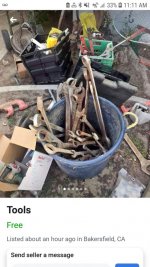
this is pretty typical in california where we don't have a large amount of indoor space, and long periods of no rain taken for granted. Eventually they are ruined.
people would put their tools and stuff they found and put it in the backyard like this.
We GJ members may really treasure big wrenches like these but it's probably something that was inherited and had no value. In the backyard it goes.
I tried to search for some Lista cabinet and they are almost always in someone's yard sitting in the dirt all rusted.
people would put their tools and stuff they found and put it in the backyard like this.
We GJ members may really treasure big wrenches like these but it's probably something that was inherited and had no value. In the backyard it goes.
I tried to search for some Lista cabinet and they are almost always in someone's yard sitting in the dirt all rusted.
Last edited:
They might be rusty but I bet they still work. You see a lot of that with farmers. Bucket of tools for a machine that rides on the machine or in a farm truck in case of a breakdown. People are unlikely to steal the ugly ones.
3baygarage
Well-known member
The ad states free so what are you waiting for?
DFB
Well-known member
Normally most tools especially higher quality tools one buys with their own hard earned cash are respected.
But for some people...it's just easy come easy go
And a lot times depends on how they came to have them
And what they feel they are worth
Inheritances, auction buys and estate sale purchases produce a lot of tools. Long gone garages and repair shops, factories, flea mkt vendors who knows. And many times they have already been a state abuse or disuse.
I see a lot Flea mkt vendors just leave tools in the rain
I've also seen plenty of contractors from all types of outdoor work though use tools and not baby them at all. Same goes for the farm and greenhouse business I've been with over the years wouldn't quite say they're being abused but ain't nobody polishing them. Doesn't take very long in humid, wet or unheated environments to gain a "patina" finish
But for some people...it's just easy come easy go
And a lot times depends on how they came to have them
And what they feel they are worth
Inheritances, auction buys and estate sale purchases produce a lot of tools. Long gone garages and repair shops, factories, flea mkt vendors who knows. And many times they have already been a state abuse or disuse.
I see a lot Flea mkt vendors just leave tools in the rain
I've also seen plenty of contractors from all types of outdoor work though use tools and not baby them at all. Same goes for the farm and greenhouse business I've been with over the years wouldn't quite say they're being abused but ain't nobody polishing them. Doesn't take very long in humid, wet or unheated environments to gain a "patina" finish
The ad states free so what are you waiting for?
At least the owner of those rusted tools knows the real value (free) and not trying to sell them.
Magnum440d100
Well-known member
I’ll reiterate what has already been said.
When working at the ranch, an ammo box was attached to the 9n which held tools to fix the 9n when it broke down. It wasn’t really water right, and the tools inside were rusty crusty. But still worked.
My friends shop, they work outside in the elements. There is cover/shade, but open sides (they are welders). Their tools are outside year round being used. Their tools are rusty.
My Grampa owned a mechanic shop in the 80’s/90’s. His tools were put away when done with them. When he retired, his tools went into tool boxes in a shed. He still used them regularly on his personal vehicles. The “shed” was a converted chicken coop 10’x12’... Even though the tools were put away in tool boxes, they still got rusty.
My main box at home is outside under an awning/carport. While I use and clean my tools regularly, I’m sure they will eventually rust. But for the last 8-9 years, so far, no rust.
A lot of times when buying rusty/crusty tools, I find that the person selling them for cheap or giving them away aren’t the ones that caused their condition in the first place. If they are rusty/crusty and they are high in price, it’s usually because they bought/paid for them...
When working at the ranch, an ammo box was attached to the 9n which held tools to fix the 9n when it broke down. It wasn’t really water right, and the tools inside were rusty crusty. But still worked.
My friends shop, they work outside in the elements. There is cover/shade, but open sides (they are welders). Their tools are outside year round being used. Their tools are rusty.
My Grampa owned a mechanic shop in the 80’s/90’s. His tools were put away when done with them. When he retired, his tools went into tool boxes in a shed. He still used them regularly on his personal vehicles. The “shed” was a converted chicken coop 10’x12’... Even though the tools were put away in tool boxes, they still got rusty.
My main box at home is outside under an awning/carport. While I use and clean my tools regularly, I’m sure they will eventually rust. But for the last 8-9 years, so far, no rust.
A lot of times when buying rusty/crusty tools, I find that the person selling them for cheap or giving them away aren’t the ones that caused their condition in the first place. If they are rusty/crusty and they are high in price, it’s usually because they bought/paid for them...
I can understand laziness in the way of not cleaning your tools, caring for them and allowing them to rust. I see it all the time when I go to the tractor shows in Indiana in search of tools. What bothers me is the amount of people selling a bucket or tool box full of rusty, hodgepodge tools on Facebook Marketplace or Craigslist and they want $150, $200... I wouldn’t drive to get the **** if it were free.
I can understand laziness in the way of not cleaning your tools, caring for them and allowing them to rust. I see it all the time when I go to the tractor shows in Indiana in search of tools. What bothers me is the amount of people selling a bucket or tool box full of rusty, hodgepodge tools on Facebook Marketplace or Craigslist and they want $150, $200... I wouldn’t drive to get the **** if it were free.
I see this a lot especially with Craftsman tools. They want more than they would cost new and are so rusty I would scrap them.
dr_clyde
Well-known member
Tools are just things to most people, no different from any other random thing you might find in the backyard. Just a means to an end.
If it breaks, rusts, wears out, or goes missing, they just buy another one to replace it. I don't particularly care about my $15 shovel. If it gets to the point where I can't use it anymore, I'll get another shovel. Most folks see wrenches and stuff the same way.
In this instance, I imagine the seller is just cleaning up an estate. If I was local, I'd go snag them. Looks like a lot of bigger sizes, which are expensive. There is also a chain hoist in the back I would be interested in.
If it breaks, rusts, wears out, or goes missing, they just buy another one to replace it. I don't particularly care about my $15 shovel. If it gets to the point where I can't use it anymore, I'll get another shovel. Most folks see wrenches and stuff the same way.
In this instance, I imagine the seller is just cleaning up an estate. If I was local, I'd go snag them. Looks like a lot of bigger sizes, which are expensive. There is also a chain hoist in the back I would be interested in.
lakeroadster
Well-known member
Some personal insight....
My Dad
He was never much of a gear head / tool junky. But he was fanatical about keeping the tools he had in good shape.
After he retired he moved and put most of his tools in a pole barn with a dirt floor.
Everything rusted that wasn't painted, including a really nice wood planer, wood lathe, etc.
I would never have guessed he would have allowed that to happen.
Only thing that survived that was usable was his Wizard Tools / Tool Box that he kept on the floor of his pickup truck. That and a DeWalt Radial Arm Saw that used to belong to my Grandpa. Fortunately I was able to keep these items.
My Grandfather
He was always a gear head / tool junkie. When he died family members took everything that wasn't bolted down. I already had pretty much everything he had so I let cousins and others take pretty much everything. I later found out they sold most of it, or gave it to friends and non-relatives.
Go figure.
My Dad
He was never much of a gear head / tool junky. But he was fanatical about keeping the tools he had in good shape.
After he retired he moved and put most of his tools in a pole barn with a dirt floor.
Everything rusted that wasn't painted, including a really nice wood planer, wood lathe, etc.
I would never have guessed he would have allowed that to happen.
Only thing that survived that was usable was his Wizard Tools / Tool Box that he kept on the floor of his pickup truck. That and a DeWalt Radial Arm Saw that used to belong to my Grandpa. Fortunately I was able to keep these items.
My Grandfather
He was always a gear head / tool junkie. When he died family members took everything that wasn't bolted down. I already had pretty much everything he had so I let cousins and others take pretty much everything. I later found out they sold most of it, or gave it to friends and non-relatives.
Go figure.
Last edited:
What's to understand? It's not your business.
My Dad's tools, looked exactly like that, but then he was running a business, farming 3 farms (in different locations) and raising 8 kids - while taking daily, some ***-kicking medicine, to control his epilepsy.
I honestly don't understand the obsession with judging other, even without the slightest idea was their story is.
Maybe that seller got those tools from someone had developed alzheimer's, left them laying on the garage floor and died in a nursing home, 5 years later.
Maybe they just don't care about tools. It's a big world out there.
My Dad's tools, looked exactly like that, but then he was running a business, farming 3 farms (in different locations) and raising 8 kids - while taking daily, some ***-kicking medicine, to control his epilepsy.
I honestly don't understand the obsession with judging other, even without the slightest idea was their story is.
Maybe that seller got those tools from someone had developed alzheimer's, left them laying on the garage floor and died in a nursing home, 5 years later.
Maybe they just don't care about tools. It's a big world out there.
jimmyin3D
Banned
I was at an estate sale recently where the grandfather was a mechanic and had loads of tools. Most were in good condition Snap On, Mac, Craftsman all from like 60’s-80’s. Son was emptying everything out for sale. I would’ve kept the tools if I were him but space is really a issue for us in SoCal. I ended up loading up the car for about a hundred dollars at least I’ll get use from it.
rijndael
Well-known member
We have this issue with everything posted for sale. No one wants to wipe it down and make it look appealing.
Pontiac787
Well-known member
Those wrenches are probably 60 years old. The look fine to me.
davethorik
Well-known member
Nobody has said it yet, but if I find a neat old wrench, I'd rather it be rusty and as-found than to have been "restored". I just recently found a very obscure brand of adjustable wrench, bought it despite being so heavily rusted it was pitted.
Worse to me is where someone took a brass wire wheel to the lettering on both sides to "clean it up"
Now it has a yellowish-orange smear on either side that I'm not sure how to fix, as it seems to have imbedded brass on or in the surface of the steel. Would a trip in the e-tank get that off? Guess I'll find out.
Worse to me is where someone took a brass wire wheel to the lettering on both sides to "clean it up"
Now it has a yellowish-orange smear on either side that I'm not sure how to fix, as it seems to have imbedded brass on or in the surface of the steel. Would a trip in the e-tank get that off? Guess I'll find out.
I see this all the time in my own family. SIL and grandson leave tools where ever they were using them when the big game comes on TV or it is lunch time. I find tools laying in the yard, driveway and on the patio. They will step over them repeatably rather than pick them up. The lawn mower stays were it ran out of gas, sometimes for weeks. They don't seem to care and definitely don't have any pride in any of their possessions (not just tools). About a month ago I picked up a floor jack and socket set that had been left in the driveway (in the rain) for 3 days. When I complain about it all I get is the "deer in the headlights" look. On the other hand my son polishes his SO tools after each use.
American Locomotive
Well-known member
Some people don't care. Cant' really fault them for it. I'm sure there's a lot of stuff I don't care about at all, that they care deeply about.
Augus7us
Well-known member
I'm surprised this surprises you
I've seen photos of tools like that here on this site in the garage gallery. There is a guy on here who's signature reads something like "I want to keep my tools somewhat organized so I throw them all in an empty trashcan". I'd argue that half the people put their tools in tool boxes and keep them organized and the other half have them in buckets, barrels, boxes or wherever they sat them down last time they used them.
I've seen photos of tools like that here on this site in the garage gallery. There is a guy on here who's signature reads something like "I want to keep my tools somewhat organized so I throw them all in an empty trashcan". I'd argue that half the people put their tools in tool boxes and keep them organized and the other half have them in buckets, barrels, boxes or wherever they sat them down last time they used them.
NFH2740
Well-known member
Dont lowball me! I KNOW WHAT ITS WORTH!!1!111!!
OccupantRJ
Well-known member
If I owned sports or exercise equipment, it would all be rusty too.
BDT/NWMN
Well-known member
Loaner tools that were not returned.
kctyphoon
Banned
The ad states free so what are you waiting for?
This.
JR 42
Well-known member
Nobody has said it yet, but if I find a neat old wrench, I'd rather it be rusty and as-found than to have been "restored". I just recently found a very obscure brand of adjustable wrench, bought it despite being so heavily rusted it was pitted.
Agreed, most folks' idea of "restored" makes me cringe... I'm perfectly capable of wire- wheeling the hell out of something and spraypainting it myself if need be. I like finding stuff in an honest state of disuse.
Hey OP, I hear ya, but at least that person's giving away their rusty old wrenches!... and not asking $100 because they're "rustic, primitive." I've paid actual pocket change for **** that looks worse.
JAYoung
Well-known member
America acquired a lot of bad habits in the prosperity that followed World War II. Easy money and the throw-away culture took hold and the ethics of thrift that were learned on the farm -- when we were in an agriculture-based economy -- were tossed into the wind.
That bucket of rusty tools you see today were a major investment in the Depression years before the war, and they were built to last generations if cared for, but if you live in a consumer society you have to consume.
That bucket of rusty tools you see today were a major investment in the Depression years before the war, and they were built to last generations if cared for, but if you live in a consumer society you have to consume.
dr_clyde
Well-known member
If I owned sports or exercise equipment, it would all be rusty too.
Ha!
This is a good perspective.
garandman
Well-known member
Had pretty good luck putting mildly rusted tools like pliers in Vinegar for a few days.
We live near the ocean. Rust never sleeps.
We live near the ocean. Rust never sleeps.
dr_clyde
Well-known member
America acquired a lot of bad habits in the prosperity that followed World War II. Easy money and the throw-away culture took hold and the ethics of thrift that were learned on the farm -- when we were in an agriculture-based economy -- were tossed into the wind.
That bucket of rusty tools you see today were a major investment in the Depression years before the war, and they were built to last generations if cared for, but if you live in a consumer society you have to consume.
Yes, but the economy changing also changed the best way to approach things.
Back then, labor was cheap and things were expensive. Now it is the opposite. It was a week's wages or more for those wrenches. Now its only a couple hours, maybe.
If the time it takes to fix or repair exceeds the cost to purchase, it makes far more sense to replace, but for simple and cheap things sometimes its more expensive to store, clean and maintain than to just replace.
Push mowers are a good example. I don't care about a cheap push mower. If it takes me more than 4 hours to repair it, I'm money ahead to just buy another one. My time is very valuable, and I charge myself shop rate for things I don't enjoy doing. Its how I evaluate everything that needs repair or replacement. If I can make more money in my shop in the same time, I hire it done or replace it. I don't work on my own cars. I can hire it done faster and cheaper. I'm actually LOSING money to change my own oil and do brakes.
I was happy to fix my furnace, because it took me less than an hour, and $100 in parts, but replacement would have been $2500, and hiring a HVAC guy would have been hundreds of dollars to replace a simple module.
Sure, take care of your stuff if its an easy get. I'm not saying trash your stuff. Putting things away out of the rain or keeping oil in the sump is just being a good steward of your things. But I'm not spending two hours doing maintenance on a $100 item. I don't replace the handle on a shovel when a new shovel is $15 or $20.
Sometimes tools are just a means to an end. Maybe those big wrenches were bought for one job and never used again, but paid for themselves 10x over on that one job.
Those are special tools for rat rods. One thing that gets me is when you see a car for sale and it has a interior shot and the floor is cluttered with debris. Doens't anyone buy vacuums anymore. If its a as is beater come and drag it off, I get it, but for a classic and asking top dollar?
danielbuck
Well-known member
- Joined
- Apr 15, 2014
- Messages
- 968
I've had tools in ammo boxes and tool drawers rust, I kept a whole collection of (cheap) tools in my willys jeep (no top or doors, open to the elements) for road trips and offroading adventures. The ammo box had a nice seal on it, so I don't think those tools would have started rusting in there. but the tool drawers didn't seal well and the tools were starting to rust in there. It didn't bother me, since they were cheap. And the rust didn't hinder their ability to function. it was just mild surface rust.
At some point to alot of folks, tools are just tools, they aren't mirrors and display pieces. I don't totally abuse all of my tools, but I don't polish them and keep them in individual cases. I toss them in the drawer or ammo boxes.
At some point to alot of folks, tools are just tools, they aren't mirrors and display pieces. I don't totally abuse all of my tools, but I don't polish them and keep them in individual cases. I toss them in the drawer or ammo boxes.
mudflap
Well-known member
Makes you wonder where all the basic hand tools go...? A small percentage fail.. but most go on forever. I know i have my Dads tools, and some of Grandpas tools, plus have acquired on my own at least 3 of everything i will ever need..and im still buying tools...lol. At what point will we all be buried in tools...? Add to the situation....less people are working on things..because less things are designed to be fixed...heck..the lawnmower my son just bought actually says...Dont change the oil in the paperwork....WTF...? WE are living in a "disposable" world now..
Last edited:
Mechanical Noise
Well-known member
If I owned sports or exercise equipment, it would all be rusty too.
Not exercising?!?! Now I've got twice the Moral Outrage!!!!!
dr_clyde
Well-known member
Makes you wonder where all the basic hand tools go...? A small percentage fail.. but most go on forever. I know i have my Dads tools, and some of Grandpas tools, plus have acquired on my own at least 3 of everything i will ever need..and im still buying tools...lol. At what point will we all be buried in tools...? Add to the situation....less people are working on things..because less things are designed to be fixed...heck..the lawnmower my son just bought actually says...Dont change the oil in the paperwork....WTF...? WE are living in a "disposable" world now..
You would be amazed, saddened and shocked by what ends up in the scrap yard. If its metal, it gets scrapped. A rusty wrench is scrap to 99% of the population.
A buddy worked at the local scrap processor for a few years, and he said he couldn't spend much time by the scales or he'd end up with literally tons of stuff too good to toss. After a while, you just get numb to it. I can't imagine sticking a crane magnet into a semi of wilton vises and throwing them in the crusher, but apparently they had the seconds from wilton come through. They had to sign an agreement to crush them immediately and not sell them. Wilton didn't want seconds on the market.
People are idiots. I offered a nice 1980's era Montgomery Wards Powr-Kraft roller cabinet with top box to my BIL to organize his tools that are scattered around his 2 car garage in small piles on the floor and some in the shed. For free. Made very well and clean.
He said he didn't have the room for it. So I laughed and pointed out that there was a pile of tools on the floor that took up more space than the footprint of the toolbox. Can't fix stupid. Enjoy searching for tools. I've been over there helping him on repairs. 80% of the time is spent on searching for various sizes of sockets and extensions, etc.. After he refused the toolbox, I don't help him anymore.
He said he didn't have the room for it. So I laughed and pointed out that there was a pile of tools on the floor that took up more space than the footprint of the toolbox. Can't fix stupid. Enjoy searching for tools. I've been over there helping him on repairs. 80% of the time is spent on searching for various sizes of sockets and extensions, etc.. After he refused the toolbox, I don't help him anymore.
The Fall
Well-known member
Evaporust.
The Fall
Well-known member
Love Powr-Kraft as well. Big fan of Monkey Ward.