To avoid these ads, REGISTER NOW!

New vise with a rough feed screw

TommyTwoTone

New member
Joined
Jun 1, 2019
Messages
4
Location
SoCal
I received a new Ridgid F-45 from Zoro today. The feed screw is anything but smooth. The Chinese made Wilton I have (71500A) is an easy 1-finger open and close, and it was so out of the box. The Ridgid is closer to a two finger affair with varying resistance as I turn the handle.

I paid a premium over the Chinese made Yost ADI thinking I'd get a superior product. I'm sure there's more to vise quality than a smooth easy going handle but this is not a good first impression. Will greasing the feed screw or additional cycles improve the operation?

Thanks in advance for the replies,

TTT

Sent from my Pixel 3 XL using Tapatalk
 
To avoid these ads, REGISTER NOW!
OP
T

TommyTwoTone

New member
Joined
Jun 1, 2019
Messages
4
Location
SoCal
lubrication & use will probably loosen it up. is it lubed as is or is the screw dry?
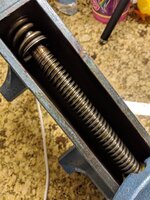
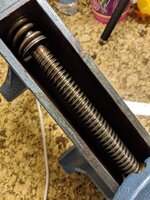
I can't see grease but oil is transferred to my finger when I touch the screw. d35610a58fc6a8bf7750ac4f5a0e97b7.jpg

Sent from my Pixel 3 XL using Tapatalk
 

Attachments

  • d35610a58fc6a8bf7750ac4f5a0e97b7.jpg
    d35610a58fc6a8bf7750ac4f5a0e97b7.jpg
    104.8 KB · Views: 0

chrisnazzy

Well-known member
Joined
Apr 20, 2013
Messages
1,671
Location
Arizona
If it were me I would first clean all the existing grease or oil off the spindle and nut. Next disassemble the vise as much as you feel comfortable. You may not want to pull the pin and release the tension on the screw retaining spring. Lastly, grease the screw and nut as well as all metal to metal contact points with Mobil 1 synthetic grease. It should make a world of difference compared to what you're working with out of the box.

Sent from my SM-G930P using Tapatalk
 

seanb02

Well-known member
Joined
Apr 11, 2017
Messages
725
Location
The Farm
I would doubt that it is actually a regular grease or oil on there, more so a sticky metal protector to keep the screw from rusting as the unit may sit on a shelf for years before being put into service.

Clean it off with brake cleaner or something, then give it some proper lube, should be just fine after that.
 

ken w.

Well-known member
Joined
Aug 16, 2012
Messages
2,237
Location
Western New York
I've been using Super Lube synthetic grease on all the vises I refurbish. It takes away any chatter and you can tell the difference right away. It makes them super smooth.
 

PureLeaf

Well-known member
Joined
Jul 25, 2014
Messages
1,417
I have 2 ridgids (Made by Peddinghaus) and an old USA wilton machinist. The wilton can be opened/closed with my pinky on 1 hand. Both of the ridgids require significantly effort and do not have that smoothness.
 
To avoid these ads, REGISTER NOW!

davethorik

Well-known member
Joined
Sep 14, 2013
Messages
4,992
Location
Norka, Ohio
I have no experience with your specific vise OP, so my following post is a generalized brainstorm intended to help.

I would disassemble and clean first. Then inspect thoroughly. Sometimes metal chips can be left behind from manufacturing processes, and even a small chip could lodge in the threads or in between dynamic and static jaws and cause problems. Could also be a burr somewhere causing the friction. Look closely anywhere there is a machined surface near a moving part, including on vise body. Look for gouges or scratches, they will lead you to the burr.

Also pay attention to the spindle threads themselves. Do they look uniform? Any obvious signs of damage? It doesn't appear that way in the pic, but we can't see the whole thing.

Also check the nut itself. Any threads inside you cannot see, run a 90° pick through just to make sure no surprises hiding in there. Next...this might be difficult to do, but see if you can check nut alignment in the vise. If the nut was factory installed incorrectly, it can cause racking and roughness in turning. Again unlikely, but I have run into older vises with this issue. However they are always American-pattern cast iron vises that have damage to the dovetail area, not a forged vise like yours.

Have you opened vise to max opening yet? If so, was it rough for the entire travel? Also, is it still rough if you back the vise all the way apart and free-spin the handle in the bare dynamic jaw?

One last possibility I can think of is a bent main screw. This may or may not be visible to the naked eye, would be easy to check on a lathe. If no lathe access, you can use the old "roll it on a flat surface" trick or hold it up against a straightedge. Again unlikely in a new vise, but vises are made by people, and people aren't perfect.

As far as grease...get all of whatever the factory oil is off the spindle and nut. It's personal preference what to put on after that. The manufacturer may even have a recommendation.

One last thing...another poster suggested polishing compound or other abrasive grit applied to smooth things down with normal use. I would advise against that- if vise is rough to open, you could stand there constantly opening and closing the vise for a week and not see any results. This may work better with cast iron, im skeptical about this method with a forged steel vise, but that's JMO. Ultimately it's still just a bandaid covering the initial problem.
 

matt_i

Well-known member
Joined
Mar 14, 2008
Messages
10,802
Location
SE Michigan
Likely there's a burr somewhere. Look for evidence of metal scratching metal for the answer. There could be a misalignment.

Deburring inside of a nut can be tricky but many times there's just one problem area to be addressed.

My personal preference is for an oil with tackifiers like Vacuoline 1419. Grease is all good but it gets smashed out of the way and then does no good. Oil will "find" the problem area and lubricate it.

I'm against abrasive compounds. It can work with steel-on-steel with repeated cleanings but it can also embed into a soft material (brass, bronze, copper, plastic, etc) and then you have a large set of forever hard particles that are wearing out the steel prematurely.
 

davethorik

Well-known member
Joined
Sep 14, 2013
Messages
4,992
Location
Norka, Ohio
Likely there's a burr somewhere. Look for evidence of metal scratching metal for the answer. There could be a misalignment.

Deburring inside of a nut can be tricky but many times there's just one problem area to be addressed.

My personal preference is for an oil with tackifiers like Vacuoline 1419. Grease is all good but it gets smashed out of the way and then does no good. Oil will "find" the problem area and lubricate it.

I'm against abrasive compounds. It can work with steel-on-steel with repeated cleanings but it can also embed into a soft material (brass, bronze, copper, plastic, etc) and then you have a large set of forever hard particles that are wearing out the steel prematurely.

Matt, I'm gonna have to start paying you to make cliffs notes summaries of my wordy posts. :lol_hitti
 

2oolhound

Well-known member
Joined
Dec 18, 2010
Messages
5,918
Location
BC Canada
Just looking at the bottom of the slide in the photo you can see it's rough cast. On many old vises that surface is machined smooth like the top and side edges. Only after machining will the dynamic slide fit into the static jaw slot. You'd just make extra slop if you planed it down smooth now. That is likely where some friction is caused. The vise is intended for more rough use rather than machinist/tool room type work.
 

ricleh

Well-known member
Joined
Nov 2, 2007
Messages
1,447
Location
Sacramento, CA
Clean and lube the contact surfaces on the slide and the main nut assembly. Lube the screw. Put it together and adjust the height of the main nut assembly with a 5mm hex so that there is a little play and everything slides smoothly. My Ridgid F-50 is nearly as smooth as my Wilton combination vises.
 

SeisMec

Well-known member
Joined
Aug 24, 2018
Messages
406
Location
Beryl, Utah
I've never rebuilt a vise, but cleaning up the contact surfaces (brake clean) and then lightly coating all those surfaces with anti-seize would be my first thought.
Does anyone think anti-seize would cause a problem?
 

exmaxima1

Well-known member
Joined
Jun 25, 2011
Messages
6,351
Location
Midwest
I have 2 ridgids (Made by Peddinghaus) and an old USA wilton machinist. The wilton can be opened/closed with my pinky on 1 hand. Both of the ridgids require significantly effort and do not have that smoothness.

I have the F-50 Ridgid (Peddinghaus-made) and it is is very smooth. One finger, easy. I bought mine used so maybe it just needs to break in. Keep in mind that's a twin-lead screw so it moves further per turn than a similar Wilton.
 

seber

Well-known member
Joined
May 31, 2016
Messages
4,223
Location
Deep East Tx.
As 2oolhound observed the bottom half of the slide has not been cleaned up. I would go over it lightly with a file to remove any high spots. Don't get crazy. Just remove any points that might be interfering. The real problem though is that you are dealing with a rolled thread. It simply is not going to be as accurate as a machined thread. There is really very little you can do about that. Clean it, grease it, and live with it.
 
To avoid these ads, REGISTER NOW!
Top Bottom