To avoid these ads, REGISTER NOW!

Is this a old land line connection?

thomasmessi

Well-known member
Joined
Apr 3, 2019
Messages
50
Location
US
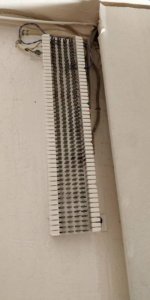
I don't know what is this but someone told me it's for the old phone line in the house... Still want to confirm before removing it... I don't have the old phone service anymore?IMG_20190615_210623.jpg

Sent from my ONEPLUS A5010 using The Garage Journal mobile app
 
To avoid these ads, REGISTER NOW!

Miss the Pontiacs

Well-known member
Joined
Nov 7, 2016
Messages
16,471
Location
Saskatchewan Canada
As someone referred to them as 66 blocks or simply punch down blocks.
You would terminate 25 pair cables on them. 25 pair cables were required for phone connections and feature cables. You used to need 3 pair for each phone line on a multi line phone.
1 Tip and Ring (dial tone)
2 A and A1 leads (control leads)
3 Lamp Ground and Lamp (light)
Then Intercom connections and additional control leads, remainder were spare.
You might find that horizontal pins maybe all common if this is the case it would be a feature block where the cable would be brought out of the key phone control box and terminated. Then you would cross connect the features to the individual 25 pair phone drops.
Now one pair can be used instead of a 25 pair cable. We also used to install sets called call directors where depending on the amount of line banks would take 25 pair per bank of lines/phone #s.

Or in this case terminate 1/2/3/4 pair cables and mark on the white separation tabs what you have terminated.
 

Jinks

Well-known member
Joined
Aug 28, 2012
Messages
2,885
Location
Daytona Beach
As someone referred to them as 66 blocks or simply punch down blocks.
You would terminate 25 pair cables on them. 25 pair cables were required for phone connections and feature cables. You used to need 3 pair for each phone line on a multi line phone.
1 Tip and Ring (dial tone)
2 A and A1 leads (control leads)
3 Lamp Ground and Lamp (light)
Then Intercom connections and additional control leads, remainder were spare.
You might find that horizontal pins maybe all common if this is the case it would be a feature block where the cable would be brought out of the key phone control box and terminated. Then you would cross connect the features to the individual 25 pair phone drops.
Now one pair can be used instead of a 25 pair cable. We also used to install sets called call directors where depending on the amount of line banks would take 25 pair per bank of lines/phone #s.

Or in this case terminate 1/2/3/4 pair cables and mark on the white separation tabs what you have terminated.

Look closely at the top horizontal. That's a split block (two twenty five pair cables). The left two pins are common, & the right two pins are common on each horizontal. A little overkill for the amount of wire in the picture, but easy to work with if you have a use for it. I used a 25 pair cable for communication between a detached garage & the house. Ran phone, alarm, & lawn sprinkler control over it.
 

Miss the Pontiacs

Well-known member
Joined
Nov 7, 2016
Messages
16,471
Location
Saskatchewan Canada
Jinks, I didn't notice that last night. So as you say mentioned you could mount 2 25 pair cables. We quit using this system approx 35 years ago where I worked. We went to the BIXs system took up less space and much more manageable for terminating and to reconfigure.
I believe I still have a couple of the push on tools laying around and for sure one more in the box never used.
 

theoldwizard1

Well-known member
Joined
Feb 22, 2011
Messages
43,174
Location
SE MI
As someone referred to them as 66 blocks or simply punch down blocks.
You would terminate 25 pair cables on them. 25 pair cables were required for phone connections and feature cables. You used to need 3 pair for each phone line on a multi line phone.
1 Tip and Ring (dial tone)
2 A and A1 leads (control leads)
3 Lamp Ground and Lamp (light)
I am not a "phone" guy, but ...


  • Why were punch down blocks call 66 blocks ? I always thought they were set up for 1 or more 25 pair cables ?
  • "Back in the day" all multi-line phones were I worked had 25 pair cables.
  • In residents, the yellow and black were commonly used for 24VAC to power lights in "princess" phone. They were originally there for a second line but I don't know of anyone who had 2 lines in the 50s-90s.
 

Shiftless

Well-known member
Joined
Mar 9, 2014
Messages
14,550
Location
East Bay SFO
The Wizard said...
“I don't know of anyone who had 2 lines in the 50s-90s.”

Those of us who had teenage children back in the ‘90s often had 2 lines...we did!
 

timewarp

Well-known member
Joined
Feb 24, 2008
Messages
272
Location
Silverdale, WA
I am not a "phone" guy, but ...


  • Why were punch down blocks call 66 blocks ? I always thought they were set up for 1 or more 25 pair cables ?
  • "Back in the day" all multi-line phones were I worked had 25 pair cables.
  • In residents, the yellow and black were commonly used for 24VAC to power lights in "princess" phone. They were originally there for a second line but I don't know of anyone who had 2 lines in the 50s-90s.

The Bell system had model numbers for everything "66"was the model number for the block that came out in 1962 and became a standard.

The yellow and black were added to drops and IW at the same time as all the phones with lighted dials, up to that time there were 3 wires , Tip, Ring and Ground(ground was for the ringing in party lines) the yellow and Black weren't originally for a second line, they started to be used for that later. Late 80's on was when second lines started becoming a standard item.
 

Miss the Pontiacs

Well-known member
Joined
Nov 7, 2016
Messages
16,471
Location
Saskatchewan Canada
I am not a "phone" guy, but ...


  • Why were punch down blocks call 66 blocks ? I always thought they were set up for 1 or more 25 pair cables ?
  • "Back in the day" all multi-line phones were I worked had 25 pair cables.
  • In residents, the yellow and black were commonly used for 24VAC to power lights in "princess" phone. They were originally there for a second line but I don't know of anyone who had 2 lines in the 50s-90s.

I have no idea why the blocks were named 66 It was just one of those things that you took for granted and called them that. I do know that there were a number of pin options and we simply referred to them as 66 blocks. Likely Bell/AT&T were the instigator as most of the tools and materials were industry specific. We followed what we called were the BSPs or Bell Standard Practice. We had book shelves dedicated to everything telephone and outside plant related. I joked that there was 4 pages of instructions to load and use your stapler. I was not likely far off:lol_hitti. It would cost a fortune to keep these files up to date and eventually they went the route of the Dodo bird. We likely had 100 locations with these files on site and it was somebodies job to keep the new posting filed.

The Y/B was like you said used for a second line or to power up a back light or later on a LCD on some phones. Many homes did have a second line either for kids, business or even a border who lived under your roof. Many times it was used as a feeder to fire up a second line on the archaic 187 phone system in businesses. Then you simply ran a 12 pair cable between the sets to common out the features and lines required. The 187 was simply a 2 line phone with a buzzer Intercom as an option. The multi line business sets were called 186s which required a 25 pair cable. If I remember correctly the 186 and 187 sets were produced under the AT&T banner but there were likely other builders/suppliers as well.

I enjoyed doing these older large cable jobs. Because when you were done it looked like a piece of art with all the cables, x connects ran symmetrically. If done like this it was a dream to trace out troubles and repair. If not and all the jumpers were a jumble, pulling on one would very likely create another trouble loosening or pulling off other jumper connections when yanking feature jumpers around.

Wish I had some pics of some of the old cabling jobs when they were done.
 
Last edited:

Miss the Pontiacs

Well-known member
Joined
Nov 7, 2016
Messages
16,471
Location
Saskatchewan Canada
The Bell system had model numbers for everything "66"was the model number for the block that came out in 1962 and became a standard.

The yellow and black were added to drops and IW at the same time as all the phones with lighted dials, up to that time there were 3 wires , Tip, Ring and Ground(ground was for the ringing in party lines) the yellow and Black weren't originally for a second line, they started to be used for that later. Late 80's on was when second lines started becoming a standard item.

You beat me to the explanation. :beer:
We used to call that twisted 3 wire, bridle wire and have no idea why. Do you? When I started installing we were using the grey (Red/Green & Yellow/Black for Xmas and Halloween which was a way of telling guys which wire went with together :lol_hitti. The red insulated was for early data and teletype machines. If I remember correctly 300 baud for data which is totally antiquated today.
 

rlitman

Well-known member
Joined
Oct 18, 2010
Messages
24,609
Location
Long Island
The Bell system had model numbers for everything "66"was the model number for the block that came out in 1962 and became a standard.

The yellow and black were added to drops and IW at the same time as all the phones with lighted dials, up to that time there were 3 wires , Tip, Ring and Ground(ground was for the ringing in party lines) the yellow and Black weren't originally for a second line, they started to be used for that later. Late 80's on was when second lines started becoming a standard item.

This. 66 blocks were the first generation of Insulation Displacement Connectors. Later IDC blocks include the venerable 110, and the even better Krone, though there are several other styles as well.
 

timewarp

Well-known member
Joined
Feb 24, 2008
Messages
272
Location
Silverdale, WA
You beat me to the explanation. :beer:
We used to call that twisted 3 wire, bridle wire and have no idea why. Do you? When I started installing we were using the grey (Red/Green & Yellow/Black for Xmas and Halloween which was a way of telling guys which wire went with together :lol_hitti. The red insulated was for early data and teletype machines. If I remember correctly 300 baud for data which is totally antiquated today.

Our "bridle" wire is a twisted pair that would use as a jumper from an aerial terminal to a six pair block mounted on a pole feeding a 6pair drop or from an aerial terminal to a 107 block on "C rural" wire. It is basically just a heavier and thicker jumper wire that could be exposed to the elements.

Here's a question for you no one has been able to answer for me in 38 years of telephony, why in: drops, IW, Central offices, is it "Red, right, ridge=Ring" but in cable Red is a tip color and green is a ring color so in a ready access terminal you would splice the Green/Red pair to the Red/Green in the drop?

Also goes to show that the yellow and black weren't meant to be a pair when they came out with the 4 wire IW, they are both Tip colors.

Pair 8 is Christmas, pair 12 is Halloween. Different perspectives from different areas. :beer:
 

ard

Well-known member
Joined
Feb 16, 2015
Messages
4,391
Location
Sierra Foothills... California
I still have those. Terminates phone, slow data and alarm stuff. Actually have 4 blocks of 25 connections. Wired as cross connects, so all jacks end on one block;

(Didnt see it above, but)
The term "punch down' is based on how you connect the wires- you hold an unstripped wire at the top of each metal connection, then use a spring loaded tool to slam the wire into a pinch point, cutting through the insulation AND trimming the end. A punching-kind of motion.
 

Lassen Forge

Well-known member
Joined
Apr 26, 2014
Messages
15,211
Location
The romantic hills of central Umbria, Italy,
Watched our building maintenance electrician start with one of those works of art trying to reconfigure phone lines, and ended up looking like a freaking birds nest. He said "Oh, I've done this before"...

Ended up taking 4 bell techs the better part of a day to straighten out the mess that guy made.

BTW - Christmas Trees (RG) and Bumble Bees (BY). Ring Tip Voice and accessory if I remember right... The folks house was wired with all 4 pin sockets for the phones (with the exception of the dial wall phone in the kitchen - sunburst yellow with the cool 10' long handset cord). We could take the desk set from dad's den and plug it in outside when we were doing barbecues and pool parties. Decades later, an apartment I had for work had an old 4 pin jack in the bedroom (No one else had any idea what it was for) - I searched St Vinnies and Goodwills, and came up with a dial princess with a 4 pin plug... and it lit like it was made to talk! (Reminded me of being a kid all over again...)
 

Stuart in MN

Well-known member
Joined
Sep 8, 2005
Messages
23,120
Location
Minneapolis
If you're going to continue using that termination block, you can still get a cheap punch down tool at Home Depot. It's not the greatest, but for the relatively few connections that are made in a residence it's good enough.
 

kbs2244

Well-known member
Joined
Nov 11, 2006
Messages
14,065
Where does the other end of that thick cable go?
That will give you a clue as to weather you can remove it or if it is still in use.
 

The Cobbler

Super Moderator
Staff member
Joined
Oct 24, 2013
Messages
25,902
Location
Niagara Region, Ontario, Canada
If you're going to continue using that termination block, you can still get a cheap punch down tool at Home Depot. It's not the greatest, but for the relatively few connections that are made in a residence it's good enough.

actually I made one with a pc of 3/16 round bar, hack sawed a slot into it to slide over the terminal, and a slight slot cross-ways to center the punch to the wire. it worked fine for the few connections I had to make.
 
To avoid these ads, REGISTER NOW!

Miss the Pontiacs

Well-known member
Joined
Nov 7, 2016
Messages
16,471
Location
Saskatchewan Canada
Our "bridle" wire is a twisted pair that would use as a jumper from an aerial terminal to a six pair block mounted on a pole feeding a 6pair drop or from an aerial terminal to a 107 block on "C rural" wire. It is basically just a heavier and thicker jumper wire that could be exposed to the elements.

Here's a question for you no one has been able to answer for me in 38 years of telephony, why in: drops, IW, Central offices, is it "Red, right, ridge=Ring" but in cable Red is a tip color and green is a ring color so in a ready access terminal you would splice the Green/Red pair to the Red/Green in the drop?

Also goes to show that the yellow and black weren't meant to be a pair when they came out with the 4 wire IW, they are both Tip colors.


Pair 8 is Christmas, pair 12 is Halloween. Different perspectives from different areas. :beer:

When I was doing aerial work 42 years ago in the Ready Accesses (RA) we had a 6 pair terminal inside the metal can (RA). We terminated our aerial drop inside the RA on these terminals and tightened them down with a can wrench. We then used Scotch Locks to cut into the aerial pole cable that ran down the alley. So we didn’t use bridle wire here as the drop was weather proof. The house end hit a rams horn and then ran into the house with a drip loop. The carbon protector was installed on a joist or power panel backboard where all your inside tel wire was located.

As for the RG/YB that was just the way it was. Only time there was a problem was if polarity was an issue. I remember hooking up an apartment entry system and when it was all connected it didn’t work. Couldn’t break dial tone. Yes I had to roll all the lines due to polarity issues.

I’ll leave a pic of the 25 pair colour code. The company I worked for hired a new guy he decided that the black should come before the red grouping. :headscratHe terminated the set end of 25 pair for days in a large office complex. Once it was hooked up and equipment circuits were blowing and fuses popping they figured out what he had done. We was looking for a new job shortly after. He even had a colour chart of the correct order.:confused:

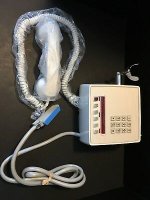
I’ll include a pic of a 186 (4line and ITC)and 187 (1-3 line or 1-2 line & ITC with optional buzzer system) sets.
 

Attachments

  • FD078790-3AA4-4415-A28C-16D5C53C1D99.jpeg
    FD078790-3AA4-4415-A28C-16D5C53C1D99.jpeg
    34.3 KB · Views: 52
  • 5AE073B2-7C55-41B7-8EE5-1BAA1DBE0CDF.jpeg
    5AE073B2-7C55-41B7-8EE5-1BAA1DBE0CDF.jpeg
    30.2 KB · Views: 42
  • 2F854C94-D4CC-48C9-AEAF-EEAE122B9483.jpg
    2F854C94-D4CC-48C9-AEAF-EEAE122B9483.jpg
    53.7 KB · Views: 41
Last edited:

Miss the Pontiacs

Well-known member
Joined
Nov 7, 2016
Messages
16,471
Location
Saskatchewan Canada
I still have those. Terminates phone, slow data and alarm stuff. Actually have 4 blocks of 25 connections. Wired as cross connects, so all jacks end on one block;

(Didnt see it above, but)
The term "punch down' is based on how you connect the wires- you hold an unstripped wire at the top of each metal connection, then use a spring loaded tool to slam the wire into a pinch point, cutting through the insulation AND trimming the end. A punching-kind of motion.

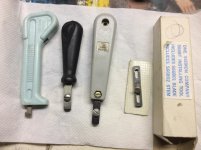
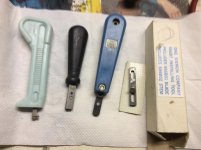
We had a spring loaded tool (blue tool in the pic) but it was used in the jumper wire interface (JWI) the boxes are located outside and connect the wire center cable to the cable running down your back lane.

Our 66 block tools were simply push/punch on and either cut or looped to the next 25 pair on the 66 block. The black tool was issued to us prior to the newer blue/gray tool. You carried 2 so you didn’t have to spin the cutting bar around when looping the second 25 pair.

If you can’t find one of these tools you can just push on with a needle nose pliers. Just make sure the wire isn’t shorting out any other pins.
 

Attachments

  • 424C5556-ED40-4D5A-B8DC-491ED5CCD406.jpg
    424C5556-ED40-4D5A-B8DC-491ED5CCD406.jpg
    124.7 KB · Views: 30
  • A56E2EE1-A7F5-44DD-A612-470237118BA7.jpg
    A56E2EE1-A7F5-44DD-A612-470237118BA7.jpg
    111.8 KB · Views: 28
Last edited:

Miss the Pontiacs

Well-known member
Joined
Nov 7, 2016
Messages
16,471
Location
Saskatchewan Canada
Watched our building maintenance electrician start with one of those works of art trying to reconfigure phone lines, and ended up looking like a freaking birds nest. He said "Oh, I've done this before"...

Ended up taking 4 bell techs the better part of a day to straighten out the mess that guy made.

BTW - Christmas Trees (RG) and Bumble Bees (BY). Ring Tip Voice and accessory if I remember right... The folks house was wired with all 4 pin sockets for the phones (with the exception of the dial wall phone in the kitchen - sunburst yellow with the cool 10' long handset cord). We could take the desk set from dad's den and plug it in outside when we were doing barbecues and pool parties. Decades later, an apartment I had for work had an old 4 pin jack in the bedroom (No one else had any idea what it was for) - I searched St Vinnies and Goodwills, and came up with a dial princess with a 4 pin plug... and it lit like it was made to talk! (Reminded me of being a kid all over again...)

Before our province was deregulated that repair would have been unnecessary as you rented your equipment from the telco. Repairs were part of the rental. Now those 4 Bell guys here would be running you about $400 an hour before taxes.

You must have grown up with money 4 pin jacks were considered an extravagant option from what Id seen. :bowdown:
I had a couple of those old 4 pin jacks and the male ends for the line cord end. Gave them away years ago, wish I still had them for my static display. And the colours of the phones were amazing from Harvest Gold to Tangerine. When I first started I was doing res repairs. One older spinster lady with red hair had all her house done in Pink of all colours. She had a pink phone that the line cord had gone bad. Pink sets were obsolete and she didn’t want the phone colour changed and all our replacement line cords were now silver satin. So I said I would check out my buddies old stock on their trucks and check the nether regions of the warehouse. I just wanted to get out of this Pink bordello so said what ever I had too. After hearing the story one of my buddies produced a pink line cord. I went back and replaced the silver satin with the pink and got a bag of cookies with guess what colour icing. We had them at our next coffee break with a good laugh. :lol_hitti
 

Jinks

Well-known member
Joined
Aug 28, 2012
Messages
2,885
Location
Daytona Beach
Jinks, I didn't notice that last night. So as you say mentioned you could mount 2 25 pair cables. We quit using this system approx 35 years ago where I worked. We went to the BIXs system took up less space and much more manageable for terminating and to reconfigure.
I believe I still have a couple of the push on tools laying around and for sure one more in the box never used.

We were still using them 20 years ago when I retired. Don't know what they're using now, & to be honest........I don't care! Retirement is WAY better than the best job I've ever seen........:thumbup:
 

Jinks

Well-known member
Joined
Aug 28, 2012
Messages
2,885
Location
Daytona Beach
actually I made one with a pc of 3/16 round bar, hack sawed a slot into it to slide over the terminal, and a slight slot cross-ways to center the punch to the wire. it worked fine for the few connections I had to make.

Just use a straight slot screwdriver under the pin. Works as well as a punch tool, just a little slower.........:dunno:
 

alcorelli

Well-known member
Joined
Mar 15, 2019
Messages
366
Location
Westchester County, NY
When I was doing aerial work 42 years ago in the Ready Accesses (RA) we had a 6 pair terminal inside the metal can (RA). We terminated our aerial drop inside the RA on these terminals and tightened them down with a can wrench. We then used Scotch Locks to cut into the aerial pole cable that ran down the alley. So we didn’t use bridle wire here as the drop was weather proof. The house end hit a rams horn and then ran into the house with a drip loop. The carbon protector was installed on a joist or power panel backboard where all your inside tel wire was located.


As for the RG/YB that was just the way it was. Only time there was a problem was if polarity was an issue. I remember hooking up an apartment entry system and when it was all connected it didn’t work. Couldn’t break dial tone. Yes I had to roll all the lines due to polarity issues.


I’ll leave a pic of the 25 pair colour code. The company I worked for hired a new guy he decided that the black should come before the red grouping. :headscratHe terminated the set end of 25 pair for days in a large office complex. Once it was hooked up and equipment circuits were blowing and fuses popping they figured out what he had done. We was looking for a new job shortly after. He even had a colour chart of the correct order.:confused:


I’ll include a pic of a 186 (4line and ITC)and 187 (1-3 line or 1-2 line & ITC with optional buzzer system) sets.
While
Running
Backwards
You'll
Vomit

That's how I learned it.

Sent from my SM-T837P using Tapatalk
 

Jinks

Well-known member
Joined
Aug 28, 2012
Messages
2,885
Location
Daytona Beach
Before our province was deregulated that repair would have been unnecessary as you rented your equipment from the telco. Repairs were part of the rental. Now those 4 Bell guys here would be running you about $400 an hour before taxes.

You must have grown up with money 4 pin jacks were considered an extravagant option from what Id seen. :bowdown:
I had a couple of those old 4 pin jacks and the male ends for the line cord end. Gave them away years ago, wish I still had them for my static display. And the colours of the phones were amazing from Harvest Gold to Tangerine. When I first started I was doing res repairs. One older spinster lady with red hair had all her house done in Pink of all colours. She had a pink phone that the line cord had gone bad. Pink sets were obsolete and she didn’t want the phone colour changed and all our replacement line cords were now silver satin. So I said I would check out my buddies old stock on their trucks and check the nether regions of the warehouse. I just wanted to get out of this Pink bordello so said what ever I had too. After hearing the story one of my buddies produced a pink line cord. I went back and replaced the silver satin with the pink and got a bag of cookies with guess what colour icing. We had them at our next coffee break with a good laugh. :lol_hitti

GOOD GRIEF! That brings back SO many memories from my residential repair days!.....:) There's nothing as crazy as people in their own homes. I had a "city founder" historic house in an area I worked. Nobody actually lived in the house, but they kept it in perfect condition. They still had 302 sets with braided cords. Had to find a new cord for one once. That took some searching. Don't remember any longer how I found it, but I eventually fixed it.

Or the elderly Southern Lady that *insisted* service people (us) come to the back door. Her home was literally so spotless you would have been comfortable eating off the floors, & she was just *incensed* that her kitchen rotary dial wall phone was "broken"! She angrily insisted that I replace it! When I opened it up & the HUGE palmetto roach that had died in the dial gears fell on the floor she nearly fainted! I cleaned the roach off her floor, put the phone back together, & left....by the back door........:dunno:
 

rlitman

Well-known member
Joined
Oct 18, 2010
Messages
24,609
Location
Long Island
actually I made one with a pc of 3/16 round bar, hack sawed a slot into it to slide over the terminal, and a slight slot cross-ways to center the punch to the wire. it worked fine for the few connections I had to make.


A 66 punchdown tool shouldn’t have a cross-ways centering slot. It should push flat to the bottom, but otherwise your tool could work on a 66. Such a handmade tool would fail miserably on a better block.
 

Slednut

Well-known member
Joined
Dec 20, 2012
Messages
2,550
Location
Washington state
How many of you guys chased a trouble in pic cable and open a closure and find a completly different color code. Good old odd count pic.

I've ran across that stuff in old buildings but it was aerial, air core. The colors were glassy looking. I could see the copper through the insulation.

We still have paper cable providing service.
 

fasteddie

Well-known member
Joined
May 25, 2018
Messages
697
Location
NJ
If you can’t find one of these tools you can just push on with a needle nose pliers. Just make sure the wire isn’t shorting out any other pins.

I use the Leatherman in my pocket if I don't have the punchdown with me or I'm too lazy to go out to the truck and get it. Needle nose push down the wire and knife blade cuts it off. I still prefer 66 blocks over 110. Easier to put a buttset on, easier to find tracer tone and much sturdier than 110. And don't get me started on Krone with that stupid Rube Goldberg scissor cutter thing.
 

alcorelli

Well-known member
Joined
Mar 15, 2019
Messages
366
Location
Westchester County, NY
I use the Leatherman in my pocket if I don't have the punchdown with me or I'm too lazy to go out to the truck and get it. Needle nose push down the wire and knife blade cuts it off. I still prefer 66 blocks over 110. Easier to put a buttset on, easier to find tracer tone and much sturdier than 110. And don't get me started on Krone with that stupid Rube Goldberg scissor cutter thing.
Just use a Rocket Ship in a 110 block to connect a **** set. Used to keep one type wrapped to the **** set cord.

Wow. This thread is bringing back memories.

Anyone remember icky pic? That nasty gooey **** in exterior cables?

Sent from my SM-T837P using Tapatalk
 

Miss the Pontiacs

Well-known member
Joined
Nov 7, 2016
Messages
16,471
Location
Saskatchewan Canada
Alcorelli
are you talking about the grease fill BSW cables? If so I do remember those SOBs especially in the winter. New services were generally piped and bonded in the summer by a summer student. By piped I mean conduited into the house and bonded to ground in the pedestal.

Many times the neither end had been touched. Sometimes you had to find the pedestal. If the snow blew in and was even with the top of the fence you had to dig it out. You would take your long handled spade and using the handle walk over to where you thought the pedestal was located. Take the spade end in your hand and push around in the snow till you hit metal. Tink tink eureka. Dig down open the pedestal and sure as **** all you find is the cable with no previous prep.

You would score the cable At 16-18 inches and since we weren’t issued propane torches years ago. You walked back to the truck and got a copy of the latest phone book. Open the book roll up a few pages and light a match. Once you toasted the cable a bit the grease wasn’t acting as glue any longer and would slip off with an easy tug. You could try slitting the side of the cable but some times or many times with cold hands you would cut the service wire inside. At least when the grease is warm you can wipe off the excess with a few pages out of the book. Take the book and simply snuff out the flames in the snow. Save it for the next cremation. It was a hell of a lot more fun to burn company property but would warm up your hands at the same time.

Then you took out you paper type punch a hole, ******** a bullet bond and ground your service. Scotch lock to your designated pair. The house end would be easier but you had to cut your PVC pipe drill your entrance hole and finally get inside the house.
You would dress for the outside and sweat like a pig running your wire inside.
I didn't mind buried areas in the summer but preferred aerial work in the winter even though it meant installing and cutting in new drops with bare hands as at least you could see your Ready Access up in the air. No bonding and no Conduit to cut up.
But I have to admit preferred doing res repair as soon as I got a chance. Business install was great most of the time cable was in the building. Unless it was a construction shack or a previously single line business was your next install. Then the aerial 6 pair came out and here you go again, up the pole.:(

As for wire wraps, I had only seen it used in Central Office circumstances.
 
Last edited:

Miss the Pontiacs

Well-known member
Joined
Nov 7, 2016
Messages
16,471
Location
Saskatchewan Canada
I've ran across that stuff in old buildings but it was aerial, air core. The colors were glassy looking. I could see the copper through the insulation.

We still have paper cable providing service.

Don’t recall ever seeing the glassy insulation. Our cable was the Alpeth type. But in my early years some older portions of the city were lead cable. Lead outer shield with cloth covered pairs, instead of the full cable count you had a portion or dedicated pairs of the count for service. Due to congestion on the cable you some times had to put a few extra spans of drop to pick up a unused pair. Awful stuff!! :shocking: Only had to deal with it once on a repair, it was due for upgrading.
 
To avoid these ads, REGISTER NOW!
Top Bottom