To avoid these ads, REGISTER NOW!

performance drop on filtrete filter

SGKent

Banned
Joined
Feb 12, 2010
Messages
1,959
Location
Citrus Heights CA
Resolved: Performance drop on filtrete filter

Have spent part of the day studying the nature of the performance drop on residential HVAC air filters. Did all the calculations etc as to the air speed and CFM. I guess that here in California in 2020 the rules under Title 20 will change and the filter sellers will have to put the data on the labels. No more of this Home Depot has one standard, Lowes and 3M another etc.. MERV and performance drop have to be labeled if I read the state article correctly. The state also did a study of filters last year, and it seemed that the 3M Filtrete 1900 was high on filtering and air flow. So in that article the state engineers said that the existing label 3M uses is very close to the new standard and already has the needed info on it. Hang in there with me. 3M is a marketing company and their website is all the reasons you will be happy with their product but detailed specs are scarce. I found articles online listing the performance drop across different filters including the Filtrete line so someone is getting that information from somewhere. Then I found an article on a HVAC forum where the ever changing specs 3M filters have were discussed in 2016. The guy who posted was blown off by the folks at the HVAC forum in question so he hasn't been back since 2016. Looking at the 3M Filters online, front, back, sides etc - I cannot find anything that gives the performance drop. Meaning it might be good at filtering because the pretty pictures show what it filters, but if it chokes the air handler then that causes other issues. Does anyone here who is familiar with HVAC or 3M Filtrete know where the hell they put that information either on the package or online? All I wanted to do was make sure the current product performs as well as the ones they gave the state to send for testing. Just as an FYI - I am not interested in a discussion of 5" vs 4" vs 2" vs just install a factory accessory etc.. All I want to know is where the heck does 3M publish that information on their filters if someone knows. Thank you in advance. I know it is probably a question no one is going to be able to help with but I thought I would throw it out there.
 
Last edited:
To avoid these ads, REGISTER NOW!

davo727

Well-known member
Joined
Jun 17, 2012
Messages
1,660
I thought I had seen here or elsewhere online talk about how terribly restrictive those 3m filtretes are. Tomorrow during civilized hours Im sure you will have many replies about this.
 
OP
S

SGKent

Banned
Joined
Feb 12, 2010
Messages
1,959
Location
Citrus Heights CA
Last edited:

danski0224

Well-known member
Joined
Jan 29, 2005
Messages
13,444
Location
Near Naperville, IL
You would likely have to email 3M and request the technical specifications.

Almost no homeowners would even know what to do with the information, and not many more in the HVAC field would know either.

Of those that do, an even smaller number would have the equipment to measure airflow and velocity.

For residential applications, there are no 1" pleated media filters that flow enough air. Any of them will actually cost money to use due to reduced airflow and therefore fewer BTU's transferred to the space.

Residential HVAC fans are typically speced at 0.5" wc TESP. I have not seen everything, but I have yet to see one at even 0.8" wc.

Measure your current TESP. I bet it is at or over 0.5" wc with a plain fiberglass air filter.

If you need better filtration, you need a media filter and ductwork modifications to get the TESP down.

If you do not know what TESP is, then you shouldn't be messing with filters :)
 

Dagny

Well-known member
Joined
Jul 25, 2014
Messages
3,007
Location
Northern Wi.
I have been installing a drop that can take a wider filter. Then you can select a filter that takes more dirt out without reducing airflow.I get calls all the time especially this time of year people buy those thinking they are doing something good. Evaporator ices up due to low airflow.
 
OP
S

SGKent

Banned
Joined
Feb 12, 2010
Messages
1,959
Location
Citrus Heights CA
Have a great 4th!

Might glance at the pdf I posted but some of the tables are below. They show specs and tests regarding flow of different filters. The 1900 supposedly had even less resistance than many of the Merv 8 filters. Images are from the State report. They found 2" filters work marginally better than 1" filters but many other websites show no gains from pleated 1" filters to even 5" filters sold by the HVAC sales folks. The answer does not always appear to be install a wide filter. Sure it makes the HVAC people money but the tests don't show that great an improvement. My guess is that the deeper filters cause the air to pass thru them at more tangent an angle, which would increase resistance.

My split system is 885 CFM / 1240 CFM. The filters are 5.80 sq ft same as 836 sq in. The FPM is 207 at the higher speed. Heat has two speeds, AC runs at the higher. I believe that the 1900 will work fine for us but need to see the manufacurer's specs that are supposed to be on the actual filter.

View media item 94071
View media item 94072
View media item 94073
View media item 94074
View media item 94075
View media item 94076
View media item 94077
 
Last edited:

JerryC

Well-known member
Joined
Apr 28, 2012
Messages
244
Location
Memphis TN
IMHO, the issue with high MERV filters is that they clog faster. The 3m filters are comparatively expensive and almost nobody wants to change them monthly. They are more restrictive than spun fiberglass filters and get more restrictive with use. Take into account that it seems most systems have filters that are physically too small and they clog up pretty quick and now you have an airflow issue causing system issues like freeze up in the short term and blower motor problems long term.

The last time I looked at them Filtrete filters had flow data printed on them. Not on the packaging but on the filter itself.

I've also spent a lot of hours researching this. I thought it would be pretty easy to find who makes filters that flow/filter better but that is not so. The other question I had is what level of filtration does it take to keep the evaporator clean? Several answers have been Merv 7 but I saw no actual testing data to back that up that I could find.
 
Last edited:

fitter30

Well-known member
Joined
Jun 23, 2019
Messages
2,981
Location
Peace Valley,mo
Furnace filters are only as good as the air flow mix going through the house. Just like a vacuum sweeper it only picks up what it sees. Just look at the dust in the air with the sun shinning in a window its just floating not flowing to the furnace return.
 
OP
S

SGKent

Banned
Joined
Feb 12, 2010
Messages
1,959
Location
Citrus Heights CA
My understanding from reading lately on this is that MERV 8 is the minimal filter the manufacturers recommend to keep the coils and ducts clean. One of the members of this house gets asthma attacks so I try for a little better air quality than MERV 8. Some years the smoke from fires in NORCAL has been bad. We have two ducts in mine, one back near the bedrooms and one near the air handler. Both get equally dirty and the filters have been faithfully changed every 2 to 4 months the last 15 years. The day of the old MERV 2 fiberglass filter is gone due to the cost and efficiency of the newer HVAC systems, and the need to keep them clean inside. I also ran hepa filters in a room where the most dust was created for years (where dogs spent most of their indoor time) but the cost of electricity today is so high it is too expensive.

The State of California is involved now because there are standards being created to level the playing field. From testing results, some 4" filters perform worse than specific 1" filters. 3M answered the question and said what I want is supposed to be printed on the frame of the filter. I'll check today.
 
Last edited:

Jackfre

Well-known member
Joined
Dec 26, 2010
Messages
4,411
Location
N CA
"The State of California is involved now because there are standards being created to level the playing field." About time!

I represented Purolator HVAC air filters years ago. It was about the time that the merv ratings were coming into play. In my experience there is no category of products that better proves the old axiom that "figures don't lie, but liars figure," than air filters. Merv ratings are good because they are a first day rating. The old spun glass filters didn't filter until they got dirty, so you had dirt catching dirt. I used a manometer on duct work and air filters. Your usual furnace is designed to operate at a .5" external static. With a manometer tube place perpendicular to the air flow read the supply side just outside the furnace. Do the same on the return side. Add the numbers together to see if you are under the .5". You can see the effectiveness or at least the impact of a filter on the system. take readings with your old filters prior to making changes a benchmark. You can see a lot with a manometer. Also, be aware that one of the biggest issues with residential duct work is leakage. It is exceedingly rare to see and old system that was properly sealed at installation. The T-24 regs now require a max leakage of 6%.
 
OP
S

SGKent

Banned
Joined
Feb 12, 2010
Messages
1,959
Location
Citrus Heights CA
Do you have a preference for a manometer? I see both digital and the old tube style out there. A nice digital one is well over $100.
 

danski0224

Well-known member
Joined
Jan 29, 2005
Messages
13,444
Location
Near Naperville, IL
Dwyer Magnahelic.

The gauge (0 to 2" wc) and an air filter monitoring kit will set you back about 80 bucks direct from Dwyer.

Dwyer doesn't offer a Magnahelic with a 1.5" wc range, so 2" wc is a better choice, unless you know it is 1" or less TESP.
 
OP
S

SGKent

Banned
Joined
Feb 12, 2010
Messages
1,959
Location
Citrus Heights CA
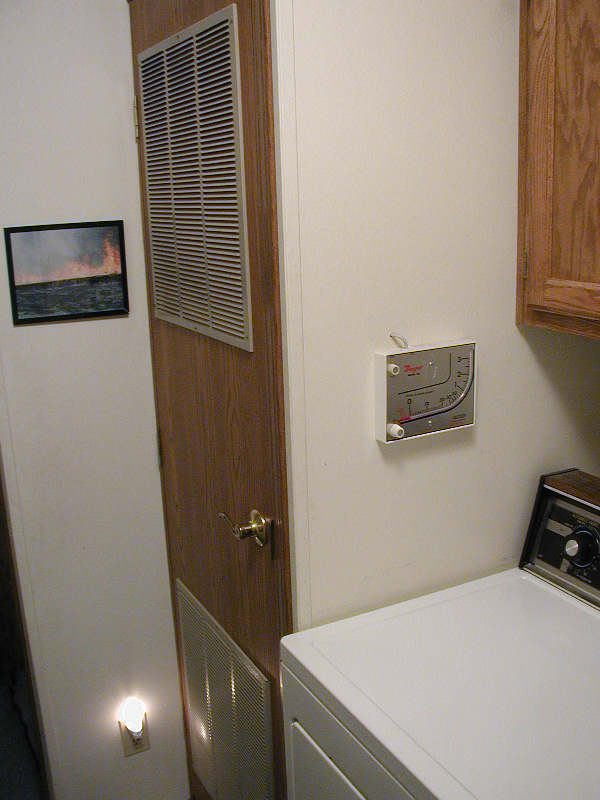
Will the Dwyer rectangle that can be attached to the system do this too? I saw one article where a guy was using this permanently on his system. When he sees it rise he replaces the filter. $30 at Amazon https://www.amazon.com/dp/B009PAN3C8/?tag=atomicindus08-20

Here is a link to the photo where he (spaco.org) shows it mounted.

DraftGageInstalledOff.jpg
 
Last edited:

danski0224

Well-known member
Joined
Jan 29, 2005
Messages
13,444
Location
Near Naperville, IL
Yes.

I have only used the traditional acrylic incline manometers. I'm assuming that style also uses a fluid.

The Magnahelic is dry- no fluid/oil.

I have an acrylic one on my system. Sometimes, the smaller AF model shows up on Ebay for cheap.

The Magnahelic is way cheaper than buying an acrylic incline manometer brand new.
 
Last edited:

Jackfre

Well-known member
Joined
Dec 26, 2010
Messages
4,411
Location
N CA
I had great luck with the Dwyer 100.5 incline manometer. Rock steady readings on reading/setting draft on oil equipment. Fieldpiece make a good digital. If you buy a digital, get the unit that can do differential pressures. It will have two taps vs one. I use that for setting gas pressures on modulating equipment.
 
OP
S

SGKent

Banned
Joined
Feb 12, 2010
Messages
1,959
Location
Citrus Heights CA
The Magnahelic is way cheaper than buying an acrylic incline manometer brand new.

One the same as the one in the photo with red oil fluid is only $30 from Amazon new. The cheapest Dwyer Magnahelic I saw was about $80 and that did not include any kind of mount. What did I miss here?
 
OP
S

SGKent

Banned
Joined
Feb 12, 2010
Messages
1,959
Location
Citrus Heights CA
The white incline manometers aren't acrylic.

I don't need something to haul around. It will be mounted and left in place. Is there some other reason I should spend $100+/- instead of $30? It looks that the $30 solution is the easiest after considering an electronic one for around the same price but then batteries would be needed, and changed when they died. I still don't see why acrylic or a round gauge is better for this use if it costs $70 more.
 
OP
S

SGKent

Banned
Joined
Feb 12, 2010
Messages
1,959
Location
Citrus Heights CA
stpped by lowes. On the Filtrete filters the info is in different places on different filters but it is on all of them. It lists the needed info to calculate the performance drop in WC.
 

LS6 Tommy

Well-known member
Joined
Dec 27, 2013
Messages
26,162
Location
Northern NJ
Almost no homeowners would even know what to do with the information, and not many more in the HVAC field would know either.

Of those that do, an even smaller number would have the equipment to measure airflow and velocity.


If you do not know what TESP is, then you shouldn't be messing with filters :)

TESP checks are part of a standard PM in my book, especially first time on a site, definitely if there's a heat short cycling complaint.

Tommy
 
To avoid these ads, REGISTER NOW!
OP
S

SGKent

Banned
Joined
Feb 12, 2010
Messages
1,959
Location
Citrus Heights CA
TESP checks are part of a standard PM in my book, especially first time on a site, definitely if there's a heat short cycling complaint.

Tommy


Tommy I am glad you do that for your clients. As I began to study my AC system these last few months to find a problem we had, I realized that in the 15 years I've owned it not even the installer ever presented me with some kind of engineering calculations that the ducting and inlet were adequate for the air handler. I do know they checked for leakage and it was almost unmeasurable, but no one ever check the inlet and outlet pressures. I was also puzzled that many HVAC people who commented in another forum were most unprofessional and likely it was because they only acted on what they could get out of a transaction. One fellow blatantly answered a question with something like "whatever I decide I want to sell you and charge you is the right solution."

For those who have glanced at this thread, TESP is Total External Static Pressure. Each segment of the system has air resistance. If the resistance goes up the blower uses more power to push the air. That reduces the system efficiency, raises electricity consumption and can even damage a system if it is too high. Different filters have different resistance. Starting in 2020 in California the filter manufactures have to print what that resistance is on the filter. 3M Filterete already has it on the cardboard air filter frame. For example - their basic MERV 5 filter has more resistance to air than their MERV 13 filter (1900) when new. One would think it would be the opposite with the higher filter making more resistance but not always. Many HVAC companies sell 4" and 5" upgrades. Sometimes a 4" or 5" filter can have more resistance than a 1" filter. Also up to now Lowe's 3M filters (MPR), Home Depot (FPR), other brands (MERV) are all using different standards to measure filtration. In 2020 the filters have to show the MERV as well as resistance from standardized testing.

GF helped me figure all this out and Thank you fellow GF members. :)
 
Last edited:
OP
S

SGKent

Banned
Joined
Feb 12, 2010
Messages
1,959
Location
Citrus Heights CA
the Dwyer gauge is in next to the furnace inlet in the garage and working.

We have two filters, one by the handler 20 x 25 x 1 and one by the back bedroom 14 x 24 x 1 on the ceiling. Both get equally dirty so I am guessing they pull about equal. Both go to the furnace air handler. Gauge reads .30 inches with new filters. The tag on the Air Handler / furnace says max external pressure drop is .50 inches. I'd like to be down around .10 to .15.

According to the furnace manual, at .30 inches it takes about 100 RPM off the fan at high speed (AC, full heat). Medium and low speed there is no loss. I've looked all evening for filters that might improve the pressure drop without passing a huge amount of dust thru and can't come up with anything locally. The basic filters that HD and Lowes sells listed greater pressure drops when we looked at them in the store than the Filtrete 1900. It is like the world only sells what is convenient to their bottom line. I think Flanders makes some Fiberglass ones that test well with a minimal MERV of about 4 but no one locally sells them. The filter frames cannot be extended to a thicker filter, or enlarged.
 
Last edited:

LS6 Tommy

Well-known member
Joined
Dec 27, 2013
Messages
26,162
Location
Northern NJ
Tommy I am glad you do that for your clients.

For those who have glanced at this thread, TESP is Total External Static Pressure. Each segment of the system has air resistance. If the resistance goes up the blower uses more power to push the air. That reduces the system efficiency, raises electricity consumption and can even damage a system if it is too high.

GF helped me figure all this out and Thank you fellow GF members. :)


I appreciate your compliment, but would like to clarify one of your above statements.

Increasing the resistance on a squirrel cage blower does not increase evaporator blower motor current draw, it decreases it. The increased power consumption comes from the extended run times you incur when there isn't the proper airflow. :thumbup:

Tommy
 
OP
S

SGKent

Banned
Joined
Feb 12, 2010
Messages
1,959
Location
Citrus Heights CA
Thanks Tommy. At .30 inches wc across the filters, Carrier's tables for that unit shows a drop from 1440 CFM to 1350 CFM (6.25%). I have to get the pressure drop down to .10 inches wc for there to be no drop at the higher fan speed. Thought I would try some MERV 4 fiberglass filters today and see what they do. Looks like Ace (Emigh) in Carmichael has the Flanders design that meets those requirements.

Appreciate the explanation you gave.
 

strutaeng

Well-known member
Joined
Dec 12, 2011
Messages
2,281
Location
Dallas, TX
I have an Aprilaire media filter when my system was installed, something like a 2400 model number. The literature stated it was good for 12 months, however, after 1 or 2 months it was loaded with dust.

My return is on the floor and we have a lot of kids running around the house. The floor return will always pick up more dirt than a return on the ceiling, but I do like having the unit in a closet rather than in the attic.

Anyways, it seemed like my airflow on the Aprilaire dropped off considerably after it was loaded, which is not difficult to believe. After a few filter changes (even did the upgrade filter) and the added cost and ordering online, I'm done with those filters. The filter people may claim that as the filter loads up, it becomes more "efficient," but at the cost of airflow, if that makes sense. Basically, the equipment manufacturers and filter people are looking at different point of view of efficiency.

I have since installed a Dwyer Manometer and have been using fiberglass filters for the last few months. It makes a world of a difference on the airflow and the gauge verifies this.

Maybe I'm wrong, but in the old days fiberglass filters was what everyone used, yet stuff seemed to run just fine?

If you really want to filter the air, why not purchase an air purifier?
 

TRWham

Well-known member
Joined
Aug 11, 2017
Messages
1,961
Location
East Cobb County, Georgia
Thanks Tommy. At .30 inches wc across the filters, Carrier's tables for that unit shows a drop from 1440 CFM to 1350 CFM (6.25%). I have to get the pressure drop down to .10 inches wc for there to be no drop at the higher fan speed. Thought I would try some MERV 4 fiberglass filters today and see what they do. Looks like Ace (Emigh) in Carmichael has the Flanders design that meets those requirements.

Appreciate the explanation you gave.

There is no area of engineering where you can get something for nothing. For filters, there is a direct trade off between filter efficiency and resistance. In ASHRAE 52.2, the lowest category of filters (MERV 1-4) has a final resistance of 0.30 WG and an initial resistance of 0.15, so even a MERV 1 filter exceeds the 0.10 you seek.
 
OP
S

SGKent

Banned
Joined
Feb 12, 2010
Messages
1,959
Location
Citrus Heights CA
I have an Aprilaire media filter when my system was installed, something like a 2400 model number. The literature stated it was good for 12 months, however, after 1 or 2 months it was loaded with dust.

My return is on the floor and we have a lot of kids running around the house. The floor return will always pick up more dirt than a return on the ceiling, but I do like having the unit in a closet rather than in the attic.

Anyways, it seemed like my airflow on the Aprilaire dropped off considerably after it was loaded, which is not difficult to believe. After a few filter changes (even did the upgrade filter) and the added cost and ordering online, I'm done with those filters. The filter people may claim that as the filter loads up, it becomes more "efficient," but at the cost of airflow, if that makes sense. Basically, the equipment manufacturers and filter people are looking at different point of view of efficiency.

I have since installed a Dwyer Manometer and have been using fiberglass filters for the last few months. It makes a world of a difference on the airflow and the gauge verifies this.

Maybe I'm wrong, but in the old days fiberglass filters was what everyone used, yet stuff seemed to run just fine?

If you really want to filter the air, why not purchase an air purifier?

I ran two large Honeywell hepa filters in the house for years. The motors expanded and had to be replaced. The cost in power would be about $30 a month these days here in the Sacramento area. That is in addition to the prefilters - the hepa ones could be cleaned with air. Caught a lot of dander from the dogs and dust so they worked - the cost was just prohibitive. Here in California the government's mentality has gone from finding inexpensive utilities for the public and clean air to tax tax tax and spend on things like health care for all of Central and South America while our streets are filled like 3rd world with homeless. I can barely afford to water my lawn and garden these days, and cool the home, let alone run hepa filters 24/7. Between 5 and 8 pm power is $0.30 a Kwh vs $0.09 Kwh a few years ago - all due to taxes and time of day pricing. Some parts of the state are even more expensive. Electric power in the USA ranges from $0.0837 in parts of the US to $.37 Kwh in So Cal.

I ran a test with the filters out and the pressure is .08 inches wc so the inlet duct is undersized. Not sure it would be worth paying a sheet metal guy to fabricate a new inlet duct. Pulling the back ceiling filter out the pressure remains .30 inches wc. I can feel draw across it but I suspect the add-on design doesn't really offer a lot of additional filter area. I'll see what the MERV 4 filters do.
 

strutaeng

Well-known member
Joined
Dec 12, 2011
Messages
2,281
Location
Dallas, TX
I ran two large Honeywell hepa filters in the house for years. The motors expanded and had to be replaced. The cost in power would be about $30 a month these days here in the Sacramento area. That is in addition to the prefilters - the hepa ones could be cleaned with air. Caught a lot of dander from the dogs and dust so they worked - the cost was just prohibitive. Here in California the government's mentality has gone from finding inexpensive utilities for the public and clean air to tax tax tax and spend on things like health care for all of Central and South America while our streets are filled like 3rd world with homeless. I can barely afford to water my lawn and garden these days, and cool the home, let alone run hepa filters 24/7. Between 5 and 8 pm power is $0.30 a Kwh vs $0.09 Kwh a few years ago - all due to taxes and time of day pricing. Some parts of the state are even more expensive. Electric power in the USA ranges from $0.0837 in parts of the US to $.37 Kwh in So Cal.

I ran a test with the filters out and the pressure is .08 inches wc so the inlet duct is undersized. Not sure it would be worth paying a sheet metal guy to fabricate a new inlet duct. Pulling the back ceiling filter out the pressure remains .30 inches wc. I can feel draw across it but I suspect the add-on design doesn't really offer a lot of additional filter area. I'll see what the MERV 4 filters do.

Well, since CA has the strictest air quality laws, you don't really need to filter anything, right? Free, fresh, clean air for all! LOL

I feel your pain. My family and I lived in SoCa when I was a little boy. We moved out in '93. Best decision my Dad made. In fact, my Dad has stated that he wouldn't return to Ca even if he was paid to count money!

We still have relatives there and have visited often, but less so lately. Aside from the government, it is a beautiful place and weather. I wouldn't live there today.

Back to your problem. Those fiberglass filters are the least restrictive I've found, something like 0.10 to 0.15" w.c. is what I recall seeing on my gauge. Unfortunately, I don't think you have many options without spending a lot of money.
 
OP
S

SGKent

Banned
Joined
Feb 12, 2010
Messages
1,959
Location
Citrus Heights CA
Back to your problem. Those fiberglass filters are the least restrictive I've found, something like 0.10 to 0.15" w.c. is what I recall seeing on my gauge. Unfortunately, I don't think you have many options without spending a lot of money.

that seems to be the case. I did notice that in the footnote of the furnace specs it said that if the factory washable filter is not used then an additional .10 wc can be added to the external pressure spec chart. Headed out soon to get some of the MERV 4 fiberglass filters to see how they work. The factory washable filter was MERV 4 from what I can gather so these systems are designed for that level of filtration. Who would have thought something as simple as a filter could require so much research.

*A filter is required for each return-air inlet. Airflow performance included 1-in. washable filter media such as contained in factory-authorized accessory filter rack. To determine airflow performance without this filter, assume an additional 0.1 in. wc available external static pressure.
.
 
Last edited:
OP
S

SGKent

Banned
Joined
Feb 12, 2010
Messages
1,959
Location
Citrus Heights CA
edit to correct number: with the generic fiberglass from Ace Hardware it dropped to .18 inches wc and I can tell there is a little more air coming out of the vents. Carriers specs show that the CFM increases by about 80 - 100 CFM with the drop. The temperature split is 13.5 F so it dropped .5 degree F with the extra air. I'll order a case of the fiberglass filters for summer. In winter the air handler is usually on medium or low so we can use the pleated filters then.
 
Last edited:

TRWham

Well-known member
Joined
Aug 11, 2017
Messages
1,961
Location
East Cobb County, Georgia
with the generic fiberglass from Ace Hardware it dropped to 1.8 inches wc and I can tell there is a little more air coming out of the vents. The temperature split is 13.5 F so it dropped .5 degree F with the extra air. I'll order a case of the fiberglass filters for summer. In winter the air handler is usually on medium or low so we can use the pleated filters then.

The last thing you need to do is drop a split that is already low. I'll admit I'm biased toward humidity control because of our location, but that condition doesn't offer much latent cooling.
 

pbon

Well-known member
Joined
May 14, 2017
Messages
3,498
I just bought Trion MERV8 instead of MERV11 because it made sense the added filtration would reduce flow and because the HVAC person who serviced our systems said the same thing and uses MERV8 unless there seems to be a lot of dust floating in the air when looking towards sunlight coming through a window.
 
OP
S

SGKent

Banned
Joined
Feb 12, 2010
Messages
1,959
Location
Citrus Heights CA
The last thing you need to do is drop a split that is already low. I'll admit I'm biased toward humidity control because of our location, but that condition doesn't offer much latent cooling.

I've asked my HVAC folks to schedule an A coil inspection and clean if needed. The split was higher when new so I suspect that the A Coil needs a cleaning. 15 years of use. I have done them before but it was a pita on the old system to pull it out, balance it while someone holds a garbage can under it to catch the cleaner and rinse to do it right. Also some folks vacate the lines, pull it out to clean it then put it back in. It is more than I want to deal with.
 

danski0224

Well-known member
Joined
Jan 29, 2005
Messages
13,444
Location
Near Naperville, IL
with the generic fiberglass from Ace Hardware it dropped to 1.8 inches wc and I can tell there is a little more air coming out of the vents. Carriers specs show that the CFM increases by about 80 - 100 CFM with the drop. The temperature split is 13.5 F so it dropped .5 degree F with the extra air. I'll order a case of the fiberglass filters for summer. In winter the air handler is usually on medium or low so we can use the pleated filters then.

1.8"wc?

Really?

Is that TESP?

I haven't seen residential equipment yet with a fan rated for more than 0.5" TESP, although I have heard that some air handlers have a 0.8" TESP rating.

If that 1.8" is TESP, then you must have major ductwork problems. If the blower motor is variable speed, it's costing you a small fortune to run it... and I'm surprised that the evaporator coil isn't freezing up.
 
OP
S

SGKent

Banned
Joined
Feb 12, 2010
Messages
1,959
Location
Citrus Heights CA
sorry .18 in wc. Edited to correct.

Numbers were

.08 in. wc no filter
.30 in. wc with lowest pleated filters
.18 in. wc with fiberglass from Ace

Manufacturer (Carrier) says external pressure across filter should not exceed .50 in. wc with the internal filter present, and that one can ad .10 in. wc if the internal washable MERV 4 filter is not present. So if I read this correctly, at .18" wc the air handler CFM is at max when on high since the internal filter is not present. Really appreciate all of you helping me thru this. HVAC is not my strongest area.

View media item 94294
 
Last edited:

metlmunchr

Well-known member
Joined
Sep 10, 2011
Messages
1,278
To measure the total external static pressure you have to read the differential across the unit from inlet to outlet. It would appear that you're currently reading only the pressure drop created by the return duct and filters.

And, FWIW, a temperature drop of 13.5* is a problem. Say the temperature in the space is 72. Your discharge air temp would be 58.5. If you take saturated air at 58.5 and warm it to 72, the relative humidity of that air will be in the neighborhood of 65%. But the actual RH in the space is going to be above that number as it is basically impossible to get the RH in the space down to the equivalent RH of the discharge air warmed to the space temp.

The usual goal for comfort cooling is 50% RH in the space. To get there, you'd need a temperature drop in the range of 18-22*F assuming the space setpoint is within the normal range of 72 to 76*F. Your specs show about 1200 cfm @ 0.5" TESP which would correspond to a 3 ton condensing unit. The insufficient temperature drop could be due to an undersized condensing unit or a unit with a low gas charge, or several other conditions that reduce the capacity of the condensing unit, but generally not due to a dirty coil or excess pressure drop across the filters.

If the condensing unit is functioning properly and adequately sized, either of these conditions(dirty coil or restrictive filter) will typically cause the temperature drop to be excessive, which is not the condition you currently have.
 
Last edited:

u3b3rg33k

Well-known member
Joined
Dec 18, 2017
Messages
4,048
IMHO, the issue with high MERV filters is that they clog faster. The 3m filters are comparatively expensive and almost nobody wants to change them monthly. They are more restrictive than spun fiberglass filters and get more restrictive with use. Take into account that it seems most systems have filters that are physically too small and they clog up pretty quick and now you have an airflow issue causing system issues like freeze up in the short term and blower motor problems long term.

The last time I looked at them Filtrete filters had flow data printed on them. Not on the packaging but on the filter itself.

I've also spent a lot of hours researching this. I thought it would be pretty easy to find who makes filters that flow/filter better but that is not so. The other question I had is what level of filtration does it take to keep the evaporator clean? Several answers have been Merv 7 but I saw no actual testing data to back that up that I could find.

the term i think you're looking for is "depth loading". a cheap filter that's just perforated will indeed clog up on the surface and then it's "filtering efficiency" will skyrocket while airflow basically halts. good filters allow dust to penetrate partway into the filter and "load up".


I have an Aprilaire media filter when my system was installed, something like a 2400 model number. The literature stated it was good for 12 months, however, after 1 or 2 months it was loaded with dust.

My return is on the floor and we have a lot of kids running around the house. The floor return will always pick up more dirt than a return on the ceiling, but I do like having the unit in a closet rather than in the attic.

Anyways, it seemed like my airflow on the Aprilaire dropped off considerably after it was loaded, which is not difficult to believe. After a few filter changes (even did the upgrade filter) and the added cost and ordering online, I'm done with those filters. The filter people may claim that as the filter loads up, it becomes more "efficient," but at the cost of airflow, if that makes sense. Basically, the equipment manufacturers and filter people are looking at different point of view of efficiency.

I have since installed a Dwyer Manometer and have been using fiberglass filters for the last few months. It makes a world of a difference on the airflow and the gauge verifies this.

Maybe I'm wrong, but in the old days fiberglass filters was what everyone used, yet stuff seemed to run just fine?

If you really want to filter the air, why not purchase an air purifier?

Did you ever measure with it before? or just after?


for fun, here's my 2200 with real media and the "equivalent" (lol) box filter. I did the maths once and the real media has something like 5-10 times the surface area. I change it annually.

attachment.php
 

Attachments

  • filters.jpg
    filters.jpg
    20.5 KB · Views: 137

TRWham

Well-known member
Joined
Aug 11, 2017
Messages
1,961
Location
East Cobb County, Georgia
Temperature split is rather meaningless for troubleshooting.

You need to figure out the running capacity of the unit.

The first step in troubleshooting is determining that there is even a problem to diagnose. Split can certainly indicate when there is a performance problem that requires further investigation.
 

Jackfre

Well-known member
Joined
Dec 26, 2010
Messages
4,411
Location
N CA
SGK, I am surprised that your contractor said that duct leakage is negligible on the system. Especially on an older system. This will veer off topic, but when we moved into our place here in Nevada City the central system had so many problems I took it to the dump and installed mini-splits throughout the place. Given our electrical costs and the new peak pricing we have the entire home zoned, controlling spaces as needed. Guest bedrooms are not conditioned until we have guests. The upstairs is never heated, getting enough conditioned air from downstairs. Net/net we see a modest increase in PG&E (that wonderful company) bills in the peak seasons and we are perfectly comfortable. I am not suggesting that you do the same change as we did. Our system was a catastrophe. Yours sounds pretty good. In many cases I suggest, "don't change, add." Putting a mini-split in the primary living are and the master bedroom might improve comfort and utility rates.This has been a good thread on filters.
 
To avoid these ads, REGISTER NOW!
Top Bottom