To avoid these ads, REGISTER NOW!

20 amp outlet/ plug on 30 amp circuit?

wazzabie

Well-known member
Joined
May 9, 2010
Messages
424
On a 120v spot welder the plug can fit either a 15 amp or 20 amp outlet. Miller calls for a 30 amp breaker on a 10/2 Romex circuit.

What size of outlet should I use? A 20 amp or 30 amp? If I use a 30 amp the plug Miller has on the welder from the factory will not work.

millerspotwelder.png
 
To avoid these ads, REGISTER NOW!

pattenp

Well-known member
Joined
Jun 4, 2008
Messages
10,175
Location
Virginia - USA
As noted in the diagram to meet NEC requirements if the circuit is 30A then the outlet also needs to be 30A. You will need to replace the plug on the spot welder.

Edit: I'm scratching my head on this because it makes no sense they put a 20A plug on it and then turn around and say 30A circuit.
 
Last edited:

mm08822

Well-known member
Joined
Jan 13, 2012
Messages
6,313
Location
NJ
Op, I suggest you first run this on a 20A ckt and see if the cb holds. A dedicated ckt to the recept would give you the most headroom for the welder.
If cb tripped, you might be able to use a 20A cb rated for high inrush.
 

pattenp

Well-known member
Joined
Jun 4, 2008
Messages
10,175
Location
Virginia - USA
I looked at a couple of other 120V spot welders online that are 1.5kva and they show just needing standard 120V 20A house current. I think the Chinese instructions on your spot welder are wrong.
 
OP
W

wazzabie

Well-known member
Joined
May 9, 2010
Messages
424
I looked at a couple of other 120V spot welders online that are 1.5kva and they show just needing standard 120V 20A house current. I think the Chinese instructions on your spot welder are wrong.

This is not a Chinese spot welder. It is a Miller.

The instructions are from the manual Miller created. I'm going to contact Miller support and share the response on this forum.
 
To avoid these ads, REGISTER NOW!
OP
W

wazzabie

Well-known member
Joined
May 9, 2010
Messages
424
I talked with Miller support. They informed me that they don't sell spot welders any longer. They just have parts for them. These spot welders were outsourced to another company. I'm not surprised since the Dayton look identical.

Anyways I didn't get any clear direction. I'm going to go with a dedicated 20 amp circuit that will fit the 20 amp plug on the spot welder. If I have issues with breaker trips then I'll have to figure something else out.

I've been running it on a 20 amp shared circuit and get breaker trips. So that is not working.

The duty cycle is 50%.

I had asked if I could run a 20 amp receptacle on a 30 amp circuit. I was told to follow code.
 

rlitman

Well-known member
Joined
Oct 18, 2010
Messages
24,792
Location
Long Island
I would suggest that if you can wire the circuit in 10 gauge, do that. But use a 15A outlet and the 20A breaker. Make sure you're either using an HACR breaker, or something made since 2009 (after which the HACR standard was absorbed into all breakers).

I very much doubt you'll experience breaker trips, on a 20A breaker. The instantaneous trip curve for 20A breakers is not significantly different than the curve for 30A, and the thermal portion of the curve (where there is a big difference between the two) isn't going to come into play with a spot welder (certainly not at 50% duty cycle).

The blades in 15A, 20A and 30A plugs all have the same amount of metal in them, so they can all carry the same currents. They're different configurations, solely to prevent dangerous interchanges.

The 10 AWG wire will have less voltage drop at the ludicrous inrush current that a spot welder uses, compared to the 12 gauge, so it may weld better with it. But at the 50% duty cycle, 14 gauge would still not overheat, so there's no safety concern about using 12.
 

wyliesdiesels

Well-known member
Joined
Aug 14, 2012
Messages
20,268
Location
Modesto, CA
It would be interesting to know what the in-rush current is on this unit.

Would need a clamp meter that has in-rush current measuring capability such as the fluke 381.
 

mm08822

Well-known member
Joined
Jan 13, 2012
Messages
6,313
Location
NJ
Op, I suggest you first run this on a 20A ckt and see if the cb holds. A dedicated ckt to the recept would give you the most headroom for the welder.
If cb tripped, you might be able to use a 20A cb rated for high inrush.

From SQ D's website:
Standard QO115 and QO120 circuit breakers are manufactured to have a magnetic trip point at approximately 8x to 10x the breaker rating. There are some applications, however, in which a load has an inrush current high enough to cause these standard circuit breakers to trip. Examples of these loads include area lighting for athletic fields, parking lots, or outdoor signs. To allow the high inrush current without tripping the circuit breaker, a high magnetic breaker should be used. These high magnetic breakers breakers have a magnetic trip point set much higher than the standard circuit breakers. They can be identified by the HM suffix on the catalog number (QO115HM). Current production HM breakers are also identified with a "High Magnetic" label on the side of the breaker (see photo).
NOTE: The above explanation comparing the standard breaker to the high magnetic breaker applies to 1-pole, 15A and 20A, QO, QOB, QOU, HOM and CHOM breakers only.

OP what make and series Panel do you have?
 
OP
W

wazzabie

Well-known member
Joined
May 9, 2010
Messages
424
I would suggest that if you can wire the circuit in 10 gauge, do that. But use a 15A outlet and the 20A breaker. Make sure you're either using an HACR breaker, or something made since 2009 (after which the HACR standard was absorbed into all breakers).

I very much doubt you'll experience breaker trips, on a 20A breaker. The instantaneous trip curve for 20A breakers is not significantly different than the curve for 30A, and the thermal portion of the curve (where there is a big difference between the two) isn't going to come into play with a spot welder (certainly not at 50% duty cycle).

The blades in 15A, 20A and 30A plugs all have the same amount of metal in them, so they can all carry the same currents. They're different configurations, solely to prevent dangerous interchanges.

The 10 AWG wire will have less voltage drop at the ludicrous inrush current that a spot welder uses, compared to the 12 gauge, so it may weld better with it. But at the 50% duty cycle, 14 gauge would still not overheat, so there's no safety concern about using 12.

I have a dedicated 20amp circuit on 12 yellow romex wired. It only is a 20 ft run from the main service panel. I just need to install the 20amp breaker.
 

rlitman

Well-known member
Joined
Oct 18, 2010
Messages
24,792
Location
Long Island
I have a dedicated 20amp circuit on 12 yellow romex wired. It only is a 20 ft run from the main service panel. I just need to install the 20amp breaker.

Yeah, that should work. However, remember that voltage drop is proportional to current, and in your case, specifically inrush current (since the pulse of a spot welder is for a very short duration). What that means is that the larger the wire you feed this with (technically, the lower the impedance), the greater the welder's overall capacity will be. This has no dependence on the number printed on the breaker (though the HM comment above is correct, IF you're getting nuisance trips).

So, if you find it not performing quite up to snuff on 12 gauge, an orange 10 gauge Romex might give you the edge you need. Or then again, it might not make that much of a difference. 20' is a fairly short run as it is.

Anyway, since you already have the circuit run, I'd say just go with what you've got.

It would be interesting to know what the in-rush current is on this unit.

Would need a clamp meter that has in-rush current measuring capability such as the fluke 381.

Ditto. If I had to take a guess (a-la how many marbles are in the jar, total stab in the dark), I'd say probably in the neighborhood of 80A.
 
Last edited:

pattenp

Well-known member
Joined
Jun 4, 2008
Messages
10,175
Location
Virginia - USA
This is not a Chinese spot welder. It is a Miller.

The instructions are from the manual Miller created. I'm going to contact Miller support and share the response on this forum.

Just because it's a Miller doesn't mean it's not China parts that have been assembled in the USA. I'd be surprised if its not China made since it was outsourced.
 

sberry

Banned
Joined
Jun 18, 2005
Messages
35,747
Location
Brethren, Michigan
They have brought on new engineers with the change to inverters, contrary to what one might think not all of them have opened a code book.
I have seen a couple tools that are instant similar to spot welder and come with ******** cords. A special carpet stapler was one of them, comes with long factory cord and says,,, no extension.
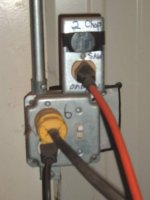
Here is a not approved outlet on my shop saw,,, my helper at the time added it with number 10 wire. I wish he would have used 12, the 10 just delivers more faster but its on a 30. The trip curve must be enough different vs a 20 that it works.
 

Attachments

  • chop saw only.JPG
    chop saw only.JPG
    30.3 KB · Views: 37
Last edited:

spudley

Well-known member
Joined
Dec 27, 2016
Messages
702
Location
Northeast Wisconsin
On a 120v spot welder the plug can fit either a 15 amp or 20 amp outlet. Miller calls for a 30 amp breaker on a 10/2 Romex circuit.

What size of outlet should I use? A 20 amp or 30 amp? If I use a 30 amp the plug Miller has on the welder from the factory will not work.

In an earlier post you wrote...
I have a Miller Spot Welder with no timer. When I acquired the welder there was no plug on the wire. The colors on the wire are white, black and green. I do not want to assume that green is neutral/ground.

Before I plug this into a 220v outlet how can I test with a multimeter which wire is neutral/ground from the spot welder?

I do appreciate the help from this forum.
So did you put the plug on the wire or was it factory installed?
 
OP
W

wazzabie

Well-known member
Joined
May 9, 2010
Messages
424
In an earlier post you wrote...
So did you put the plug on the wire or was it factory installed?

I have two Miller spot welders.

1) MSW-41 120v with the factory plug that fits into a 15amp or 20amp outlet.

2) MSW-51 220v that did not come with a factory plug. It was mounted to a stand that operated with a foot pedal which I have removed. It was a stationary spot welder but I want to be able to move it around. I've wired this spot welder with a 6-50p plug as I also have an extension cord with 6-50p. I will only run this on a 30amp circuit.

I was not getting very good welds on the 120v spot welder but that was on a shared 20amp circuit.

I'm installing three dedicated circuits in the garage.
1. 120v 20amp
2. 220v 30amp on 10/2 romex
3. 220v 50amp on 6/2 romex
 
OP
W

wazzabie

Well-known member
Joined
May 9, 2010
Messages
424
I got the three new dedicated welding circuits working in the garage.

1. 120v 20amp
2. 220v 30amp on 10/2 romex
3. 220v 50amp on 6/2 romex

Thank you for the help.
 
To avoid these ads, REGISTER NOW!
Top Bottom