To avoid these ads, REGISTER NOW!

How do you test if power is reaching a window motor?

Jacobson

Well-known member
Joined
Jan 11, 2014
Messages
1,482
I forgot how to do this. Did it once.

Unplug wires from the electrical motor.
To test the motor, I connect a battery directly to the 2 leads on the motor.
I can also do a continuity test on the window switch itself.

But, how do you test if power is reaching a motor?
To see if wires are broken.
Flip switch and see that power is reaching the target.

Do I attach a multimeter to the 2 wires?
What setting on the MM? voltage/DC? Amps/current?
 
To avoid these ads, REGISTER NOW!

eyeball

Well-known member
Joined
Jul 14, 2011
Messages
407
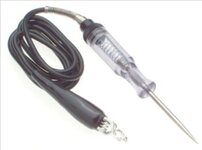
Test light is a quick and dirty method.


You absolutely can test it with a multimeter.

However, I agree withFinn, if you just want to make sure the switch is getting power a test light is a simple way.

Assuming you find no power to the switch, the test light will also be a good way to work your way backwards through the circuit to find the problem.

In following with garagejournal traditions and protocol, if you don’t have a test light, now would be a good time to add one to your arsenal. They are only about 10-15 bucks. Look for one with a strong ground clamp and a long cord.

Any auto parts store will have one.

3ece3c0e587b077f91e6dc7480bc17c5.jpg
 

Attachments

  • 3ece3c0e587b077f91e6dc7480bc17c5.jpg
    3ece3c0e587b077f91e6dc7480bc17c5.jpg
    27 KB · Views: 0
Last edited:

Aquamoose

Well-known member
Joined
Jan 28, 2014
Messages
365
A better option is a pos/neg test light that plugs in a cig lighter or with a receptacle with large alligator clips to connect directly to the battery. Box trucks carry them, not auto parts stores.

Two big benefits, it is safe to test on ANY circuit in the vehicle. Testing a regular bulb test light in the wrong places can damage electronics. Second is it let’s you know if it’s pos or neg right away. A second led show’s that it’s powered & ready to be used. That type of test light (called CSTL - Circuit Sage Test Light) is the perfect tool for testing window circuitry since some of the wires provides power or ground depending on switch direction.

- Master EVT (Emergency Vehicle Technician) since 1992.

Sent from my iPhone using Tapatalk
 
Last edited:

2ndGearRubber

Well-known member
Joined
Mar 24, 2014
Messages
14,185
Location
Pittsburgh
No LEDs, just don't stick devices which actually draw current into sensitive areas. A volt meter will confirm B+/ground is reaching a component. LEDs lie, like continuity. Volt meters lie too, just less so.


Volt meter, plug tips into two-wire plug for motor, flip switch. DC volts, 20 volts peak if it's not auto ranging. One result should be battery voltage, the other "negative" battery voltage, as the polarity will have reversed from the switch.

A tail-light bulb, like 3057 will draw approx. 2 amps constant current when shorted across the battery terminals. Unplug motor, and using an old piece of tail-light wiring with a bulb and socket, load the circuit by replacing the load of the motor with that of the test light. Flip switch in either direction, bulb should illuminate. A window motor will be drawing more than that 2 amp current, but usually if a circuit fails due to lack of current carrying capacity, it ain't moving 10, OR 2 amps.


https://www.garagejournal.com/forum/showthread.php?t=428886


I also made one out of an old-school sealed beam bulb - 5amp constant draw baby. :lol_hitti
 

joe_pinehill1

Well-known member
Joined
Feb 23, 2013
Messages
537
Location
Northern Virginia
Take the door panel off. What kind of car?
First what is the symptom? window won't go up and down? It might be the regulator and not the power to the motor or the motor. If you see the wire rope all tangled, its the regulator

If the regulator looks fine, demate the connector to the motor, many cars its a two pin connector. Put a meter on connector and push the switch, see if you have 12 Volts. If you don't see 12 volts across the connector pins, you need to trouble shoot the elctrical system. If you do, its the motor. Your meter should be set to volts, auto range or for a scale that lets you measure 0 to 20 Volts.

If the car is relatively new, its probably the regulator, IMHO.

If I knew more I'd be making youtube videos.
 
Last edited:

Bighead38

Well-known member
Joined
Nov 11, 2012
Messages
5,612
Location
Rockland County NY
A better option is a pos/neg test light that plugs in a cig lighter or with a receptacle with large alligator clips to connect directly to the battery. Box trucks carry them, not auto parts stores.

Two big benefits, it is safe to test on ANY circuit in the vehicle. Testing a regular bulb test light in the wrong places can damage electronics. Second is it let’s you know if it’s pos or neg right away. A second led show’s that it’s powered & ready to be used. That type of test light (called CSTL - Circuit Sage Test Light) is the perfect tool for testing window circuitry since some of the wires provides power or ground depending on switch direction.

- Master EVT (Emergency Vehicle Technician) since 1992.

Sent from my iPhone using Tapatalk

That’s what I grew up using. I thought the old man was gonna cry when his broke and the snap on driver said he couldn’t replace it. He called his Mac guy and got one from them.
 

rustyjames

Well-known member
Joined
Dec 28, 2008
Messages
1,077
Location
central nj
Bang on the door till you get a reaction from the motor.:lol_hitti

I've done that a few times with different vehicles successfully. It helps to know where the location of the motor is. On the inside of the door just bang with your hand. Don't have much to lose.
 

APEowner

Well-known member
Joined
Oct 2, 2009
Messages
4,166
Location
Sunny, New Mexico
The power to windows is switched polarity so you need to check both sides of the connector. I like to sue a test light because it draws current and will detect a bad connector, switch or relay that'll test OK with a volt meter. Connect one side of the light to one side of the connector and the other to the other. It should turn on with the switch in either the up or down position.
 

MattT

Well-known member
Joined
Feb 20, 2010
Messages
3,201
A tail-light bulb, like 3057 will draw approx. 2 amps constant current when shorted across the battery terminals. Unplug motor, and using an old piece of tail-light wiring with a bulb and socket, load the circuit by replacing the load of the motor with that of the test light. Flip switch in either direction, bulb should illuminate. A window motor will be drawing more than that 2 amp current, but usually if a circuit fails due to lack of current carrying capacity, it ain't moving 10, OR 2 amps.

:thumbup: I learned a long time ago the best way to get an accurate diagnosis on a power window circuit is to load it. IIRC I found this out on the first one I did, after replacing the motor:(
 

theoldwizard1

Well-known member
Joined
Feb 22, 2011
Messages
43,216
Location
SE MI
I forgot how to do this. Did it once.

Unplug wires from the electrical motor.
To test the motor, I connect a battery directly to the 2 leads on the motor.
If the motor runs, it is a switch/wire problem.

I can also do a continuity test on the window switch itself.
The continuity test must ne doen withe the switch disconnected. The results may just confuse you because it is NOT a simple ON/OFF switch.

But that is just the door switch. It gets its power from the driver door switch (newer cars may have a "smart" module that controls the motor). The best you can do is use a test light with the tail connected to ground. Verify the light (and the ground) work. With the key on, back probe all of the wires coming into the door switch. One of them should be hot from the driver door switches. If not, you have a wiring problem from the driver door. If you do have power from the driver door switches, then operating the passenger door switch should make one of the wires at the motor hot and the other grounded.

To do any more diagnosing you need a wiring diagram. Go to BBB Industries. Set up an account (its free and I don't think I have gotten any spam from it). Select Wiring Diagrams and enter your vehicle information.

Without a wiring diagram you are just shooting in the dark !
 
Last edited:

mautotech

Well-known member
Joined
Feb 13, 2012
Messages
105
What type of vehicle?
Some vehicles are not as simple as just bi-directional Vbatt/gnd.
If you have an integrated window control module with communication to the BCM the diagnostics are different.
 
To avoid these ads, REGISTER NOW!

MattT

Well-known member
Joined
Feb 20, 2010
Messages
3,201
What type of vehicle?
Some vehicles are not as simple as just bi-directional Vbatt/gnd.
If you have an integrated window control module with communication to the BCM the diagnostics are different.

Are there window motors out there which aren't 2 wire DC brushed? Wouldn't surprise me if someone has gone to 3 wire ECM/brushless but I haven't heard of, or seen, any?
 

theoldwizard1

Well-known member
Joined
Feb 22, 2011
Messages
43,216
Location
SE MI
Are there window motors out there which aren't 2 wire DC brushed? Wouldn't surprise me if someone has gone to 3 wire ECM/brushless but I haven't heard of, or seen, any?

I have not seen one yet ! Probably not cost effective. Brushed DC motors that don't see a lot of run time are dirt cheap and last forever. The last big "break through" in DC motors is when "rare earth" magnets became cheap. That was a LONG time ago.
 

MJK

Well-known member
Joined
May 21, 2018
Messages
732
Location
Tucson, AZ
Put the key in the on position, but without the car running and turn on the map lights. Preferably, do this when it is dark. Hit the window switch. If the lights dim, it is likely the motor. If not, I suspect your problem is upstream.

^ this is not a perfect way to do it, but it is right a lot more often than it is wrong.
 

2ndGearRubber

Well-known member
Joined
Mar 24, 2014
Messages
14,185
Location
Pittsburgh
Are there window motors out there which aren't 2 wire DC brushed? Wouldn't surprise me if someone has gone to 3 wire ECM/brushless but I haven't heard of, or seen, any?

Nissan, and others. Mounted to the motor is a control unit. Needs power/ground and a pulse-width modulated signal from the switch. That's how that specific system does all the fancy window features.
 

Miss the Pontiacs

Well-known member
Joined
Nov 7, 2016
Messages
16,500
Location
Saskatchewan Canada
Put the key in the on position, but without the car running and turn on the map lights. Preferably, do this when it is dark. Hit the window switch. If the lights dim, it is likely the motor. If not, I suspect your problem is upstream.

^ this is not a perfect way to do it, but it is right a lot more often than it is wrong.
.

Quick and dirty I like it:beer:

Someone else mentioned the crappy wire used from the door switch to the motor. I had broken wire in the harness within the drivers door. Driving down the road the power locks would engage and disengage. On a rough road all you heard was click click click. I had about a half hour trip it was enough to drive you crazy. Spliced out a few wires and was back in business in no time.
 

theoldwizard1

Well-known member
Joined
Feb 22, 2011
Messages
43,216
Location
SE MI
Segue - All "small" DC motors in cars typically have a built in current limiting resistor show that if you run them up against the stop you don't over heat them or the wiring. The problem is, as they get old, the grease in the gear box get stiff and the amount of torque required to move the mechanical thing goes up.

The simple solution is a new motor and gear box.

If you are cheap, you can A) clean out and re-lube the gear box and/or B) replace the current limiting resistor inside the motor. Now this "resistor" does not look like a normal resistor. It is usually just a piece of foil near one of the brushes. Replace it woith a thicker piece of foil.
 

Wrench97

Well-known member
Joined
Jun 23, 2018
Messages
12,132
Location
Southeastern Pa
What type of vehicle?
Some vehicles are not as simple as just bi-directional Vbatt/gnd.
If you have an integrated window control module with communication to the BCM the diagnostics are different.

+1 The newer the vehicle the more likely the command runs through a com circuit but you can still start with power and ground tests at the motor.

Knowing what vehicle it is can get you more specific guidance.
 

budmur

Well-known member
Joined
Jul 21, 2014
Messages
70
Location
Athens, TN
This problem is the textbook use for a Power Probe. As long as the motor is unplugged from the vehicle, there's no way to cause damage.
 

nate_g_2003

Active member
Joined
Jul 28, 2015
Messages
28
Location
Gregory, TX
To do any more diagnosing you need a wiring diagram. Go to BBB Industries. Set up an account (its free and I don't think I have gotten any spam from it). Select Wiring Diagrams and enter your vehicle information.

Without a wiring diagram you are just shooting in the dark !

Thanks for this! This is an amazing resource!
 
OP
J

Jacobson

Well-known member
Joined
Jan 11, 2014
Messages
1,482
This was for a friend's car, and it turned out to be a fuse.
I will buy a test light.

But, I still want to remember how to test the wires with a MM.
Let's say switch is working, and the motor worked with direct power.

So, detach motor, and MM is now connected to the wires that would normally go to the motor.
What setting do I put the MM on? DC ? Ohms?
Once I flip the switch, if the wires are good, I should see 12V, right?
 

MattT

Well-known member
Joined
Feb 20, 2010
Messages
3,201
So, detach motor, and MM is now connected to the wires that would normally go to the motor.
What setting do I put the MM on? DC ? Ohms?
Once I flip the switch, if the wires are good, I should see 12V, right?

DC volts. You're looking for 12V with the switch flipped in one direction and -12V in the other. Then repeat with the test light looking for normal brightness in both directions. And either a taillight or sealed beam, like Scott mentioned earlier, is better for load testing the circuit than a low draw test light.
 

theoldwizard1

Well-known member
Joined
Feb 22, 2011
Messages
43,216
Location
SE MI
This problem is the textbook use for a Power Probe. As long as the motor is unplugged from the vehicle, there's no way to cause damage.

To bad a lot of people don't READ THE INSTRUCTIONS that come with the Power Probe and just jam the thing in to the back of the connector and pump in B+

Even if you do unplug the motor and prove that it is good with the Power Probe, where is the failure ?
 

theoldwizard1

Well-known member
Joined
Feb 22, 2011
Messages
43,216
Location
SE MI
But, I still want to remember how to test the wires with a MM.
Let's say switch is working, and the motor worked with direct power.
You are MUCH BETTER OFF WITH A TEST LIGHT !

A DMM will tell you there is "voltage" at a test point but not if there is sufficient POWER to make the device operate !

So, detach motor, and MM is now connected to the wires that would normally go to the motor.
What setting do I put the MM on? DC ? Ohms?
With the motor disconnected from the rest of the vehicle wiring you actually want to do a CONTINUITY test. This is sort of a special case of ohms. It does not really give you a value. There is usually a tone and/or light that says there is a CONTINUOUS path (no broken wires) between the two test points. 99% of the time this is all you need to know (the other 1%, you want ohms but that is uselees unless you have a spec or another know good device to compare it with).


You are asking the most basic, basic questions, which means you really need to take some kind of a class in automotive electric.
 

theoldwizard1

Well-known member
Joined
Feb 22, 2011
Messages
43,216
Location
SE MI
Once I flip the switch, if the wires are good, I should see 12V, right?

DC volts. You're looking for 12V with the switch flipped in one direction and -12V in the other.
Okay, lets move to the REAL world !

If the window motor is not moving or not even trying to move (mechanical problem), experience will tell you that 99% of the time it is a fuse, switch or wire problem. No voltage is getting to the motor, period.

A test light across the motor terminals would prove this.


If more technicians understood how to use a test light, I think they would be netter electrical diagnosticians. Watch a couple dozen South Main Auto or Pine Hollow Automotive YouTube videos. A test light, a wiring diagram and the knowledge/experience on how to use them are all they need 90% of the time.
 

Wrench97

Well-known member
Joined
Jun 23, 2018
Messages
12,132
Location
Southeastern Pa
Test for voltage and ground at the motor with it hooked up is the simplest way with either a test light or DMM, Personally a good test light is my first choice for this.
 

theoldwizard1

Well-known member
Joined
Feb 22, 2011
Messages
43,216
Location
SE MI
Test for voltage and ground at the motor with it hooked up is the simplest way with either a test light or DMM, Personally a good test light is my first choice for this.

You can have voltage at a test point, but if you don't have the require POWER you have nothing. A typical 12V test light draws about 250mA (1/4A), so if the light is bright, you know you have at least that much power available.


Okay, ADVANCE OHM'S LAW. So you want to power up a device, but you don't want it to draw too much power (for whatever reason). If you put a test light in SERIES between the voltage source (battery) and the "device under test" the maximum amount of power that can be consumed is 250mA. Need more power ? Make you own "heavy duty" test light using something like a headlight bulb. Those will draw (or limit) to about 4A-5A.
 
To avoid these ads, REGISTER NOW!
Top Bottom