To avoid these ads, REGISTER NOW!

Is this wiring OK?

AntonLargiader

Well-known member
Joined
Nov 20, 2016
Messages
1,372
Location
Charlottesville, VA
I pulled 14-3 MC through a drilled hole in my soffit to fed the porch light; I used MC because of possible nails and so forth in the areas that I couldn't see. 3-wire because there's a 3-way inside the house and another 3-way outside.

Subsequently I decided that the outside switch box should be plastic so that a WiFi switch in it would get better signal. Even though the house end of the MC is bonded to a grounded metal box, I have read that I can't run the MC to a plastic box.

So, rather than run the 3-wire to the switch and then 2-wire back up to the fixture, I am hoping I can run the 3-wire to the fixture and then two 14-2 UF-b cables from there down some PVC conduit to the switch: one would be the travelers and one would be load and neutral.

Question: is it OK to repurpose the neutral conductor that way? I don't see any 4-wire at my Lowes.
 
To avoid these ads, REGISTER NOW!

jeffmattero76

Well-known member
Joined
Mar 26, 2018
Messages
115
Not an expert, but it is my understanding that the neutral must run in the same cable as the hot.

Sent from my SM-G530T using Tapatalk
 

PCustoms

Well-known member
Joined
Jul 23, 2011
Messages
23,055
Location
VT
If you are running conduit just get individual wires, thwn I believe.
 
OP
A

AntonLargiader

Well-known member
Joined
Nov 20, 2016
Messages
1,372
Location
Charlottesville, VA
Then it sounds like I should just go grab some 12-3 UF-b. That way I have travelers and their neutral in one cable going to the switch, and power and neutral in a separate cable going to the light.

If it was a "Sure, we double Romex up all the time that way" thing then that's one thing, but I don't want to generate any kind of sideways glance from the inspector.

I guess two Romex cables running together doesn't really count as together, right?

And it's not all conduit... just from the switch up through the ceiling. The trusses really clog up the space above that, and the switch is sort of in a wall between the main porch and the vestibule, which are each framed differently. I thought about conduit and gave up on that.
 
OP
A

AntonLargiader

Well-known member
Joined
Nov 20, 2016
Messages
1,372
Location
Charlottesville, VA
Doesn't have to be 12 since it's fed by 14. And where it comes down the post in conduit, I think it's a wet location. It will certainly get wet in some storms.
 

teamextreme

Well-known member
Joined
Aug 10, 2013
Messages
867
Location
Lakewood, CO
Wait a tic, back up to the original premise that you can't run MC to a plastic box. I've never heard of that. True, it's not something you normally see, but what code section would disallow it? As long as the metal jacket is grounded, which he says it is, what's the issue?

Edit: Nevermind, I think I just realized the issue... not being able to use a connector on the MC is probably the reason, Yes?
 

Jkcolo22

Well-known member
Joined
Nov 28, 2018
Messages
74
Location
Castle Rock, CO
Wait a tic, back up to the original premise that you can't run MC to a plastic box. I've never heard of that. True, it's not something you normally see, but what code section would disallow it? As long as the metal jacket is grounded, which he says it is, what's the issue?

Edit: Nevermind, I think I just realized the issue... not being able to use a connector on the MC is probably the reason, Yes?


You could technically use the proper connector with a metal blank front plate with the 1/2” knockout... interested to see how this one comes out.


Sent from my iPhone using Tapatalk
 
OP
A

AntonLargiader

Well-known member
Joined
Nov 20, 2016
Messages
1,372
Location
Charlottesville, VA
My original plan (once I decided to use a plastic box) was to run the PVC conduit up into the ceiling and at that point I would use a double MC connector to join the original 3-wire NC and the 2-wire MC going to the fixture. The metal jackets would end at that connector (single strands going down the conduit is fine since they are identified as TWHN) and I'd have bonding all the way to the fixture. And I can still do that, but not if it raises any eyebrows.

Since the ceiling will be finished at some point, I am trying to avoid having exposed cover plates everywhere. If that wasn't an issue, I'd transition from one wire type to another to make this simpler.
 

mm08822

Well-known member
Joined
Jan 13, 2012
Messages
5,965
Location
NJ
As long as everything is bonded, 314.3 has an exception that explicitly permits armored cable to be used with non-metallic boxes.

Yes but AC cable is not MC cable, which is what the OP posted.

MC cable in between plastic boxes would not have the armor grounded. This could easily be a safety issue if a conductor becomes nicked and energized the jacket.
 

TRWham

Well-known member
Joined
Aug 11, 2017
Messages
1,961
Location
East Cobb County, Georgia
Yes but AC cable is not MC cable, which is what the OP posted.

MC cable in between plastic boxes would not have the armor grounded. This could easily be a safety issue if a conductor becomes nicked and energized the jacket.

In this case, I interpret the code is using the term generically (referring to "metal-armored" (lower case) cable and not AC specifically), but I agree it could be interpreted differently. As long as there is a continuous ground path and each metal component is bonded, why would it not work? That MC has a separate ground conductor makes it even easier.
 
OP
A

AntonLargiader

Well-known member
Joined
Nov 20, 2016
Messages
1,372
Location
Charlottesville, VA
In my case, the armor would be grounded. The originating box in the house is metal and grounded. The MC housing would be grounded all the way to the double MC connector, which would ground the housing from there to the fixture. But I don't know if that meets the letter of the law. I read some references to "internally bonded" which make me think of grounding bushings inside plastic boxes which would mean connections, which wouldn't work because I don't want another access cover.

If I can run the MC as described, bonding the two housings via the connector, then I'll just do that.

And if I can't, then I'll get some 14-3 UF-b and do it that way.

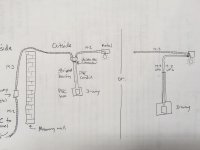
D6443DEA-AA9C-4750-B8B0-7FFBBD1FEDE1.jpg
 

alfredeneuman

Well-known member
Joined
Mar 3, 2011
Messages
4,581
Location
Fullerton, CA
I chose MC because it is better protected against the likely dangers when drilling and fishing through unseen areas in a 90 year old house.

Why would you think that, and why would the age of the house matter?
EDIT: I was replying to TRWham when I made the previous comment on the plastic
 
Last edited:
To avoid these ads, REGISTER NOW!

mm08822

Well-known member
Joined
Jan 13, 2012
Messages
5,965
Location
NJ
In this case, I interpret the code is using the term generically (referring to "metal-armored" (lower case) cable and not AC specifically), but I agree it could be interpreted differently. As long as there is a continuous ground path and each metal component is bonded, why would it not work? That MC has a separate ground conductor makes it even easier.

Because plastic is non-conductive, and the armor must be grounded. :thumbup:

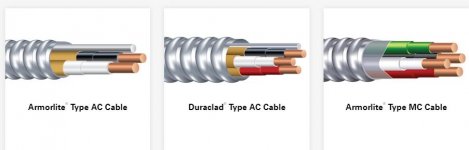
That's the problem....the mc cable jacket used between two plastic boxes would be left ungrounded. Ac has a bare conductor in coontact with the armor and mc has an insulated grd.

AC_vs_MC_construction.JPG
 

TRWham

Well-known member
Joined
Aug 11, 2017
Messages
1,961
Location
East Cobb County, Georgia
And I suspect much of what is written on forums may not distinguish between "between plastic boxes" and "to a plastic box."

I understood that you were running MC from the panel to a plastic box, then transitioning to UF and/or PVC conduit. There would only be one run of MC that is bonded at the panel and no need for further bonding as there is no more metal.
 
OP
A

AntonLargiader

Well-known member
Joined
Nov 20, 2016
Messages
1,372
Location
Charlottesville, VA
I understood that you were running MC from the panel to a plastic box, then transitioning to UF and/or PVC conduit. There would only be one run of MC that is bonded at the panel and no need for further bonding as there is no more metal.

Sorry the side of my diagram got cut off, but it's either:

1) MC to metal box and UF to plastic box, or
2) MC to plastic and bonding to another MC via a double connector.

I think I have my answer. Reading the responses here, option 2 may be OK but its legality is unclear or confusing to people who work with this stuff all day. No reason to go there.
 

TRWham

Well-known member
Joined
Aug 11, 2017
Messages
1,961
Location
East Cobb County, Georgia
Sorry the side of my diagram got cut off, but it's either:

1) MC to metal box and UF to plastic box, or
2) MC to plastic and bonding to another MC via a double connector.

I think I have my answer. Reading the responses here, option 2 may be OK but its legality is unclear or confusing to people who work with this stuff all day. No reason to go there.

I had not seen the diagrams when I first responded so I was interpreting the original description. Option 1 seems clearly permitted and perfectly safe. Metal conduit to metal box, all bonded, then transition to UF and run to the plastic box.

I have seen option 2 described elsewhere as a work around but 1 seems more straightforward.
 

TRWham

Well-known member
Joined
Aug 11, 2017
Messages
1,961
Location
East Cobb County, Georgia
Looking at your diagram again, I am prompted to ask why you need 5 wires at the switch? Which wires are already run? Is it still possible to run power straight to the light and 3 wires to each switch?
 
OP
A

AntonLargiader

Well-known member
Joined
Nov 20, 2016
Messages
1,372
Location
Charlottesville, VA
Looking at your diagram again, I am prompted to ask why you need 5 wires at the switch? Which wires are already run? Is it still possible to run power straight to the light and 3 wires to each switch?

Three to carry the travelers and their neutral current, and two for the fixture. Keeps the neutrals with their associated conductors. Merely running three wires for a switch loop does not provide a neutral, which is required now.
 
OP
A

AntonLargiader

Well-known member
Joined
Nov 20, 2016
Messages
1,372
Location
Charlottesville, VA
In this case, I interpret the code is using the term generically (referring to "metal-armored" (lower case) cable and not AC specifically), but I agree it could be interpreted differently.

Looks like you're probably right. I found this quote here: "For the purposes of this exception, the term metal-armored cable includes cables with a metal covering such as mineral-insulated, metal-sheathed cable (Type MI), metal-clad cable (Type MC), and armored cable (Type AC)."
 

mm08822

Well-known member
Joined
Jan 13, 2012
Messages
5,965
Location
NJ
Looks like you're probably right. I found this quote here: "For the purposes of this exception, the term metal-armored cable includes cables with a metal covering such as mineral-insulated, metal-sheathed cable (Type MI), metal-clad cable (Type MC), and armored cable (Type AC)."

You should go back and read the sentance before the one you take out of context. You'll find your plastic box alone doesnt meet the requirement.

Look at the pic i posted of the difference between ac and mc cable. Without special provisions within the plastic box, mc fails. (The sentance b4 the 1 u quoted.)
 
OP
A

AntonLargiader

Well-known member
Joined
Nov 20, 2016
Messages
1,372
Location
Charlottesville, VA
Not sure what you're getting at. There are two exceptions to 314.3 and both have the explanatory wording I cited that supports TRWam's opinion that MC cable was included in the exception. That's all. I was replying to his post saying he thought MC was included but he could be wrong.

Whether or not either of the exceptions apply to my situation is different, but it doesn't matter at this point.

You should go back and read the sentance before the one you take out of context. You'll find your plastic box alone doesnt meet the requirement.

Look at the pic i posted of the difference between ac and mc cable. Without special provisions within the plastic box, mc fails. (The sentance b4 the 1 u quoted.)
 
OP
A

AntonLargiader

Well-known member
Joined
Nov 20, 2016
Messages
1,372
Location
Charlottesville, VA
Done and working. The only hitch I ran into is that the waterproof Taymac enclosure (at the other end of that UF-b) was designed to use a switch with a metal frame, and the plastic frame of the Wemo switch is thicker and therefore makes the cover gap away from the box. I’ll get some thicker gasket for that.

244E1967-6501-4E82-863B-8D4E4FCED8FB.jpg
 
To avoid these ads, REGISTER NOW!
Top Bottom