To avoid these ads, REGISTER NOW!

Old electric motor questions

white91formula

Well-known member
Joined
Dec 11, 2012
Messages
424
Location
Boston, MA
Hi All.

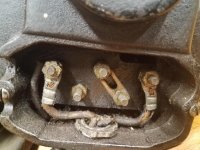
i have this old Westinghouse single phase motor I inherited from a friend along with a old South Bend lathe. I got the jumpers switched over to 110v and put power to it. It spins very quietly and smoothly.

I want to get it wired up to a reversing drum switch. Sounds easy enough, until i open it.

What are peoples thoughts on this ?

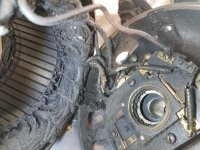
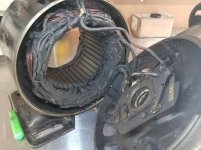
Inside of motor is really nasty. The wiring insulation on the leads are totally deteriorated and the colors are not distinguishable.

How can I wire this to a reversing switch, do i need to take the terminal block out ? How can i go about replacing the wire leads ?

Does anyone have a wiring diagram ? I could not find much info online searching for the motor.
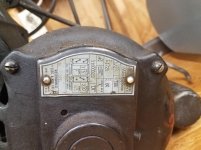
 

Attachments

  • 20191015_184252.jpg
    20191015_184252.jpg
    147.5 KB · Views: 93
  • 20191015_184302.jpg
    20191015_184302.jpg
    152.6 KB · Views: 84
  • 20191018_125023.jpg
    20191018_125023.jpg
    156 KB · Views: 98
  • 20191018_124847.jpg
    20191018_124847.jpg
    151 KB · Views: 87
To avoid these ads, REGISTER NOW!

walta

Well-known member
Joined
Jan 13, 2017
Messages
2,312
Location
Dutzow Missouri
You need to find the yellow and red wires and swap them to change the rotation.

My guess is if you look close the yellow arrow in this photo is pointing at a wire the was yellow about 70 years ago and the red arrows wire was red at one time.

Walta
 

Attachments

  • a0191015_184302.jpg
    a0191015_184302.jpg
    14.2 KB · Views: 54

lilredex

Well-known member
Joined
Apr 29, 2006
Messages
5,956
Location
Toronto
First thing needed is to blow out that dust. In picture #3 the top wire looks like one end of the start winding. If you can find the other end and reverse those leads it will reverse it.
 

pancho400cid

Well-known member
Joined
Sep 26, 2014
Messages
4,521
Location
Austin, TX
I don't know about reversing drums so I'm no help there.

Where the power leads pass through the frame, the insulation looks to be gone. Miracle it didn't short when you put power on it. Any insulation that is degraded like that needs to be fixed.

Also looks like it was over-greased. Pumping too much grease into the bearings forces it past the inner seals and into the motor.

Cleaning it can be tricky and it is easy to blow/wash conductive dust/goo into crevices where it does more harm than good literally.
 
To avoid these ads, REGISTER NOW!

floridafarmer

Well-known member
Joined
Nov 27, 2010
Messages
233
Location
Central Florida
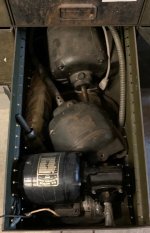
I'm not much help on the wiring but the post makes me wonder if there is any demand/interest for these old motors - I have a couple of bins of them that I picked up years ago - they are just cool to look at. Do people use them when the recondition old equipment?
 

Attachments

  • IMG_7830.jpg
    IMG_7830.jpg
    74.2 KB · Views: 24

lilredex

Well-known member
Joined
Apr 29, 2006
Messages
5,956
Location
Toronto
Dust them off and advertise them F/S.

Around here they would bring $10 to $75 each if you have the time. Especially, the one with the attached reducing gear box, might be suitable for a band saw speed reducing project or mixer, or powered beader, etc.
 

MBfreak

MEMBER EMERITUS
Joined
Dec 10, 2010
Messages
2,301
Location
Linkoping , Sweden
White 91 formula.
I believe that with a few hours work you can restore the electric motor.
The black stuff covering one end of the winding seems to me to be grease and dust. I do not see any burn marks from overheating, which also usually leaves a very obvious burnt varnish smell.
It requires basic soldering skills, an ohmmeter, patience and some handicraft. Ie, perfect for a GJer.
Start by measuring the resistance between each wire and between each wire and ground. If you have high readings ( ie > 100 kiloOhm) between each wire and ground, it is worth continuing.
Wipe off as much gunk as you can and then make a simple sketch of the wiring ends and the centrifugal switch.
Then remove the wires from the terminal board and switch so you get the stator alone. Use a citric based diluted cleaning liquid, 75 C warm, and spray on and brush off with a soft bristle brush.
Then dunk the entire assembly in very hot water and blow off. Let sit for >24 h in a warm place so all water evaporates.
Since the leads out are soldered to the copper wiring, you need to remove the strings that secure the winding ends, outleads and slip over insulation.
Cut open the string and remove. You can now take one outlead at a time , pull off the slip over insulation , desolder the rotten wire and solder in new outleads. Get tthe best quality wire you can rated at > 500 V. Use double shrink tubing over each solderd conn.. When done, dress the ougoers as best as you can and tie up the winding ends and the joints / outgoers as close to original as you can.
Clean out all other parts, restore the centrifugal switch and reassemble/reconnect.
You now have a high quality US made motor that will last several lifetimes for hobby work.

Ola
 

Boilerhouse

Well-known member
Joined
Mar 20, 2012
Messages
1,320
Location
Muskoka
I'm not much help on the wiring but the post makes me wonder if there is any demand/interest for these old motors - I have a couple of bins of them that I picked up years ago - they are just cool to look at. Do people use them when the recondition old equipment?

I recently picked up an older drill press which had an ancient Repulsion Induction 1/2 HP motor on it. The motor, originally built for 30 cy, then rewired 70+ years ago as 60 cy, was very large and heavy for it's HP and unfortunately, did not work. Sniffing around YouTube, I was somewhat surprised that there are demand for motors like these from collectors who will restore them, then place them on a shelf with the rest of their collection.
 
To avoid these ads, REGISTER NOW!
Top Bottom