SGKent
Banned
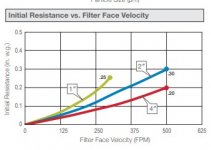
Without going online to research it, which I have already done, does anyone have a formula for determining optimal filter size for a given CFM using the higher MERV filters? Example - a 1000 CFM air handler requires X filter area when a higher MERV filter is used. A 1250 CFM air handler requires Y filter area when a higher MERV filter is used.
I don't have the ability, time and money to build a series of returns and stick different filters on them to see when the pressure falls to acceptable levels. In this case acceptable would be .15" wc or less. I'd like to get below .10" wc if possible.
The split system runs between 1000 to 1200 CFM depending on where I set the motor, and currently has two filters for a total of 678 sq inches or 4.7 sq ft. That works perfect with a MERV 1 fiberglass filter however when a pleated high MERV filter with the lowest resistance available is used, the pressure drop rises above the design limit. I need a formula for calculating optimal filter area when a higher MERV filter is used. The local HVAC folks can only guess.
So far the best formula I can find online is to use is, "Filter Area = 2.0 square feet (or more) for each 400 cfm of air flow." So 1000 \ 400 = 2.5 tons X 2.0 = 5.0 sq ft minimum at 1000 CFM or 1200 \ 400 = 3 tons x 2.0 = 6.0 sq ft minimum. I don't want to have a new return built, cut the wall to install it and find out that formula falls short. On the other hand I don't want to guess large and make a whole wall a return grille either. Someone else in the same article the 2.0 X ton number came from uses 3.0 X ton, which changes the numbers to 7.5 sq ft and 9 sq ft. Somewhere out there is a formula that can be relied on.
Also - does anyone know - if you have a filter that is say .28" wc at 1040 CFM and you parallel it with an identical filter, does the pressure drop to .14" wc because the surface area is double? That is how electrical resistance works but I don't know about air pressure resistance.
I don't have the ability, time and money to build a series of returns and stick different filters on them to see when the pressure falls to acceptable levels. In this case acceptable would be .15" wc or less. I'd like to get below .10" wc if possible.
The split system runs between 1000 to 1200 CFM depending on where I set the motor, and currently has two filters for a total of 678 sq inches or 4.7 sq ft. That works perfect with a MERV 1 fiberglass filter however when a pleated high MERV filter with the lowest resistance available is used, the pressure drop rises above the design limit. I need a formula for calculating optimal filter area when a higher MERV filter is used. The local HVAC folks can only guess.
So far the best formula I can find online is to use is, "Filter Area = 2.0 square feet (or more) for each 400 cfm of air flow." So 1000 \ 400 = 2.5 tons X 2.0 = 5.0 sq ft minimum at 1000 CFM or 1200 \ 400 = 3 tons x 2.0 = 6.0 sq ft minimum. I don't want to have a new return built, cut the wall to install it and find out that formula falls short. On the other hand I don't want to guess large and make a whole wall a return grille either. Someone else in the same article the 2.0 X ton number came from uses 3.0 X ton, which changes the numbers to 7.5 sq ft and 9 sq ft. Somewhere out there is a formula that can be relied on.
Also - does anyone know - if you have a filter that is say .28" wc at 1040 CFM and you parallel it with an identical filter, does the pressure drop to .14" wc because the surface area is double? That is how electrical resistance works but I don't know about air pressure resistance.