To avoid these ads, REGISTER NOW!

New Compressor - setting it up

ckucia

Well-known member
Joined
Sep 23, 2008
Messages
370
Location
West Virginia
Finally managed to justify a new compressor. Got the 80 gallon 5hp IR that Tractor Supply carries.

It was a sudden decision (it's my Christmas present) and since the colder weather has set in I'm probably not going to set it up completely right away.

Looking for suggestions on things I might want to do with it before the first run or things you wish you would have done differently with yours after it was set up.

Would it be worth coating the inside with something (gas tank sealant or similar?) prior to running it for the first time, to prevent rust?

If this were a HF compressor, I'd be disassembling the pump completely, and then reassembling after checking everything. Is IR a good enough company I can skip that? I bought the 1 year extended warranty so I'm covered but beyond that I'll be on my own. Plus, some of the warranty is "bring it back to TSC" which, frankly, ain't happening after what I went through to get it home, but that's a story for another day...

I've wanted a compressor like this for 30 years but our old houses never had the power in the garage to support it, and the cost was a hurdle. Yeah, I'd like a Quincy, but chances are this is the best compressor I'll ever own. I'd like to be sure it lasts the rest of my life without any issues.
 
To avoid these ads, REGISTER NOW!

bob15

Well-known member
Joined
Dec 8, 2011
Messages
6,863
Location
Northeasten, CT
I find it overkill (even for a HF) to take the brand new compressor pump apart and put back together. If you buy a new car/truck, do you take the engine apart when you bring it home? What do you plan on finding wrong inside the pump? Plan on taking and pulling the electric motor apart as well?

BTW: you take the compressor apart (even a HF) and you just voided the warranty.

Just wire it up, put in compressor oil in it (IR All Season is fine) and use it.
 
OP
C

ckucia

Well-known member
Joined
Sep 23, 2008
Messages
370
Location
West Virginia
Already have more questions...

The outlet is 3/4, but there's a bushing and a 1/2 valve. I'm guessing using a 3/4 valve would be better along with using 3/4 for all the lines. But the 3/4 thread is in a (2in") bushing, so I could presumably replace that and go with something larger. But then it seems like it would make sense to have all the pipe larger. Is there a point of diminishing returns here? Does 1" make sense or is it overkill?

Should I regulate at the compressor or regulate at the use points? How about water separation - central or at the ends?

I know there used to be a lot of discussion between black iron, copper, pvc, etc. I used to be in the black iron or copper camp, but it's been years since I've researched. Are there better alternatives now, or are those still the two best methods for running air piping?
 
OP
C

ckucia

Well-known member
Joined
Sep 23, 2008
Messages
370
Location
West Virginia
I find it overkill (even for a HF) to take the brand new compressor pump apart and put back together. If you buy a new car/truck, do you take the engine apart when you bring it home? What do you plan on finding wrong inside the pump? Plan on taking and pulling the electric motor apart as well?

BTW: you take the compressor apart (even a HF) and you just voided the warranty.

Just wire it up, put in compressor oil in it (IR All Season is fine) and use it.

Actually, if I had known about the casting flash issues in Chrysler 2.7s, yes, I would have taken the new engine apart rather than waiting for it to grenade after the warranty was expired if it were a car I wanted to keep for the rest of my life. I'm admittedly weird that way.

I'd be looking for the typical issues with chinese sourced items - loose/missing fasteners, casting flash, ill-fitting parts. I understand IR runs their pumps on the line before they get shipped, which makes me feel better. I don't think the issues are present in all China-sourced items, and decent QC would catch most of them. HF doesn't have the greatest track record for decent QC, but I was hoping IR still does even when they source out of China.

However, I'm in the woods over an hour from any metro areas. It's up to me to keep the thing running, warranty or not. If I threw away $100 on the warranty by taking it apart but it ensures that it won't break on me two+ years from now when the warranty is expired, then that's OK with me. I guess I'm asking for the experiences of recent purchasers of IR compressors sold retail and used heavily in a residential setting for guidance...
 

Lucid Moments

Well-known member
Joined
Aug 9, 2015
Messages
1,775
Location
Gainesville, Ga
There is no downside to larger piping except for cost, but there is little benefit either. I assume you are eventually go to some sort of flexible hose at some point so if your hard line can flow more than your flexible line then there is no benefit to going larger. Unless you are going to have multiple users anyway.

Look into Rapid Air products as an alternative to black iron or copper. It goes up quick and fast. Not perfect, but what is.
 

jkuro

Well-known member
Joined
Apr 28, 2009
Messages
552
Put in a nice 1/4 turn ball valve and piping to periodically drain off the water. Also a good regulator and water filter.
 

MFolks

Well-known member
Joined
Feb 3, 2013
Messages
1,045
Location
Springfield Mo.
Unless U.S. made,all black iron pipe may leak at the joints,unless you want to run a tap and die over all the threaded areas. Had a friend use Chinese made pipe,ran a gas line for a furnace in a new house,had to disassemble the pipes and clean up the joint with taps and dies,after numerous leaks,once that was done,no problems.
 

sweetk30

Well-known member
Joined
Jan 2, 2011
Messages
2,306
Location
finger lakes area upstate ,ny
Put in a nice 1/4 turn ball valve and piping to periodically drain off the water. Also a good regulator and water filter.


x2 on the bottom drain valve swap out .

i do a 90* street L then length of 1/4" to a ball valve and then a pipe to bar fitting . last a length of 3/8" hose to let me drain it in a 5 gal bucket and NOT all over the floor .

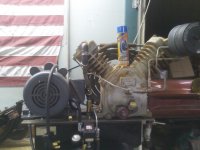
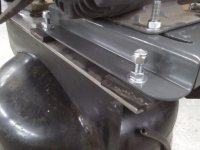
only mod i would do to a brand new unit is rubber pads between the tank plate and the pump and motor . another member showed me this on here when i built my 2 IR units from parts . WOW they are so much more quiet with rubber isolating the parts from the BELL of a tank that magnifies the harmonic sounds . then rubber pads under the tank feet to floor . also good QUALITY flex hose from tank to plumbing thats bolted to shop walls is needed to isolate flex and movement .

i scored some old conveyor belting from a gravel pit mine for my rubber . and then 2 adjustable motor plates to make belt adjustment a breeze and also give me the rubber isolation to the tank and be able to adjust the motor later .

that hydro hose was for testing . its been replaced with a custom made correct hose like the big one has .

big one = 2545 pump / 5hp / 19cfm@175psi . pump was a 10hp unit but can be 5/7.5/10hp i used a 5hp i got a smoking deal on .
little one = 234 pump / 5hp / 9cfm@175psi . was a 1.5hp or 3hp factory i had the 5hp laying around .
 

Attachments

  • 0813161848d.jpg
    0813161848d.jpg
    99.7 KB · Views: 118
  • 0813161849a.jpg
    0813161849a.jpg
    89.7 KB · Views: 111
  • 0819161314a.jpg
    0819161314a.jpg
    111.4 KB · Views: 113
  • 0812162120b.jpg
    0812162120b.jpg
    130.6 KB · Views: 109
Last edited:

Dh3256

Well-known member
Joined
Mar 19, 2018
Messages
1,145
I assume you are eventually go to some sort of flexible hose at some point so if your hard line can flow more than your flexible line then there is no benefit to going larger.

One benefit of larger diameter line is that it increases storage capacity, so it effectively increases the size of the tank. Probably more of an issue and help for a compressor with a smaller tank though.
 

mike93lx

ALLIANCE MEMBER
Joined
Dec 9, 2013
Messages
37,944
Location
Richmond, VA
Tearing apart a new compressor or adding **** to the inside of your tank (which will just end up in your air) is crazy.

Drain it regularly, change the oil at the recommended interval and work on real projects
 

matt_i

Well-known member
Joined
Mar 14, 2008
Messages
10,752
Location
SE Michigan
I wouldn't mess with the compressor. I would use the synthetic oil that IR "makes" (rebrands) for their compressor. I think its the All Season mentioned above. They used to double the compressor unit warranty to 2 years if you used that oil some years back.

The things to do with it would be to find a suitable location to deal with all of the noise, figure out your wiring, and whether you want bells and whistles like an inhibit-switch (to disable it when you're not there).

I set my pressure switch down to 130psi from 175psi. Don't need all of that pressure for anything that I do. It takes 1 nut driver and a few minutes of playing around.
 
OP
C

ckucia

Well-known member
Joined
Sep 23, 2008
Messages
370
Location
West Virginia
Thanks guys.

I like that rubber under the pump idea. Noticed the tank rings like a bell already.

I have an out of town funeral to go to this week so nothing's going to happen until after the holiday. First step is making a place for it, second is wiring. Then I'll probably hook up a drain and discharge fitting so I can at least fire it up and hook up a hose. Anything further will likely wait until spring.

I was kinda inclined to use copper for the air lines throughout the garage even though it's pricey, because it's humid here in WV (so humid my tools rust in the garage). Thought the copper would cool the air and help get the humidity out.

But the IR manual states "Do not use plastic pipe, soldered copper fittings, rubber hose, or lead-tin soldered joints anywhere in the compressed air system."

Unless I'm missing something, that seems to imply that iron pipe is the only commonly available acceptable material for IR. Unless shark bites are OK for copper?

I had no intention of using PVC, but it also additionally says "DO NOT USE PVC PLASTIC IN THE COMPRESSED AIR DISCHARGE LINE" (in all caps).

Another interesting blurb and something I hadn't really though about, although it's probably not a problem, is it states "If you will be using synthetic compressor lubricant, all downstream piping material and system components must be compatible". I mention that because, if the oil gets out of the pump into the piping, then it seems it ought to get into the tank. If so, then why is it that tanks rust? Shouldn't the oil protect them?
 
To avoid these ads, REGISTER NOW!
OP
C

ckucia

Well-known member
Joined
Sep 23, 2008
Messages
370
Location
West Virginia
I used copper, silver soldered... in my shop.

Any idea why IR doesn't like it? I can see maybe not liking lead/tin but they seem to rule out any soldered joints.

I guess brazing the copper is an option. I've done a little brazing but I'd be an expert by the time I finished running air lines in the shop if every joint had to be brazed.
 

sberry

Banned
Joined
Jun 18, 2005
Messages
35,747
Location
Brethren, Michigan
You don't always have to pipe to every corner, a section or 2 may be enough to the locations for a reel or whip. There should be a stick for first timers with a comp,m **** you don't have to do everything you have ever read or heard and a lot of it doesn't work all that well for a couple reasons, one being this aint a GM plant and you are not a truck tire center. The 1/2 valve and pipe is fine in a common garage, way easier to get leaks stopped and so many less fittings to deal with. While a 1/2 hyd hose has some smaller fittings internal they are short, you eventually go thru smaller ones on the secondary, its moot especially when they are on the hi side of the regulator.
One of the most important things is whether this is in a heated garage? This makes a difference for the drain. The factory is designed to be in freezing weather, often for months. Some old horizontals had a hose in the tank as a sump, I like plumbing out thru the wall, when I read a boogered auto drain thread I walk over and crack them open.
It can run years on an oil change, blocking the sound is a good thing. Invest in reel, find a fil/reg to put ahead of it. In a normal garage the ball valve at the tank can be the disconnect. On large manifold systems with lots of stuff I add a local valve ahead of the filter on the hard line.
Resist the urge to adjust every knob, leave it set like it was at the factory, its the reason you got the unit you did. I like it pumped 24/7, use a ball valve if there are leaks downstream, that is the only reason it will run unless you use it, ok if leaving for long time, shut it off.
 
Last edited:

MattT

Well-known member
Joined
Feb 20, 2010
Messages
3,201
The outlet is 3/4, but there's a bushing and a 1/2 valve. I'm guessing using a 3/4 valve would be better along with using 3/4 for all the lines. But the 3/4 thread is in a (2in") bushing, so I could presumably replace that and go with something larger. But then it seems like it would make sense to have all the pipe larger. Is there a point of diminishing returns here? Does 1" make sense or is it overkill?

Size your pipe to deliver the flow you need at the points of use. All depends on the length & complexity of the pipe run and the running CFM demands of your tools.

But the IR manual states "Do not use plastic pipe, soldered copper fittings, rubber hose, or lead-tin soldered joints anywhere in the compressed air system."

That looks like a CYA written by over cautious lawyers. I'll agree with the lead-tin solder but everything else is "Do not use some.........".

And if you ain't supposed to use rubber hose in compressed air systems why do they sell it:headscrat:confused:

https://www.ingersollrandproducts.c.../premium-rubber-hose/premium-rubber-hose.html
 

Stuart in MN

Well-known member
Joined
Sep 8, 2005
Messages
23,185
Location
Minneapolis
Thanks guys.

I was kinda inclined to use copper for the air lines throughout the garage even though it's pricey, because it's humid here in WV (so humid my tools rust in the garage). Thought the copper would cool the air and help get the humidity out.

But the IR manual states "Do not use plastic pipe, soldered copper fittings, rubber hose, or lead-tin soldered joints anywhere in the compressed air system."

Unless I'm missing something, that seems to imply that iron pipe is the only commonly available acceptable material for IR. Unless shark bites are OK for copper?

Strictly speaking, if you dig into the regulations and requirements deep enough I think you'll find that copper pipe is supposed to be silver soldered for air lines, and lead-tin solder joints aren't supposed to be used (although many people do.)
 

greg13

Well-known member
Joined
Aug 2, 2018
Messages
497
Location
Weedsport, NY
I guess I would have to ask just how hard are you planning on running the compressor over the next two years?
I just bought an 80 gal. compressor from 1948 that still runs fine, a little slow but holds air with no problems.
 

Shadowdog500

Well-known member
Joined
Dec 7, 2009
Messages
9,881
Location
Down the shore
Last edited:

BD1

Well-known member
Joined
Mar 18, 2007
Messages
4,602
Location
north side
IF you want clean copper air lines, go with Propress Fittings. Buy copper and fittings from supplier and they'll rent or give you the tool to use. No soldering or inside residue, just a tight crimped joint.


Sent from my iPhone using Tapatalk
 
OP
C

ckucia

Well-known member
Joined
Sep 23, 2008
Messages
370
Location
West Virginia
Thanks for all the advice.

Been out of town for a funeral. I have some projects to work on - compressor is on the list but not I priority. I hope to get it at least partially hooked up over the next three days.
 
To avoid these ads, REGISTER NOW!
Top Bottom