To avoid these ads, REGISTER NOW!

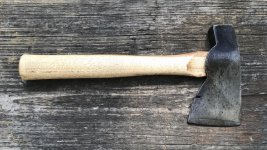
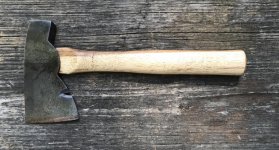
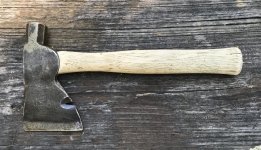
Dug up old hatchet/hammer head

yardiron

Well-known member
Joined
Oct 9, 2014
Messages
209
Location
NJ
I figured I'd post this here.
Last fall a buddy had a huge old oak tree fall over in a storm. Being its was a huge tree for this area, and deep in his woods behind his farm, I wanted the wood. The base of the tree was roughly 39" across.

While cutting the tree clear of the root ball, I ran a metal detector over the areas where I was going to cut, and also around the roots and in the hole just out of curiosity. I found a rusty clump of dark brown dirt that was obviously iron. I've also found quite a few old horse shoes in the same area, they turn up all over the place both in the woods and in the fields.

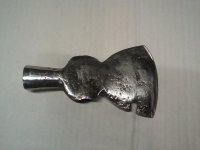
I tossed all the bits in a bucket and forgot about them till the other day. I decided to see what the rusty clump was so I started picking at it till i realized it was a hatchet/hammer head. With no other real choice, I dropped it in a can of Evaporust for a few days.

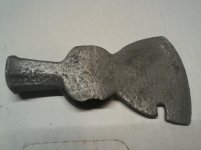
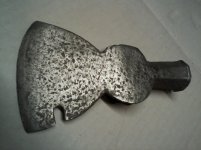
After a good scrubbing I can see the thing is forged and the hole is parted with something sharp, the angle isn't perfect, its slightly canted to the left.
I see no markings, but a lot of surface metal has been rusted away over the years.
I am curious as to how old it may be.
The farm there now was built in the late 40's, the original home on the property, was from said to be from the turn of the last century, 1902 or so.
I have no history as to what the old foundation in the woods is, nor what was there before. This was found far back in the woods even beyond where the original house sat.

My guess is its just an old carpenters hatchet but I'm curious as to how old it could be since it was beneath the outer root ball of such an old tree.
 

Attachments

  • 0112200034-01.jpg
    0112200034-01.jpg
    77.5 KB · Views: 189
  • 0112200035-04.jpg
    0112200035-04.jpg
    105.8 KB · Views: 182
  • 0112200035-01.jpg
    0112200035-01.jpg
    105.2 KB · Views: 171
To avoid these ads, REGISTER NOW!

lardy1

Well-known member
Joined
Mar 17, 2019
Messages
3,409
Location
Michigan
That's an incredible find. I have no idea how it could be identified/dated, but if you do, please post whatever you may find.
 

steaks&anvils

Well-known member
Joined
Oct 15, 2016
Messages
2,470
Location
Colorado
I'm curious as to how old it could be since it was beneath the outer root ball of such an old tree.

Maybe if you count the tree rings you can get a "rough" estimate of the age? guesstimate how long it may have taken for the roots to grow out over the hatchet?

Also, if a object is lost in the woods, how long might it take for it the be buried by yearly Forrest? to be far enough under the surface to be below the roots?

The local historic society probably has an archaeologist who can get you a few answers (type of hatchet, years made, when the area was settled, previous use of the area?

-jeff
 

Sevenhills1952

Well-known member
Joined
Aug 30, 2018
Messages
1,750
Location
Virginia
Maybe this is it?
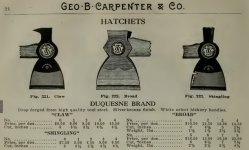
"shingling hatchet except this was probably also used to cut shake shingles. A standard shingling hatchet has a much smaller cutting edge. The mushroom is from hitting it with a hand sledge hammer to cut shakes."3c382f1f7b085ffe74fe493946472a35.jpg

Sent from my SM-S320VL using Tapatalk
 

Attachments

  • 3c382f1f7b085ffe74fe493946472a35.jpg
    3c382f1f7b085ffe74fe493946472a35.jpg
    17.1 KB · Views: 2

d42jeep

Well-known member
Joined
Oct 22, 2014
Messages
16,581
Location
Northern California
During WW2, these were referred to as “Half Hatchets”. Maybe yours is an earlier version.
-Don
 

Attachments

  • 36CC9BE5-F290-4BB4-9959-2CF0B31AEE1B.jpg
    36CC9BE5-F290-4BB4-9959-2CF0B31AEE1B.jpg
    114.2 KB · Views: 59
  • A1280097-9E1E-4BC0-9E2F-F3B8BE2544B8.jpg
    A1280097-9E1E-4BC0-9E2F-F3B8BE2544B8.jpg
    150.4 KB · Views: 78
OP
Y

yardiron

Well-known member
Joined
Oct 9, 2014
Messages
209
Location
NJ
Maybe this is it?
"shingling hatchet except this was probably also used to cut shake shingles. A standard shingling hatchet has a much smaller cutting edge. The mushroom is from hitting it with a hand sledge hammer to cut shakes."3c382f1f7b085ffe74fe493946472a35.jpg

Sent from my SM-S320VL using Tapatalk

That sure looks like it.

The tree had about 160 very narrow rings, but I didn't really take an exact count. 39" was what it measured where I cut the trunk away, it got wider at the very base and narrowed a bit just above that point. I didn't take the very bottom because it set off my metal detector in that area.

I sort of figured maybe someone stuck the hatchet in the tree, or broke it throwing it and left it there years ago. It was in the hole left by the uprooted root ball, deep enough I had to climb down in the hole to get at it.
Its odd that something that's likely not all that old was beneath a tree that old, but it may well have been tossed at the tree and broken or lost when the tree was far smaller and somehow got into the ground there?

Which direction should the notch be in if I make a handle for this thing?
What was the notch used for?

When they say 'shingle hammer' do they mean shakes or asphalt shingles?
If its for asphalt roofing, then its from the 20th century, and I'd venture to guess the slot is for pulling nails.

Age wise, the part that gets me is that it appears to have been hand forged. I can see where the handle hole was parted with something sharp and I can see that the cutting edge is sort of 'folded' over onto itself in layers. I would think that a hammer or hatchet made after maybe the 1930's or so would likely be made factory forged not hand hammered and parted over an anvil.
 

Attachments

  • 3c382f1f7b085ffe74fe493946472a35.jpg
    3c382f1f7b085ffe74fe493946472a35.jpg
    14.7 KB · Views: 2

d42jeep

Well-known member
Joined
Oct 22, 2014
Messages
16,581
Location
Northern California
The notch is for pulling nails and on all of the WW2 examples I’ve seen, the notch goes toward the handle. I had to put some new handles on mine. I think that yours is much earlier than all of mine.
-Don
 

Attachments

  • 3F69E63E-0085-4077-AC0A-A823B8ECDE28.jpg
    3F69E63E-0085-4077-AC0A-A823B8ECDE28.jpg
    152.4 KB · Views: 41
  • A47064F0-C320-4ED6-B9EE-F0CAD7EF94E8.jpg
    A47064F0-C320-4ED6-B9EE-F0CAD7EF94E8.jpg
    150.3 KB · Views: 40
  • F03E2507-F912-493A-A539-160500F40C0C.jpg
    F03E2507-F912-493A-A539-160500F40C0C.jpg
    154.3 KB · Views: 42
  • 76517E6E-B4F6-49AB-97D4-0A0CE04B4401.jpg
    76517E6E-B4F6-49AB-97D4-0A0CE04B4401.jpg
    152.7 KB · Views: 45
Last edited:

four.cycle

Well-known member
Joined
Oct 19, 2015
Messages
29,138
Location
Tacoma, Washington
Last edited:
OP
Y

yardiron

Well-known member
Joined
Oct 9, 2014
Messages
209
Location
NJ
I wasn't thinking of cedar shingles as siding, you may be right.
When 'shingles' were mentioned I automatically thought roofing shingles.

Where it was makes more sense now, even the house there now has cedar shake siding, although its the grooved or contoured type.
There is a lot of cedar in the area too, likely do to the proximity to the old creek bed.
I've taken quite a few cedars from that area myself for transplant at my house, cedar trees drink up a lot of water and did wonders for a minor flooding issue I had there.

Am I right to assume this should have a straight hammer type handle?
 

akasrick

Well-known member
Joined
Apr 10, 2017
Messages
795
Location
south jersey
My guess is its just an old carpenters hatchet but I'm curious as to how old it could be since it was beneath the outer root ball of such an old tree.

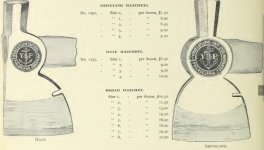
Not saying this is it. 1886 Prentiss catalog.
attachment.php

attachment.php

attachment.php

akasrick
 

Attachments

  • 1896axehead.jpg
    1896axehead.jpg
    43.5 KB · Views: 446
  • yerkesPlumb.jpg
    yerkesPlumb.jpg
    78.7 KB · Views: 439
  • cutinches.jpg
    cutinches.jpg
    67.4 KB · Views: 436
Last edited:

Downwindtracker 2

Well-known member
Joined
Jun 13, 2019
Messages
1,715
Location
BC
I had a Plumb I bought in the '70s , I used it in heavy timber work. The ax part was handy in adjusting fits.
 

larry_g

Well-known member
Joined
Apr 28, 2007
Messages
16,893
Location
oregon
Some kids could have found the hatchet in Grandpa's shed and decided to build a fort, cut down the tree, dig a foxhole. The tool could be any age but been in the ground only a decade or three. I know a few of my dads tools are lost and buried various places about the farm.

lg
no neat sig line
 
Last edited:

outofbounds

Well-known member
Joined
Oct 23, 2019
Messages
1,393
Location
Michigan
Just my two cents, and I am by no means an expert, but that sort of looks hand forged to me. I would presume the basic elements of the design date back a few hundred years. Guessing 19th century?
 

SeisMec

Well-known member
Joined
Aug 24, 2018
Messages
406
Location
Beryl, Utah
It was in the hole left by the uprooted root ball, deep enough I had to climb down in the hole to get at it.
Its odd that something that's likely not all that old was beneath a tree that old

...

Age wise, the part that gets me is that it appears to have been hand forged. I can see where the handle hole was parted with something sharp and I can see that the cutting edge is sort of 'folded' over onto itself in layers. I would think that a hammer or hatchet made after maybe the 1930's or so would likely be made factory forged not hand hammered and parted over an anvil.

Agree it's almost certainly older than 1930's.

If it were buried near the edge of the root ball just a few inches deep, wouldn't it have fallen to the bottom of the hole when the root ball was uprooted?

Don't discount the possibility that it might already have been grandpa's old, hand-me-down hatchet when it was lost/buried. Original purchase from blacksmith might be in a completely different state and grandpa, dad or last owner brought it with them.

Just curious - if you don't mind - if continental US were divided by tic-tac-toe grid - where did you find it?
 

leg17

Well-known member
Joined
Aug 11, 2011
Messages
1,374
Location
Kentucky
Just my two cents, and I am by no means an expert, but that sort of looks hand forged to me. I would presume the basic elements of the design date back a few hundred years. Guessing 19th century?

Hard to say.
Some ax companies hand forged into the 20th century, but drop forging using dies has been around for a long time.
 

Downwindtracker 2

Well-known member
Joined
Jun 13, 2019
Messages
1,715
Location
BC
I bought a Plumb?? hand axe at the fleamarket. It had red epoxy so that's why I thought it might be a Plumb . It was hammer welded. A high carbon bit with a softer steel eye.
 
OP
Y

yardiron

Well-known member
Joined
Oct 9, 2014
Messages
209
Location
NJ
It definitely looks hand forged, there are a lot of irregularities at all points, and the handle hole is crude and uneven. You can see the 'cut' marks from a sharp parting tool. The blade is canted to the left a bit in relationship to the handle hole.
The nail slot is smooth, not tapered, its sort of U shape cut with no bevel at all. It would only be able to pull a nail if the nail head was already sticking up.
Something else i was thinking about is that nearly all of the horse shoes we found were right in the same area as well. They were in bunches of 6 and 8, often rusted into clumps, most also in the hole beneath the tree.
The hatchet head and horse shoes weren't just laying loose on top, as if they had fallen in as the tree fell, they were pretty well buried in the orange dirt below the root ball. I decided to go get a metal detector after finding an chunk of iron in the hole, and a few old coins around the edges of the hole. The tree left a hole about 5ft deep in the middle, and most of the soil was orange dirt and clay. The root ball is still there, we dragged it away from the hole a bit with the intention of cutting it up burning it once the rain washed down some of the dirt. I also didn't want it falling back into the hole.

The area is southern NJ. On the border between Cumberland and Gloucester Counties meet. In the the 50's, it was egg farming territory, but I don't know what was really hear before that. The last family who owned it built the current house, and several chicken coops in the late 40's and early 50's. I don't know why the original house was torn down, but I do know it sat further off the road than the current house, and that it was still standing in the early 1970's, although it had been abandoned for decades at that time. If I recall, damage from Hurricane Belle in 1976 is what forced its demolition.
I grew up not too far away and we used to ride dirt bikes in the trails in that area.
I remember that area being very swampy back then, bad enough that it was hard to get through on a dirt bike back then, especially in the spring. Till some time in the early 80's, there were several abandoned 40's cars in that woods too, but they're gone now. I've always wondered how they got them out of there. The ground back then was like a wet sponge, and the woods was always far too thick to just tow or roll them out. We actually couldn't figure out how they ever got there in the first place and pretty much figured they were abandoned there before the trees grew. More of the old foundation was visible back then, as was some of the back wall and most of the chimney. I didn't know the owners then, we were just riding through the woods to get somewhere. No one minded back then, it was mostly farms then and the woods went on for several miles in those days.

I found that using a metal detector there is about useless for the most part as there's constant signals, there's bits and pieces of iron all over the place. I've found everything from farming tools to leg irons. I even found a model A windshield and frame laying against a tree nearby. It had been partially swallowed by the tree. It had a 1932 PA inspection sticker still on the window and a sticker for some park in California. I was able to cut the thing out of the tree unharmed and the current property owner sold it online.
I've found at least a dozen old, Champion #3 spark plugs in the dirt there, they turn up every time they plow the field.

I suppose a lot of old farms are pretty much the same in this area, I suppose most have history pretty far back.
 

Downwindtracker 2

Well-known member
Joined
Jun 13, 2019
Messages
1,715
Location
BC
When they say hand forged, mostly they don't mean by a blacksmith pounding away on an anvil,, rather a trip hammer. I think that's what they call it. Swedish Granfors claim hand forged, but that how they do it.

I find it's interesting the history of the place. You have lot more of it than we do on the wet coast.
 
To avoid these ads, REGISTER NOW!

mikeinri

Well-known member
Joined
Nov 29, 2019
Messages
8,266
Location
MA
Pretty neat find. All I've ever found buried around here is broken glass.

Mike
 
OP
Y

yardiron

Well-known member
Joined
Oct 9, 2014
Messages
209
Location
NJ
Pretty neat find. All I've ever found buried around here is broken glass.

Mike

There's plenty of that there too.

I think they buried everything they didn't want any more.
I ran the tractor there when the new owners first moved in, just plowing the field I turned up an old metal box, an engine block, two rear axles from an old Ford, and literally hundreds of small metal items, everything from spark plugs to silverware. I actually went looking to see if it were a landfill at some point.
The junk came out of one field, closest to the old foundation in the woods.
The wooded area that's within that property is about 11 acres, it goes further but its someone else's property. The foundation and all that I've found are well within the main property.
The dried up creek bed is what made me go looking, I couldn't believe that it was completely gone in such a short time. It was a viable creek and the whole area was 'wet' back in the early 80's, now there's little to no sign that there ever was a creek there and the ground has completely dried up. I was told that the creek may be why we keep finding so many Indian arrow heads as they tended to camp and hunt near water ways. I should probably try to id the horse shoes too, I've probably found a hundred or so in the one area. Most were in bunches.
 

RTM

Well-known member
Joined
May 13, 2019
Messages
13,229
Location
SF Bay Area
The property I grew up on was rumored to be the dump area from an ancient dairy farm. We found more **** turning over the yard than any of our neighbors. Usually glass, but some metal too.
 
OP
Y

yardiron

Well-known member
Joined
Oct 9, 2014
Messages
209
Location
NJ
When I was a kid, a few old timers used to say they buried everything because the dirt it displaced was worth more the the scrap value, and they didn't have to haul it anywhere.

The entire property is littered with metal and remains of old buildings.
 

Sevenhills1952

Well-known member
Joined
Aug 30, 2018
Messages
1,750
Location
Virginia
Actually this got me thinking. Growing up in the 50s our place was part of the neighbors 2500 acre place. Amazing guy lived in a cabin, no electricity, car, tractor. He did have some huge draft horses. He lived like 1800s, I loved talking to the fellow (South Central Virginia). Everything he did by hand, felling trees, had miles of split rail fences. He used antiquated tools, adze, froe, etc. He had large chestnut trees still standing on his place he used for rails, etc.
In some of his creeks he had long strips of Ash (I believe it was) underwater. He would cane chairs and set out in Sun to dry and stretch Ash strips tight.
One thing he did was he maintained paths and roads all over his place, and I remember some large trees (usually oaks) he would store tools wrapped in a burlap sack (oiled if I remember).
My point is years ago maybe that was done a lot, so this shingle hatchet could have been forgotten over time.
All of this is lost art.
If tools like that could only talk!

Sent from my SM-S320VL using Tapatalk
 
OP
Y

yardiron

Well-known member
Joined
Oct 9, 2014
Messages
209
Location
NJ
One of the thing we keep finding in the one field is old knob and tube insulators, they must have been from the original house. The general consensus is that the older house that used to be farther back, was likely the parents of the guy who built the house in the late 40's, when they passed, that house was likely razed to make for more farming ground. None of that explains the old foundation in the woods. The last owner was a welder/farmer he built custom truck bodies and fixed farm equipment farmed part of the property and kept chickens. As time went on he did only the welding and kept just enough of the farm going for his own use. That owner died in the early 80's.
I only knew of the place because I had a buddy that lived a down the road a bit.

I'd really like to know what happened to all the old cars back in that woods, they were pretty much grown in place back in the 70's, and I highly doubt they rusted completely away, but there's no sign of them other than a wheel or two laying around the property that likely came from the one old Plymouth. They were both in super rough shape when I last saw them there, there wasn't likely any salvageable parts even back then, so I doubt anyone would go through much trouble to remove them.
The only car part we found was an old rear truck bumper likely off an old step side 40's pickup. The woods is littered with a ton of dumped semi wheels and tires, but those are 60's-70's era wheels that were likely dumped there rather than paying to dispose of them.

What should I do with the old hatchet? Leave it alone or clean it up and rehandle it?
I suppose I can fix the mashed in end without losing any metal, some heat and a few minutes on an anvil and it should go right back to the way it was.
I can make it look almost new again but somehow that don't seem right. It feels like I'd be erasing its history or something.
 
OP
Y

yardiron

Well-known member
Joined
Oct 9, 2014
Messages
209
Location
NJ
After my last post I got to messing with it some more. I heated the hammer end up enough to let me reshape the thing and to put the displaced metal back where it belonged. I then filed the face back into shape and sanded the whole thing to blend it.
Now the question is do I continue sanding or should I take it back to a rough finish in the blast cabinet and blacken it naturally.
The cut edge is pretty hard, a file barely touches it, but the rest of it is pretty soft. After working on it some more, I think the cutting edge is folded over several times to form a harder steel surface. I can see the line where the steel changes now that its sanded a bit. Right now its sanded with 120 grit just enough to blend out the hammer marks I made fixing the hammer head.

One thing I notice is that the metal itself has lines in it running lengthwise, sort of like you see on wrought iron.
 

Attachments

  • 0117200202-02.jpg
    0117200202-02.jpg
    72.3 KB · Views: 53
  • 0117200202-00.jpg
    0117200202-00.jpg
    145.7 KB · Views: 53
  • 0117200202-01.jpg
    0117200202-01.jpg
    72 KB · Views: 61

Rick B.

Well-known member
Joined
Dec 29, 2008
Messages
460
Location
East Tampa
Nice job on the the carpenter's hatchet. I love seeing what I refer to as "ground-found" tools. Tools that were found on or in the ground of which I have a few.
 

Farmer J.

Well-known member
Joined
Sep 18, 2016
Messages
1,995
Location
UK, Cornwall/Hertfordshire.
After my last post I got to messing with it some more. I heated the hammer end up enough to let me reshape the thing and to put the displaced metal back where it belonged. I then filed the face back into shape and sanded the whole thing to blend it.
Now the question is do I continue sanding or should I take it back to a rough finish in the blast cabinet and blacken it naturally.
The cut edge is pretty hard, a file barely touches it, but the rest of it is pretty soft. After working on it some more, I think the cutting edge is folded over several times to form a harder steel surface. I can see the line where the steel changes now that its sanded a bit. Right now its sanded with 120 grit just enough to blend out the hammer marks I made fixing the hammer head.

One thing I notice is that the metal itself has lines in it running lengthwise, sort of like you see on wrought iron.

You could keep it, and use it just like is is now. The previous owner is undoubtedly smiling down upon you, "well, just look, that guy has found my old hatchet head under the tree stimp, he's beat it back in to shape and brought it in to use again"!

Thanks for posting, and sharing your experience.
 
OP
Y

yardiron

Well-known member
Joined
Oct 9, 2014
Messages
209
Location
NJ
I have to say it doesn't look much like it did when I first found it. When I first spotted it, it was a brown lump of orange dirt that set off the metal detector. I had actually jumped down in the hole to grab a clump of horse shoes that were in similar shape but on those I could see it was something metal.
The first thing I did tap on the clump of dirt till a rusty hatchet head appeared.
After rinsing it off, I dried it and soaked it in some Evaporust and it didn't look too bad. I then hit it with a mix of walnut shells and glass beads and at that point I could see it was pretty old. That's when I took the first pics earlier in this thread.

Both the a hammer head and the blade are at a strange angle to the handle hole, when looking at the hammer head straight on, you can see its rotated to the right about an eighth turn or so. and the blade is turned to the left a couple of degrees as well. The hole through the middle isn't centered, the metal is thin at opposite edges, thus the break away you see on one lower side. There's no doubt that this was banged out over a fire and anvil a long time ago, by hand.

I have to question whether or not the 'nail puller slot' was really intended to pull nails or for something else, the edges are not beveled at all and its pretty wide. It would grab and pull a roofing nail head but not much else. The metal there is about 1/4" thick and squarely cut around all edges. The blade is only tapered and sharp on the front edge, the lower, beard area is blunt and follows the normal contour of the blade overall.
The metal is harder than most modern hammers, it doesn't sand or file well at all.
The hammer head heated easily though and went right back into shape, but it would not form at all cold even with a 5lb hammer on the anvil but it didn't take much heat to make it malleable.
I'll deal with the cut edge once its on a handle, I have to dig through a box of vintage handles I've got out back first, maybe I've got something suitable, if not I'll have to find a suitable piece of wood and make one. As a hatchet, I think its still a viable tool, the cut edge is harder than any others I've seen and the fact that its so well used and not chipped says a lot for the quality of the steel.

While I think it would look great all polished out and smooth, I think I'd be loosing too much metal to get it there. I'm leaning towards just blackening it and sharpening the edge. If I sand it to the point its chrome smooth and all the low points are gone, I'd likely loose .020" off the surface. My concern would be in the already thin handle area.
I also don't think any blacksmith would have bothered to do any polishing on a piece like this, my guess would have been that it was probably oil blackened, handled and sharpened. I've probably already made it better than it ever was finish wise.

Its also hard to tell which are original surface imperfections and which are rust pits.
 
OP
Y

yardiron

Well-known member
Joined
Oct 9, 2014
Messages
209
Location
NJ
You could keep it, and use it just like is is now. The previous owner is undoubtedly smiling down upon you, "well, just look, that guy has found my old hatchet head under the tree stimp, he's beat it back in to shape and brought it in to use again"!

Thanks for posting, and sharing your experience.

I can only hope that's the case.
The real piece of the puzzle would be finding out who he was and how this hatchet head got where it was when I found it.

What makes me really think about it is that I've got a buddy who hunts Indian artifacts, and one comment he's made over and over to me is that most all artifacts are found within 18" of the surface and that most are around the base of old trees. This wasn't 'around' a tree, it was under a tree, and an old one at that. For it to have gotten where I found it, I would have thought it would have been there either when the tree was a lot smaller, or not there at all. My guess is that it was thrown at the tree and broken, the head lost and forgotten back when that tree was a lot smaller. As the woods grew up around the forgotten house, the tree grew and as the root ball spread it swallowed up this hatchet and all the horse shoes I found. Both the hatchet, and the horseshoes were embedded in the dirt below, not loose in the hole, so they didn't likely just fall in as the roots broke and let go.
The tree was healthy when it fell, it was just top heavy and like several others around it, it towered above the surrounding canopy enough to catch more wind. (It wasn't the only tree to have fallen in that area but the only one near this old foundation). The ground is soft, and other than a more recent layer of compost, the dirt below is orange clay and sand mix. The tree didn't have a very large root structure for its size. Most of the largest roots were near the surface.
The trunk was nearly perfectly straight for 36ft up, then it branched off into several large limbs. One of these had fallen prior to its toppling.
If this was there in that tree's early years, its far older than I was ever thinking. A local retired blacksmith I spoke to told me the horse shoes were likely mid 1800's or earlier since they were wrought iron and not steel and they use fewer nails of which a few were oddly spaced suggesting that they were made to suit a bad or damaged hoof. While I'm not a horseshoe expert, they look little like anything I've seen lately . The shoes are thin, narrow, and quite small. It was suggested that they may have been for a pony not a full size horse. Most are roughly the size a mans hand. Nearly all the shoes I we found have been the same size.
In the mix of things, I found quite a few lead round balls, larger caliber, some in perfect condition. The tree had a lot of lead in it at about 20ft off the ground.
The horse shoes were deeper and more to the center of the hole than was the hatchet and they were clumped, four and five intertwined in bunches together. I think there's a dozen or more that came from that hole, and four dozen more from the area around it as well as a bunch that got plowed up in the one rear field.
 

Sevenhills1952

Well-known member
Joined
Aug 30, 2018
Messages
1,750
Location
Virginia
Have you gone to your local courthouse to search back previous owners? I did here and then internet researched with that information, even found pictures of original owners. I've found interesting things with my metal detector here and 15 miles away where I grew up.

Sent from my SM-S320VL using Tapatalk
 

Yale

Well-known member
Joined
Oct 22, 2014
Messages
84
I'd be willing to bet that your hatchet was made by forge welding two pieces of wrought iron to a tool steel cutting edge. The sharp corners in the eye are where the two pieces of wrought iron come together. This would account for the difference in thickness on each side as, once they are welded together, it would be difficult to move metal into or out of either side without distorting the whole piece.

Somebody should be able to chime in on when wrought iron fell out of favor for axe making but certainly before 1900. Steel became a viable construction material in the 1880-90's so probably before then.
 
OP
Y

yardiron

Well-known member
Joined
Oct 9, 2014
Messages
209
Location
NJ
Have you gone to your local courthouse to search back previous owners? I did here and then internet researched with that information, even found pictures of original owners. I've found interesting things with my metal detector here and 15 miles away where I grew up.

Sent from my SM-S320VL using Tapatalk

The problem there is that the area I found this in didn't fall under the jurisdiction of the same town back then, it was just outside of two neighboring boroughs back then, one of which got absorbed into one town.
The oldest map I could find was from 1876, and it doesn't show any detail outside of the city limits, it just leaves that area blank. I did find an undated map from somewhere between 1861 and 1874 that shows a freight railroad running almost right where this property is, but in my lifetime, and no where on any modern maps does it list the railroad nor the steam saw mill it led to back then. The location of the saw mill on the map is houses today which were built in the 1920's through the 60's. I suppose its quite possible that the presence of the saw mill back then may have been what helped settle this area, both by clearing and making farm land, and providing lumber for building.
The funny thing is though there was another huge saw mill and lumber company here as well, along the main railroad that goes just as far back. That one was still up and running when I was a kid in the late 60's.
The main railroad that cuts through town still exists but I don't see any sign of any past cut offs heading that direction. The main road that the property is on now existed, but none of the cross roads it now lies between were there in any map prior to the very late 1890's.
I suppose that building could have been from the railroad but I can't tell by the old hand drawn maps available if indeed that's exactly where it ran.
There is zero history for the area prior to 1861. This, nor any of the surrounding towns existed, its shown as being wooded with a couple trails cutting through here and there.


I'd be willing to bet that your hatchet was made by forge welding two pieces of wrought iron to a tool steel cutting edge. The sharp corners in the eye are where the two pieces of wrought iron come together. This would account for the difference in thickness on each side as, once they are welded together, it would be difficult to move metal into or out of either side without distorting the whole piece.

Somebody should be able to chime in on when wrought iron fell out of favor for axe making but certainly before 1900. Steel became a viable construction material in the 1880-90's so probably before then.

I gave the two pieces forged together some thought, and it makes sense but there are obvious cut marks that form the opening, as if something sharp edged was repeated hammered through there.
I do think the cut edge could have been forge welded onto it. Its obviously different material.

Wrought iron generally gave way to mild steel for most contsruction and tools in the mid 1890's, it was always my understanding that while steel had been around for centuries, they weren't able to perfect its manufacture or consistency to around that time. Those who I spoke to about the horse shoes told me the same thing.
Of course that doesn't mean that some back woods blacksmith wasn't still doing it the 'old' way for years after that but I was told that when it comes to horse shoes, wrought iron was pretty much gone by 1895. I don't know if that held true for tool making blacksmiths.
 
OP
Y

yardiron

Well-known member
Joined
Oct 9, 2014
Messages
209
Location
NJ
Looking at the map showing the old railroad has me thinking now, we keep finding bits of some type of old track all over the place, but it looks nothing like modern railroad track. Its a fraction of the size and hollow. I found several pieces of it on 6" lengths lying in the woods not far from where I found the hatchet. But its been cut in pieces. None of the pieces I found appear to be from the same length, (Cuts don't match up). Its sort of sheared or fractured not saw cut.
Maybe what they show as a railroad isn't any thing like the railroad we have now?
I originally just thought it may have been trolley track but trolley track is different, looking nothing like this or railroad track as its buried flush with the roadway.

One thought was that maybe this was something cut up and left behind but another thought is that maybe the blacksmith was right here and the bits of old track were what they were banging into tools? I can't imagine any reason a farm would have bits of track laying around in the woods.

Something else that's missing from all the old maps is the creek. There's no sign of any water on any of the 1800's maps, yet I know there was flowing water there as late as the early 1980's. I remember riding too close to the marshy area and getting my dirt bike bogged down in that mess back there a day after Hurricane Belle came through this area. We were riding around checking out all the old farm buildings that had blown down, lots of old chicken houses and old barns fell during that storm. I remember my buddies telling me I should have brought a real dirt bike and not my brand new Honda XL350. I had just gotten my license and wanted something I could ride on the road too. I remember getting it bogged down so bad I was using the trees to pull it along in the flooded woods near the creek. There was a wooden dam in the creek right there, the kind with the round wheel on top to crank it open and closed, it had been blocked buy a few downed trees, one tree had smashed the dam boards closed which were also partly clogged up with branches and limbs that washed down the creek. We figured that since we were already soaked, we went ahead and cleared the dam letting the area drain. I kept the shoes I ruined that day all these years, they're hanging on a nail in the shed outback at my parents old house which I now own.

There's an access road that runs back to the neighborhood behind that property, I now sort of wonder if that road was the old railway bed.

Does anyone recognize what this track is or what it was used for?
Its soft, I can see where the top surface is worn on one side and mushroomed on the other a bit.
Some of the other things we fine regularly there are huge 5/8" square headed bolts, odd lengths with crude threads, and flat plates of iron about 11" by 8" bent slightly in the middle length wise. They're roughly 5/8" thick. I collected about 40 of them so far further back in that woods. There's also lots of old chain but nothing very heavy, just short bits of stretched out, often broken bits of chain with maybe 3/8" diameter links forming maybe a 1.5" long link. Its welded chain so its not anything very old, it just all over the place in the woods.

As you can see in the pics, the track bits are tiny compared to full size railroad track, the piece on the left is a new cutoff from a current railway. Its deemed to be a future anvil project if I ever find the time.
 

Attachments

  • 100_0465.jpg
    100_0465.jpg
    109.7 KB · Views: 21
  • 100_0467.jpg
    100_0467.jpg
    115.4 KB · Views: 21
  • 100_0464.jpg
    100_0464.jpg
    80 KB · Views: 23

Sevenhills1952

Well-known member
Joined
Aug 30, 2018
Messages
1,750
Location
Virginia
You wonder how much steel was melted down during The Civil War? (The war of northern aggression we called it here in Virginia [emoji16]).

Sent from my SM-S320VL using Tapatalk
 

Downwindtracker 2

Well-known member
Joined
Jun 13, 2019
Messages
1,715
Location
BC
We forget that railroads did what truck lines do now. There were a lot of short collector lines feeding the main lines. They would be used for short hauls too.

Around here, before the invention of the logging truck they used railroads to haul logs. The roadways were quick and cheap. And the rails weren't main line either. There were a couple of gear driven brands of locos.
 
To avoid these ads, REGISTER NOW!
Top Bottom