To avoid these ads, REGISTER NOW!

Installing a natural gas heater myself?

exactly

Well-known member
Joined
Jan 23, 2020
Messages
71
Location
Minnesota
I recently purchased my first house, a 1984-built home with an attached garage that is 22' x 22' and has a 9' ceiling. I am hoping to do woodworking and other projects in it, but because Minnesota winters are cold, heat is a necessity. The 16' door is insulated and very well sealed, but I do need to insulate the walls that are not shared with the house.

I've gotten a few quotes, which range from $2,000 - $2,800 for a common, 30,000 - 45,000 BTU Hot Dawg, with the higher end being a sealed-combustion unit. One guy does Reznor but quoted me $4,000 for a standard unit or $4,500 for a sealed-combustion unit. All of these prices are installed. All have said the job doesn't get much easier than this one, noting it will only take an afternoon.

Natural gas service is on the opposite side of the wall and just a couple feet down, in the utility room in the basement. Now, whereas I am entertaining installing my own subpanel to get more than one outlet in the garage, I really do not think I will do my own gas work.

Can or should I simply have a plumber do the gas work, and then I can do the heater and vent myself? I've been reading manuals for the units by Mr. Heater, Modine, and Reznor, and it sounds pretty simple.

A lot of woodworkers have even recommended the 50,000 BTU Mr. Heater Big Maxx unit available at Menards for $360, so I headed over there to take a look. I ended up talking to a guy who helped his neighbor install one. He talked about how easy it was, and said you just need to make sure to use the right venting (class III, as I understand it) and have a plumber do the gas work so it's safe and legal.

Assuming I have a plumber do the gas work...one one hand, I can spend $400 and get a 'cheap' unit from Menards (aren't these pilot light vs electronic ignition, though?), but on the other hand, for only $500 more I could order an HDS45, or another couple hundred bucks a Reznor sealed unit (can't recall specific price off the top of my head). I could be as low as $1,000 for exposed flame or perhaps $1,500 for sealed combustion, no?

Attached is a photo of my utility room, which, again, is directly on the opposite side of the garage rear wall and down one level.

Thoughts? Am I crazy?
 

Attachments

  • utility - garage wall.jpg
    utility - garage wall.jpg
    48 KB · Views: 120
To avoid these ads, REGISTER NOW!

The Cobbler

Super Moderator
Staff member
Joined
Oct 24, 2013
Messages
25,926
Location
Niagara Region, Ontario, Canada
not answering all of your questions, but I hung my own heater, ran the b-vent and had a friends nephew(gasfitter) hook up the gas line & tag it. cost me a few hundred If I recall.
 

Jakemedic

Well-known member
Joined
Jul 26, 2013
Messages
722
Location
Cornfields of SE Iowa
I have done my own gas work in the past. The last I hired out and paid for, even though I could have done it myself. The liability associated with it is just huge. In the spring when I build my shop, I will have the gas done again. No sense having the insurance company deny a claim cause I did that myself.
 

Farmall450

Well-known member
Joined
Dec 23, 2011
Messages
13,368
Location
Marengo, Illinois
My dad's been thinking of one of the Dyna-glow blue flames to avoid blowing a hole in the roof/wall for an ugly vent. Not looking to keep the thing 80 degrees or running hard/all the time so I'm not too concerned about the lack of vent. That would be a no brainer self-install.

Looking forward to the responses.
 

D45

Well-known member
Joined
Mar 21, 2014
Messages
4,836
Location
NW INDIANA
I ran the black gas pipe, hung the heater, and installed the vertical vent all myself

Never did this type of installation before and it's all cake

Don't pay anyone - it's easy and much cheaper do it it all yourself
 

Redraptor

Well-known member
Joined
Dec 15, 2016
Messages
100
Location
Greenville, PA
As stated above, it ain't rocket science. Common sense and check your work you'll save a few bucks. Although I recently installed (2) 50K Big Maxx heaters, if you are going to seriously heat this building all winter, I would go with a Reznor or Modine. Mine are for occasional heating/back-up.
 

bczygan

Well-known member
Joined
Nov 4, 2009
Messages
22,002
Location
DETROIT! Arsenal of Scrappers
My dad's been thinking of one of the Dyna-glow blue flames to avoid blowing a hole in the roof/wall for an ugly vent. Not looking to keep the thing 80 degrees or running hard/all the time so I'm not too concerned about the lack of vent. That would be a no brainer self-install.

Looking forward to the responses.

I've got 2.

They work.


Bill
 

Chevy-SS

Well-known member
Joined
Feb 11, 2010
Messages
1,492
Location
Rhode Island
I installed a Modine Hot Dawg myself. Pretty easy. I did all the work, and had the plumber check it out and hook up the gas line. In my opinion, it's ALWAYS good to have a trained set of eyes review your work.
 

pbon

Well-known member
Joined
May 14, 2017
Messages
3,498
I DIY’d mine. Mr Heater Big Maxx 50k on sale for $260 — figure on $400 plus some black iron pipe and Tee, yellow flex, regulator kit. I heat year full time. Obviously insulate. For 500SF, 30k would be fine but the selection of hanging shop heaters is less in that size. You don’t need sealed combustion unless you are doing work that releases flammable chemical vapor. I would definitely use a vented unit. Plug in a carbon monoxide and/or poisonous gas detector if you want a little more peace of mind. I have them in my shop and in the house. Class 3 for horizontal vent and yes, figure on $300 for a 5’ vent kit. You could pay a plumber to run the gas to the location and hang/connect the heater yourself. Technically it should be on a dedicated power line (120v). You can do your sub panel and shop wiring also if you feel up to it. In my old 600 SF garage, I used a 60A sub with 6 or 8 slots. Make sure it can do 220 — draw from both sides. Some small panels don’t. You may want something that uses 220 later 220 are dedicated so one outlet per line and each uses up 2 breaker spaces.
 

Rc_Guy

Well-known member
Joined
Apr 14, 2013
Messages
4,449
Location
Minnesota
I did my own at my old house, the current house in Avatar has in floor heat.

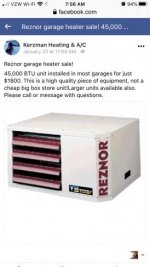
Not sure where you live but this is my neighbors company.

Not sure why the picture is not showing.
 

Attachments

  • 8D39B4B1-7F35-4500-8C70-C2E396CAD600.jpg
    8D39B4B1-7F35-4500-8C70-C2E396CAD600.jpg
    21 KB · Views: 63
Last edited:

Showkey

"MEMBER EMERITUS"
Joined
Aug 9, 2014
Messages
8,638
Location
Wausau WI
My dad's been thinking of one of the Dyna-glow blue flames to avoid blowing a hole in the roof/wall for an ugly vent. Not looking to keep the thing 80 degrees or running hard/all the time so I'm not too concerned about the lack of vent. That would be a no brainer self-install.

Looking forward to the responses.


As discussed many times before........they work.........but:

Add moisture to the shop air......some cases way too much moisture.
Add toxins to the air, not just combustion gases but any chemical and solvents that pass through the flame are toxic.
They smell to some extent.........some will complain of eye irritation and head aches, varies by individual.
 

shawnn

Member
Joined
Apr 18, 2015
Messages
21
To do your own gas piping, which I did in my house with no previous experience, follow these rules. Use black iron pipe. Cut to proper length and thread with a threading machine. Clean the threads and wrap with yellow Teflon (gas approved) tape 5 wraps in the direction such that threading will not unwind the tape. Use a big pipe wrench and crank them down well. Buy or build a leak down gauge - I built one using a gauge and various bell reducers from the small gauge diameter up to the pipe size. Pump air in to 25 psi and let sit a while, 15 minutes or longer. If the pressure drops at all, wrench the connections tighter and perform the test again until the entire run maintains pressure. Plan ahead for future appliance additions and install tee's with plugs in those locations. Put a vertical trap in at the end where you will connect the flexible line from the pipe to the appliance. I personally felt safer knowing I did it right, cut no corners and checked every run.
 
Last edited:

klassenl

Well-known member
Joined
Feb 20, 2016
Messages
713
Location
Southern Alberta
I did my own. My heater cost me almost $800, that's just the heater (you Americans with your high value dollar get things so cheap).

My dad is a gas fitter so I learned all of the skills as a kid. I also have access to all of the threading equipment.

If you have no previous knowledge about pipe fitting and don't have access to the tools just hire it out.

However hanging and venting of the unit doesn't required any special skills or tools so as long as you have the drive to get it done you should be able to do it yourself no problem.
 

Farmall450

Well-known member
Joined
Dec 23, 2011
Messages
13,368
Location
Marengo, Illinois
As discussed many times before........they work.........but:

Add moisture to the shop air......some cases way too much moisture.
Add toxins to the air, not just combustion gases but any chemical and solvents that pass through the flame are toxic.
They smell to some extent.........some will complain of eye irritation and head aches, varies by individual.

I wouldn't put on in the house, that's for sure
 

Jackfre

Well-known member
Joined
Dec 26, 2010
Messages
4,411
Location
N CA
50kbtu for 450 sq ft is about double what you will need, if the place is insulated at all. I would suggest you look at a Rinnai EX22. It is simple to install and comes with the vent. 2.5" hole in the wall.
 
To avoid these ads, REGISTER NOW!

D45

Well-known member
Joined
Mar 21, 2014
Messages
4,836
Location
NW INDIANA
I have a 75k Hot Dawg - again that I mounted myself

Total project cost was probably $800 - including the heater

Noway in hell I'd pay someone $2000+ for the install
 

BCreekDave

Well-known member
Joined
Dec 17, 2015
Messages
206
Location
Dayton, OH
I did my own too. 40k Hot Dawg I got for 400 and probably have 200 in the install parts and pieces.
The hardest part for me was locating it on the ceiling. I wanted the vent to go up and miss the ceiling beams and the roof beams and they were not in line with each other. Several trips into the attic to measure and then to install the cross pieces to bridge the ceiling beams to thread the hanging screws into.
The gas line was already stubbed out to below the ceiling when I built the house, so that was easy.
Passed the county inspector no problem. Even installed a thermostat I can control with my phone so I can warm it up before I get home.
 

Git

Well-known member
Joined
May 18, 2008
Messages
6,894
Location
S Cal
My dad's been thinking of one of the Dyna-glow blue flames to avoid blowing a hole in the roof/wall for an ugly vent. Not looking to keep the thing 80 degrees or running hard/all the time so I'm not too concerned about the lack of vent. That would be a no brainer self-install.

Looking forward to the responses.

I installed a 30,000 BTU Mr Heater about a month ago in my garage (looks just like the Dyna Glow). I had originally purchased it during the summer from Amazon Warehouse and only paid about $80 for it. My gas meter is on the other side of the wall so the installation was pretty easy - black iron pipe into the garage and then a short piece of flex to the device. The heater sits on top of a workbench that runs down the sidewall so it is off the floor, just like my water heater (minimum 18") to avoid igniting gas fumes, etc. (normally no vehicles in my garage)

After reading all the naysayers on the forum about these types of heaters - especially the part about all the fumes in the garage are going to pass through the flame, yada yada yada, I am happy to say it works great and was well worth the money paid

Right now (9:40 AM) it's 47 degrees outside and I am sitting in shorts and a T shirt in my garage where it's 75

Now keep in mind, it doesn't get that cold in S Cal, this time of the year, maybe into the 40's overnight but it easily gets my garage into the mid 70's on setting #2 out of the 5 settings. And a little common sense goes a long way. I only run it for four hours at a time (I set a timer), I have a CO detector in the garage, I make sure there is fresh air access and when I shut it off, I shut it off at the device and at a valve where it comes into the garage. No issues at all so far. No, my garage didn't become some dripping wet cave, no my eyes don't water, no I don't get headaches. If you come into the garage you can detect a small odor of it running, but it's not really noticeable, once your out there

Lastly - most of the hot air goes straight up to the ceiling, where my mini-split is, so I run the fan on the mini-split to blow the air down. I used to use the Mr Slim to heat, but I thought natural gas would be a better option
 
Last edited:

Farmall450

Well-known member
Joined
Dec 23, 2011
Messages
13,368
Location
Marengo, Illinois
I installed a 30,000 BTU Mr Heater about a month ago in my garage (looks just like the Dyna Glow). I had originally purchased it during the summer from Amazon Warehouse and only paid about $80 for it. My gas meter is on the other side of the wall so the installation was pretty easy - black iron pipe into the garage and then a short piece of flex to the device. The heater sits on top of a workbench that runs down the sidewall so it is off the floor, just like my water heater (minimum 18") to avoid igniting gas fumes, etc. (normally no vehicles in my garage)

After reading all the naysayers on the forum about these types of heaters - especially the part about all the fumes in the garage are going to pass through the flame, yada yada yada, I am happy to say it works great and was well worth the money paid

Right now (9:40 AM) it's 47 degrees outside and I am sitting in shorts and a T shirt in my garage where it's 75

Now keep in mind, it doesn't get that cold in S Cal, this time of the year, maybe into the 40's overnight but it easily gets my garage into the mid 70's on setting #2 out of the 5 settings. And a little common sense goes a long way. I only run it for four hours at a time (I set a timer), I have a CO detector in the garage, I make sure there is fresh air access and when I shut it off, I shut it off at the device and at a valve where it comes into the garage. No issues at all so far. No, my garage didn't become some dripping wet cave, no my eyes don't water, no I don't get headaches. If you come into the garage you can detect a small odor of it running, but it's not really noticeable, once your out there

Lastly - most of the hot air goes straight up to the ceiling, where my mini-split is, so I run the fan on the mini-split to blow the air down. I used to use the Mr Slim to heat, but I thought natural gas would be a better option

I figured they'd work pretty well. It's no worse than a torpedo or infrared sparingly.
 

marinusdees

Well-known member
Joined
Oct 30, 2012
Messages
1,325
Location
Edgewood, Washington
As stated above, it ain't rocket science. Common sense and check your work you'll save a few bucks. Although I recently installed (2) 50K Big Maxx heaters, if you are going to seriously heat this building all winter, I would go with a Reznor or Modine. Mine are for occasional heating/back-up.

Amen. 30 years ago. No problems yet. I am 82. Can die tomorrow.
 

spudley

Well-known member
Joined
Dec 27, 2016
Messages
702
Location
Northeast Wisconsin
Right now (9:40 AM) it's 47 degrees outside and I am sitting in shorts and a T shirt in my garage where it's 75
Where I'm at, when its 47 degrees outside, the OHD is open and I'd have the AC on at 75.:thumbup:

In the northern climes when cold tools meet warm air things get real wet, real quick. Not wise adding any additional moisture.
 

Aileron

Well-known member
Joined
Apr 15, 2019
Messages
468
Location
outside
To do your own gas piping, which I did in my house with no previous experience, follow these rules. Use black iron pipe. Cut to proper length and thread with a threading machine. Clean the threads and wrap with yellow Teflon (gas approved) tape 5 wraps in the direction such that threading will not unwind the tape. Use a big pipe wrench and crank them down well. Buy or build a leak down gauge - I built one using a gauge and various bell reducers from the small gauge diameter up to the pipe size. Pump air in to 25 psi and let sit a while, 15 minutes or longer. If the pressure drops at all, wrench the connections tighter and perform the test again until the entire run maintains pressure. Plan ahead for future appliance additions and install tee's with plugs in those locations. Put a vertical trap in at the end where you will connect the flexible line from the pipe to the appliance. I personally felt safer knowing I did it right, cut no corners and checked every run.

Do not put 25psi on the gas piping, unless its capped and not connected to appliances. The gas valves are only rated for 1/2psi. If you do a leak down use a water column gauge.
 

HoosierBuddy

Well-known member
Joined
May 9, 2006
Messages
2,928
Location
Southern Indiana
Some marginal advice above.

I have used both teflon tape and liquid pipe sealant over the years, and do not use teflon tape anymore. Even using the "gas" thicker type and the required number of wraps I have found leaks. If you use a good pipe sealant (I prefer Rectorseal #5...but there are other good ones)...I have had much better luck.

As others have said...the response to a failed pressure test is not "tighten all the fittings". It's going to be check to see that the leaking fitting is tight and if not disassemble, clean, redope, reassemble, and try again. If it fails after that....you have a thread problem. Replace and start over.

Also...cutting your own threads with a pipe threader is not a trivial thing. I have screwed it up myself, and once the threads are FUBAR you'll not get them to seal. The two biggest issues are not enough or improper threading oil (use the right stuff made for threading) and dull threading dies. Onces the treading dies are dull, they need to be disposed of and replaced. As an aside, the best thing about Ridgid threaders is, it doesn't matter how old they are, you can still buy parts for them. Try to find dies for an old Toledo threader and you'll see what I mean.

Anyway...plumbing gas is not rocket science, but it's not as easy as making hamburger helper either. For a novice, you AT A MINIMUM need to have a pro review your work before putting gas on it.

Phil
 

59 wagon man

Well-known member
Joined
Oct 25, 2010
Messages
1,589
Location
hollywood fla
like the airline pvc pipe discussions you will get advice all over the place so here is mine.
1 - check local codes. homeowner may not be allowed to do his own gas work thereby screwing you if god forbid you ever had an insurance issue
2 - use sealed air combustion. there is a show on tv called "engineering Catastrophes" and it is never one thing alone which causes problems but a merging of several issues .if you can do the exhaust the intake won't be much different.
3 - years ago in NY I built a 1 car garage and had an old reznor gas fired space heater and it was great. in a few minutes you could be working in a t-shirt with 2 ft of snow outside. yes it had a standing pilot but back then I don't even remember if we had sealed air combustion but I remember when we painted my friends car we heated the garage then shut the heater and pilot off. Today I would use sealed air combustion
 

b-boy

Well-known member
Joined
Oct 2, 2013
Messages
2,155
Location
Buffalo NY
I've done NG pipe myself and hired it out. It's fairly straight forward. Lowes/HD will cut pipe to size for you as needed. Leak testing is a must. I use pipe dope only. I like the thicker pipe dope.

I hired a plumber do do a NG black pipe run in my old house. he tapped into a line and added a 6ft run with a shutoff valve for a small heater in my basement. He charged me $300. A few years later, when I moved, I disconnected the heater and the entire pipe/shutoff valve came loose. He never fully tightened them. I don't know how it didn't leak and blow up my house. That's when I started doing it myself.
 

Farmall450

Well-known member
Joined
Dec 23, 2011
Messages
13,368
Location
Marengo, Illinois
I've done NG pipe myself and hired it out. It's fairly straight forward. Lowes/HD will cut pipe to size for you as needed. Leak testing is a must. I use pipe dope only. I like the thicker pipe dope.

I hired a plumber do do a NG black pipe run in my old house. he tapped into a line and added a 6ft run with a shutoff valve for a small heater in my basement. He charged me $300. A few years later, when I moved, I disconnected the heater and the entire pipe/shutoff valve came loose. He never fully tightened them. I don't know how it didn't leak and blow up my house. That's when I started doing it myself.

Yikes!
 

1badrz28

Member
Joined
Jul 29, 2019
Messages
10
Location
Mn
I purchase a Hot dawg 60k from Shurail heating in Bloomington, MN. They were the cheapest I found around, even online. Than went to Menards for the venting which was around 100.00 or so for the b vent. I ran the copper line before the sheet rock was put up in my new home, but my old home I ran the yellow flexable pipe up from the basement manifold, because there was no way I could route copper through the walls. Just don't forget to bond the gas line.
 

ac_185

New member
Joined
Dec 29, 2022
Messages
1
Where I'm at, when its 47 degrees outside, the OHD is open and I'd have the AC on at 75.:thumbup:

In the northern climes when cold tools meet warm air things get real wet, real quick. Not wise adding any additional moisture.
So keep thermostat at 68 all winter long, that’s what I do. I cannot remember where I’d read or heard but I do not let garage get below 50 or whatever lowest setting of thermostat. When you only run heater to occasionally warm it up, like you just mentioned, the coils in the heater start getting moisture. Granted they are aluminized steel, but in time they will rust out 👌🏼
 

Rc_Guy

Well-known member
Joined
Apr 14, 2013
Messages
4,449
Location
Minnesota
So keep thermostat at 68 all winter long, that’s what I do. I cannot remember where I’d read or heard but I do not let garage get below 50 or whatever lowest setting of thermostat. When you only run heater to occasionally warm it up, like you just mentioned, the coils in the heater start getting moisture. Granted they are aluminized steel, but in time they will rust out 👌🏼
Like you yeah we keep our garage at 70°, the same as the house. In fact this time of year we leave the door open going into the garage that way if I’m out here I can talk to her still.
 
To avoid these ads, REGISTER NOW!
Top Bottom