To avoid these ads, REGISTER NOW!

Sub Panel in Shed - Wiring Questions

berky2755

Member
Joined
Jul 10, 2017
Messages
12
Location
PA
Thanks in advance....

I've been doing tons of research and I think I have an idea of what I need, but just looking for validation and/or corrections.

My situation is in the attached image. Basically, I have a sub-panel in my attached garage, that I plan to tap into so I can get electricity to my standalone shed (some might call it a second garage :thumbup:). Anyway, based on the information I found in other threads, I have a few options, none of which I'm super fond of. I'd like to have a single wire I could run the whole way and not have to use conduit inside.

1) run 2-2-2-4 aluminum mobile home feeder with the RHW-2 rating, in conduit the entire way, inside and out.

2) run 2-2-2-4 aluminum SER cable inside each structure, 2-2-2-4 AL MHF outside/underground in the conduit, and some sort of junction box at the transition points between inside/outside. Any part numbers for what these junction boxes are?

3) some other option I'm not aware of.


Follow-on questions:

a) does the shed panel need it's own ground rods? (my understanding is yes, it does)
1) if so, should the shed ground still tie into the garage sub-panel's ground?
i) if not, is there any benefit to still running a 2-2-2-4 instead of just a 2-2-2?
b) what is the maximum breaker size I can use in the garage panel for the shed given the 2 gauge AL?
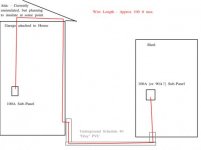
 

Attachments

  • shed_wiring.jpg
    shed_wiring.jpg
    17.2 KB · Views: 59
To avoid these ads, REGISTER NOW!

pattenp

Well-known member
Joined
Jun 4, 2008
Messages
10,175
Location
Virginia - USA
You need 4 wire feeder along with ground rods at shed. The earth ground using rods and the equipment ground between panels serves two different purposes. The max overcurrent protection for #2AL is 90A.
 

wyliesdiesels

Well-known member
Joined
Aug 14, 2012
Messages
20,067
Location
Modesto, CA
Yes you need 2 rods. Also meed to isolate neutral bar which means separate ground bars.

EGC in feeder and GEC from rods terminates on ground bar along with EGCs from branch circuits.
 
OP
B

berky2755

Member
Joined
Jul 10, 2017
Messages
12
Location
PA
Thanks. That makes sense on the grounding.

Can anyone answer if there's a better option for the wiring type? If not, what kind of junction boxes can I use that aren't super expensive?
 

Innovate1

Well-known member
Joined
Jul 28, 2014
Messages
4,291
Location
Illinois near St. Louis, Missouri
You show the conduit stopping short of the panels on both ends. From the drawing it looks easy to continue the run on the shed end to the panel but it may not be. If it is easy enough I would continue to the new subpanel and eliminate the box and splice on that end.

Do you really need 90A? Just a question and maybe you do. But if you don't running smaller wire is easier and cheaper and will cover most one man shops. Also 90A breakers are not stocked some places so you might want to go to 80A which is more common.

As far as boxes go, any with enough volume for the size and number of wires. I think I would put an LB on the outside and put the box on the inside but you could put it outside if it's weatherproof.

My local big box stores have PVC boxes in several larger sizes without holes. You just drill holes for the size conduit you are using.
https://www.menards.com/main/electrical/electrical-boxes-covers/electrical-boxes/carlon-reg-pvc-enclosure-box/e989nnj-car/p-1444444980096-c-6425.htm

For the underground portion using long sweep 90s makes pulling wire much easier. They aren't very common under 2" size so go with 2" or bend you own. I did it with steam from a teakettle through a larger pipe for a few minutes. Something like a 24" radius will keep all or most of the bend below ground.
 
OP
B

berky2755

Member
Joined
Jul 10, 2017
Messages
12
Location
PA
You show the conduit stopping short of the panels on both ends. From the drawing it looks easy to continue the run on the shed end to the panel but it may not be. If it is easy enough I would continue to the new subpanel and eliminate the box and splice on that end.

Right, that's just where I presumed the transition from outside to inside. In the shed side, running conduit into the panel shouldn't be difficult. It's more on the garage side that is the issue.

Do you really need 90A? Just a question and maybe you do. But if you don't running smaller wire is easier and cheaper and will cover most one man shops. Also 90A breakers are not stocked some places so you might want to go to 80A which is more common.

Need is such a strong word ... haha. Most likely, no, I will never ever use or need that much. I just tend to plan for 'what if' scenarios and if I'm going to run cable anyway, I don't want to have to redo something later. Spending a little extra on bigger cable is a drop in the bucket when considering the rest of the project costs.


As far as boxes go, any with enough volume for the size and number of wires. I think I would put an LB on the outside and put the box on the inside but you could put it outside if it's weatherproof.

My local big box stores have PVC boxes in several larger sizes without holes. You just drill holes for the size conduit you are using.
<url stripped due to my post count>

Thanks. I wish I had a Menards around here, but I'll check the local stores to see what they have. I was planning to use an LB Conduit Body for the transition inside. It's sounding like my best option will be (on the garage side at the least) to use one of those PVC boxes with something like a power distribution block? Or do they make something better/cheaper to splice the wires together?

For the underground portion using long sweep 90s makes pulling wire much easier. They aren't very common under 2" size so go with 2" or bend you own. I did it with steam from a teakettle through a larger pipe for a few minutes. Something like a 24" radius will keep all or most of the bend below ground.

yeah, I will have 2 areas with 45' sweeps and 90' sweeps at each building.


Thanks again to everyone for the responses.
 

LS6 Tommy

Well-known member
Joined
Dec 27, 2013
Messages
26,162
Location
Northern NJ
Around here, if you run power (other than a utility outlet and a light) to a shed, it's considered living space and you gotta pay taxes on it. You also will probably get nailed for not having the proper permits to build said "living space".

Tommy
 

Norcal

Well-known member
Joined
Mar 16, 2008
Messages
13,769
Around here, if you run power (other than a utility outlet and a light) to a shed, it's considered living space and you gotta pay taxes on it. You also will probably get nailed for not having the proper permits to build said "living space".

Tommy

Reason 10,001 not to live in NJ.:lol_hitti
 

Baydog

Member
Joined
Jun 17, 2017
Messages
23
If you transition aluminum cable to another type of aluminum in a Jbox make sure:
1. The Jbox is completely waterproof (hard to achieve long term) or isn't outside if possible. Aluminum fails quickly when exposed to moisture.
2. Pay attention to connectors. Polaris bugs are good. Make sure anything you use is aluminum rated. The expoy underground slice kits are a good way to keep the splices moisture free in above ground jboxes if properly listed. Try to use a splice box big enough to leave a loop in case a connection fails anyway.
3. Use Noalox and brush it in good before making the connection
 
Last edited:

wyliesdiesels

Well-known member
Joined
Aug 14, 2012
Messages
20,067
Location
Modesto, CA
If you transition aluminum cable to another type of aluminum in a Jbox make sure:
1. The Jbox is completely waterproof (hard to achieve long term) or isn't outside if possible. Aluminum fails quickly when exposed to moisture.
2. Pay attention to connectors. Polaris bugs are good. Make sure anything you use is aluminum rated. The expoy underground slice kits are a good way to keep the splices moisture free in above ground jboxes if properly listed. Try to use a splice box big enough to leave a loop in case a connection fails anyway.
3. Use Noalox and brush it in good before making the connection

Anti-ox paste is not required by code unless manufacturer calls for it and none of the wire manufacturers today call for it so...
 

mike93lx

ALLIANCE MEMBER
Joined
Dec 9, 2013
Messages
37,847
Location
Richmond, VA
please add your location (at least a state) to your profile so we can give proper advice

there is no option that avoids conduit 100% of the way.

even if you used SER inside, you will need to protect the MHF at least while it is above grade. you do not need conduit underground though.

if you do plan to transition from MHF to SER, your box size will be dictated by your conduit size, so keep that in mind. Putting in a bigger than needed conduit will also mean you have a big junction box.

If it was at my house, I would probably run 1.5" conduit end to end and use XHHW.
 

u2slow

Well-known member
Joined
Nov 20, 2011
Messages
3,610
Location
BC
Around here....

You'd run armoured, rubberized cable (Teck or ACWU) right from the shop panel to the shed panel. No extra splices or junction boxes. Use appropriate cable connectors & straps along the way. Also, no ground rod/plate required when you use a 4-wire cable.

Oh yeah, bury the cable too. :thumbup:
 

Bert_

Well-known member
Joined
Dec 24, 2016
Messages
9,768
Location
NW Iowa
If you transition aluminum cable to another type of aluminum in a Jbox make sure:
1. The Jbox is completely waterproof (hard to achieve long term) or isn't outside if possible. Aluminum fails quickly when exposed to moisture.
2. Pay attention to connectors. Polaris bugs are good. Make sure anything you use is aluminum rated. The expoy underground slice kits are a good way to keep the splices moisture free in above ground jboxes if properly listed. Try to use a splice box big enough to leave a loop in case a connection fails anyway.
3. Use Noalox and brush it in good before making the connection

Fails quickly with moisture huh?

Better not tell that to the miles of overhead wire I've ran...
It's aluminum. It's not protected at all. Even the splices only have a loose plastic cover.

I'd just use an appropriately sized N3R metal pull box, they aren't expensive. More problems are caused by trying to seal something completely than not trying at all.
 
Last edited:
OP
B

berky2755

Member
Joined
Jul 10, 2017
Messages
12
Location
PA
please add your location (at least a state) to your profile so we can give proper advice

there is no option that avoids conduit 100% of the way.

even if you used SER inside, you will need to protect the MHF at least while it is above grade. you do not need conduit underground though.

if you do plan to transition from MHF to SER, your box size will be dictated by your conduit size, so keep that in mind. Putting in a bigger than needed conduit will also mean you have a big junction box.

If it was at my house, I would probably run 1.5" conduit end to end and use XHHW.

Sorry about that. I'm in PA. I already plan to have conduit covering 100% outside (above and below ground), I just don't want to have to run it inside (PITA)
 
To avoid these ads, REGISTER NOW!
OP
B

berky2755

Member
Joined
Jul 10, 2017
Messages
12
Location
PA
Around here....

You'd run armoured, rubberized cable (Teck or ACWU) right from the shop panel to the shed panel. No extra splices or junction boxes. Use appropriate cable connectors & straps along the way. Also, no ground rod/plate required when you use a 4-wire cable.

Oh yeah, bury the cable too. :thumbup:

I've read about this Teck stuff a few places, but from what I can tell, it's crazy expensive. Maybe not so much in Canada?
 

thammel

Well-known member
Joined
Oct 3, 2005
Messages
2,245
Location
Maryland
I believe the ground rods need to be 8' apart. I drove in two 8' long ground rods. This is not an easy task...I was 69 at the time....am 70 now. I tried using an impact hammer...best approach was just the good old sledge.
 

mike93lx

ALLIANCE MEMBER
Joined
Dec 9, 2013
Messages
37,847
Location
Richmond, VA
I believe the ground rods need to be 8' apart. I drove in two 8' long ground rods. This is not an easy task...I was 69 at the time....am 70 now. I tried using an impact hammer...best approach was just the good old sledge.

Like a hammer drill or a real rotary/demo hammer?

With a real demo hammer and a bit designed for ground rods, it will be much faster than a sledge hammer and a lot easier. But a hammer drill will never get it done outside of maybe florida
 

Terry D

Well-known member
Joined
Mar 25, 2015
Messages
2,202
Location
St. Louis, MO.
Use my big Milwaukee rotary hammer drill all the time, actually until about 2 years ago, I never even used the ground rod driver attachment. Works like a champ.
 

mike93lx

ALLIANCE MEMBER
Joined
Dec 9, 2013
Messages
37,847
Location
Richmond, VA
Use my big Milwaukee rotary hammer drill all the time, actually until about 2 years ago, I never even used the ground rod driver attachment. Works like a champ.

it's probably fine, but i don't love the idea of driving directly off the chuck (assuming that's what you do)
 

Terry D

Well-known member
Joined
Mar 25, 2015
Messages
2,202
Location
St. Louis, MO.
it's probably fine, but i don't love the idea of driving directly off the chuck (assuming that's what you do)

I will admit, I did it that way for years, just put the chuck of my spline shaft over the rod . Never had a problem. I figured instead of the tool beating on a hardened bit, it was just beating on the rod. Maybe I've just been lucky. But about 2 years ago, I did buy the attachment for ground rods
 

mike93lx

ALLIANCE MEMBER
Joined
Dec 9, 2013
Messages
37,847
Location
Richmond, VA
I will admit, I did it that way for years, just put the chuck of my spline shaft over the rod . Never had a problem. I figured instead of the tool beating on a hardened bit, it was just beating on the rod. Maybe I've just been lucky. But about 2 years ago, I did buy the attachment for ground rods

The tool is designed to beat on that hardened spline though
 
OP
B

berky2755

Member
Joined
Jul 10, 2017
Messages
12
Location
PA
Speaking of ground rods, I've watched some videos of people using a hose to force it down... basically the water acts as a drill in front of the rod. Has anyone ever tried this? Just curious.
 

Terry D

Well-known member
Joined
Mar 25, 2015
Messages
2,202
Location
St. Louis, MO.
,
Speaking of ground rods, I've watched some videos of people using a hose to force it down... basically the water acts as a drill in front of the rod. Has anyone ever tried this? Just curious.
I have seen water drills for boring out a foundation underground for a new qater service. Guess it same principle

Sent from my SM-G960U using The Garage Journal mobile app
 

u2slow

Well-known member
Joined
Nov 20, 2011
Messages
3,610
Location
BC
To avoid these ads, REGISTER NOW!
Top Bottom