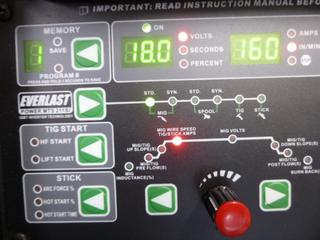
All wire feed welders can vary two parameters, voltage and amperage.
Voltage is controlled with the voltage control switch/knob/screen.
Amperage is controlled with the wire feed speed.
The main thing you control or vary is the wire feed speed. You need the voltage control to 'balance' the wire feed speed with the arc length and the resistance of the wire and arc.
That whole volts = amps x ohms thing, it's not just a good idea but is actually a Law.

In broad terms, if the voltage is too low, then the wire stubs into workpiece.
If the voltage is too high (ignoring getting into spray transfer mode, where you want/need a 'high' voltage), then the arc is unstable and you get spatter (possibly transitioning into globular transfer mode).
(the voltage setting will also affect the height and width of the weld bead, and also some other welds effects)
Generally, set the voltage midway between 'too little' (wire stubs into workpiece) and 'too much' (increased spatter).
A 'good' weld on 1/4" thick steel with a 120V wire feed welder with a max output of 125 amps and a 200 ipm max WFS and using 0.030 FCAW-S wire?
Iffy (without some 'tricks', and maybe not even then). What parameters does the door chart suggest for that metal thickness with that wire diameter and type?
Do a test weld. Take a piece of 1/4" steel and set the machine voltage to 'max' and the wire feed speed (amperage) to 'max' also (you only have a max of 200 ipm on that machine and some 0.030 FCAW wire at ~200 ipm will be ~125 amps). See if you can get an acceptable weld (bead size/shape and penetration into the workpiece).
Then try and weld two pieces of 1/4" steel together. **** joint or lap joint or T joint. Make a test and then try and break the weld joint apart. Examine the break and see if you got decent weld penetration into those 1/4" steel pieces.
And remember,
If there's slag, then drag.
(FCAW is a slag producing/using welding process, just like SMAW aka stick welding, use a "drag" technique when welding.)