To avoid these ads, REGISTER NOW!

Garage foundation / heated slab concrete question

hellspcangel911

Well-known member
Joined
Jan 3, 2010
Messages
237
Hi All,
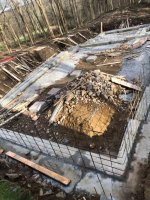
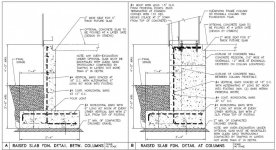
I have the land excavated and about to have the concrete contractor put up forms for the pour, its an akward site with ledge and fill. The build is a 40x60 steel barn made of cold formed Cees and Zees. The slab will be 5", radiant heated, with 2" of poly insulation board below. The engineer (provided by the barn manufacturer, and it appears this is his first non-monolithic pour) shows a 2" wide seat for the slab to sit on.

My first question is does this seat make sense if I was planning to do 2" of poly insulation around the perimeter of the slab just like under it to prevent heat loss? Should I do 1" insulation instead? Lose the seat all together and just run the 2" board down the side of the foundation wall 2 feet?

Second question, because of the grade slope, one side of barn will be below grade, so that foundation wall will be in part a 8' retaining wall. He has done the same 2" seat there in the footer. The concrete guy wants to pour the footer lower so the slab sits on top of it and not just mating at the side and sitting on the 2" shelf. I liked the idea but realized the 4 columns of the barn are to be anchored to the footer as well. I assume its not a good idea to put the columns on the slab and anchor them thru into the footings?

Thank you and stay safe!
 

Attachments

  • Foundation and slab detail.jpg
    Foundation and slab detail.jpg
    159.5 KB · Views: 239
  • Retaining wall detail.JPG
    Retaining wall detail.JPG
    101 KB · Views: 218
  • DJI_0202.jpg
    DJI_0202.jpg
    144.8 KB · Views: 232
To avoid these ads, REGISTER NOW!

gnpenning

Well-known member
Joined
Jan 25, 2015
Messages
2,754
Location
I have more questions than answers.
Your heated slab will be heating the great outdoors if it comes into contact with any concrete be it the foundation or driveway. A thermal break at all contact areas will save you heating cost. Stop the slab under the garage doors. Paid for that mistake and corrected the next time.

See it all the time on job sites. In my area just look for the melted snow. The ones that are open minded, when pointed out what is going on aren't very happy with the builder.... Know of one guy that is a heating contractor and heating the great outdoors. Don't count on others knowing better.
 

kj_mustang

Well-known member
Joined
Feb 9, 2011
Messages
1,213
Location
Harrisonburg, VA
Because of the amount of fill, the seat for the slab to sit on is probably required. My attached garage had to have an engineered slab. It sits totally on top of the poured concrete walls and has a support pier in the center. Mine has radiant also. I have the 2" foam under the slab and I just glued 1/4" foam on the outside of the walls and put my metal lathe and veneer stone over it.
 

slackdaddy1

Well-known member
Joined
Mar 15, 2014
Messages
476
Location
Southern MD
Either the fill is properly compacted or not,, a 2" shelf will not save sloppy site work.


Because of the amount of fill, the seat for the slab to sit on is probably required. My attached garage had to have an engineered slab. It sits totally on top of the poured concrete walls and has a support pier in the center. Mine has radiant also. I have the 2" foam under the slab and I just glued 1/4" foam on the outside of the walls and put my metal lathe and veneer stone over it.
 
OP
H

hellspcangel911

Well-known member
Joined
Jan 3, 2010
Messages
237
thanks for the prompt responses. The 2" seat was added by the engineer before any excavation, it was just an option, I said yes not really thinking it thru.
So are you guys suggesting getting rid of the 2" seat or trying to make it bigger? If i put two inches of foam board on the edge, the seat wont hold up the slab and will be useless anyway.......rght?
 

kj_mustang

Well-known member
Joined
Feb 9, 2011
Messages
1,213
Location
Harrisonburg, VA
My building inspection dept. didn't care how well the fill was compacted. Because of the amount of fill, they required an engineered slab. You can argue with the engineers who design them.
 
OP
H

hellspcangel911

Well-known member
Joined
Jan 3, 2010
Messages
237
The plans don’t show a slab, it’s optional, the 2” seat I don’t think takes into account the foam... engineers do things by the book, concrete guys usually use experience and more common sense.... I’m trying to Belden the best of both using you guys as a resource. What would you do?
 

ConCretin

Well-known member
Joined
Jan 20, 2011
Messages
3,379
Location
Central Maine
To your second question first; I'd definitely lower the footing 6" and place the floor over it. Why add an unnecessary joint in the floor, not to mention the finish on the top of the footing will never match the floor.

If the slab goes in before the steel columns, simply leave block-outs in the slab and fill them after the steel is up. If the steel goes first, just pour the columns into the slab (a wrap of expansion foam would be a good idea).

With regard to the shelf at the top of the wall, I agree with slackdaddy. It's unnecessary and more trouble than it's worth. You want the base under the slab to provide uniform support. The slab can accommodate a little, gradually distributed settlement but will not do well with the edge rigidly supported and a a void underneath.

A thermal break is definitely a good idea. A piece of 1/2" expansion material works fine without being unsightly. They make a closed cell foam with a removable top strip you can remove a fill with sealant.

Finally I would run rigid insulation on the inside of the foundation wall from the bottom of the slab to 4' below the exterior grade. This will prevent the frost from coming through the wall and freezing the material under your slab.

Give my Guide to Floor Slabs in the link below a read for some additional thoughts.
 
Last edited:

wssix99

Well-known member
Joined
Mar 2, 2011
Messages
5,161
Location
Chicago, IL
With regard to the shelf at the top of the wall, I agree with slackdaddy. It's unnecessary and more trouble than it's worth. You want the base tunder the slab to provide uniform support. The slab can accommodate a little, gradually distributed settlement but will not do well with the edge rigidly supported and a a void underneath.

A thermal break is definitely a good idea. A piece of 1/2" expansion material works fine without being unsightly. They make a closed cell foam with a removable top strip you can remove a fill with sealant.

+1 on all of this and the similar sentiments above. Having that ledge works against a floating slab and (if there is any settlement of the fill) could leave a void and lead to really nasty cracking.

The only time I've seen stuff like this is on a structural slab, which it appears this is not. I'm wondering about your engineer... (although, floors are a specialized thing and they might not be fully experienced in all the aspects)

On my home, I used this stuff at the thermal breaks. (I have an epoxy coated, heated floor.) I used foam for my thermal break, cut out the top inch with a heat knife, and then capped it with the slab gasket - it looks great.

https://www.pavepatch.com/slabgaske...2JN2cpQwQwul2l3Q1YnArLvq8kduLFRMaAq4XEALw_wcB
 
OP
H

hellspcangel911

Well-known member
Joined
Jan 3, 2010
Messages
237
LLWillysfan - I appreciate your advice and you taking the time to write up the guide to Floor Slabs. The finish of the slab wont match the footing anyway, unfortunately. I'll be pouring the slab down the road as budget allows (possibly next year), it will help the fill (mostly sand) settle as well.
Is using the 2" foam board 4' down on the inside of the walls, but is it overkill as a thermal break vs the 1/2"? I like the product wssix99 sent. Ive also seen people rip down PVC pipe lengthwise to put over the 2" thermal break at door openings which looks pretty slick.

To put the slab on top of the footing would require the manufacturer to increase those columns the thickness of the slab plus the 2" foam, and having this footing set that far lower than the the other three foundation walls. Not sure thats actually worth it? this particular side is on ledge, Ive hammered it down low enough to accommodate some gravel, 2" foam and a 5" slab, but its essentially sitting on ledge. The retaining wall that shares the footing will also be pinned to the ledge. Shouldnt that be sufficient vs sitting on the footing? Any reason to pin the slab to the ledge as well?

We prepped the site by compacting the virgin soil, rolling out stabilization fabric, then dumped 400 pounds of 1/2" rock on top in the form of 2 steps to make the forming easier (and cheaper).

wssix99- Ive been wondering about the engineer as well. I dont entirely blame him since hes never seen the site as hes located across the country. He was assigned to the job by the barn manufacturer hes held up the job three months while he was just getting everything together. The local guys arent familiar with the Cees and Zees kits, so for them its either red iron style or stick built. The concrete contractors either think this foundation is overbuilt (5' wide footings....) or undersized if they worked on commercial red iron buildings.

I'm under the gun here, with Corona the town has shut down all residential construction projects, mine has already been started but if I dont get the forms up soon I wont be able to get the inspector out in time.

I'll scrap the 2" seat idea based on your guys views. Thank you
 

Attachments

  • unnamed.jpg
    unnamed.jpg
    19.1 KB · Views: 36

ConCretin

Well-known member
Joined
Jan 20, 2011
Messages
3,379
Location
Central Maine
Sounds like your base prep is appropriate and I agree that hammering out more ledge just to get the footing under the slab probably isn't worth the cost to address what is essentially a cosmetic issue. You had a couple more questions;

Q - Is using the 2" foam board 4' down on the inside of the walls, but is it overkill as a thermal break vs the 1/2"?

A -2" of board will block the cold whereas 1/2" material is just a thermal break, which blocks heat/cold transmission from direct contact between two elements. 1/2" material wouldn't be adequate to protect the base material under your slab from freezing. Btw, you want more than 4' of insulation on the side where the slab is higher than finish grade. The insulation should go from slab elevation to 4' below finish grade.

Q - The retaining wall that shares the footing will also be pinned to the ledge. Shouldnt that be sufficient vs sitting on the footing? Any reason to pin the slab to the ledge as well?

A - There is no need for the shelf under the slab in the footing or to pin the slab to the footing. Let the slab be supported by the base underneath and nothing else. Slabs perform best when isolated from the structure completely so they are free to shrink and to a lesser degree, expand without constraint.

Good luck with your project and get to work before you get shut down!
 

yeldogt

Well-known member
Joined
Jan 2, 2012
Messages
18,184
You don't say where you are ? How cold.

These mono pour footing seems to cause issues depending on locations .. I have wanted to do them and just ran into more problems than it's worth. There is a learning curve with building departments. In areas where it's often done -- everybody knows them and it's not a big deal. In NJ the last time I tried they wanted so much engineering -- it was not worth the trouble.

It seems like you have done all the engineering and everybody is on board ... I can't directly comment on the shelf other than to say in NYC -- it's done all the time. I always do it if I can ... especially depending on the situation w/ lots of fill. In a perfect world everything is perfect. Take my beach house. I had them pin my sidewalks .. all the other houses built have drop along the foundations ... mine are fine. Do I have a void down there ..maybe ...does it mater on something like a sidewalk or a slab with normal traffic?

As to the insulation. With a heated slab -- one of the reasons you insulate under the slab is so you are not driving the heat into the earth. The other item I don't get is the insulation on the inside of the foundation wall ? The earth has heat -- why stop that heat from keeping the foundation warm? In northern Europe buildings have insulation on the outside of the foundations and horizontal out from the building to trap the earths heat to keep the foundations warm .

So I insulate on the exterior of the foundation -- I use a thermal break on the slab edge and live with the small contact area at the ledge. In real world -- even with very cold temps .. the temp at that spot is not that much different. I have done numerous buildings and checked out this spot prior to turning on the heat. Now -- I'm in the north east and mid-atlantic. Not Alaska.

My house in Germany was an insulated foundation building w/ no insulation under the slab -- no radiant.
 

egdede

ALLIANCE MEMBER
Joined
Dec 20, 2009
Messages
2,094
Yeldogt; aren't you worried about a void expanding? An engineer said to me: Funny things happen when water runs under concrete.
 

yeldogt

Well-known member
Joined
Jan 2, 2012
Messages
18,184
Yeldogt; aren't you worried about a void expanding? An engineer said to me: Funny things happen when water runs under concrete.

Not really .... I'm talking about a sidewalk along a garage -- or a house. Typically what happens -- the soil drop and the sidewalk with it ......directing the water towards the house.

If the side walk stays sloped away because it's sitting on something ... how much water can there be? I'm not talking about places that have been washed out ..I'm talking about natural ground settling.

I know all about -- If it's done correctly. Years ago I bought a bought an old property to turn into my home/office -- had to take down some huge horrible pine trees. A few were where I wanted some extra parking -- huge holes. We used sonotubes to make some supports. I'm doing the same with my AC units and generator because all the ground is moved and built up.

How many cracked and sinking garage aprons are around ?
 

egdede

ALLIANCE MEMBER
Joined
Dec 20, 2009
Messages
2,094
My house sits on expansive clay soil. Typically what happens is that the soil at the outer edge of the walk will expand as rain falls. That edge lifts, water is now diverted towards the foundation.

Over time, as soil pushes whole houses around by expanding and contracting, small gaps will appear at the side of foundations both between the sidewalks as they separate and the soils as they contract from the foundation. Water runs down these gaps and carries soil with it, leaving voids. If you have a 90 year-old foundation with no steel, those expansion cycles can lead to voids which cause large chunks of the foundation to break of as individual blocks as they end up unsupported.

Funny things happen when water runs under concrete. We are on a steep slope, so gravity always assists in carrying soil from top to bottom, and voids happen. The fix is called 'under-pinning' and is a very expensive undertaking.
 

Attachments

  • C56E29D5-3B50-4583-994D-8F1884A3AC68.jpg
    C56E29D5-3B50-4583-994D-8F1884A3AC68.jpg
    152.4 KB · Views: 113
Last edited:

yeldogt

Well-known member
Joined
Jan 2, 2012
Messages
18,184
My house sits on expansive clay soil. Typically what happens is that the soil at the outer edge of the walk will expand as rain falls. That edge lif mi ts, water is now diverted towards the foundation.

Over time, as soil pushes whole houses around by expanding and contracting, small gaps will appear at the side of foundations both between the sidewalks as they separate and the soils as they contract from the foundation. Water runs down these gaps and carries soil with it, leaving voids. If you have a 90 year-old foundation with no steel, those expansion cycles can lead to voids which cause large chunks of the foundation to break of as individual blocks as they end up unsupported.

Funny things happen when water runs under concrete. We are on a steep slope, so gravity always assists in carrying soil from top to bottom, and voids happen. The fix is called 'under-pinning' and is a very expensive undertaking.

That's quite an underpin ---

It's common with and old building when you need to use what was a basement -- I just had to do it again for my latest project -- those old stone foundations did not go very deep ... and yes ... very expensive.
 
Last edited:

ard

Well-known member
Joined
Feb 16, 2015
Messages
4,391
Location
Sierra Foothills... California
I dont know HTF you get shoes and socks that white under there...

;)

Agree w LLs advice on thermal insulation all the way down the wall. Even with insulation under the slab.
 

egdede

ALLIANCE MEMBER
Joined
Dec 20, 2009
Messages
2,094
I merely supervised this phase. I did some framing up under there though!
 

andyvh1959

Well-known member
Joined
Feb 15, 2020
Messages
2,598
Location
Green Bay WI
Hmm. Built a 24x28 detached garage last fall here in Green Bay, on a 4" slab with a 12" edge around all four side (locked slab). The slab was poured on top of 2" foam, which also angled down to the 12" edge, all four sides. I installed 1/2" PEX tubing for infloor heating, and the wall sills are atop two rows of 8" block. Reading the replies above I feel I should dig down around the slab and install 2" foam sheet vertically down at least two feet and up to the sill plate level. On the front I could dig down two feet and put in 2" foam up to 4" from the top of the slab. Would it be worth the effort? Especially now that I have easy access to the perimeter before finishing the siding and landscaping.

Son in law is a supervisor for Northern Concrete, he said to use 2" foam positioned about 6" below grade and angled slightly down away from the slab, extending out 24" from the slab. Would that be as effective or should I just go straight down 2' to 4' around the outside of the slab?
 

Attachments

  • Closed up.jpg
    Closed up.jpg
    150.4 KB · Views: 28
Last edited:
To avoid these ads, REGISTER NOW!

ConCretin

Well-known member
Joined
Jan 20, 2011
Messages
3,379
Location
Central Maine
Son in law is a supervisor for Northern Concrete, he said to use 2" foam positioned about 6" below grade and angled slightly down away from the slab, extending out 24" from the slab. Would that be as effective or should I just go straight down 2' to 4' around the outside of the slab?

Andy, you'd probably get more responses if you started a new thread but since you asked here, I'll take a stab at your question.

It depends on what you are trying to accomplish. If you want to isolate the structure from frost movement entirely, you should install some additional insulation around the perimeter to keep the frost from getting into the soils under the structure.

The other option is to let the structure 'float' on the frost. This is a common practice and generally works fine as long as the soils are relatively well drained and any movement is uniform.

The extent of potential frost movement obviously depends on the amount of water in soils to begin with. The dryer the soils, the less expansive they are when frozen.

The rigid insulation under and around the slab blocks the cold and allows the natural heat from the earth to maintain soil temps above freezing. You can extend the insulation out or down a distance equivalent to the frost depth in your area. If you have the room, going out as your son in law suggested is probably easier.

It's a little more complicated with a structure that is heated and insulated because the frost tends to be concentrated around the perimeter of the structure. Unless the soils are quite frost resistant, I'd lean towards installing some additional insulation to eliminate the possibility of differential movement.
 
Last edited:

andyvh1959

Well-known member
Joined
Feb 15, 2020
Messages
2,598
Location
Green Bay WI
Thanks for the detailed reply. My new shop garage sits on 8" to 12" compacted recycled asphalt on top of soil that is higher in sand than clay. My lot is in the heavily wooded west side of Green Bay, with lots of large mature red and white oaks, ash, huge maples, etc. When it rains real hard water will collect on the west side of the garage and behind it. Before the garage was built, the natural grade of the property drained right into the area where the garage is now, again, high sand/soil content.

Aside from building up the fill to get the slab above the natural draining of the lot, I also needed to get it high enough that eventually with some slope change on the driveway the water will drain around to the west of the garage. So, I am thinking my better option is to dig down alongside and around the garage and install 2" foam up to the sill level. I can cover the top of the foam with formed aluminum, and then backfill dirt around the slab to finalize the landscaping grade.

At the front of the slab I had the site prepped to cut out a section of the old driveway (4" concrete with about 2" of asphalt on top) about 10" away from the eventual slab location. There is fill at the front of the slab I can remove to install 2" foam up to within 4" of the grade. Eventually that will be capped off with new concrete up to the garage slab. All a lot of work now, bet its the best time to do the 2" foam to minimize the heat loss from the slab heating system into the soil.

After the fill went in, it was slightly higher than the cut edge at the south end of the driveway. The 2" foam went on at that level, and 4" slab atop of that. So the new slab is at least 6" higher than the driveway level. The drainage of the driveway will eventually be directed to the right (west) side of the garage, to the right of the door.
 
Last edited:
OP
H

hellspcangel911

Well-known member
Joined
Jan 3, 2010
Messages
237
I appreciate all the posts. Backing up a little in the conversation, I was also worried about settling and what would happen beneath the slab. That was one of the reasons I decided to do the slab after the build was complete. The site is partially on ledge, which is both good and bad. The top section will be strong, but the lower section wont be on ledge. Furthermore the ridge of ledge appears to be capturing water and channeling it down either side of the ridge, running beneath the slab. Ill be installing footing drains to get this water away from the structure all together. I compacted the entire site as much as possible, once we bring in the fill (sand) I hope some rain and time get it fully compacted before bringing the final layer of gravel for the slab on top.

We got the footings started, some more hammering in one spot to get the ledge lower, than hopefully pour footings soon.

Looking ahead, after the foundation is poured, do the foundation walls have to be waterproofed from the exterior? I was planning to do the retaining wall with 2" poly from the outside as the inside of it will be a finished wall in the barn, but its that enough? heavy mil vapor barrier over the 2" foam? What about the foundation walls that are below the slab, any reason to waterproof those?

thanks
 

Attachments

  • WhatsApp Image 2020-04-03 at 8.14.02 PM.jpg
    WhatsApp Image 2020-04-03 at 8.14.02 PM.jpg
    157.1 KB · Views: 35
Last edited:

wssix99

Well-known member
Joined
Mar 2, 2011
Messages
5,161
Location
Chicago, IL
Looking ahead, after the foundation is poured, do the foundation walls have to be waterproofed from the exterior? I was planning to do the retaining wall with 2" poly from the outside as the inside of it will be a finished wall in the barn, but its that enough? heavy mil vapor barrier over the 2" foam? What about the foundation walls that are below the slab, any reason to waterproof those?

You'd want to waterproof the foundation walls from the outside and there are specific products, which can be applied over the foam. Or, you can apply them behind the foam.

You should analyze your water table and understand how things act. You don't want water to see under the floor and have pressure that would force it back up through the floor. If you put your drain tile below the floor level, then it should take care of you and you shouldn't have to worry about things below that level.
 
OP
H

hellspcangel911

Well-known member
Joined
Jan 3, 2010
Messages
237
You'd want to waterproof the foundation walls from the outside and there are specific products, which can be applied over the foam. Or, you can apply them behind the foam.


You should analyze your water table and understand how things act. You don't want water to see under the floor and have pressure that would force it back up through the floor. If you put your drain tile below the floor level, then it should take care of you and you shouldn't have to worry about things below that level.


What are you calling drain tile? So you recommend waterproofing the walls even if they are below slab ?


Sent from my iPhone using Garage Journal
 
OP
H

hellspcangel911

Well-known member
Joined
Jan 3, 2010
Messages
237
OP
H

hellspcangel911

Well-known member
Joined
Jan 3, 2010
Messages
237
The drain pipe at the foot of the foundation.


No. I also would put the drainage just below the slab, also vs. all the way down at the foundation. Regardless, I would waterproof all the way down to the pipe.


Perfect. Thanks


Sent from my iPhone using Garage Journal
 
OP
H

hellspcangel911

Well-known member
Joined
Jan 3, 2010
Messages
237
Got the ledge hammered out, generated quite a bit of rock, I guess I’ll use that as fill later on
ec0b16396d2dcd4215d732a22fb8f47a.jpg


Sent from my iPhone using Garage Journal
 

Attachments

  • ec0b16396d2dcd4215d732a22fb8f47a.jpg
    ec0b16396d2dcd4215d732a22fb8f47a.jpg
    200.9 KB · Views: 3

egdede

ALLIANCE MEMBER
Joined
Dec 20, 2009
Messages
2,094
Redgard! I love that stuff, use it baths and showers all the time. Two coats and you know you won’t have any water issues. Didn’t realize I could use it for the foundation . Thanks for the tip!


Sent from my iPhone using Garage Journal

The drain pipe at the foot of the foundation.


Glad to help. I'd never heard of it. Wanted a solid glued on, but there was no room. I was skeptical at first, but impressed with the applied product.

No. I also would put the drainage just below the slab, also vs. all the way down at the foundation. Regardless, I would waterproof all the way down to the pipe.

Do you mean 'yes' all the way down to the drain-tile?
 
OP
H

hellspcangel911

Well-known member
Joined
Jan 3, 2010
Messages
237
Well hit another snag, after beating the ledge and cleaning it off it’s still not enough. The back of the footer is 46” wide from the face of the retaining wall, I’ve cleaned off the ledge, removed all the loose stone and will just pin to it for the pour, the jagged nature of the ledge should help the concrete hold as well. Thoughts? IMG_1308.jpg


Sent from my iPhone using Garage Journal
 
OP
H

hellspcangel911

Well-known member
Joined
Jan 3, 2010
Messages
237
f344776b02f8c3e42ead4022d7fbb789.jpg86254c0b9d7ff3daf3b8ed301826807f.jpg
Footings almost ready... we pour tomorrow afternoon


Sent from my iPhone using Garage Journal
 

Attachments

  • f344776b02f8c3e42ead4022d7fbb789.jpg
    f344776b02f8c3e42ead4022d7fbb789.jpg
    168.5 KB · Views: 4
  • 86254c0b9d7ff3daf3b8ed301826807f.jpg
    86254c0b9d7ff3daf3b8ed301826807f.jpg
    173.7 KB · Views: 4

ConCretin

Well-known member
Joined
Jan 20, 2011
Messages
3,379
Location
Central Maine
Well hit another snag, after beating the ledge and cleaning it off it’s still not enough. The back of the footer is 46” wide from the face of the retaining wall, I’ve cleaned off the ledge, removed all the loose stone and will just pin to it for the pour, the jagged nature of the ledge should help the concrete hold as well. Thoughts?

It looks like your drawings call for a 5'-2" wide footing but because of the ledge you can only get 3'-10" (46")? A retaining wall resists overturning from the weight of the soils bearing down on the footing so a narrower footing will be less effective than a wider one. With that said, I doubt you'd have a problem but drilling and grouting some dowels into the ledge would be cheap insurance. I'd probably install a hook bar every 12" or so on the fill side. Better yet, consult with whoever did your plans.
 
OP
H

hellspcangel911

Well-known member
Joined
Jan 3, 2010
Messages
237
Thanks! That’s basically what we did, hooked every 20” and made the footing 8” wider in the opposite direction. Not ideal but should work fine. It might be worth tying the retaining wall the ledge as well?


Sent from my iPhone using Garage Journal
 

scottydosnntkno

Well-known member
Joined
Aug 8, 2010
Messages
670
It sounds like a lot of members are assuming the 2” shelf is to make up for ‘sloppy site work’ or bad fill, when they are two very different things.

With a normal, 4” concrete slab with no rebar yes you want good, compacted fill as it is supporting the slab. Generally done when the slab is bearing on virgin ground, or small amounts of fill.

When you get above 2-3’ of fill, a self supporting or engineered slab is often more economical. My personal house has two garages which due to elevation the garage slabs are about 6’ above existing grade. So they’re all poured walls with a 4” internal brick ledge that the slab bears on, and then it has a tied rebar web so the entire slab is self supporting like a parking deck. Ours spans 30’ front to back and 45’ wide to side in both garages, and I park my ram 2500 and Escalade esv in them daily with no cracking.

We filled with sand, asphalt millings, 1x3, whatever I could get my hands on cheap when we needed 1500yds of fill underneath, but it’s not compacted or structural in any way. The slab is fully self supporting off the footers/poured walls

You can do a 2” ledge, but I would recommend a 4” if your going to heat it. That way you can foam the inside of the wall, and the retaining wall portion for a thermal break. 2” insulation and 2” of bearing. Our foundation guys do a 4” inside edge because they already have the form blocks for doing a normal outside brick ledge.

Depending on your outside wall finish will determine what is best. If your doing brick, you’d need a 14” wall with an inside and outside ledge. If your doing siding/veneer then you would only need a 10” wall. And the foam inside vs outside would also impact your siding options
 

ConCretin

Well-known member
Joined
Jan 20, 2011
Messages
3,379
Location
Central Maine
No amount of rebar will turn a 4" slab into a 'structural' slab. I agree however with your point that a slab shelf often has an alternative purpose such the hiding a slab edge. The fact that the OP's engineer included a shelf in the footing suggests he is erroneously using it to support the slab.
 
Last edited:

wssix99

Well-known member
Joined
Mar 2, 2011
Messages
5,161
Location
Chicago, IL
No amount of rebar will turn a 4" slab into a 'structural' slab. I agree however with your point that a slab shelf often has an alternative purpose such the hiding a slab edge. The fact that the OP's engineer included a shelf in the footing suggests he is erroneously using it to support the slab.

Amen


When you get above 2-3’ of fill, a self supporting or engineered slab is often more economical. My personal house has two garages which due to elevation the garage slabs are about 6’ above existing grade. So they’re all poured walls with a 4” internal brick ledge that the slab bears on, and then it has a tied rebar web so the entire slab is self supporting like a parking deck. Ours spans 30’ front to back and 45’ wide to side in both garages

This is not supported by accepted engineering. A deck is a edge-supported slab of some sort, with air underneath. A slab on grade is a continuously supported slab. The two don't mix. The former requires a level of reinforcement (as noted above) that I highly doubt you have in your garage, and the later will not play well with the edges constrained during freeze/thaw cycles.

We've seen people do this. We've seen "engineering" plans calling for this. Sadly, it doesn't make it right or even an accepted design practice. Unfortunately designers do stuff like this and the inspectors and approves don't have the skills or engineering background to know better and catch the complications.

Floating slabs are well understood, as are slabs on grade: https://www.concretenetwork.com/concrete/foundations.htm

I would be very interested to see some literature or technical information on the benefits and performance of these constrained floating slabs sitting on foundation walls. (I do not think such information exists in a reputable place.)


I park my ram 2500 and Escalade esv in them daily with no cracking.

If this is the case, it's probably more to do with your garage being heated. If it wasn't and the ground underneath were to freeze and heave, I expect your experience would be a lot different. I would definitely not ever let the temperature drop below 32 degrees and would make sure the foundation is frost protected.


We filled with sand, asphalt millings, 1x3, whatever I could get my hands on cheap when we needed 1500yds of fill underneath, but it’s not compacted or structural in any way.

Depending on the particular type of fill, compaction may not be so critical. Particularly if a deep slab is on top - the loads on the fill will also be really small.
 
To avoid these ads, REGISTER NOW!
Top Bottom