To avoid these ads, REGISTER NOW!

GTR Restoration and Build

RLaCasse1

Well-known member
Joined
Mar 8, 2014
Messages
272
Prequel to the actual thread:

Hi all,

Figured I would start a thread on here to keep track of my GTR restoration, seek advice, and garner some feedback on the work I am performing. Since this forum is full of very knowledgeable fabricators, it seemed like the place to do this. I had made a few posts in a previous thread about a 93 RX-7 I was working on building while I was stationed in Germany; however, the continuation of that build was contingent on whether I could get the car back to the states with me. The car was a RHD JDM spec model, and I would not have made it through customs as I was missing some key paperwork. Luckily, I was able to sell the car for everything I had in it, plus a few bucks... And as fate would have it, right after I sold that car I had the opportunity to buy my childhood dream car and so I jumped on that opportunity. So in late 2017 I came to own a 1992 Nissan Skyline GT-R, AKA "Godzilla."

Meet Becky...
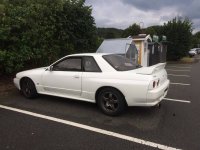
First Day.jpg

Becky, so named as she is white and trashy, was imported to Germany by another friend in the military; however, German inspectors are extremely tough on any car an American owns so the car failed its inspection. The owner then tucked the car in his garage and there it sat for quite some time. Before I really knew the guy, I was randomly talking to him about how I was looking for one and he mentioned he had one he was trying to sell. I spent a few weeks just poking around the car checking it out, it wasn't going anywhere, and finally decided to buy it knowing it needed tons of work.

I spent the next 7-8 months sorting Becky out and doing an enormous amount of mechanical work to make her reliable and fun. I also spent an enormous amount of time running her *** off on the autobahn, and for even more fun, tearing up the little curvy German roads. The twisties are where the GTR shines... But, Becky was not without her occasional issues and tow truck rides.
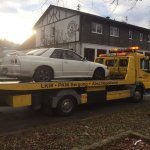
Germany Tow.jpg

I was shipped back stateside, to Las Vegas, in May 2018 and Becky was on a boat for a quite a few weeks but she finally made it to the port facility in St. Louis, Missouri and I had to go pick her up. Now, it would have made sense if I had shipped the car to the LA port since it's close to Las Vegas; however, I had my truck and trailer at my parent's house in Missouri, so I opted for St. Louis so I could get everything in one shot. Unfortunately, this turned out to be a weekend job....

I flew into STL on a friday afternoon, made it to my parent which live three hours south. Drove my truck out of the hole it had sat in the the four years, hooked up the trailer, and off I went back up to STL to get Becky. Finally, I had Becky back, I was loaded up, and ready to go.
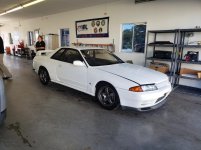
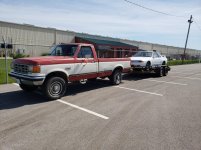
First Sighting in USA.jpg

Ready to go.jpg

The drive was hell... it was f*cking hell. 1,600 miles. 30 something hours. All in a truck that did around 60 mph, got 11 mpg, and had no A/C in the middle of summer. FML. But, I can't complain, for sitting for four years and not even getting an oil change before taking off, that truck did just fine. Anyways, made it to Las Vegas that same weekend. Did STL to Amarillo on day 1, then Amarillo to Vegas on day 2.

Once in Vegas I enjoyed Becky for a few months, all the while planning a tear down and restoration. My lady was constantly confused as to why people were always looking at Becky and why her friends at work wouldn't shut up about the car. So, during a night of more teasing from the lady, my timeline was slightly expedited by me proving her wrong about the car being "slow" and no rev limiter. :shocking:

So, I began stripping Becky and got her on a rotisserie since I figured it would be much easier to mover her around in my small three car garage and save a little space. She tucks nicely to the side and still gives me plenty of space to work in the rest of the garage.
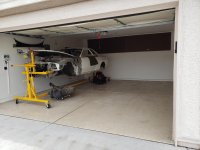
On the rotisserie.jpg

I am sorry this was a lengthy post, but it is basically a run up to where I am now with the car. I will be posting before too long with a summary of the damage and the repairs I have to make to the chassis itself before paint. I have never done bodywork, I have done tons of mechanical work, but never body work. So this is going to be a huge learning curve for me and I hope to learn a lot from you guys as I progress through this restoration.

First question, anyone have any suggestions for worthwhile web-based image hosting sites? I used to use Photobucket, but got rather annoyed with it.

Thanks for reading!!!
 
To avoid these ads, REGISTER NOW!
BORING HOP YARD

Well-known member
Joined
Jan 13, 2007
Messages
1,101
Location
Boring Oregon
Hey nice project GTR.
Not sure about photo hosting, I just download photos from my pc into a thread.
GTR looks like original paint and doesn't look like it has any heavy damage.
Thanks for sharing!
 
OP
R

RLaCasse1

Well-known member
Joined
Mar 8, 2014
Messages
272
Hey nice project GTR.
Not sure about photo hosting, I just download photos from my pc into a thread.
GTR looks like original paint and doesn't look like it has any heavy damage.
Thanks for sharing!

Unfortunately, importers do an excellent job of covering up damage. GTRs are known for issues in certain areas and Becky is not an exception. I'll post pictures later, but there is an enormous amount of body/chassis work that needs to be done.
 

Ohmthis

Well-known member
Joined
Jan 20, 2013
Messages
3,013
Location
Outside of Louisville KY
Great job with the lead in on the project. I loved the “Becky” name. I had a girl friend once that I nicknamed her crazy Becky, but crazy in a bad way. I do the same and just upload picture to the site. The only downside is that you may only be able to do a few at a time. I’m curious on this project, I’ve never been a fan of most “tuner” (sorry if that name offends you), but I enjoy the engineering.
 

joneschase

Active member
Joined
Aug 2, 2014
Messages
33
In for this.
Sweet car, sorry about the damage, excited to see you breathe some life into it again.


Sent from my iPhone using Garage Journal
 

phule

Well-known member
Joined
Jan 11, 2016
Messages
312
R32 & 33 my two favorites.

Sent from my SM-N960U using Tapatalk
 
OP
R

RLaCasse1

Well-known member
Joined
Mar 8, 2014
Messages
272
The damage:

I am going to do my best to give a concise break down of all the chassis and body issues Becky has, and hopefully get some helpful information in the process on how I should go about approaching the repairs. I'm going to try my best to give this rundown of Becky, starting at the front and working to the rear.

1. One of the first things I noticed on Becky when I was inspecting her was the right headlight was not lining up too well. About two months after buying the car I nailed a deer, luckily German deer are the size of a medium dog, and found myself replacing that headlight. In the process, I found some damage to the right side of the core support. Nothing too terrible, but damage none the less, I assume from a previous accident.


At this time, I do not intend on replacing the right side core support as I feel the damage can be repaired fairly easily by finessing the metal back in place. It doesn't appeared to be tweaked to badly, so I'm thinking this fix will be fairly straight forward. Additionally, the hole that is no longer round is for one the headlight mount bolts and lies on what was originally a flat surface. So I intend on patching that hole and drilling a new hole for the mount.

2. One of the many areas the GTR is prone to rust is underneath the plastic cowl cover. The cover sits directly on the metal cowl, traps water, and rusts over time. Becky has unfortunately had her cowl rust through on both sides where the cowl meets the hood ridge brace.


Since 99% of the cowl is in excellent shape, I will likely be removing the hood ridge braces and making small patches for the rusted areas. The hood ridge braces will be welded back in place afterwards. The rusted areas do not have an overly complex curves or shapes to them so this should be fairly straight forward.

3. Worst of the worst, at least in my opinion... the jack point, and outer and inner sills. The GTR is notoriously weak in the jack point area and often take a lot of damage to that area of the sill, jack point, and frame rails. The pictures below are of just one side of the car; however, both sides have very similar damage. I am only addressing one side, primarily the right side, in this post to reduce duplication. The first image is as shot of the outer sill, from the front wheel well, to give an idea of how badly the sill and pinch weld is bent out of shape. The second image should give a fairly decent idea of the over all mess.


Unfortunately, the extent of the damage is not clear in these two picture alone. Because the car was jacked improperly so many times, the sills were crushed repeatedly until it started affecting the inner sill and the floorboard itself. The following images give you an idea of how badly the inner sill and floorboard were affected. The first shows the bowing of the sill and the second shows how the floorboard came up and crushed the sill. Where the sill and floorboard meet should be a 90 degree angle.


This repair appears to be one of the more complicated repairs the car needs. I have a rough game plan for how I want to approach it; however, I am unsure if it's the best approach. I'd like to remove the outer sill, then simultaneously coax the floorboard and inner sill back into their original shape. Then patch the areas that needs patching, and replace the sill with a new OEM sill (still available luckily).

4. Rear quarter panels. Luckily OEM quarters are still available. Once again, I am only focusing on the right side, the left side is not even close to as bad. I could tell the right side quarter had issues when I first checked out Becky because it had some shoddy bodywork already in place (first picture). "Had issues" was a slight understatement which became very apparent as I stripped the car down. Additionally, the car appears to have possibly been hit in the area as the outer wheel house looks a little rolled toward the inside of the car (not picture).


As of now, the intention is to replace the left quarter panel and hopefully only that on the left side. Luckily the damage on the left side is not as severe as the right side. The right side will receive a new outer wheel house, sill extension (under the quarter), and a quarter panel.

5. The rear parcel shelf on the car has several holes in it that have plastic inserts for screw to thread into. Those screws hold the rear window lower trim in place. They are prone to rust from water damage.


Similar to the front cowl, only minor patches are needed to repair the damage; however, since the insert hole is actually square, getting the correct positioning may prove difficult for me.

6. AND FINALLY, the rear panel. There are rust issues right around where the tail lights mount.


The hope is to make some simple patch panels to fix what replacing the quarter panels does not.

Lengthy post, I know. But that is a basic rundown of what is going on with the chassis. I am all ears on better approaches and advice on how to go about these repairs. The next post will likely be a basic "vision" for the car and where I want the restoration and build to go.
 

Abeo

Well-known member
Joined
Oct 22, 2009
Messages
784
Location
Calgary, Ab
I'm having flashbacks to doing rust repair on my s13... good luck. It'll come together, you just need to do it bit by bit.

Since Canada import laws are 15 years, we got a head start on gtrs. People are still parting them out here from time to time.
 

BORING HOP YARD

Well-known member
Joined
Jan 13, 2007
Messages
1,101
Location
Boring Oregon
Body does has some issues, not bad.
Your going to need some body shop tools as you know.
Do you have a clamp for pulling like this?
https://www.amazon.com/dp/B00LBG1GTG/?tag=atomicindus08-20
Since you have the car on the rotisserie you could rotate it upside down. Use steel to make a bridge built off the floor pans that spans the repair area resting on strong points on the floor pan. Build a flat plate with a threaded shaft that would span the bridge you built and connect to the pull clamp to pull the sill back into position.
I have a surplus steel yard near me, I make these types of temporary tools all the time. I cut the welds apart and put the steel back into my stock until its been used up and scrapped.
Do you have a large slide hammer like this?
https://hamdown.hibid.com/lot/71411-136733-12369/harbor-freight-13-lb-heavy-duty-slide-hammer-set/
You may be able to slowly pull the sill back with a slide hammer and a good clamp with many repeated blows.
I have used a slide hammer to fix the same issue on a few 510's and a S12.
Key is all the impact from the slide hammer has to go into the pull, if the clamps keeps slipping you will have a hard time pulling it.
Hope this helps
 
OP
R

RLaCasse1

Well-known member
Joined
Mar 8, 2014
Messages
272
Body does has some issues, not bad.
Your going to need some body shop tools as you know.
Do you have a clamp for pulling like this?
https://www.amazon.com/dp/B00LBG1GTG/?tag=atomicindus08-20
Since you have the car on the rotisserie you could rotate it upside down. Use steel to make a bridge built off the floor pans that spans the repair area resting on strong points on the floor pan. Build a flat plate with a threaded shaft that would span the bridge you built and connect to the pull clamp to pull the sill back into position.
I have a surplus steel yard near me, I make these types of temporary tools all the time. I cut the welds apart and put the steel back into my stock until its been used up and scrapped.
Do you have a large slide hammer like this?
https://hamdown.hibid.com/lot/71411-136733-12369/harbor-freight-13-lb-heavy-duty-slide-hammer-set/
You may be able to slowly pull the sill back with a slide hammer and a good clamp with many repeated blows.
I have used a slide hammer to fix the same issue on a few 510's and a S12.
Key is all the impact from the slide hammer has to go into the pull, if the clamps keeps slipping you will have a hard time pulling it.
Hope this helps

Awesome idea on the bridge, I like it. I can try something like that and maybe set the bridge up on the frame rails, though the damage is outside the rails.

Great suggestion on the clamps, I had a different thing in mind, but I feel those clamps are going to be a much better route. And yes, the slide hammer was on the list of stuff to purchase.

At the same time I am pulling that area of the sill down, I was going to use something along the lines of a porta-power inside the car between the inner sill and trans tunnel. I figured with light pressure pushing the sill out, it would help the sill go back in place as the floor is pulled down.
 
Last edited:

sweet victory

Well-known member
Joined
Jun 9, 2016
Messages
1,263
Location
USA
Best of luck! This looks like it's going to be a fantastic thread!

I use smugmug. It's a few bucks a month, but totally worth it if you're into any sort of photography.
 
OP
R

RLaCasse1

Well-known member
Joined
Mar 8, 2014
Messages
272
The Goal:

Though I do love the original white color and clean white GTRs are gorgeous, I have decided to go with a different color on the car. She's gonna get that orange Donald Trump Spray tan. I am not 100% decided she will be orange, probably more around 99.9%; and the orange I would like to go with is the R35 GTR Katsura Orange. I love the color and effect of the paint based on lighting. I wish I possessed the skills to photoshop an R32 this color.

47076900234_02bc0308f2_z.jpg

46950142635_485e2459d7_z.jpg

Wheels are likely going to be the fattest TE37s I can stuff under the car. The look I am shooting for is nearly identical to the below car, including most body mods, but with the Katsura Orange.

46950227955_04a1c8634a_z.jpg

33989176158_ca45992173_z.jpg

The GTR's engine is the RB26 and is a straight 6 cylinder, twin turbo, DOHC, 2.6 liter engine. The engine I chose to go with for this build though is the RB30. The RB30 was available in Australia and New Zealand in several vehicles, but was never in the GTR. The RB30 is a 3.0 liter engine that is very similar to the RB26, but has a taller deck height and longer stroke. It does require some modification to make fit and work; however, I wanted this engine for the larger displacement and better stroke/rod ratio. The goal is an E85 car pushing around 850hp on a large single turbo while still retaining the A/C, cause Vegas is f*cking hot. Below is my RB30s the day they came in from New Zealand.

32922376307_2c0d51c84a_z.jpg

47814331212_0e1f562888_z.jpg

The engine is currently with a machine shop getting worked over and I'll assemble it at a later date.

Well, I think that is about it on the backstory and the vision for the car. From here on out it will likely be slower updates on actual progress on the car. I suspect there will be a lot of photos of screw ups and blood....
 

KBigg

Well-known member
Joined
Apr 15, 2019
Messages
474
Location
NE Indiana
This is awesome. I dont care what it is, American, foriegn, 4 wheeler, lawnmower, etc... If someones putting quality work into it, its cool. This should be a good build, looking forward to seeing the progress.
 
To avoid these ads, REGISTER NOW!

KojiKP

Well-known member
Joined
Aug 12, 2014
Messages
75
Location
WA
Good luck on the build, I'll be following along. I just sold my '90 GTR
 
OP
R

RLaCasse1

Well-known member
Joined
Mar 8, 2014
Messages
272
Another area of concern on the car that I forgot to mention in the post detailing the damage is the doors. Each door has similar rust areas on their interior just below the mirror. I will either be sourcing replacement doors, or cutting the door skin off, fixing the rust, and then replacing the skin. You can't see it in the first picture, but the second shows it well.


A few weeks back I made a nice big bath of dry ice and isopropyl alcohol to try and get all of the sound deadening mats out of the car. The bath worked very well and most of the mats came out very easily. On vertical surfaces though, there was no way to use that mixture, so I used electronic freeze spray. This stuff worked amazingly well; however, at nearly $10 a can, it is not a cost effective as dry ice and alcohol. But, it worked better than dry ice and you could pull huge sections of sound deadening.


But there were trouble areas with the sound deadening, along some of the major seams, the **** was gooped on there and it didn't appear to be seam sealer. Here's a couple examples.

32932717487_1e6664f404_z.jpg


I couldn't get that stuff off with anything, not a hammer and chisel, not a scrape, not a wire wheel, nothing. So today I went and bought one of those oscillating cutting tools things and a scraper attachment. It ended up going through the remaining sound deadening like it was butter.


Now a question, just how clean/stripped do I need to get this car before sandblasting will easily strip the rest? Should I go ahead and remove most of the seam sealer as well?
 

Pwaley

Well-known member
Joined
Apr 25, 2011
Messages
244
Love KPGC10 GTRs all the way through R32, R33, and R34! Keep up the good work.
 

BORING HOP YARD

Well-known member
Joined
Jan 13, 2007
Messages
1,101
Location
Boring Oregon
The door rust doesn't look very back from my knot hole, I would bet you could make a box out of plywood lined with plastic that is close to the shape of the door' placed on its nose then filled up with some cheap acid like Vinegar. A vinegar bath doesn't hurt fresh metal and it will only eat the rust. It takes a couple of weeks for it to work but the rust will come out bare metal.
What is your goal with the GTR when your done, street, track, show car, or?
Removing seam sealer is fine for a track car but might end up letting water in the body if driven in the rain very much. Sound deadening is kind of the same thing, are you going to put something back on the floor and seams, are you going to have music, carpet or have a conversation with someone in you car.
Is the goal to remove everything off the metal and then put everything back so you will know its all good. Be very careful of sand blasting, it can kill the GTR if done wrong by stretching the metal beyond repair. I have seen this before both by sandblasting pros and body men. If you do sand blast, put the car in the sun to make sure everything is very dry and rotate it to get the sand out, it will take a long time to get the sand out. I was warned about having problems with getting the sand out on my truck cab, they were right it took about 40 rotations on a rotisserie being vacuumed after each rotation to get all the sand out. You don't want sand to drop on you new paint.
4-5 years ago I stripped out the sealer and sound deadening on a s12 but I was building a track car and every seam on the body had to be stitch welded every inch to increase body rigidity. I used angle grinder with a wire wheel to get the last of the seam sealer off.
Hope this helps.
 

Boulderdash

Member
Joined
Nov 21, 2018
Messages
9
Location
UK
My mate has one of these. He said its his nest egg, as it's one of those cars where the appreciation rate is so steep it beats any bank interest rate 4 or 5-fold.
 
Last edited:
OP
R

RLaCasse1

Well-known member
Joined
Mar 8, 2014
Messages
272
The door rust doesn't look very back from my knot hole, I would bet you could make a box out of plywood lined with plastic that is close to the shape of the door' placed on its nose then filled up with some cheap acid like Vinegar. A vinegar bath doesn't hurt fresh metal and it will only eat the rust. It takes a couple of weeks for it to work but the rust will come out bare metal.
What is your goal with the GTR when your done, street, track, show car, or?
Removing seam sealer is fine for a track car but might end up letting water in the body if driven in the rain very much. Sound deadening is kind of the same thing, are you going to put something back on the floor and seams, are you going to have music, carpet or have a conversation with someone in you car.
Is the goal to remove everything off the metal and then put everything back so you will know its all good. Be very careful of sand blasting, it can kill the GTR if done wrong by stretching the metal beyond repair. I have seen this before both by sandblasting pros and body men. If you do sand blast, put the car in the sun to make sure everything is very dry and rotate it to get the sand out, it will take a long time to get the sand out. I was warned about having problems with getting the sand out on my truck cab, they were right it took about 40 rotations on a rotisserie being vacuumed after each rotation to get all the sand out. You don't want sand to drop on you new paint.
4-5 years ago I stripped out the sealer and sound deadening on a s12 but I was building a track car and every seam on the body had to be stitch welded every inch to increase body rigidity. I used angle grinder with a wire wheel to get the last of the seam sealer off.
Hope this helps.

It's actually kind of hard to see in the picture, but the rust in the door is bad enough that some of it has deteriorated entirely, so it will have to have small piece fabricated and replaced on the interior of the door.

I would like to have the car blasted, but like you mentioned, damaging the skin of the car has been a concern. There is a blaster here in Vegas who says it should be fine; however, my understanding is the GTR is very hard to pull off due to the some of the aluminum panels and the steel on the body being thinner than most cars. So I am not entirely sure it will be blasted. If it is, then I will be doing basically what you said, rotating it constantly and vacuuming it non-stop until every bit of sand is out of it.

I also considered just using aircraft stripper on the body, but I wanted to sand blast it to try and get the car as clean as it can possibly be.

The goal for the car is just to have a nasty street car, it won't be a track car. It will be a fun car to take out on the weekend when it's nice and to take to shows. Even if I did strip the seam sealer now, I'd still be resealing the seams later on, and yes, I will be adding sound deadening back into the car. I will say, I have also considered stitch welding seams; however, I'm not sure I want to take it that far at this time.
 

BORING HOP YARD

Well-known member
Joined
Jan 13, 2007
Messages
1,101
Location
Boring Oregon
The reason I asked....
I have a couple of friends that own body shops and I wanted to share the input they gave me when I do this type of work. It looks like 90% of the primer inside the car is in very good condition, most of it has paint on top of it. Here is the question I get from them. What is wrong with the 90% why not just scuff it up and repaint, I reply "peace of mind", they say waste of "material and time". I have done it both ways and to tell you the truth if done correctly they both are fine. I also tape off and shoot tinted bed liner down on the floor pans after prime and seam seal.
When I strip I use aircraft stripper or a DA sander.
You live in the heat and aircraft stripper should work very well.
I use these gloves, there one of the only ones that will protect you from the stripper.
https://www.newpig.com/north-silver-shield-4h-gloves/p/WPL262
I use another pair of gloves over the top of them so I can grip things like these gloves
https://www.ebay.com/p/Ansell-11-840-Hyflex-Coated-Gloves-Nitrile-Silver-6-PR/12028079289
The Silver glove protection last a very long time if you use gloves on top of them. I have a bucket of soapy water next to the area I'm stripping so If I have to take off the glove I put the gloves in the soapy water and get all the stripper off, let them dry and reuse. I have a cheap electric pressure washer that I use in my shop.
I apply stripper until I'm done, I rinse off with the washer, soap it down and scrub with scotch-brite and blast with high pressure, being very carful to hit every seam. Stripper still could be in the seam joint and may get pulled out during paint "not good".

So when you think clean remember your goal is a surface for primer to bite into and each layer of material to bite into material before. I like to use epoxy primer on all my projects.
Anyway I'm just trying to give the benefit of what I have learned along the way.
keep mind if you think "oh bullshirt" to any of my responses its ok, you have to do the way you want!
 
OP
R

RLaCasse1

Well-known member
Joined
Mar 8, 2014
Messages
272
The reason I asked....
I have a couple of friends that own body shops and I wanted to share the input they gave me when I do this type of work. It looks like 90% of the primer inside the car is in very good condition, most of it has paint on top of it. Here is the question I get from them. What is wrong with the 90% why not just scuff it up and repaint, I reply "peace of mind", they say waste of "material and time". I have done it both ways and to tell you the truth if done correctly they both are fine. I also tape off and shoot tinted bed liner down on the floor pans after prime and seam seal.
When I strip I use aircraft stripper or a DA sander.
You live in the heat and aircraft stripper should work very well.
I use these gloves, there one of the only ones that will protect you from the stripper.
https://www.newpig.com/north-silver-shield-4h-gloves/p/WPL262
I use another pair of gloves over the top of them so I can grip things like these gloves
https://www.ebay.com/p/Ansell-11-840-Hyflex-Coated-Gloves-Nitrile-Silver-6-PR/12028079289
The Silver glove protection last a very long time if you use gloves on top of them. I have a bucket of soapy water next to the area I'm stripping so If I have to take off the glove I put the gloves in the soapy water and get all the stripper off, let them dry and reuse. I have a cheap electric pressure washer that I use in my shop.
I apply stripper until I'm done, I rinse off with the washer, soap it down and scrub with scotch-brite and blast with high pressure, being very carful to hit every seam. Stripper still could be in the seam joint and may get pulled out during paint "not good".

So when you think clean remember your goal is a surface for primer to bite into and each layer of material to bite into material before. I like to use epoxy primer on all my projects.
Anyway I'm just trying to give the benefit of what I have learned along the way.
keep mind if you think "oh bullshirt" to any of my responses its ok, you have to do the way you want!

This is all good info, thank you for sharing. I've never done bodywork in this level, so believe me, it is appreciated. Like I said in my last post, I am not 100% sold on blasting being the right route. I have also considered the stripper route. But I guess I was under the impression the end result of blasting a car is that it would be better stripped than using a stripper. Please let me know if that's entirely untrue.
 

bradpac

Well-known member
Joined
Sep 8, 2013
Messages
721
Location
Central TX
On that car you would really probably be better off with sanding and/or stripper as it's a fairly slab-sided vehicle.

IMO blasting works best if you're in a hurry and send it off get it done and keep moving or if you have a body with a lot of crevices or contours that are hard to get to or sand and even then on the flat sections I would probably still sand or use stripper to avoid the risk of warping. Whatever you do, don't take it to a place that does industrial blasting on heavy gauge stuff, they will ruin sheet metal in a hurry.

You may look into dustless blasting, I've heard it is really good with heat build up as it uses water, but I've never actually had a car done with it.
 

BORING HOP YARD

Well-known member
Joined
Jan 13, 2007
Messages
1,101
Location
Boring Oregon
Have you thought about which primer your going to use?
Let's say you going to sand the inside of the car and shoot SPI Epoxy primer.
https://www.southernpolyurethanes.com/primers
High quality at a lower then local price for me in Oregon.
(Prepping the Surface: Metal or aluminum must be clean of all rust, oils, and any films. Never clean metal with lacquer thinner, acetone, or reducers of any kind. When prepping aluminum and metals for epoxy always sand aluminum or metals with 80 grit DA paper. Clean bare metals or aluminum with SPI 700 Waterborne WGR, clean with 710 WGR then let it sit 45-60 minutes before applying SPI Epoxy! If you have any questions on how to prep any type of substrate please call our tech line before beginning)
So in your case your going to be going over a painted substrate as well as bare metal, I use 80 grit on a DA for all areas that I cant get into, then 80 grit by hand then red scotch-brite in the areas that are very hard to get into.
I use CRE-X21 epoxy primer when I use an acid on the metal to removing rust. If you use an acid to remove rust you have to neutralize the acid with water and a little dawn soap, kind of like the stripper process. CRE-X21 has the following statement
(The surface to be coated must be abraded or sandblasted and free of all contamination (including dust, dirt, oil, grease and oxidation). A chemical treatment (or conversion coating) will improve adhesion and performance properties of the finished coat.)
The SPI epoxy does not play well with metal that has been etched.
I really like CRE-X21, made by PPG for their industrial line and its much cheaper than the automotive DP epoxy primer.
https://images.oreillyauto.com/parts/img/documents/ppg/cpcpb418+cre-x21+series+80513+fin.pdf
The reason I bring up primer, when you are thinking about surface prep " should I sand blast" do yourself a favor and prepare your self by seeing what the product needs. Sand blasting would work but is not needed if you abrade the surface.
I would bet with the right tools you could knock out sanding the inside of the car over a weekend.
Also on the rocker panel.
I have thinking about this since I posted about building a beam.
Place your hands together in front of your chest like your praying.
Your elbows represent the metal that is bulging from being pushed up into the floor.
if you pull the metal back into the correct location the bulging metal my just go back into position without being pushed on from the inside. Now take your hands together from the praying position and move them as far forward as you can, check how your elbows are no longer bulging out and there now in a straight line, I would bet this is what your rockers will do when pulled.
 
Last edited:
OP
R

RLaCasse1

Well-known member
Joined
Mar 8, 2014
Messages
272
Have you thought about which primer your going to use?
Let's say you going to sand the inside of the car and shoot SPI Epoxy primer.
https://www.southernpolyurethanes.com/primers
High quality at a lower then local price for me in Oregon.
(Prepping the Surface: Metal or aluminum must be clean of all rust, oils, and any films. Never clean metal with lacquer thinner, acetone, or reducers of any kind. When prepping aluminum and metals for epoxy always sand aluminum or metals with 80 grit DA paper. Clean bare metals or aluminum with SPI 700 Waterborne WGR, clean with 710 WGR then let it sit 45-60 minutes before applying SPI Epoxy! If you have any questions on how to prep any type of substrate please call our tech line before beginning)
So in your case your going to be going over a painted substrate as well as bare metal, I use 80 grit on a DA for all areas that I cant get into, then 80 grit by hand then red scotch-brite in the areas that are very hard to get into.
I use CRE-X21 epoxy primer when I use an acid on the metal to removing rust. If you use an acid to remove rust you have to neutralize the acid with water and a little dawn soap, kind of like the stripper process. CRE-X21 has the following statement
(The surface to be coated must be abraded or sandblasted and free of all contamination (including dust, dirt, oil, grease and oxidation). A chemical treatment (or conversion coating) will improve adhesion and performance properties of the finished coat.)
The SPI epoxy does not play well with metal that has been etched.
I really like CRE-X21, made by PPG for their industrial line and its much cheaper than the automotive DP epoxy primer.
https://images.oreillyauto.com/parts/img/documents/ppg/cpcpb418+cre-x21+series+80513+fin.pdf
The reason I bring up primer, when you are thinking about surface prep " should I sand blast" do yourself a favor and prepare your self by seeing what the product needs. Sand blasting would work but is not needed if you abrade the surface.
I would bet with the right tools you could knock out sanding the inside of the car over a weekend.
Also on the rocker panel.
I have thinking about this since I posted about building a beam.
Place your hands together in front of your chest like your praying.
Your elbows represent the metal that is bulging from being pushed up into the floor.
if you pull the metal back into the correct location the bulging metal my just go back into position without being pushed on from the inside. Now take your hands together from the praying position and move them as far forward as you can, check how your elbows are no longer bulging out and there now in a straight line, I would bet this is what your rockers will do when pulled.

I honestly have not looked into the paint and primer too much yet, but my plan was to work backwards from the paint and find out what is required to achieve the best results. In regards to sanding, I may go that route simply because I don't want to be trying to get sand out of it before I go to paint it.

How you explain the inner sill is basically what I am thinking is happening and how fixing it will go. The beam in the car was just merely for extra coaxing on that inner sill.

Sorry for such a later response, been wrapped up with other things like my WRX.
 
OP
R

RLaCasse1

Well-known member
Joined
Mar 8, 2014
Messages
272
Engine Work

It has been a substantial amount of time since an update on this thread. Unfortunately, life has kept me pretty busy since last year, but back to making some progress.

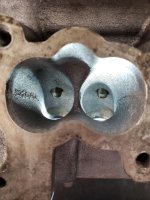
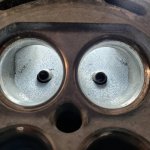
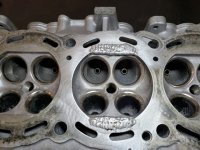
One of the projects I have been doing to keep myself busy is working on the engine. I've spend some of my free time over the last month doing some port work on the head I will be using for the engine in this car. Nissan's OEM castings for the RB26 head are pretty rough. As such, I decided to do some work to smooth the casting and bowl transition areas; however, I am not really doing an major "shaping" work in the ports and bowls. The only shaping I am doing is to the exhaust ports, the head has some odd lumps for no apparent reason and most people remove them (see pics).

I am still working on the head, I am still nowhere close to finished.

Original OEM casting. Extremely rough and also has really rough transitions in the bowl area where the machine work meets the unmachined area.
OEM Port.jpg
OEM Bowl.jpg

Below is a shot of the first intake port that I took up to 380 grit, which is where I will stop with the intake ports. For comparison, the other port in the image is only at 120 grit.
Intake Port_380 Grit.jpg
Intake Port_380 Grit vs. 120 Grit.jpg

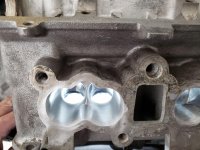
As mentioned above, the exhaust ports all have an odd protrusion in the port. It's an area of super thick aluminum, it can all be cut away without risking the integrity of the head or risking cutting into a water jacket.
Exhaust Port_Lump Removed.jpg

In addition to port work, the head did need a repair to one of the combustion chambers. The head was welded up at a machine shop and I am doing the reshaping of the combustion chamber. The pics below are a before and the progress I've made so far, though much more needs to be done. It's hard to tell in the second picture, but the surface is flat on one plane and decking the head will result in the proper shape.
Welded Chamber.jpg
Welded Chamber_Shaped.jpg

Like I said, I still have an enormous amount of time left on the head work alone.

Sorry for the picture size, maybe I'll figure that out in the future.
 
Last edited:
OP
R

RLaCasse1

Well-known member
Joined
Mar 8, 2014
Messages
272
Core Support Replacement

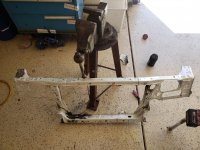
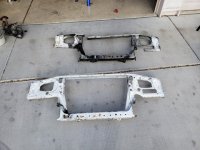
One of the issues with this car is the core support was damaged in an accident. The damage is not too horrible, but it is slightly misshaped. Additionally, someone hacked up several mounting holes on the core support, though I am unsure why. I didn't think the old support was worth repairing, so I chose to replace it. Luckily I found a front cut in Florida with a good core support and purchased it, then had my brother ship it to me in Las Vegas using Greyhound.

First things first, I had to get the core support off the front cut. Learned a few things along the way as I did this. This is the first time I've really done any major chassis work like this. So it's all a learning process.

This is the front cut. It ended just forward of the shock towers and included, but not pictured, the bumper, grill, headlights, crash bar, etc. I didn't have to remove to much excess, but still enough spot welds to be a couple hours of work.
Front Cut.jpg

But, it came out eventually. Someone had done a little smoothing work on the visible areas of the core support which made finding certain spot welds extremely difficult, this unfortunately resulted in two areas being a little more swiss cheese-like than necessary. Notice the swiss cheese at the ends, upper right/left of the core support.... I chose to disassemble the front cut first so I could get some practice in before working on the car.
Core Support Removed.jpg

Next, I cut the damaged one off the car. I didn't have spot-weld bits when I disassembled the replacement core support, but I decided to go grab a few when working on the car. They were junk, but then again they were from Harbor Freight. Next time, I'll probably buy a few high-quality ones so they will hold up better. The car at least, did not take any damage as I removed the core support.
Off the Car.jpg
Old vs. New.jpg

Then for shits and giggles, I decided to test fit the replacement core support. Just wanted to see it. I already took it back off as I have a ton of cleaning/prep work and repairs to complete before I weld it to the car.
Test Fit 2.jpg
 

casmurbax

Well-known member
Joined
Sep 25, 2012
Messages
2,758
Location
Wilton, NY
Very nice project you have going.
I thought you sent the engine to an engine shop post #17?
What rotisserie is that?
How were you able to drive on the autobahn when the German authorities said no to the previous owner on allowing it in.
 

BORING HOP YARD

Well-known member
Joined
Jan 13, 2007
Messages
1,101
Location
Boring Oregon
Welcome back.
Here is some take it or leave it advise on the front end.
Go to home depot and get some of theses screws.
https://www.homedepot.com/b/Roof-Fastener/Metal-Roofing-Accessories/N-5yc1vZ1z0lpb2Z1z0xd06
After you have aligned the core support back up install one of these screws in every spot weld you drilled out. Then you need to install everything back on the car fenders, doors, hood, grill and such. You want to check and verify all the gaps are good and the hood will latch. Once you verify that everything fits like it should and your satisfied with the fitment take it back apart, except for the front sheet metal that has been screwed in place. Now its time to weld up the holes you drilled. Remove one screw and weld up the holes in the metal. Do this one screw at a time, jumping all around to minimize warpage.
The screws allow you to make adjustments if needed during the fit up of the front end, they also pull the metal together for a tight fit to reduce gaps between sheet metal to prevent rust later and the mimic what a spot weld will do. Once the screw is removed the two pieces of Sheetmetal should be very tight to one another making it easier to weld, I use a hammer and dolly to make sure its flat and not distorted from the screw. I think of it as building an eggshell then welding it. If your moving metal during the welding you could be affecting final fit. I wont go into weld through primers, I use epoxy prime between the Sheet metal and weld with lots of fresh air.
You can see an example of what I'm talking about when I fixed my kids 510 that she crashed.
You can see the white screws starting about 2:04, Hope this helps
 

driftpin

Well-known member
Joined
Dec 22, 2016
Messages
11,259
Location
Miami-Dade/Broward Co. Florida
The door rust doesn't look very back from my knot hole, I would bet you could make a box out of plywood lined with plastic that is close to the shape of the door' placed on its nose then filled up with some cheap acid like Vinegar. A vinegar bath doesn't hurt fresh metal and it will only eat the rust. It takes a couple of weeks for it to work but the rust will come out bare metal.
What is your goal with the GTR when your done, street, track, show car, or?
Removing seam sealer is fine for a track car but might end up letting water in the body if driven in the rain very much. Sound deadening is kind of the same thing, are you going to put something back on the floor and seams, are you going to have music, carpet or have a conversation with someone in you car.
Is the goal to remove everything off the metal and then put everything back so you will know its all good. Be very careful of sand blasting, it can kill the GTR if done wrong by stretching the metal beyond repair. I have seen this before both by sandblasting pros and body men. If you do sand blast, put the car in the sun to make sure everything is very dry and rotate it to get the sand out, it will take a long time to get the sand out. I was warned about having problems with getting the sand out on my truck cab, they were right it took about 40 rotations on a rotisserie being vacuumed after each rotation to get all the sand out. You don't want sand to drop on you new paint.
4-5 years ago I stripped out the sealer and sound deadening on a s12 but I was building a track car and every seam on the body had to be stitch welded every inch to increase body rigidity. I used angle grinder with a wire wheel to get the last of the seam sealer off.
Hope this helps.

O.P.: I've read the entire thread, I enjoy the detail. You're doing a good job of taking your time, avoiding mistakes.

boring hop yard: you have much-more experience than I do, from reading your posts here. I would like to-ask you, have you ever tried vinegar for zinc die-cast, or german-sliver? (like carbs, or other precision die-cast parts) The reason I ask is that when I've done that, the material deteriorated to the point that it apparently went into-suspension in the vinegar. I was using 'cleaning vinegar' at 6% concentration. It was in-there for >24 hours, and I was a bit surprised when I found (or rather, "lost") that. It was inside another vessel, so it wasn't easy to-see when I did a visual inspection after about a half-day, to check on things. Never-again! Luckily the piece (on a Japanese motorcycle) is still available OEM/NOS.
 
OP
R

RLaCasse1

Well-known member
Joined
Mar 8, 2014
Messages
272
Very nice project you have going.
I thought you sent the engine to an engine shop post #17?
What rotisserie is that?
How were you able to drive on the autobahn when the German authorities said no to the previous owner on allowing it in.

1. I did send the block to a machine shop. I will assemble it at some point in the future. I am doing a bunch of headwork and it will then be sent to the machine shop once I'm done. When I get it back I will assemble everything.

2. I don't remember the brand. I bought it off Jegs or Summit, can't remember for sure. It's just a low quality "cheap" rotisserie.

3. All cars have to pass an inspection in Germany to be licensed. The previous owner bought the car and had it inspected. The car failed inspection miserably and he just put it in his garage as he didn't want to deal with it. I bought the car from him after he had it for a while in the garage. I'm fairly experienced with working on cars, so I just fixed everything and had it reinspected. It passed, I registered it, then I had fun with it on the autobahn and especially the smaller curvy roads.
 
OP
R

RLaCasse1

Well-known member
Joined
Mar 8, 2014
Messages
272
Welcome back.
Here is some take it or leave it advise on the front end.
Go to home depot and get some of theses screws.
https://www.homedepot.com/b/Roof-Fastener/Metal-Roofing-Accessories/N-5yc1vZ1z0lpb2Z1z0xd06
After you have aligned the core support back up install one of these screws in every spot weld you drilled out. Then you need to install everything back on the car fenders, doors, hood, grill and such. You want to check and verify all the gaps are good and the hood will latch. Once you verify that everything fits like it should and your satisfied with the fitment take it back apart, except for the front sheet metal that has been screwed in place. Now its time to weld up the holes you drilled. Remove one screw and weld up the holes in the metal. Do this one screw at a time, jumping all around to minimize warpage.
The screws allow you to make adjustments if needed during the fit up of the front end, they also pull the metal together for a tight fit to reduce gaps between sheet metal to prevent rust later and the mimic what a spot weld will do. Once the screw is removed the two pieces of Sheetmetal should be very tight to one another making it easier to weld, I use a hammer and dolly to make sure its flat and not distorted from the screw. I think of it as building an eggshell then welding it. If your moving metal during the welding you could be affecting final fit. I wont go into weld through primers, I use epoxy prime between the Sheet metal and weld with lots of fresh air.
You can see an example of what I'm talking about when I fixed my kids 510 that she crashed.
You can see the white screws starting about 2:04, Hope this helps

I like the screw idea. I was trying to avoid punching holes in the car as much as possible. But that may be worth it for the sake of a tight fit up. I had originally intended on using quite a few clamps to achieve the same effect.

Also, I was considering whether I need to put all the front body parts on to see if everything lines up. Is this necessary when the core support literally only fits one way. Like it butts up against flanges and I don't really see a method of adjusting that. Thoughts?
 

BORING HOP YARD

Well-known member
Joined
Jan 13, 2007
Messages
1,101
Location
Boring Oregon
Driftpin I have not tried it on zinc die cast or German silver, were you trying to clean or de-rust?
Quick search says bad things can happen with mixing zinc and vinegar, unless you want to strip it off.
https://www.iforgeiron.com/topic/12460-stripping-zinc-with-vinegar/

When I clean a carburetor I only use something like Berryman Chem dip, I have a 5 gallon container that is about 15 years old, but it still works great. I would bet a sonic cleaner would also do very well for you. I would start with the mildest dish soap and keep working my way up until I got it clean enough.
I'm currently restoring a 59 Ghia and have been using phosphoric acid on all of the suspension parts before they are primed and painted. I have also the acid on aluminum and magnesium but I never leave it on very long. I soaked my Datsun 510 fuse box in vinegar overnight followed by a soapy water "dawn dish soap" to neutralize the acid.
I then blow dry to prevent flash rust. Fuse Box and all of the copper fuse holders looked brand new.
Hope this helps.
 
To avoid these ads, REGISTER NOW!
Top Bottom