va.grouseman
Well-known member
Shift, that's what I call a true retirement/pension/savings plan.---You'll draw a whole lot more return on those than any bank will pay.---Mine are just in piles.


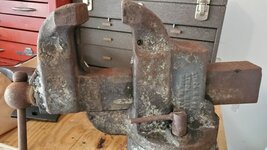
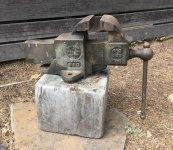
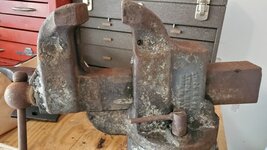
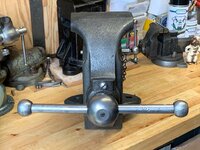
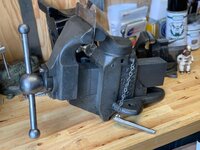
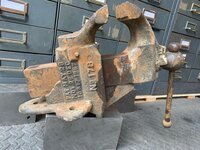
Got this interesting vise today.
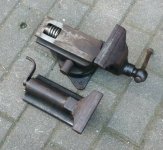
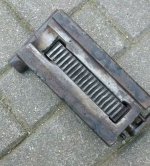
It's a swivel and quick adjust/release vise that opens to the back. Must be very old, and has no name on it. You have that handle in the back that rises/lowers the rack so the worm gear is either engaged or disengaged and you can quickly adjust the dynamic jaw. The swivel lock is an eccentrically mounted bar.
I checked old german patents but can't find anything.
The ball shaped end of the lead screw also points more to british or american origin? Any ideas?
Thank you for sharing! I saw that on your Instagram story and instantly realized the design with the handle out back was used as a quick release. Just curious what do you believe the value on such a vise is?
Sent from my iPhone using Tapatalk
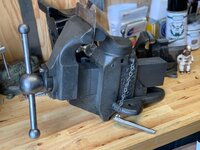
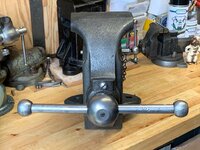
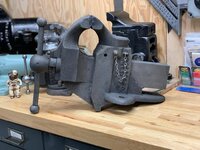
Got this interesting vise today.
It's a swivel and quick adjust/release vise that opens to the back. Must be very old, and has no name on it. You have that handle in the back that rises/lowers the rack so the worm gear is either engaged or disengaged and you can quickly adjust the dynamic jaw. The swivel lock is an eccentrically mounted bar.
I checked old german patents but can't find anything.
The ball shaped end of the lead screw also points more to british or american origin? Any ideas?
Very interesting - the lift off rack and worm has some relation to the Syers and Kenyon of the 1870s in Bradford UK area, and there were small English made bench clamp vices with 'German style' flat half oval and anvil moving rear in catalogues around 1900, but this looks different.
good find
 .
.Shift, that has grown since I was there! Well done!
If any of the vise gurus would be interested in commenting on this, I would appreciate it. I've gotten a few takes, but wouldn't mind having a few more before I slam a beer and spring into action.
Any of those ideas would work. How often do you expect to clamp something vertically up from the floor? As you said, in those instances a shim would make that possible. Not ideal for regular use but once a year is not worth considering if that move let’s you drill holes in a better location.
But you don’t need all four mounting lugs through bolted. Lots of great vises have only 3 lugs to begin with.
Shiftless. -
Nice vise collection. But living in earthquake country, looking at all those vises sitting on tall shelves gives me the creeps! Are they bolted down?
Shift, looks like an excellent place to filet a blue catfish, or dress a hog.---But you got to be willing to loose a little bit of that nice shine.
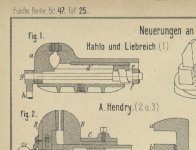
Yes, when looking for patents I found DE2577 (early one!), registered 21.03.1878, which is the german patent for this wood wise by Syers by Hahlo & Liebreich in Bradford. PDF
and 42107A by some austrian guy that copied it?
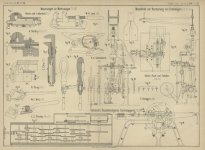
Edit: I googled for patent schraubstock schneckenwelle zahnstange (german words for patent vice worm rod rack) and got bumped to dingler.culture.hu-berlin.de. Could be I didn't tell you guys about this awesome page. I found that when I looked for vise patents. Just like scientific american can be read for free on archive.org this is a digitzed version of the german equivalent. With nice high res spread images perfect for large prints to frame and hang at the wall
The article I found was http://dingler.culture.hu-berlin.de/article/pj247/ar247125 which only shows a low res version, if you click to the full book you get a listing of all spreads Journal 247
Anyways it mentions a "Hahlo und Liebreich's Patent (* D. R. P. Kl. 49 Nr. 2577 vom 22. März 1878) " which is the english germanized patent from above being used by a vise made by "E. und P. Rottsieper in Ronsdorf" (foot note Vgl. Stephens 1872 206 * 427. Th. Hall 1873 209 * 11. 210 * 93. Lynde 1878 228 * 401. J. Thomson 1882 246 * 146.)
Then explains how it works. The vise's drawing is the upper left one but this is also the instant type, where you just move the main handle up and down to disengage and engage and tighten. Kinda close but not it.
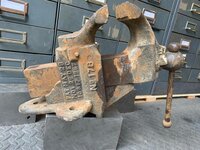

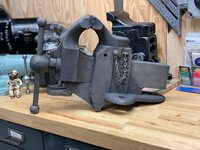





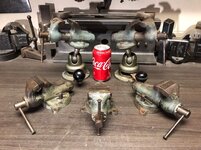
In honor of these pages hitting 80,000 postings, I submit an updated photo tour of one corner of my vise cave.
The tall skinny pic is of a corner shelf with bullets 2, 2.5, 3, 3.5, 4, 4.5, and 5. The 6 inch and bigger bullets exceed my self imposed 100 pound weight limit. I sold off a few heavier Reeds (4C and a 406) after I imposed my limit. That’s a C1 on the top shelf next to the Laphroaig bottle. (In the pic for scale purposes only)
I know a few of you are really digging the **** carpeting. It was on the floor when we bought the house almost 40 years ago.
I built the shelving, wired up the floodlights (I need a few more), and hung the aluminum mini blinds.
The room is a walk out basement with a door to the garage and a door to the back yard where I had a 10x10 slab poured that serves as an outdoor workshop.
.
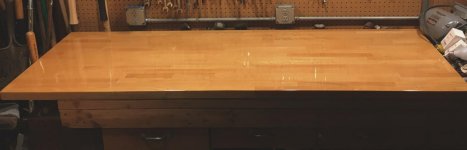
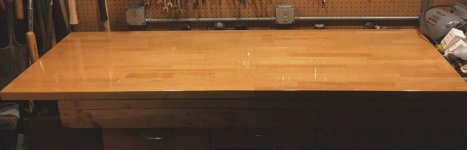
That bench top looked like that for maybe one week. Now it’s dirty, stained, paint spattered and scratched up. Acetone is rough on polyurethane. I have some shallow protective plastic trays but don’t always use them.
I could lift it up, move it outside, attack it with my belt sander and apply fresh polyurethane. Maybe someday I will. No plans for that now.


I think it's the natural state of a workbench top to look scruffy to an extent. That said, I was watching one of the Adam Savage videos where he fixes up a wobbly workbench, and the last thing he does, while telling the story of how it was a practice at ILM, is top the bench with brown paper and paper tape. It immediately struck me as a useful thing - you can write/trace/draw on it, it's sacrificial in a minor way, etc. and easy to change:
It's not pretty, but it's kinda cool and pretty tidy-looking. And clearly ready for work.
I think it's the natural state of a workbench top to look scruffy to an extent. That said, I was watching one of the Adam Savage videos where he fixes up a wobbly workbench, and the last thing he does, while telling the story of how it was a practice at ILM, is top the bench with brown paper and paper tape. It immediately struck me as a useful thing - you can write/trace/draw on it, it's sacrificial in a minor way, etc. and easy to change:
It's not pretty, but it's kinda cool and pretty tidy-looking. And clearly ready for work.
I think it's the natural state of a workbench top to look scruffy to an extent. That said, I was watching one of the Adam Savage videos where he fixes up a wobbly workbench, and the last thing he does, while telling the story of how it was a practice at ILM, is top the bench with brown paper and paper tape. It immediately struck me as a useful thing - you can write/trace/draw on it, it's sacrificial in a minor way, etc. and easy to change:
It's not pretty, but it's kinda cool and pretty tidy-looking. And clearly ready for work.

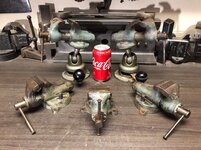

 very nice!
Where does a guy find new jaws for an old vise?
Its only a craftsman. Still functional but needs some jaws.