To avoid these ads, REGISTER NOW!

Putting air line through brick wall -suggestions wanted

gsebast1

Well-known member
Joined
Feb 6, 2006
Messages
58
Location
TX
Hello,

I am plumbing my new workshop with RapidAir 3/4” but first need to get the air from the compressor behind the building through the brick part of the wall.
Should I use black pipe, copper, or RapidAir outside?

Any tips or suggestions how to best put an air line through a wall?

Will be building a cover for the Quincy compressor after I run the lines.
 

Attachments
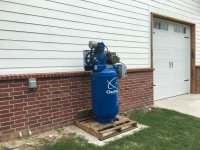
  • F6C3484D-AD36-405B-8070-2824E118C516.jpg
    F6C3484D-AD36-405B-8070-2824E118C516.jpg
    152 KB · Views: 174
Last edited:
To avoid these ads, REGISTER NOW!

Chris705

Well-known member
Joined
Nov 1, 2012
Messages
834
Location
The Finger Lakes of NY
I am would not advise on using copper unless you use a bushing and if doing that you may as well use the back iron or rapid-air product. The are sometimes salts and other minerals associated with the brick veneer, I would be worried about a galvonic reaction with the copper option. Maybe if you have never seen efflorescence on the wall it is anon issue.
 

nadogail

Well-known member
Joined
Jan 23, 2009
Messages
31,952
Location
Coronado, CA
IMHO, a PVC or ABS sleeve will protect your air line from damage and make eventual replacement easier,
 

karoc

Well-known member
Joined
Dec 19, 2017
Messages
1,999
Location
Hemphill Tx
IMHO, a PVC or ABS sleeve will protect your air line from damage and make eventual replacement easier,[/QUOTE
Plus 1,at work anything going through cinder block,or anything that will have concrete involved needs sleeves. Seems like cement attacks metal
 

txvwnut

Well-known member
Joined
Jan 1, 2015
Messages
7,620
Location
Bedford, Texas
Black pipe through the wall then use a heavy duty hose to connect the pipe to the compressor. This will prevent any vibration from the compressor being transmitted through the wall and into the building.
 

Firebrick43

Well-known member
Joined
May 12, 2015
Messages
14,035
Location
West central Indiana
Um, why not through the siding/wood wall above the brick Veneer? No only easy to drill but siding can will be replaced where brick would be difficult to impossible to patch invisibly.
 

CraigStu

Well-known member
Joined
May 22, 2014
Messages
4,030
Location
Blacksburg, Va
Um, why not through the siding/wood wall above the brick Veneer? No only easy to drill but siding can will be replaced where brick would be difficult to impossible to patch invisibly.
I agree. Going through wood and siding is so much easier. I'd find a wall stud and use black iron pipe that is attached to the stud with some type of saddle bracket. Flexible hose to the compressor, and your RapidAir inside.
 

Joemctag

Well-known member
Joined
Aug 11, 2017
Messages
813
Location
Outside raleigh nc
Like karoc said, pvc sleeve, say 2”. You can pack the annular space between the sleeve and the air line with fiberglass insulation plus caulk if you want. If it was gas, water, sewer or electrical conduit, you’d probably be required to have the sleeve, even on a residence.
 
To avoid these ads, REGISTER NOW!
OP
G

gsebast1

Well-known member
Joined
Feb 6, 2006
Messages
58
Location
TX
Thanks for all the great replies. I decided I will go through the siding instead of the brick. I thought aesthetically it would look better going through the brick, but it IS on the back of a garage, so it doesn’t matter that much.

I have a finished wall on the inside so I’m trying to decide whether to use copper, black pipe, or RapidAir to run from the compressor outside and through the wall to connect to the Rapid Air system on the inside.
Anybody have photos of how they punched their system through the outside wall and secured on the inside?


  • Black pipe - seems the easiest but I want as minimal corrosion as possible because I will be painting cars and parts.
  • Copper - seems good but how do you run it through a finished wall and solder/secure it?
  • RapidAir - Easisest to do, but should it be run on the outside of the building? Not sure if it is affected by UV rays. I don’t know if it can be painted? I could put some kind of chase over it.
 
Last edited:

NUTTSGT

Super Moderator
Staff member
Joined
Sep 14, 2009
Messages
50,945
Location
Northern Central Ohio
IMHO, a PVC or ABS sleeve will protect your air line from damage and make eventual replacement easier,

This is my first thought as well but I realized this thread is a few weeks old. However, you did come back.

Personally, I'd make the hole big enough for a PVC conduit sleeve to slide the airline through and I'd use black pipe and just keep it painted.

You could add a siding block like mount for a light fixture/outlet. That would dress it up.

I would also use a section of hydraulic hose to go from the compressor to the black pipe for vibration isolation. In doing so, I'd make sure there is a decent droop in the hose to direct any rain water down away from the hole entrance.

Once it's done and installed, I'd simply caulk (color match) around the airline and sleeve.


EDIT: As a side thought, you could use a piece of stainless to make the transition from outside to inside.
 
Last edited:
OP
G

gsebast1

Well-known member
Joined
Feb 6, 2006
Messages
58
Location
TX
Thanks for the great feedback. I dumped the idea of going through the brick once I saw how well the RapidAir blocks could work to help me put the pipe theough the wall. One tiny hole and the RapidAir blocks fit into the trim on my building like I had designed it that way.
Just did an overnight pressure test and less than .5 psi difference in 12 hours.
👍
 

Attachments

  • F7FE61BF-1B1F-4E4D-93BD-586C5AD2DAA3.jpg
    F7FE61BF-1B1F-4E4D-93BD-586C5AD2DAA3.jpg
    149.8 KB · Views: 65
  • 970EBD26-B9FD-4877-98E3-FE5DBCEEBA87.jpg
    970EBD26-B9FD-4877-98E3-FE5DBCEEBA87.jpg
    150 KB · Views: 62
  • 00C334CF-E424-48E9-9D32-3B0C118F2675.jpg
    00C334CF-E424-48E9-9D32-3B0C118F2675.jpg
    99.1 KB · Views: 66
  • B8275249-865E-477E-9890-B5DAEC0595DA.jpg
    B8275249-865E-477E-9890-B5DAEC0595DA.jpg
    151.6 KB · Views: 116
  • 03104CDE-2897-4192-B653-DF507287B0D7.jpg
    03104CDE-2897-4192-B653-DF507287B0D7.jpg
    61.8 KB · Views: 65
OP
G

gsebast1

Well-known member
Joined
Feb 6, 2006
Messages
58
Location
TX
Marc,

That’s exactly what I’m doing. Going to have approx 215 ft of line with 7 drops and drains.
Trying to do this right the first time.
 

LS6 Tommy

Well-known member
Joined
Dec 27, 2013
Messages
26,162
Location
Northern NJ
I would do copper, several wraps of black tape. or shrink wrap if you're going thru the brick. good to go .

IMHO, a PVC or ABS sleeve will protect your air line from damage and make eventual replacement easier,[/QUOTE
Plus 1,at work anything going through cinder block,or anything that will have concrete involved needs sleeves. Seems like cement attacks metal

This is the way to go. I'd move the compressor away from the building or turn it at least 90°. You're goimng to hate changing the belt.

Tommy
 

larry_g

Well-known member
Joined
Apr 28, 2007
Messages
16,879
Location
oregon
https://www.garagejournal.com/forum/attachment.php?attachmentid=1060968&d=1602782018
attachment.php


In this picture it looks like the flex hose connection is higher than the run of the pipe and the pipe is level. This all adds up to water collection in the piping. I would suggest that you rework things so that water condensing in that section of piping is configured so that it will flow back into the receiver where it can collect and be removed with your tank drain. I can't see how the yellow line is connected to the receiver but it should be going uphill all the way to the pipe connection. Water management in a pneumatic distribution system is not something to overlook.

lg
no neat sig line
 
OP
G

gsebast1

Well-known member
Joined
Feb 6, 2006
Messages
58
Location
TX
I'd move the compressor away from the building or turn it at least 90°. You're goimng to hate changing the belt.

Tommy

Thanks Tommy. This is some great feedback. :thumbup:

I’m doing something unusual and putting double-hung windows with screens on both sides of the building so there will be great ventilation during the super hot Texas summers. This will also allow some side access by being able to take the windows out.

Turning the compressor 90 degrees may be the way to have total access to everything without having to build a much larger enclosure.
 

LS6 Tommy

Well-known member
Joined
Dec 27, 2013
Messages
26,162
Location
Northern NJ
Thanks Tommy. This is some great feedback. :thumbup:

I’m doing something unusual and putting double-hung windows with screens on both sides of the building so there will be great ventilation during the super hot Texas summers. This will also allow some side access by being able to take the windows out.

Turning the compressor 90 degrees may be the way to have total access to everything without having to build a much larger enclosure.

Quincy's are great pumps, but I'd like to kick the guy who designed the belt cage in the nuts.

Tommy
 

HenryAZ

MEMBER EMERITUS
Joined
Sep 18, 2012
Messages
1,054
Location
South Congress AZ
Quincy's are great pumps, but I'd like to kick the guy who designed the belt cage in the nuts.

I had to deal with this recently, replacing the motor on my QT-5. The compressor is mounted with the belt cage on the wall side, about 8" from the wall. I had to take the cage apart, and when done I decided to leave only the front part of the cage in place, a single "panel" of cage. The main part, consisting of the top, sides, and back panel, which comes off as one piece, is now in the attic. You really have to try hard to get near the belt/pulleys, so I believe the one panel is adequate.
 
To avoid these ads, REGISTER NOW!
Top Bottom