To avoid these ads, REGISTER NOW!

Finished control panel for SB Lathe. Pics

HoosierBuddy

Well-known member
Joined
May 9, 2006
Messages
2,935
Location
Southern Indiana
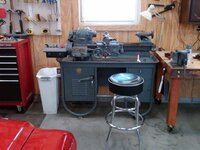
This is a control panel I built to provide inputs for the VFD drive on the lathe. I like the way it turned out. Ivan (from this forum) sent me the blueprints for the control circuit. I used some surplus Alan Bradley switches instead of the radioshack p/n's on the plans.

-pics-completed-lathe-vfd-control-panel-sbcontrol1.jpg

-pics-completed-lathe-vfd-control-panel-sbcontrol2.jpg

-pics-completed-lathe-vfd-control-panel-sbcontrol4.jpg


It was a really fun project!

Phil
 
To avoid these ads, REGISTER NOW!

mrb

Well-known member
Joined
Dec 31, 2008
Messages
3,734
I like it!!! cool that you used lamacoid labels...the thing looks like it came with the lathe.
 

APEowner

Well-known member
Joined
Oct 2, 2009
Messages
4,166
Location
Sunny, New Mexico
That looks really nice. You may want to rethink the location of the VFD and the open back on the panel. Once you start making chips I think you'll find that they will find their way into the back of the panel and into the cooling fan on the VFD.
 

rsanter

Well-known member
Joined
Dec 22, 2007
Messages
18,524
Location
visalia ca
Just be sure your motor is VFD rated. Don't want to cook it.

the motor will not be VFD rated as they didnt have VFDs back then

the issue is at lower speeds the fan in the motor will not move enough air to keep the motor cool under long operation.
what some people do is to add an auxiliary fan to keep air moving through the motor regardless of motor RPM

bob
 

Stuart in MN

Well-known member
Joined
Sep 8, 2005
Messages
23,186
Location
Minneapolis
I agree on covering the back side of the control panel, as well as the VFD (maybe a simple shield over the top of it that will keep chips out but let air flow in.) The panel itself looks good, I like that you included a nice big emergency stop button.
 
OP
H

HoosierBuddy

Well-known member
Joined
May 9, 2006
Messages
2,935
Location
Southern Indiana
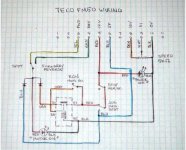
Good point on the open back and the VFD cover. I'll see what I can do. BTW...John Pitkin is the guy that did the control panel wiring design. This is the circuit diagram from the pdf file he wrote.

I changed up the design a little bit by using a pc relay in place of the "run" light. I had to do that because my AB lamps were 120V. I also use a relay to run my Jog light. This circuit diagram was extremely helpful to me in putting this thing together.

attachment.php


Phil
 

Attachments

  • teco control.jpg
    teco control.jpg
    128.8 KB · Views: 308

Iroc-Z

Well-known member
Joined
Mar 21, 2006
Messages
720
Location
New Germany, MN
Can some one explain what he did? Does this allow you to slow the electric motor down? Also is your lathe two phase or three phase?
 

Stuart in MN

Well-known member
Joined
Sep 8, 2005
Messages
23,186
Location
Minneapolis
With a VFD, you can run a device with a three phase motor (like a lathe) from the regular single phase power that most people have at home. You can use the VFD to vary the motor speed, or even run it in reverse, but with a lathe those things aren't necessarily as important since it has a means to control the turning speed already. The VFD can also provide a soft start and soft stop, so the motor will ramp up to speed and slow down gradually - this saves wear and tear on the machinery and reduces the startup current. In real life there really isn't any such thing as two phase power.
 

rsanter

Well-known member
Joined
Dec 22, 2007
Messages
18,524
Location
visalia ca
a VFD is a variable frequency drive
it takes AC in and turns it into DC then digitally turns it back into AC.
the AC output now can have the frequency changed in order to change motor speed without loosing rated power output of the motor

the RPM of a motor is controlled by the number of windings, voltage/amperage, and the frequency

bob
 
To avoid these ads, REGISTER NOW!

Stuart in MN

Well-known member
Joined
Sep 8, 2005
Messages
23,186
Location
Minneapolis
There is... or was.... but you will never encounter it. Was actually common at the "turn of the century" (1900) but is no longer generated or used.

Charles

Yeah, that's basically what I meant - it was done in the past, but you're not going to find it anywhere today outside of a history book.
 

Rentawrench

Well-known member
Joined
Sep 22, 2009
Messages
186
Location
Holyoke,Ma. USA
You want a 2 phase Bridgeport motor? lol

I bought a Bridgeport at an auction,got it home an my Uncle told me it was 2 phase. Told me the Only 2 phase left was the oldest church in town to run the Big Pipe Organ,an that all the mills had it during WWII. I kept it incase it makes a comeback. Yes I keep TOO MUCH Junk.

Nice Job on the VFD.
 

Iroc-Z

Well-known member
Joined
Mar 21, 2006
Messages
720
Location
New Germany, MN
One last question for you guys. Could you use one of these on lets say a drill press in order to adjust the speed without messing with belts?
 

Falcon67

Well-known member
Joined
Jun 11, 2009
Messages
18,371
Location
Merkel, TX
One last question for you guys. Could you use one of these on lets say a drill press in order to adjust the speed without messing with belts?

To a point, if the drill press has a 3 phase motor rated for a frequency drive.

PS - nice panel, good layout. YES - cover that thing before you fry it. I put mine way up on the wall above chip fly level.
 

larry_g

Well-known member
Joined
Apr 28, 2007
Messages
16,899
Location
oregon
Hmm so these only work with three phase motors. I see. Thanks guys.

I wish that was quoted on every site that is even remotely connected to men and machines.

In reference to Falcon67's statement "To a point, if the drill press has a 3 phase motor rated for a frequency drive." that a freq drive rated motor is necessary I have to disagree a bit. In the industrial world where a motor is running constantly at a reduced speed and nearing peak current it is very important as the freq rated motors have insulation that will handle the additional heat. In most home shops you are not running anywhere near 100% duty cycle and can get by with a regular motor. Additionally if you limit the speed range to keep the motor operating near rated speed you will have no problems. Think in the range of 50% reduction and a 10% increase and you should be fine. Just be smart about it. On the lathe if your planning some hogging on some tough material gear it down keep the motor speed up. The VFD isn't a magical box that gives unlimited speed ranges eliminating any gear or belt changes. Think of it as the accelator in your stick shift automobile. You use it to adjust speed in a specific gear, bit you shift the trans to keep the engine in its proper operating range for the driving condition.

lg
no neat sig line
 

Iroc-Z

Well-known member
Joined
Mar 21, 2006
Messages
720
Location
New Germany, MN
I wish that was quoted on every site that is even remotely connected to men and machines.

In reference to Falcon67's statement "To a point, if the drill press has a 3 phase motor rated for a frequency drive." that a freq drive rated motor is necessary I have to disagree a bit. In the industrial world where a motor is running constantly at a reduced speed and nearing peak current it is very important as the freq rated motors have insulation that will handle the additional heat. In most home shops you are not running anywhere near 100% duty cycle and can get by with a regular motor. Additionally if you limit the speed range to keep the motor operating near rated speed you will have no problems. Think in the range of 50% reduction and a 10% increase and you should be fine. Just be smart about it. On the lathe if your planning some hogging on some tough material gear it down keep the motor speed up. The VFD isn't a magical box that gives unlimited speed ranges eliminating any gear or belt changes. Think of it as the accelator in your stick shift automobile. You use it to adjust speed in a specific gear, bit you shift the trans to keep the engine in its proper operating range for the driving condition.

lg
no neat sig line
Thanks for the explanation. That makes total sense. The reason I ask is we have a Ellis Drill press at work that looks to be 220v. It has an Ellis speed control mounted on it that lets you switch between forward and reverse. Then it also has a knob that adjusts the speed. I rarely have to mess with the belts. It is similar to this model.
http://www.tools-plus.com/ellis-9400.html
It is just nice to control the speed with a quick flip of a dial for most drilling procedures.
 
To avoid these ads, REGISTER NOW!
Top Bottom