To avoid these ads, REGISTER NOW!

Drilling 9/16 holes in A36

mcbane

Well-known member
Joined
Jul 23, 2017
Messages
794
Location
California
Question for drilling experts:

I am trying to figure out how to drill 9/16 without premature failure of drill bits. I have drilled hundreds of small holes in mild steel on a single cobalt bit before. 3/16 I drill straight through and get perfect spirals. For 3/8 holes I use the 3/16 as a pilot first. The 3/8 bit is clearly slowing down after maybe 300 holes in 3/16 thick angle iron, cutting dry at 290 rpm.

So for the 9/16 holes I drilled 3/16, then 3/8, the 9/16. The first hole on a new bit produces perfect spirals. But the edges are already chipped and it slows down with each new hole. After 50 holes the cutting edges look beat up and drilling is slow. Chips are yellow or blue rather than silver. After 100 holes it is done. Been through two bits so not a fluke.

Drilling at 200 rpm on. jet 20 inch press. Dry. Am I trying to feed too fast or is my minimum drill press rpm too fast? Or do I just need to use lube? Don’t want lube because I need to weld and paint later and I want to avoid a day of solvent wiping parts.


Sent from my iPhone using The Garage Journal mobile app
 
To avoid these ads, REGISTER NOW!

bri_man57

Well-known member
Joined
Mar 6, 2013
Messages
189
Location
Windsor Colorado
I'm no expert but I would be using a brush with some cutting oil to lube the drill but keep the mess to a minimum. And I believe your rpms are about 2.5x faster than the recommended Rpm.

Sent from my SM-N920T using Tapatalk
 

BlindViper

Well-known member
Joined
Dec 1, 2009
Messages
1,306
Location
York, PA
I'm no expert but I would be using a brush with some cutting oil to lube the drill but keep the mess to a minimum. And I believe your rpms are about 2.5x faster than the recommended Rpm.

Sent from my SM-N920T using Tapatalk
max speed for low carbon steel is 80-100 sfpm or 543-679 rpm with a 9/16 drill
 

larry_g

Well-known member
Joined
Apr 28, 2007
Messages
16,885
Location
oregon
Do you not know how to sharpen a drill bit? Might be time to learn. I also subscribe to the process of using a pilot drill the size of the web thickness and then go to the finish drill. With drilling with the 3/8" bit you are using 1/3 of the 9/16 cutting edge. Try going 3/16" and then 9/16" IF your machine has the power.

lg
no neat sig line
 
OP
M

mcbane

Well-known member
Joined
Jul 23, 2017
Messages
794
Location
California
Thanks for the advice. Tomorrow I’ll try 3/16 straight to 9/16. My schedule doesn’t permit use of lube but I have ordered a drill bit sharpener. I have a huge collection of dull bits.


Sent from my iPhone using The Garage Journal mobile app
 

LeeG

Well-known member
Joined
Nov 29, 2012
Messages
1,527
Location
Phoenix, AZ
Unless you are forbidden from using lubricant, it can significantly speed up the drilling process. Here is a great Project Farm video on cutting oils.


Time to drill a 3/8” hole through mild steel was 71 seconds doing it dry, and 31 seconds with the best oil (Tap magic).
 
OP
M

mcbane

Well-known member
Joined
Jul 23, 2017
Messages
794
Location
California
I normally use lube for all drilling because I normally don’t care how long it takes to clean the metal afterwards and I care how long drill bits last. In this case I have no time. A day of delay is very costly. And there will be a welding special inspector potentially flunking welds because the metal wasnt adequately degreased. I’ll return to normal, sane work approach once this project is done.


Sent from my iPhone using The Garage Journal mobile app
 

matt_i

Well-known member
Joined
Mar 14, 2008
Messages
10,728
Location
SE Michigan
Chips are yellow or blue rather than silver.


This is your guide as to how much heat is being produced in the cut. Which transfers directly to the razor sharp edge of your tool and breaks it down -- dulls it.

Any time you are making a blue chip you're compromising a steel edge tool. Carbide can handle a lot more heat but this is far from the right application for carbide.

The only way is to go slower. I'd cut that at 80 rpms if I wanted my bits to last for a long time and a key parameter was "no lube".

As you are describing its either timeouts for sharpening or order a pile of drill bits and view them as consumables necessary to gain speed on the job.

Or find an ironworker (machine not a person) and they'll all be done in an hour or two. BAM its done, two seconds to return the punch for the next hole.

Those old SFM tables come from the 1930s with industrial engineers in an office trying to do time studies about how many horizontal mills they needed to buy to make cylinder heads, not a person paying for their own edge tools. Its a starting point for sure but if your own wallet is on the line you may want to choose differently.
 

RoninB4

Well-known member
Joined
Jul 22, 2020
Messages
3,565
Location
Under My House
It would be best to look up cutting speeds/feeds but sometimes a speed selection isn't possible, like a drill press with no setting dial or a hand held drill. A general rule of thumb for cutting with HSS (lathe, mill, or drill) is a yellow/blue chip is too fast. Cutting fluid is best but sometimes I machine things dry too, just don't tap something dry unless it's cast iron. I would also second the suggestion to learn how to sharpen cutting tools on a bench grinder, look this up it's not difficult to learn. Carbide has different rules about speed/feed but carbide isn't suitable for everything no matter what anyone else says. My opinion is based on 30+ years of machining.
 
Last edited:

MushCreek

Well-known member
Joined
Jan 14, 2015
Messages
9,783
Location
Upstate South Carolina
I wouldn't be anywhere near 80-100 sfpm unless I was using a rigid, automatic machine like a CNC mill, and flood coolant. Sure, it will do it, but you'll eat drill bits. I would skip the 3/8" drill, and use coolant. The too-big pilot hole is causing vibration, which is chipping the 9/16 bit. Actually, on my Bridgeport I would use a center drill, then go right to the 9/16, but you may not have enough power for that. If the chips are blue, it's too hot for good bit life. You have to make a choice between cycle time, bit life, and potential clean-up afterwards. If you're doing paying production work, which is what hundreds of holes generally is, you need to do a time/cost study to really know which route is cheapest. It might actually be cheaper to blast through dry, and just throw away the burnt bits. Or not.

I've done production machining on and off my whole life. We've been surprised sometimes by what time studies reveal. On one job, the cost of quickly re-sharpening a bit was 3X the cost of just chucking up a new one. It goes against my nature to throw anything away, but time is money. Likewise, if you slow it down enough to do 500 holes, how much tine have you added to the cycle time?

Of course, you could just use a punch press and get the cycle time down to a couple seconds, if you have enough volume to justify the tooling. I worked at a boat trailer manufacturer, and they punched 95% of the holes.
 

king nero

Well-known member
Joined
Dec 27, 2010
Messages
1,469
Location
Belgium
Punching has its disadvantages, but I have no idea if the application is "high-tech" enough to warrant not using punching.

Isn't a core drill an option?
 

BillK

Well-known member
Joined
Aug 24, 2006
Messages
9,328
Location
Beautiful Southern Maryland
How many holes do you have to drill ?? As much as it kills me I have also adopted the "throw it away" mentality on most drill bits, especially small ones.

I generally find it better to not use a starting hole other than a center drill. I drill 3/4" and 1" holes in crankshafts for balancing and find that they drill best without a starting hole. I did a few 9/16" yesterday and was running at 238 rpm.
 
To avoid these ads, REGISTER NOW!

nadogail

Well-known member
Joined
Jan 23, 2009
Messages
31,965
Location
Coronado, CA
A little Tap Matic in a saucer applied with an acid brush will work wonders. If required a wipe with an alcohol dampened rag should clean everything up "good enough".
 

BillK

Well-known member
Joined
Aug 24, 2006
Messages
9,328
Location
Beautiful Southern Maryland
720 holes. Around 500 in 3/16 angle, the rest in 1/4 plate.

Wow !!

Have you tried without the pilot holes ?

You stated that a day delay would be "costly" ? How much is "costly" ? Looks like 9/16 cobalt bits are $45 each at McMaster and they are usually expensive. Would buying 5 of them be less costly than the time you spend trying to sharpen them etc ?
 
OP
M

mcbane

Well-known member
Joined
Jul 23, 2017
Messages
794
Location
California
Building a red iron garage. I have a tight construction window so cost is mostly a risk of damage due to weather (sometimes it snows by last week in August). Otherwise, equipment rental is burning $2K per week when crew is idled.

The extra parts needed are due to a design error by the metal building engineers. There is a corrective detail but their lead time to produce would blow out the schedule by a month or more based on prior responsiveness. So I am producing parts and will charge back to them. My bill will include a lot of cobalt drill bits.

And I havent tried without pilot holes - my drill press doesnt have enough power for that.
 

nadogail

Well-known member
Joined
Jan 23, 2009
Messages
31,965
Location
Coronado, CA
Are you buying them only one at a time? Sometimes trying to save money by purchasing only exactly what you calculate you need can bite you where you carry your wallet.

I try to "Round Up" to the next whole package. I never buy only a half box of something because I know I will eventually use the surplus. My stock of accumulated extras has eliminated the need for many trips to the supply house.
 

nadogail

Well-known member
Joined
Jan 23, 2009
Messages
31,965
Location
Coronado, CA
Are you buying them only one at a time? Sometimes trying to save money by purchasing only exactly what you calculate you need can bite you where you carry your wallet.

I try to "Round Up" to the next whole package. I never buy only a half box of something because I know I will eventually use the surplus. My stock of accumulated extras has eliminated the need for many trips to the supply house.
 

BukitCase

Well-known member
Joined
Apr 11, 2017
Messages
1,075
Location
Oregon
"What power drill is adequate for drilling 1” holes with no pilot hole?"

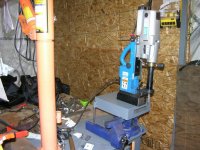
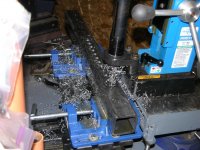
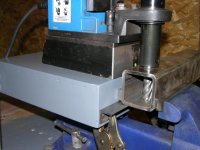
Or a mag drill - I use mine these days for ANY hole big enough for an annular cutter - also have adapter and regular chuck for smaller ones.

I routinely drill 21/32" (clearance for 5/8 bolts) in 1/4" wall tubing - the 21/32 cutter has drilled a few hundred holes, still sharp. A36 steel 1/4" thick takes about 22 SECONDS per hole. 1-1/2" holes (backhoe pins, etc) in 3/4" steel takes maybe a minute... Steve
 

Attachments

  • DSCN1877.jpg
    DSCN1877.jpg
    156.9 KB · Views: 64
  • XY-Use-5.jpg
    XY-Use-5.jpg
    155.1 KB · Views: 59
  • DSCN1884.jpg
    DSCN1884.jpg
    139.9 KB · Views: 54
  • XY-Use-10.jpg
    XY-Use-10.jpg
    153 KB · Views: 55
Last edited:

4 FN 27

ALLIANCE MEMBER
Joined
Oct 19, 2015
Messages
4,635
Location
Minnesnowta
Speed, Feed, Chip Load and Lube will determine the life of the Drill.

Or

Is there a shop in your area with a Water Jet?

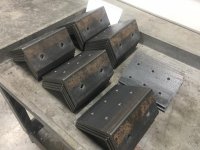
I blasted holes through Angle with mine a while back for a friend. He needed 2 .5625 holes and 6 .375 holes added to each 6 inch piece of 1/4 Angle.

He did the 3/8 holes in my Mill and I did the 9/16 holes in the Water Jet.

He brought with him a hand full of 3/8 & 9/16 new Viking Drills. He used 1 3/8 Drill. Didn't even touch the 9/16 bits. He left them as payment for my time.

We should have done all the holes in the Water Jet.

Took less than a minute a part.

attachment.php


attachment.php


The Drill Bit after 156 holes:

attachment.php
 

Attachments

  • IMG_6833.jpg
    IMG_6833.jpg
    147.9 KB · Views: 320
  • IMG_6834.jpg
    IMG_6834.jpg
    148.1 KB · Views: 323
  • IMG_6835.jpg
    IMG_6835.jpg
    65.8 KB · Views: 322

gorilla

Well-known member
Joined
Dec 13, 2007
Messages
1,652
Bearing in mind that cutting fluids are suppose to be a coolant more than a lubricant you could try alcohol. I worked for many years in the high vacuum industry, no hydrocarbons were allowed in the 304 SST vacuum chambers. When we needed to drill a hole we used alcohol with good results.
 

tonyciambrone

Well-known member
Joined
Nov 4, 2015
Messages
1,152
Location
Northern Illinois
Bearing in mind that cutting fluids are suppose to be a coolant more than a lubricant you could try alcohol. I worked for many years in the high vacuum industry, no hydrocarbons were allowed in the 304 SST vacuum chambers. When we needed to drill a hole we used alcohol with good results.

Even soapy water is a step up imo from nothing. Have used it many times when I didn't or couldn't get cutting oil on a piece
 

Whitworth

Well-known member
Joined
Dec 26, 2011
Messages
2,093
I think your 3/8 pilot hole is a waste of time and as others have said leads to chatter. Spot drill then go to 9/16". You should have enough horsepower.
Use HSS drill bits and lots of them, if production speed is paramount. HSS is less brittle than cobalt, cheaper too. You're not operating cobalt fast enough speeds to warrant the additional cost.
The length of the bit make also be a factor in chipping. Longer bits will flex more under pressure. Might try screw machine length drill bits.

I would be using lubricant, but I understand this is an issue with clean up.

Also watch out for for drills catching on breaking through the hole, can be grabby amd cause more chipping.
 

matt_i

Well-known member
Joined
Mar 14, 2008
Messages
10,728
Location
SE Michigan
Are you buying them only one at a time? Sometimes trying to save money by purchasing only exactly what you calculate you need can bite you where you carry your wallet.

I try to "Round Up" to the next whole package. I never buy only a half box of something because I know I will eventually use the surplus. My stock of accumulated extras has eliminated the need for many trips to the supply house.

McMaster lists a black oxide 9/16 S+D bit as $28...there's a TiN coated for $47...that would be a pretty good hit to the old inventory budget depending on the size of the case qty....

I also think the steel they use in those buildings is a lot closer to A50 than A36 to keep costs down.

I'm thinking a rag(s) soaked in mineral spirits would clean them all up as fast as you can wipe them down would lead me back to the Magic Tap solution.
 
OP
M

mcbane

Well-known member
Joined
Jul 23, 2017
Messages
794
Location
California
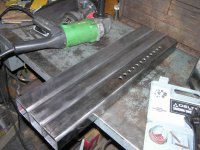
I was unable to try a new bit on a 3/16 hole, but I have tried my poorly resharpened bits on both 3/16 and 3/8 holes. Chatters like crazy on the 3/16 hole and the cutting edges are gone after a single hole. Could be my sharpening technique, the drill press lack of power and rigidity, or a combination of those two.

In a 3/8 hole I get perfect foot long spirals coming off the bit but have to be very careful as the bit is about to exit the hole or it grabs - probably due to wrong sharpening angle. I get around 40 holes before it loses its edge. That’s more than I got with the factory sharpened bits but I am feeding the bit in more gently now.

A couple of new bits arrive today (now that the project is done) so I will experiment with a fresh bit and a 3/16 pilot just to see how that works.


Sent from my iPhone using The Garage Journal mobile app
 

MushCreek

Well-known member
Joined
Jan 14, 2015
Messages
9,783
Location
Upstate South Carolina
That's one of the tricky things about large drills in relatively thin material- they want to grab and pull themselves through at the end. Even in a milling machine it will do that if you're hand feeding. That's where a CNC shines; it won't allow the bit to get sucked through. It maintains the ideal feed pressure instead. You almost have to pull up at the end; certainly guard against it sucking through. On my mill, I use a steering wheel for feeding the quill. With that, I can apply downward pressure and upward pressure at the same time. Depending upon the handle configuration of your drill press, you may be able to do that.

Sharpening bits by hand is an art. When I was a rookie, they would give you a pail of dull drill bits, and a chunk of brass. You sharpened the bit, then checked to see if it drilled to size in the chunk of brass. I sharpened thousands of bits back in the day, and can nearly do it blind-folded now. I can even do split points if the bit is big enough, and I can get to a sharp cornered grinding wheel.
 

matt_i

Well-known member
Joined
Mar 14, 2008
Messages
10,728
Location
SE Michigan
That's one of the tricky things about large drills in relatively thin material- they want to grab and pull themselves through at the end. Even in a milling machine it will do that if you're hand feeding. That's where a CNC shines; it won't allow the bit to get sucked through. It maintains the ideal feed pressure instead. You almost have to pull up at the end; certainly guard against it sucking through. On my mill, I use a steering wheel for feeding the quill. With that, I can apply downward pressure and upward pressure at the same time. Depending upon the handle configuration of your drill press, you may be able to do thatl.

To your point, anytime a person feeds with the quill they are subject to the backlash/lost motion in the rack & pinion set.

If a person has a mill and there is any doubt, feeding with the knee (Z-up) with quill-locked will eliminate almost all of the problems of backlash. Not possible with a drill press, its where the 500-600lb knee casting shines.
 

sberry

Banned
Joined
Jun 18, 2005
Messages
35,747
Location
Brethren, Michigan
We had something similar, we put cross hairs on and plasma cut them. I got to loosen up or pretty soon I can almost thread them in.
 
To avoid these ads, REGISTER NOW!
Top Bottom