To avoid these ads, REGISTER NOW!

Welding in patch panels

Lippyp

Well-known member
Joined
Jun 26, 2006
Messages
6,720
Location
Shropshire, UK
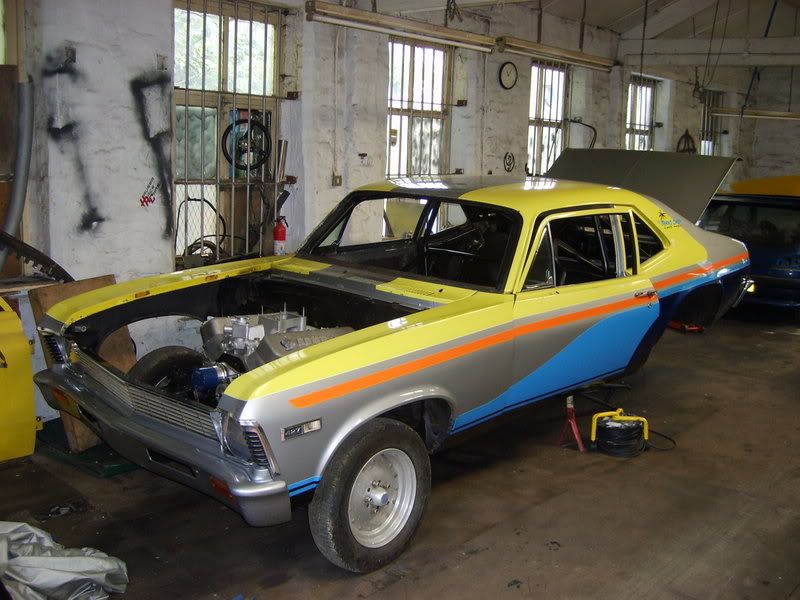
Yep, its a '67 long fleet with a 300 horse 350ci small block, up here in sunny lancashire. Lots around here, I borrowed some workshop space from some friends to do that work, it shared space with the following:

Genuine 68 427SS Impala


Nova being built for the track


9 second 1/4 Camaro


although the camaro and Impala have been sold now to fund the building of this Impala coupe which they're hoping to get running 7's


A friend up the road drives an 08 Mustang GT as his daily and has this for the weekends

440 '70 'Cuda

 
To avoid these ads, REGISTER NOW!

stricht8

Well-known member
Joined
Apr 20, 2008
Messages
1,714
what's planishing?

It's a process of smoothing out sheetmetal. Usually done with a smooth faced steel body hammer or ******* over a steel dolly of similar crown to the panel you are forming. It can also be done mechanically with an air powered planishing hammer.
 

ZRX61

Well-known member
Joined
Aug 15, 2006
Messages
28,716
Location
Solar Blight Valley, SoCal
It's a process of smoothing out sheetmetal. Usually done with a smooth faced steel body hammer or ******* over a steel dolly of similar crown to the panel you are forming. It can also be done mechanically with an air powered planishing hammer.

& used to make welded joints in sheet metal disappear ;)
 

stricht8

Well-known member
Joined
Apr 20, 2008
Messages
1,714
So you do some spot welds, then planish, then do more spot welds, repeat??

You mean tack welds. So you do a few tacks, grind down both sides flush or just proud of flush, then you stretch the tacked area by hammering on dolly. Technically planishing is a term better used when smoothing out the finished ground down weld bead area including about a half inch above and below the actual bead. This area is known as the HAZ or heat affected area. Check out www.metalmeet.com and do a search on HAZ. You will be amazed at what you'll learn there! :bounce:
 

Yardgoat

Well-known member
Joined
Jan 29, 2010
Messages
57
Location
Rockmart,Ga 30153
LOL Oh yeah we have a group effort going on with this project. Every time he's over here,we are always working on some kind of project together. He has learned alot from his old man and we are having a blast.:thumbup:

You are a blessed man,,,Great tech,post it on HAMB its tech week you could win a prize,its that good,good luck...............YG:beer:
 

MP&C

Well-known member
Joined
Oct 21, 2009
Messages
4,403
Location
Leonardtown, MD
I had another fender patch job that came in, so I thought I would add it to this thread as we took quite a few more pictures to make a better tutorial.

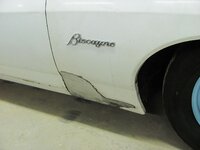
Zach showed up in the Biscayne, which really helped out to have a good pattern in the adjacent panels to work against. He was originally going to just bring the fender, but I think after all is said and done we can see that would not have worked as well.


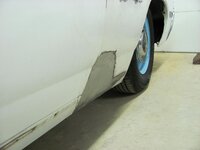
Here is what we had to work with.


Picture001-2.jpg


Where he had done a nice job of trimming his replacement prior to welding (especially for a first timer):
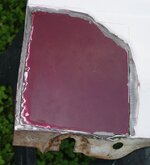

4626439887_ea5b112675_o.jpg


..........I think a lot of the problems he experienced was due to not testing the welder set up on some scrap pieces first and additionally some weld contamination from residual rust scale.


In trimming out repair panels for fenders, I have always tried to install a new flanged rear edge in order to minimize the vertical welds. The more welds, the more shrinkage, the more possibility of the panel moving. Where we could planish out the welds in an attempt to counter some of this shrinking effect, that is not possible behind the fender brace, so what he ended up with was this:


Picture002-2.jpg


......where you can see the replacement patch has pulled in a couple different areas to noticeably widen and distort the door to fender gap. I point these out not to pick on his work, but to highlight the possible effects of installing the patch in this manner that perhaps another method should be considered.

Where the vertical weld seam on the right side was clear of the brace to allow for planishing the welds, this had not been done and serves as a good demonstration as to how the metal will shrink. If we were to look at the profile of the lower fender from the side, it appears much as an arc (to simplify things). Due to the heat from welding and the subsequent shrinking we always hear of, the effect in the case of an arc will be for it to lose some of its radius to more closely resemble a straight line. In this case, what we see is a valley down through the middle of the weld as that exact result occurred.


Picture005-2.jpg


Prior to removing the fender, it was marked with a reference line to be able to duplicate the original fender edge location once a new patch was fitted into place. Where the fenders rear edge had distorted from all the weld shrinkage, the mark was measured from the door edge to provide for a consistent door gap.


Picture001-2.jpg


The fender was removed and Zach mastered fairly quickly the fine art of spot weld removal using a cutoff wheel. You can plainly see as the outer layer gets hot (speed is required here to generate heat), especially pronounced when the layer begins to thin, it will turn blue in color. When you begin to see the silver color of bare metal right next to the blue, you are now into the second layer. Time to stop there, grind a bit more around the perimeter of blue, and gently pry to check if the panel will release.

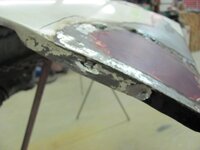
Picture006-1.jpg


Picture007-1.jpg


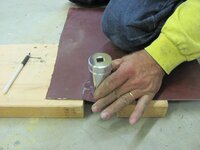
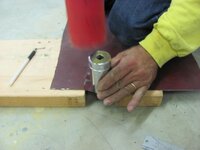
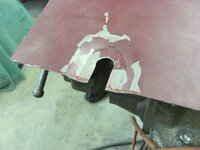
Where the lower flange of the fender had some rust issues of its own, we had to duplicate the contour around the lower mounting bolt.
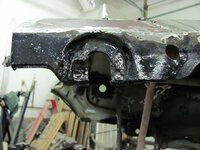
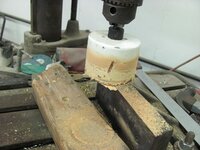
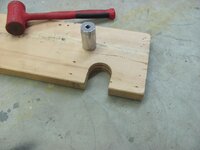
Picture009-1.jpg


Picture010-1.jpg


Picture011-1.jpg


Picture012-1.jpg


Picture013-1.jpg


Picture014-1.jpg


Picture015.jpg


The lower flange was bent and the new weld seam was moved slightly to the right to remove some of the valley more easily and to also provide more room for planishing both the weld and the HAZ (heat affected zone) adjacent to it.


Picture017.jpg


Picture018.jpg


Picture019.jpg


The fender was refitted (one of many times) to insure the distortion had been removed and we had a nice straight panel in alignment to the door...


Picture021.jpg


Then the patch was aligned to the lower flange mounting hole, trimmed to fit, clamped inplace, and marked for the fender rear edge flange.
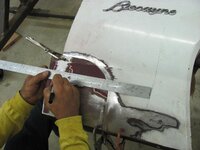

Picture022.jpg


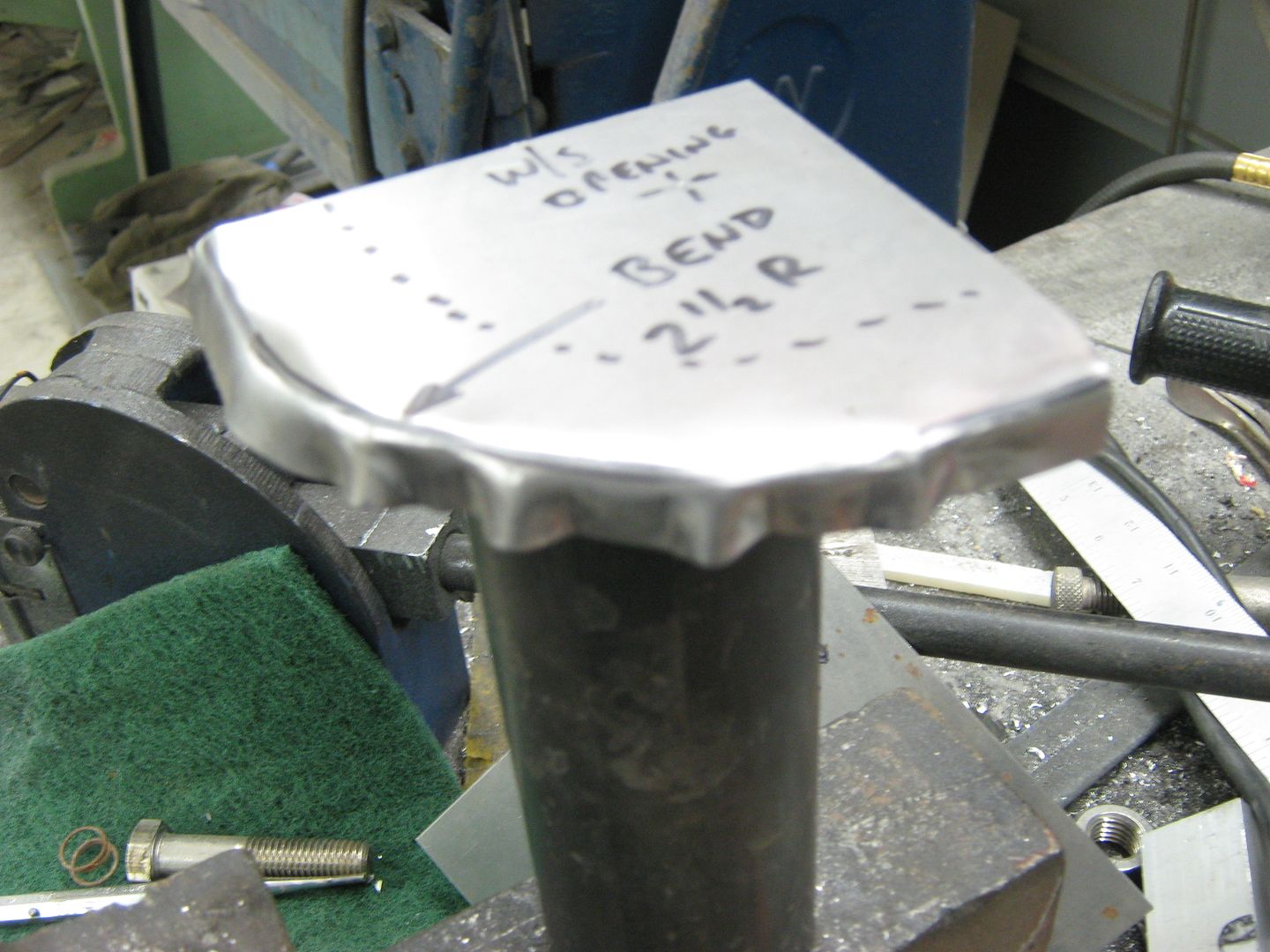
To show what is possible using "basic" tools, and since the bend is not prefectly straight, a short section of wedge "anvil" was clamped in the vice and a low crown hammer used to gradually form the bend. A shrinker and stretcher also came into play to duplicate the "arc" profile of the fender, and this was checked to the front edge fo the door....
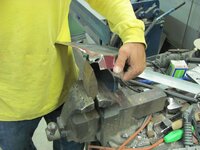

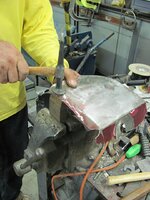
Picture027.jpg


Picture028.jpg


Picture029.jpg


Picture030.jpg


Picture031.jpg


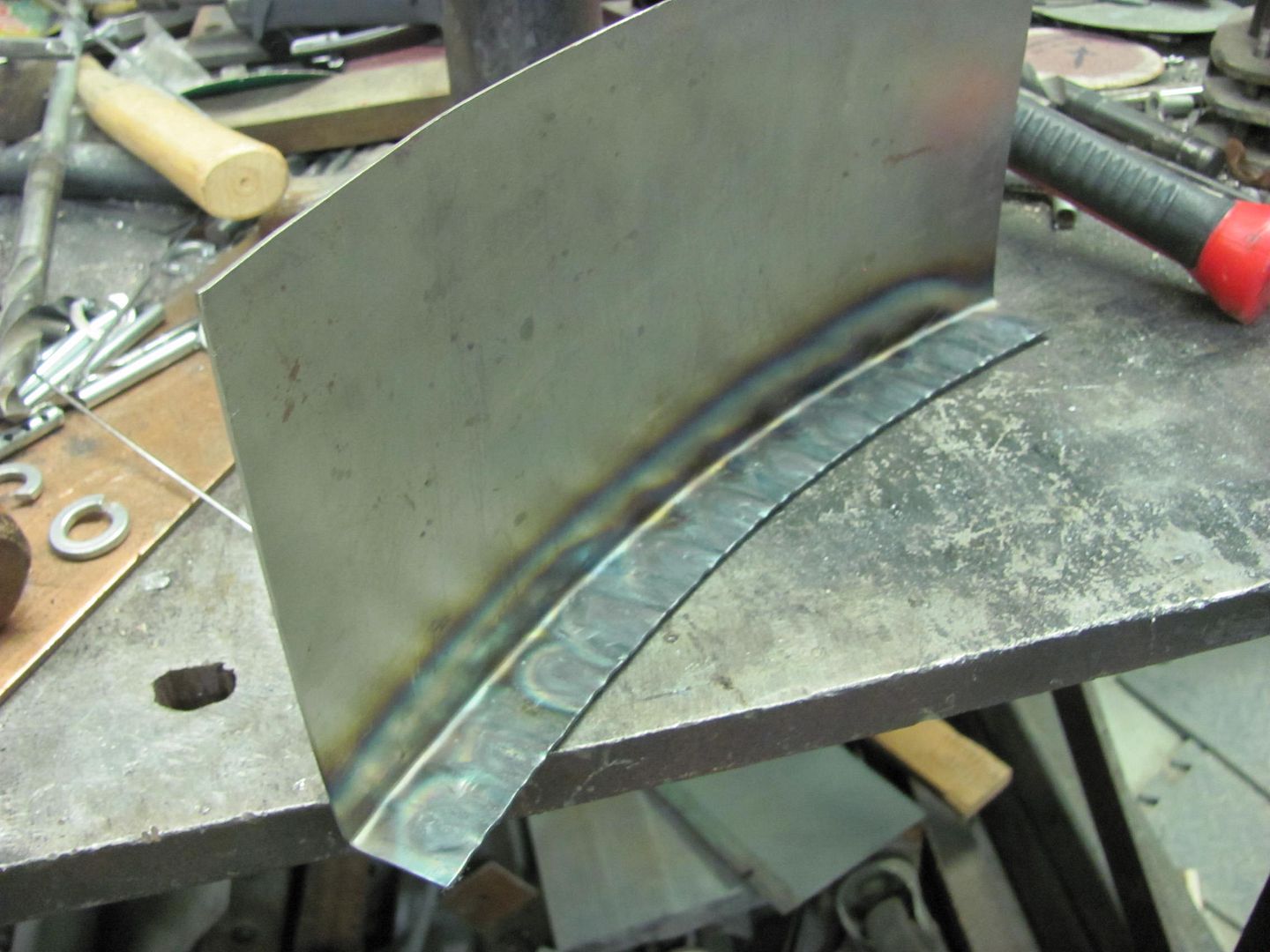
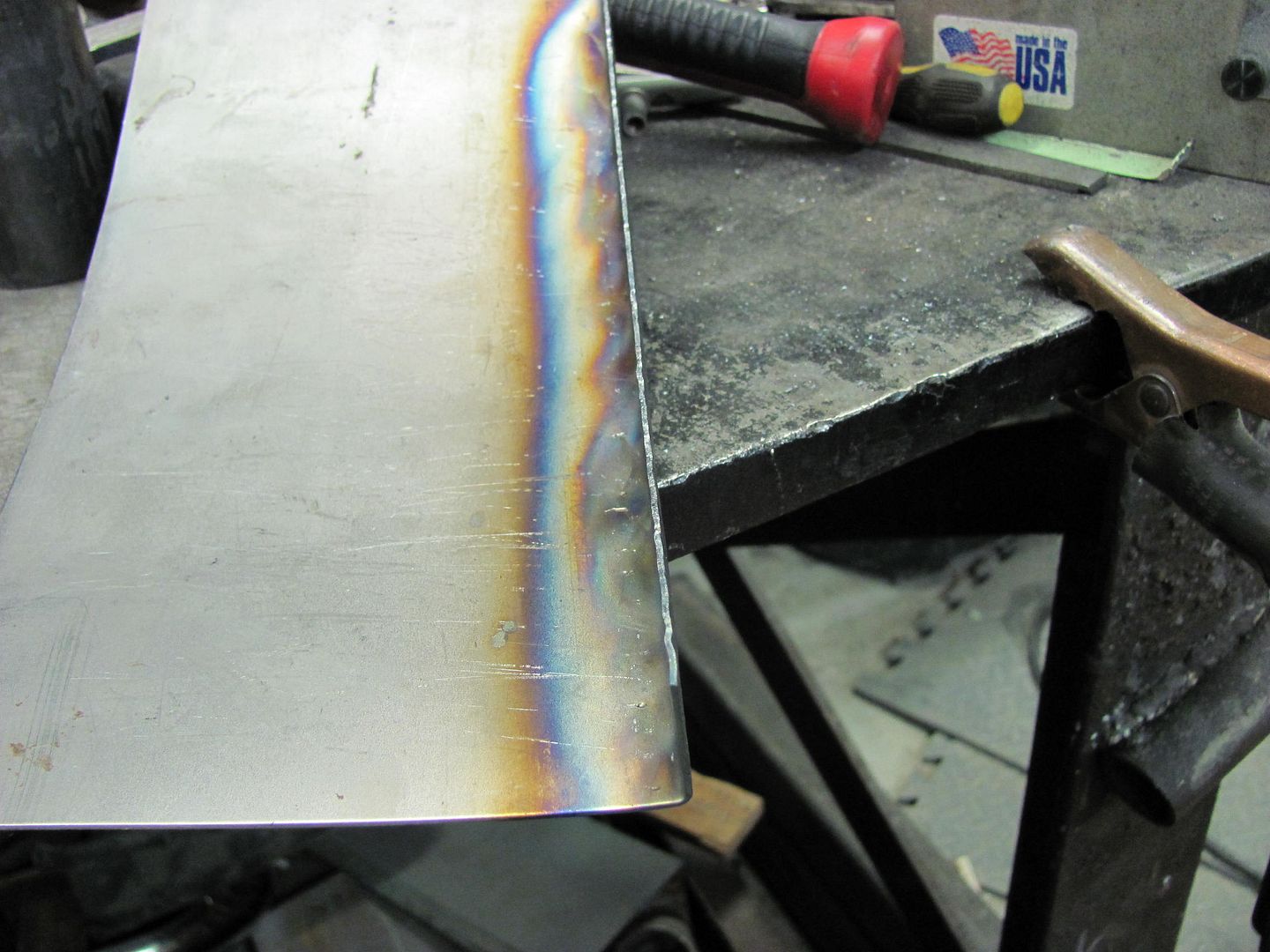
Then the patch was welded to the fender. I normally use weld "dots" in Mig welding sheet metal, and the machine gets set a little hotter (full penetration welds) and wire feed speed a little faster (less chance of blowout). Then the weld dots will be planished out, ground down just above flush (gets them out of the way for planishing the next set) and then planish the HAZ next to the welds as required. The top right cut was done using a large radius, which helps to reduce the shrinking effects that get comnpounded when working in a tight 90 degree corner. Where the inside radius will still shrink a bit more than the outside, the radius does make it a bit more manageable. Usually the HAZ on the inside radius is just planish a little more than the outside radius.


Picture036.jpg


Picture037.jpg


Picture038.jpg


Picture041.jpg


Picture042.jpg


Picture043.jpg


Picture044.jpg


Picture048.jpg


Picture049.jpg


Picture050.jpg


Picture051.jpg


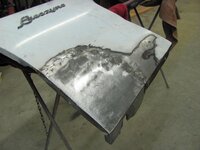
Where we did wind up with a slight depression right over the brace (should have put a bit more crown in the panel) Once Zach gets it all painted up it should last him quite a few years to come. I think he has a much better appreciation for working with sheet metal now, and look forward to his progress photos in the future..
 
Last edited:

e-tek

Well-known member
Joined
Dec 19, 2007
Messages
10,690
Location
Saskatoon, SK
Hey MP&C - is there anywhere you aint?! ;)

This is a great thread for anyone doing patch panel work. But make sure you read every post - some of the one-timers have good additions. I'll add a couple things that I've found in my own 25+ year go at this hobby:
1. I like to POR15 on the back sides of any still-rusty metal you aren't replacing. Just don't use it on smooth, painted or new metal - it won't stick.
2. Weld-through primer is the bomb at or near any welds. It has a high Zinc (or Copper) content and actually makes welds stronger. Anything else will jsut burn off.
3. For **** welding, the smaller the gap the better IMO. Look at MR&C's last patch panel (with the rounded corners) - almost no gap. BUT, you do need a bit of a gap, or the metal pieces can bind together and then it's hard to get them flush for welding. I use a small, thin flat-blade screw driver to adjust my gaps as I go.
4. One thing that hasn't been mentioned wrt tack-welds - but can really help when starting out: at first, only pull the trigger for a second. Once you have a few tacks, you can then add to them with a bit longer of a pull to ensure full penetration (I know it's all very ******...:dunno::lol_hitti)
5. As one poster said: there's NOTHING wrong with filler. Everyone uses it. The issue is when someone uses it as a structural member!!:eyecrazy:
6. Practice! It was mentioned already - practice setting up your welder, practice shaping panels, practice!

So, what to do if you DO burn through? How to fill a nice fat hole? Use a piece of copper (smash a piece of copper pipe flat, or buy a copper back-up tool from Eastwoods for $38.00). Hold or clamp it behind the hole and then fill it with weld. The weld won't stick very well to the copper, plus it ***** heat away from the metal decreasing distortion. Remove the copper piece and you'll have a filled hole that is quite flat on the backside.

Looking forward to seeing more from this thread for sure!:beer:
 
Last edited:

Justanoldguy

Well-known member
Joined
Jun 1, 2008
Messages
3,673
Location
Atiamuri. Central North Island. New Zealand
Hey MP&C - is there anywhere you aint?! ;)

This is a great thread for anyone doing patch panel work. But make sure you read every post - some of the one-timers have good additions. I'll add a couple things that I've found in my own 25+ year go at this hobby:
1. I like to POR15 on the back sides of any still-rusty metal you aren't replacing. Just don't use it on smooth, painted or new metal - it won't stick.
2. Weld-through primer is the bomb at or near any welds. It has a high Zinc (or Copper) content and actually makes welds stronger. Anything else will jsut burn off.
3. For **** welding, the smaller the gap the better IMO. Look at MR&C's last patch panel (with the rounded corners) - almost no gap. BUT, you do need a bit of a gap, or the metal pieces can bind together and then it's hard to get them flush for welding. I use a small, thin flat-blade screw driver to adjust my gaps as I go.
4. One thing that hasn't been mentioned wrt tack-welds - but can really help when starting out: at first, only pull the trigger for a second. Once you have a few tacks, you can then add to them with a bit longer of a pull to ensure full penetration (I know it's all very ******...:dunno::lol_hitti)
5. As one poster said: there's NOTHING wrong with filler. Everyone uses it. The issue is when someone uses it as a structural member!!:eyecrazy:
6. Practice! It was mentioned already - practice setting up your welder, practice shaping panels, practice!

So, what to do if you DO burn through? How to fill a nice fat hole? Use a piece of copper (smash a piece of copper pipe flat, or buy a copper back-up tool from Eastwoods for $38.00). Hold or clamp it behind the hole and then fill it with weld. The weld won't stick very well to the copper, plus it ***** heat away from the metal decreasing distortion. Remove the copper piece and you'll have a filled hole that is quite flat on the backside.

Looking forward to seeing more from this thread for sure!:beer:

That was more useful to me as a beginner than a lot of the previous 90 posts.
Thanks..:)
 

78Bird

Well-known member
Joined
Apr 23, 2010
Messages
528
Location
Charlotte, NC
A note on copper backing tools, I snagged a junk heatsink out of a fairly new computer that had it's cooling fan die, and it was a junk part. Remove the dead fan and I have a nice beefy hunk of copper with heat dissipating fins on the backside, and they make a good grip for it as well that doesn't get hot when welded against. The things base is 3/8" thick at least and very hefty for it's size. It works great :D
 

z28snksknr

Well-known member
Joined
Jul 8, 2009
Messages
1,827
Location
Turnersville, NJ
This thread is AWESOME. I am planning my first patch panel over the weekend and I just realized how much I DONT KNOW by reading this.
:bowdown:
Thanks you for sharing. Next week, I'll have related posts on how NOT to do patch panels!!

:lol_hitti
 
To avoid these ads, REGISTER NOW!

MP&C

Well-known member
Joined
Oct 21, 2009
Messages
4,403
Location
Leonardtown, MD
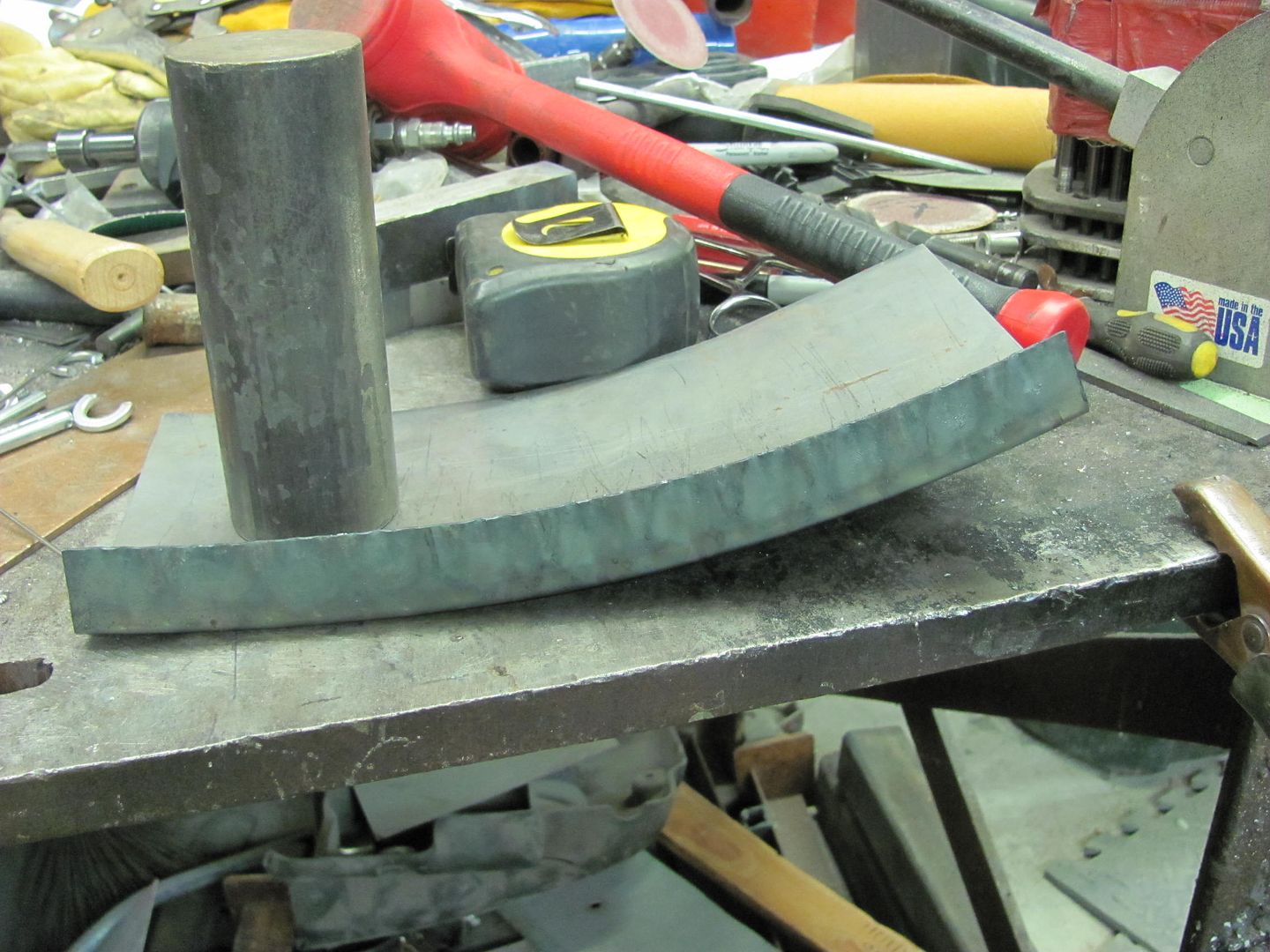
This part isn't exactly welding patch panels, but may come in handy just the same. For those that may need to form up some patch panels but don't have those shrinker/stretchers at your disposal, here's a how-to on tuck shrinking.


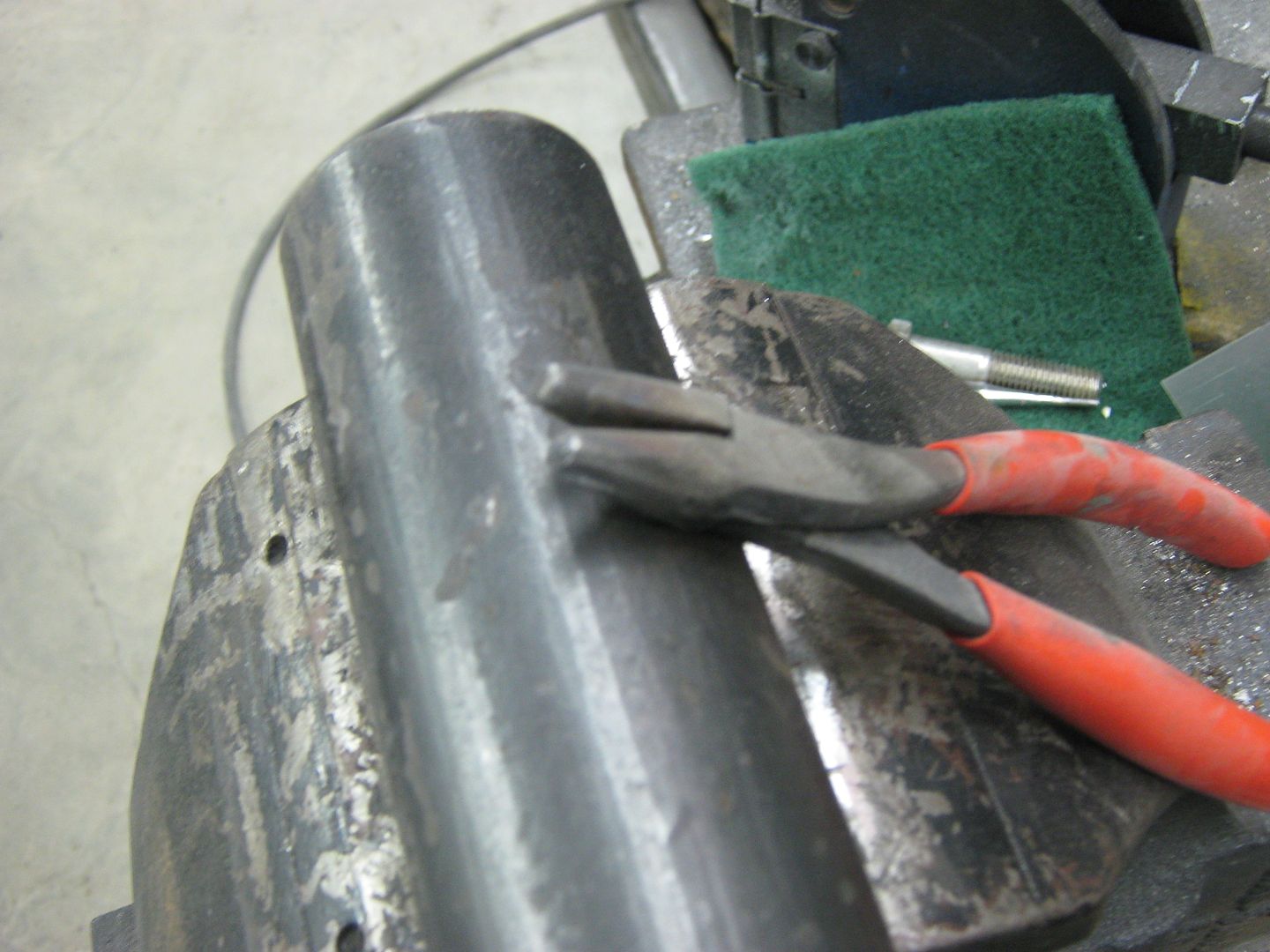
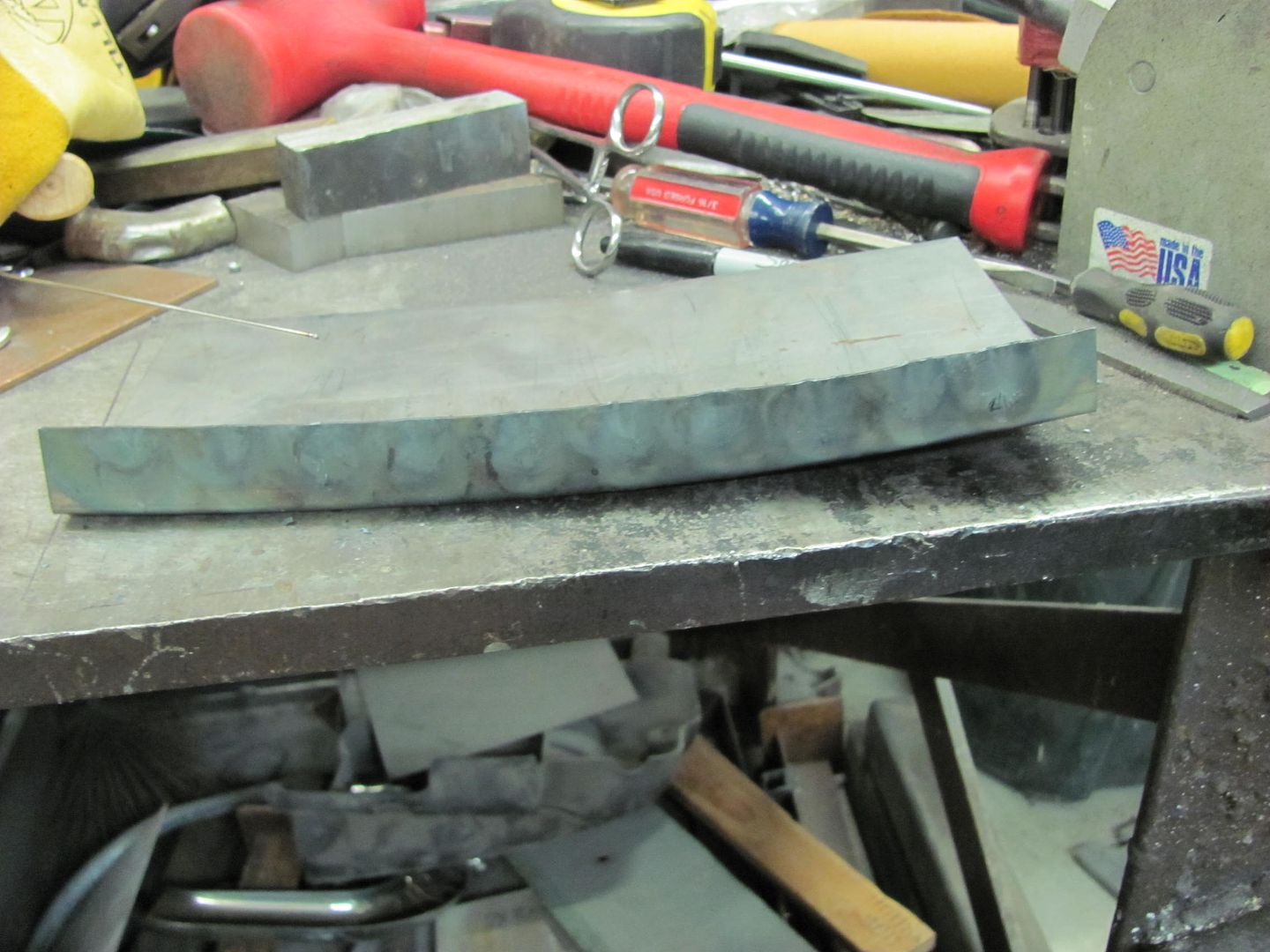
Here are some "tucking" pliers I made out of neccessity when forming up a replacement piece for rust repair, and I'll have to admit, their biggest flaw is not providing accurate, consistent tucks. Of course, the operator could also be flawed.....


Picture053-1.jpg


Picture054.jpg


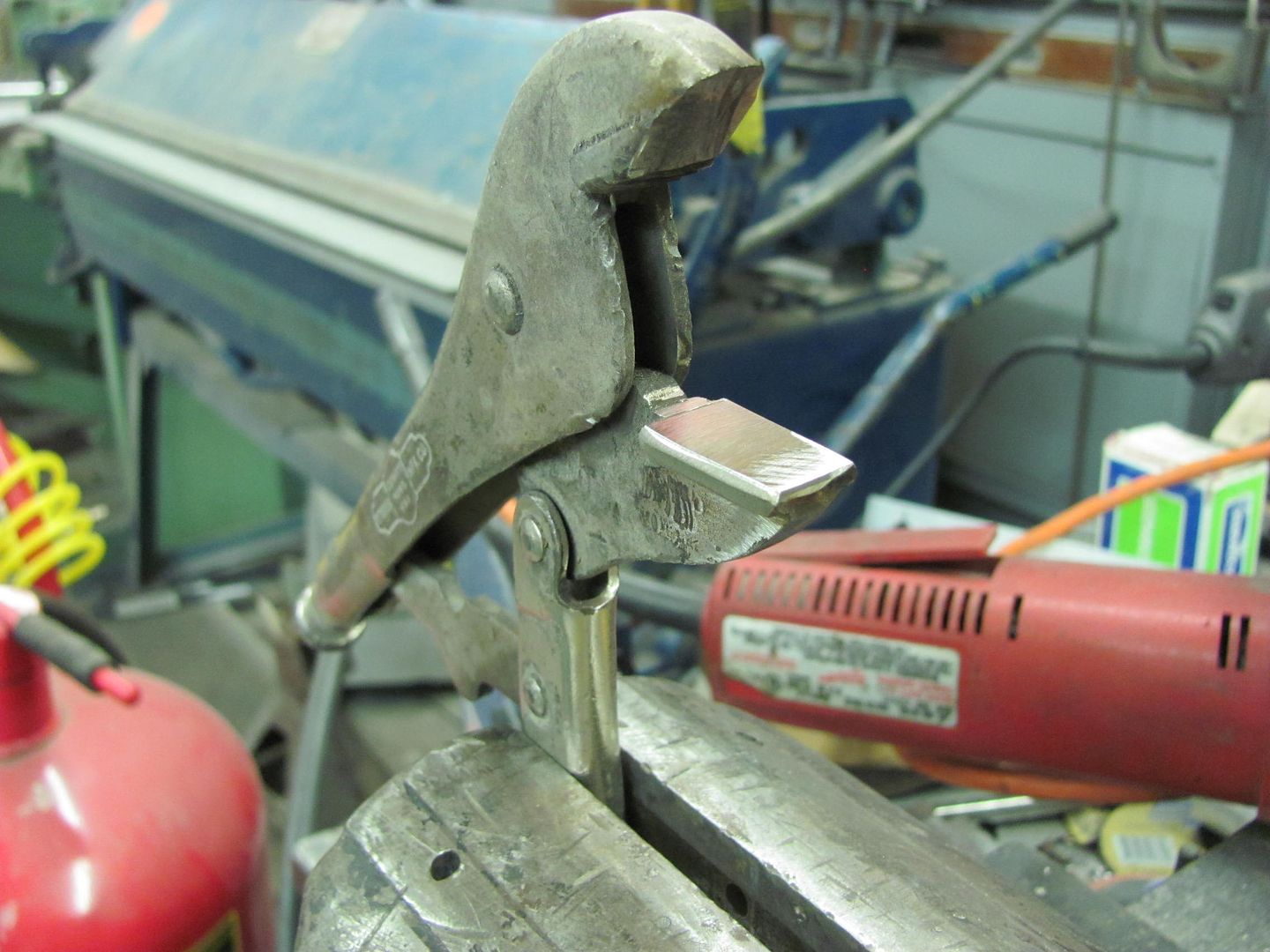
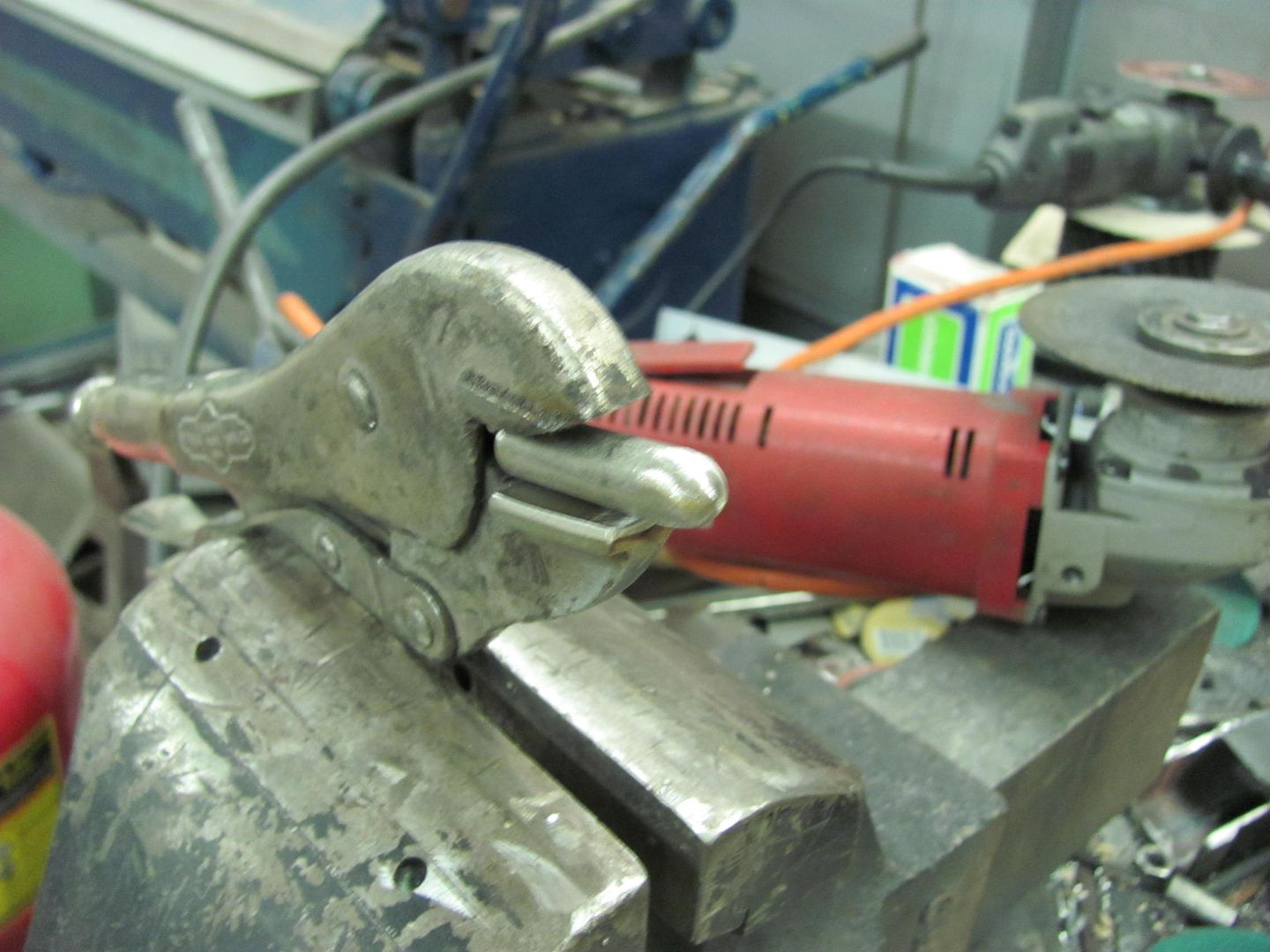
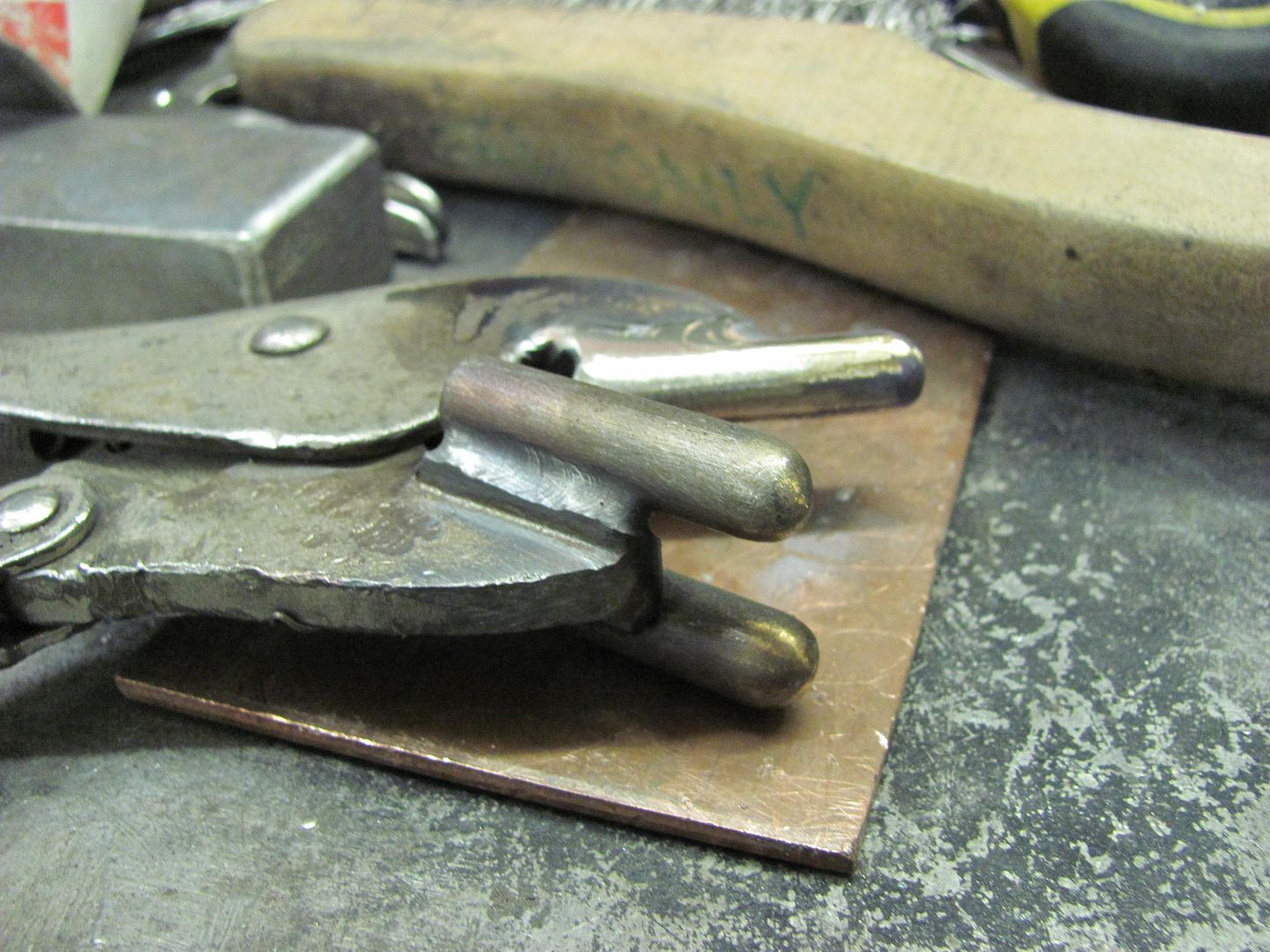
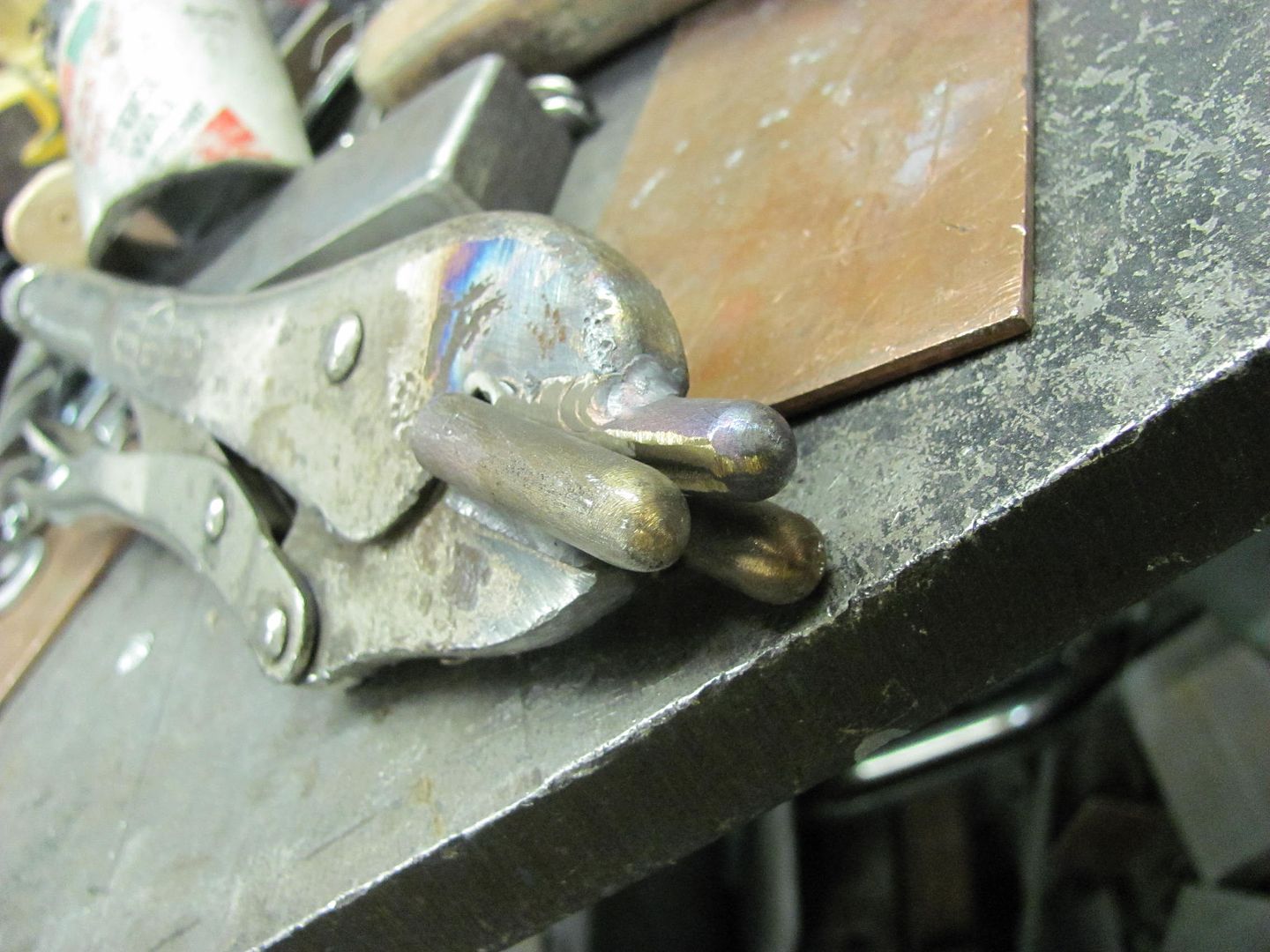
The more consistent the tucks, the more consistent the distance between them, in the end, the more consistent our radius will be. To improve on the tucks I'll start out by making a tool that will more accurately duplicate consistent tucks. We'll start off by finding a pair of vise grips suitable for the job, which in this case means the jaw serrations are starting to wear and round off. Finish what has started by removing the serrations to produce a nice flat jaw on the bottom, and cut the top one off at about 30 degrees from its original position. This will help to form the tuck in a tapered fashion.


Picture001-3.jpg


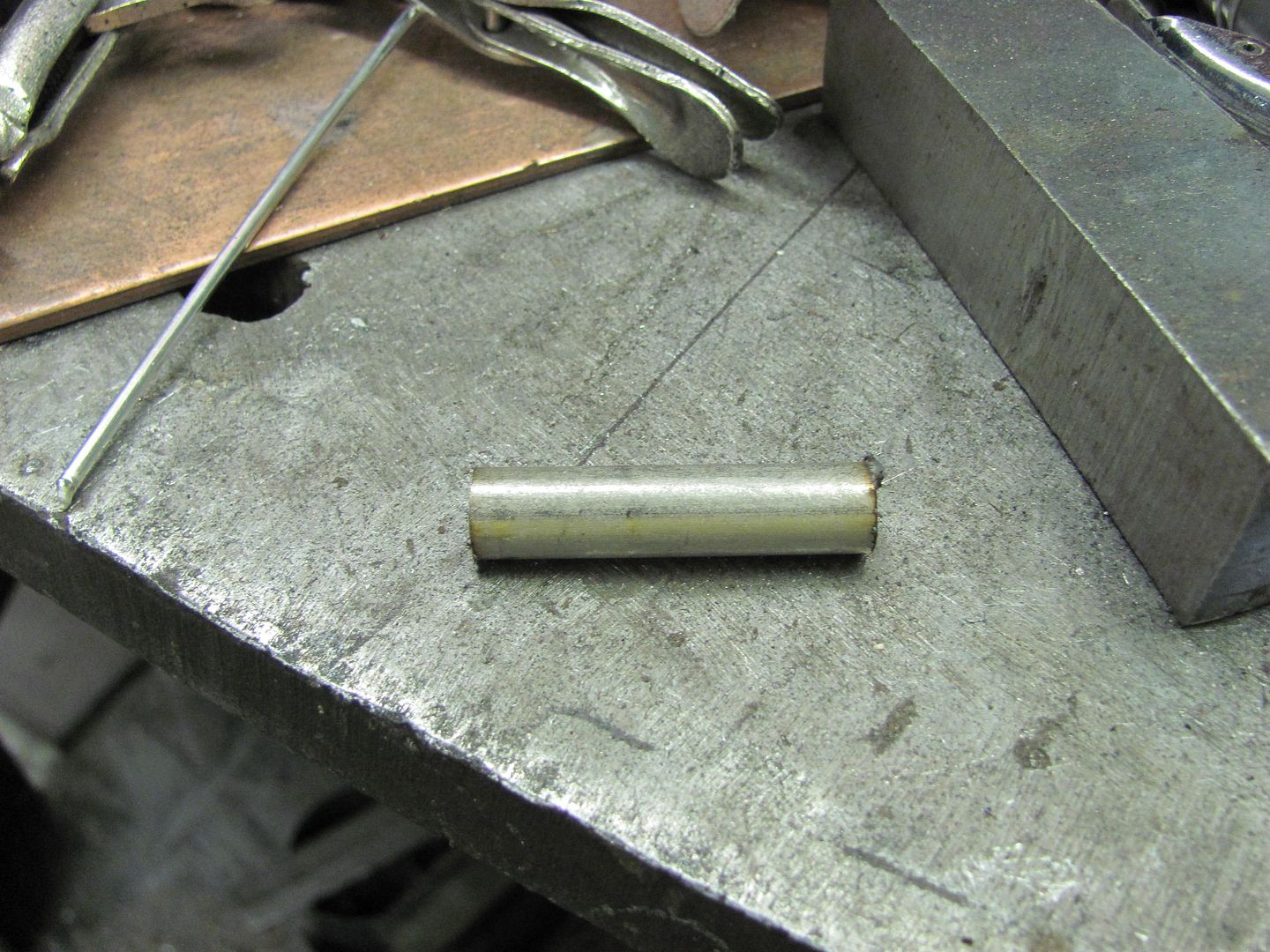
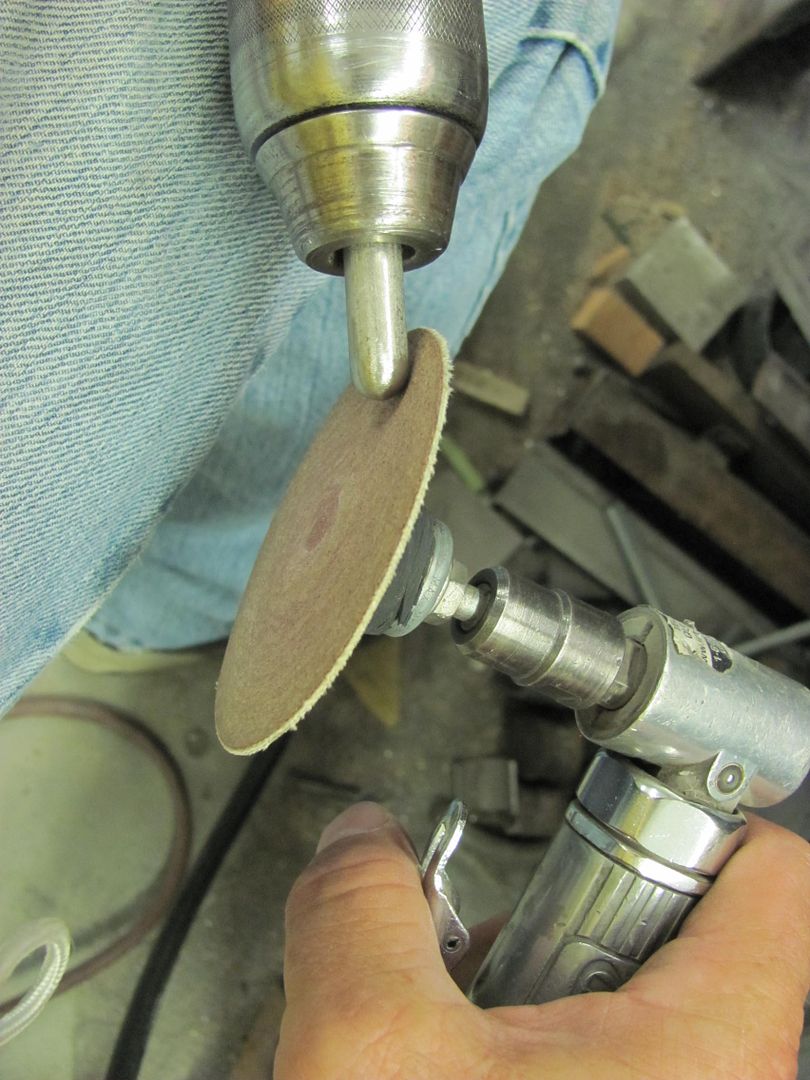
I had some extra long shouldered 3/8 bolts, perfect round stock for the job. Three of them were cut off to 1-1/2" length.


Picture003-3.jpg


Now because we don't have a fancy shrinker-stretcher machine likely means we don't have a lathe either. No sweat, use this economy model made by Dewalt...


Picture004-3.jpg


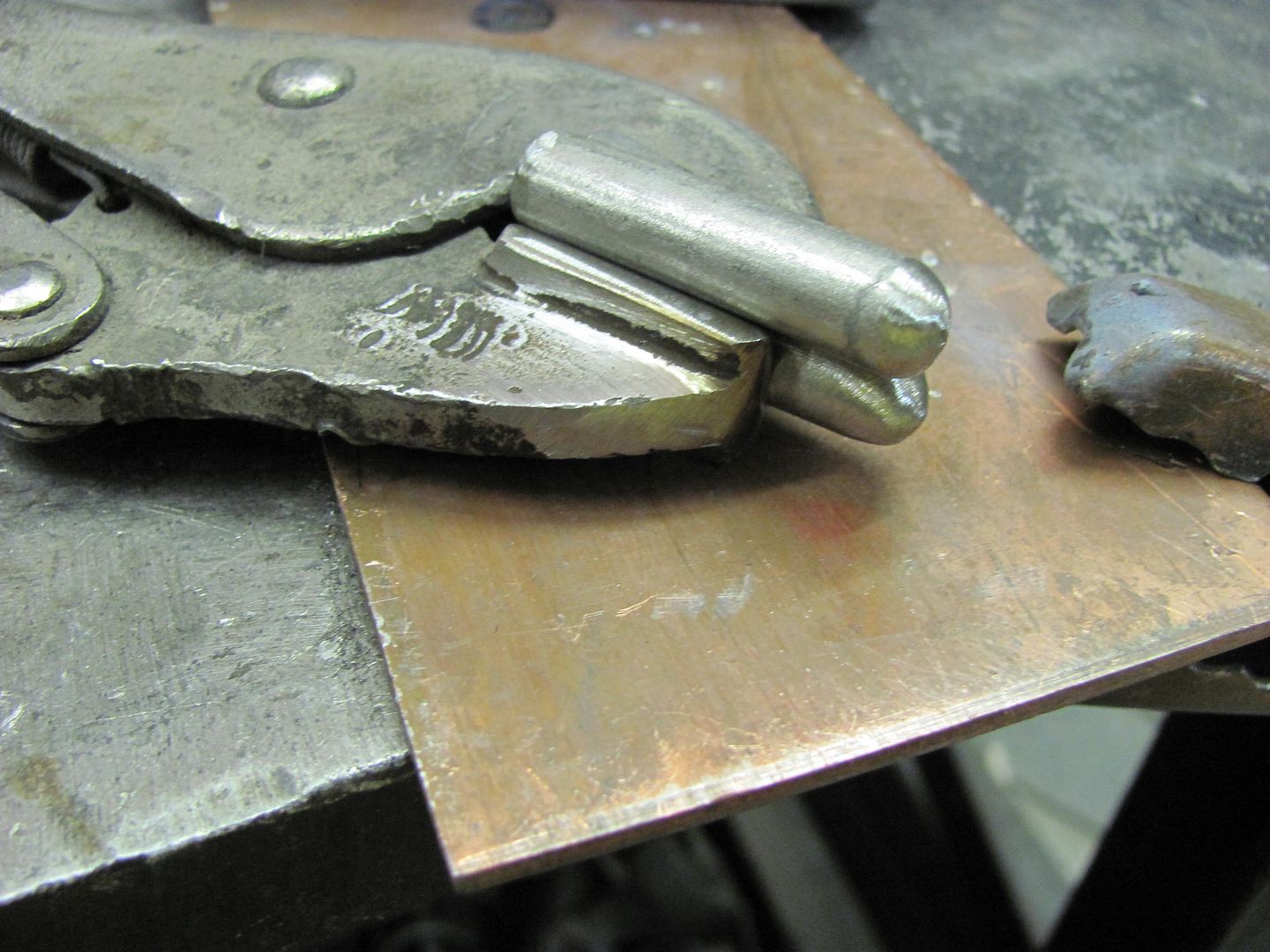
To set the spacing for the "fingers" the first is clamped in the vise grip jaw, centered.


Picture007-2.jpg


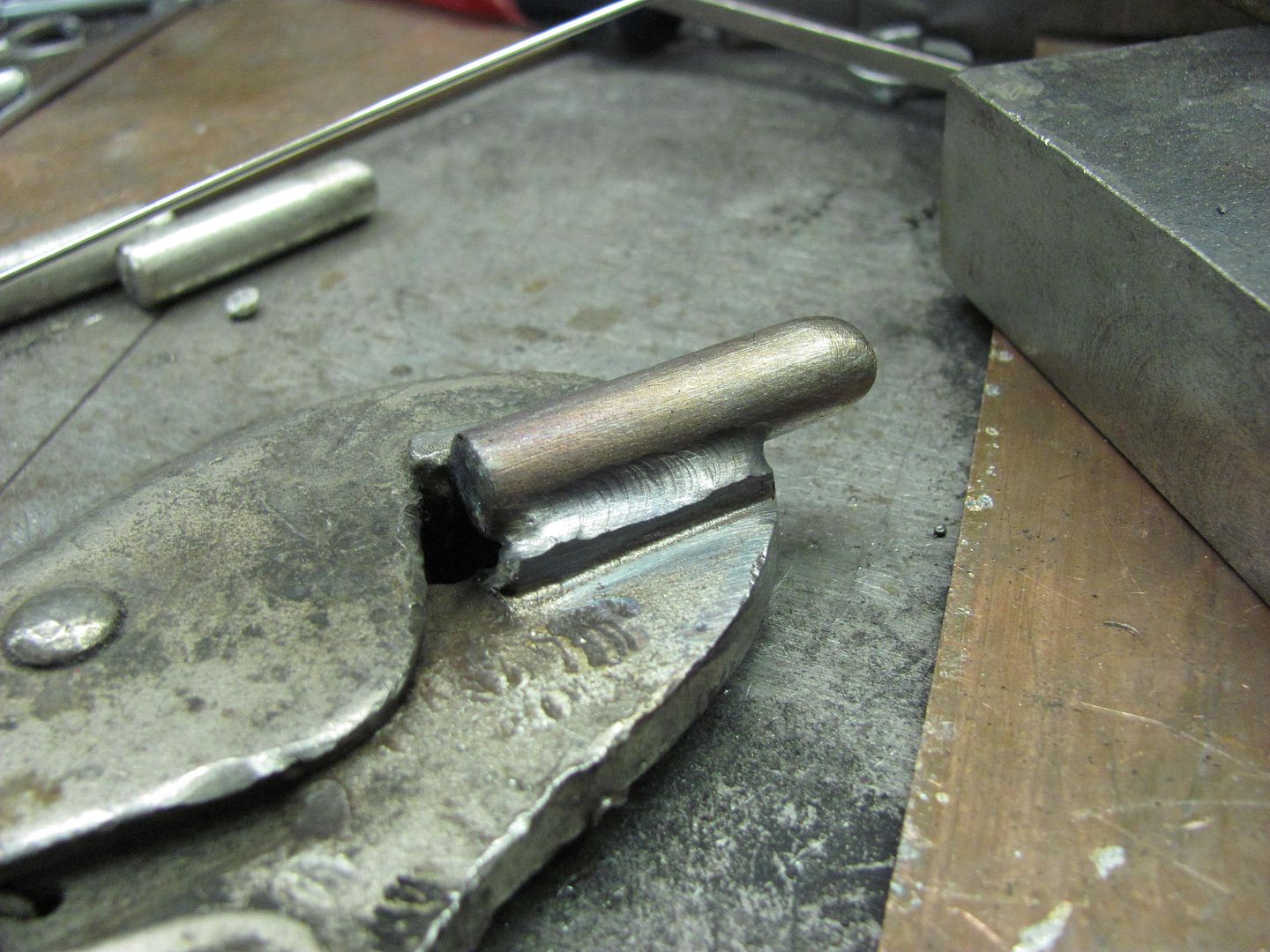
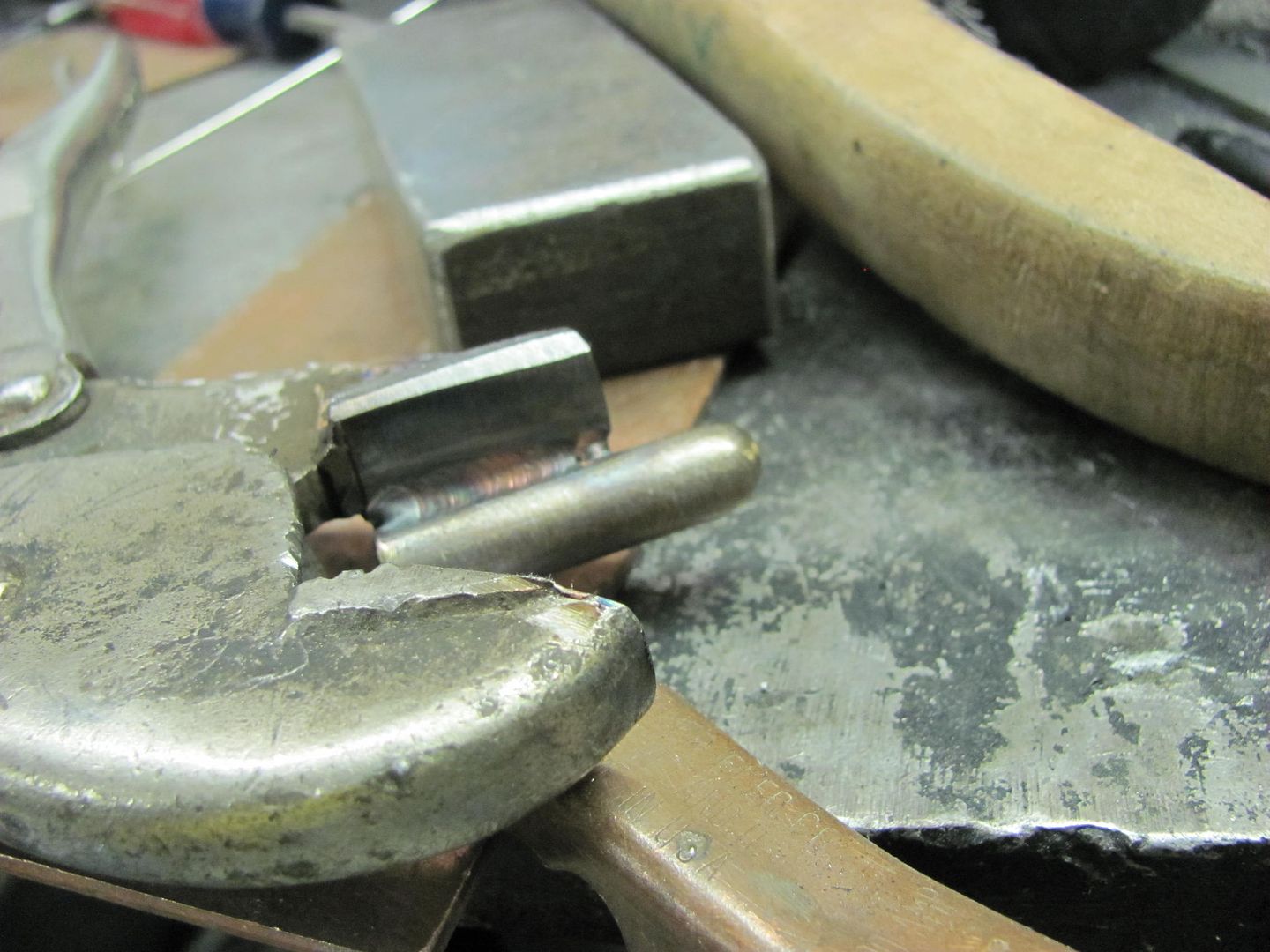
The outer is placed next to it and then welded down the outside, center finger removed, and then welded down inside.


Picture008-2.jpg


Picture009-2.jpg


Picture010-2.jpg


Repeat for opposite side, then weld center finger.


Picture011-2.jpg


Picture012-2.jpg


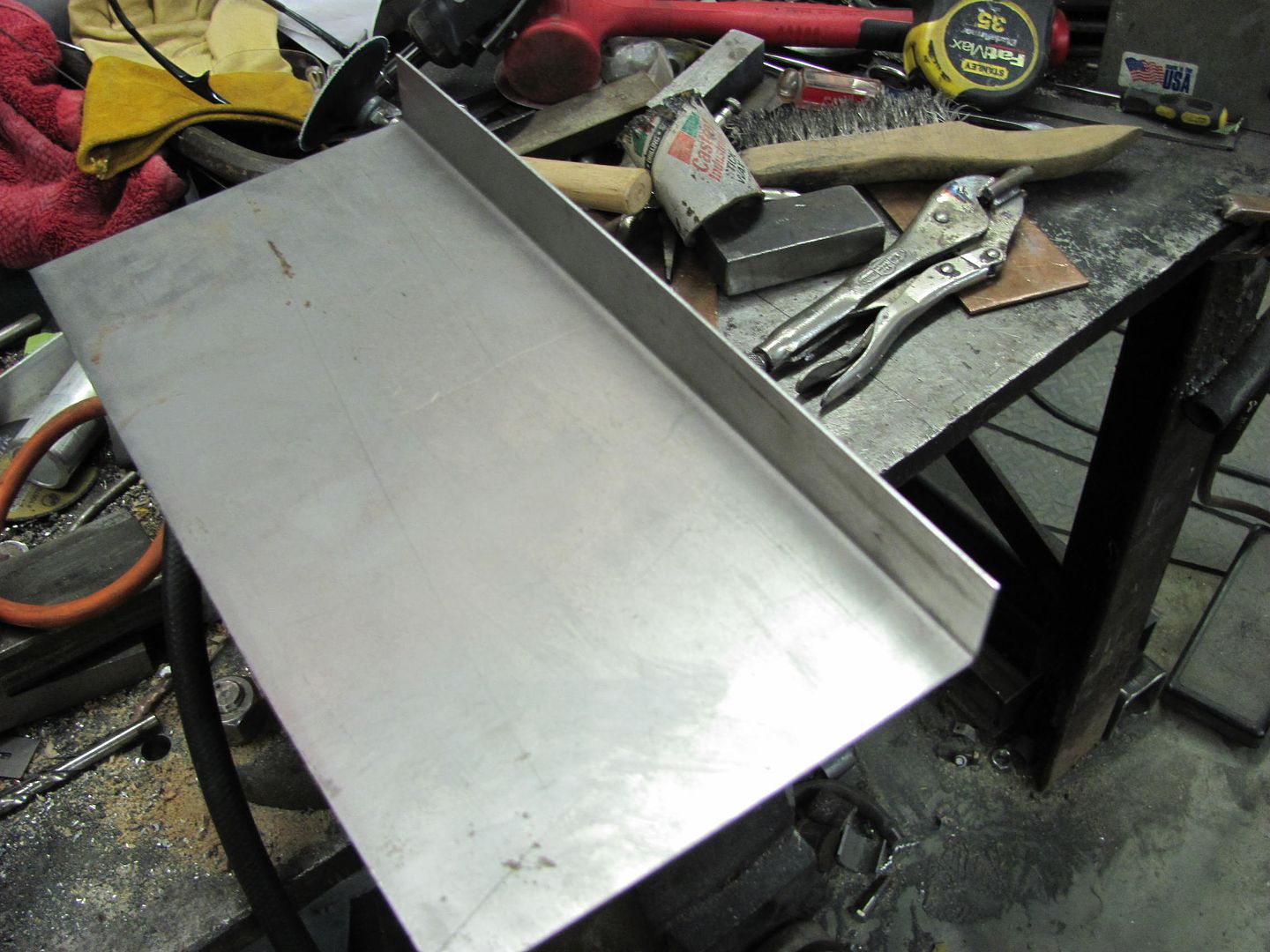
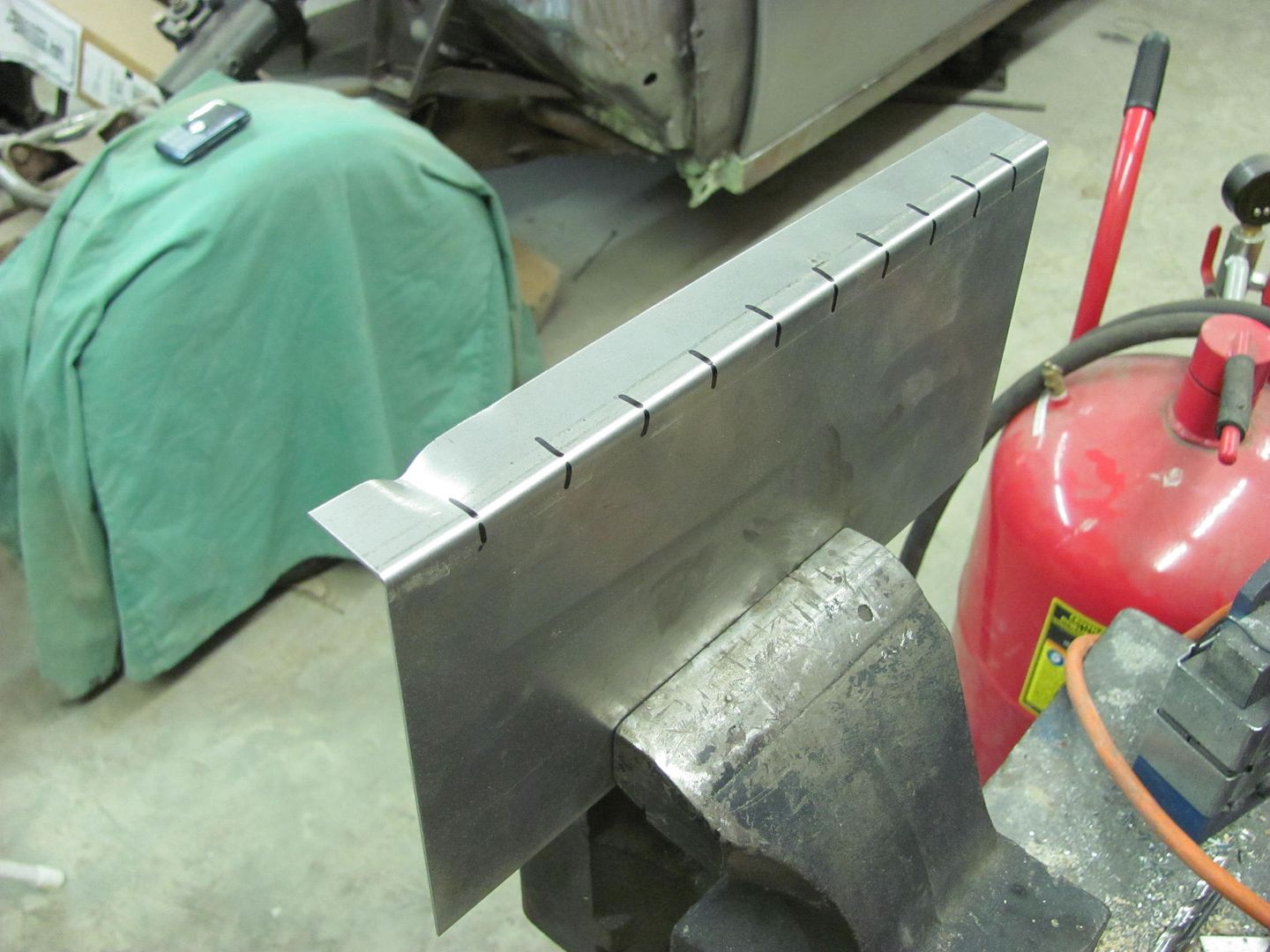
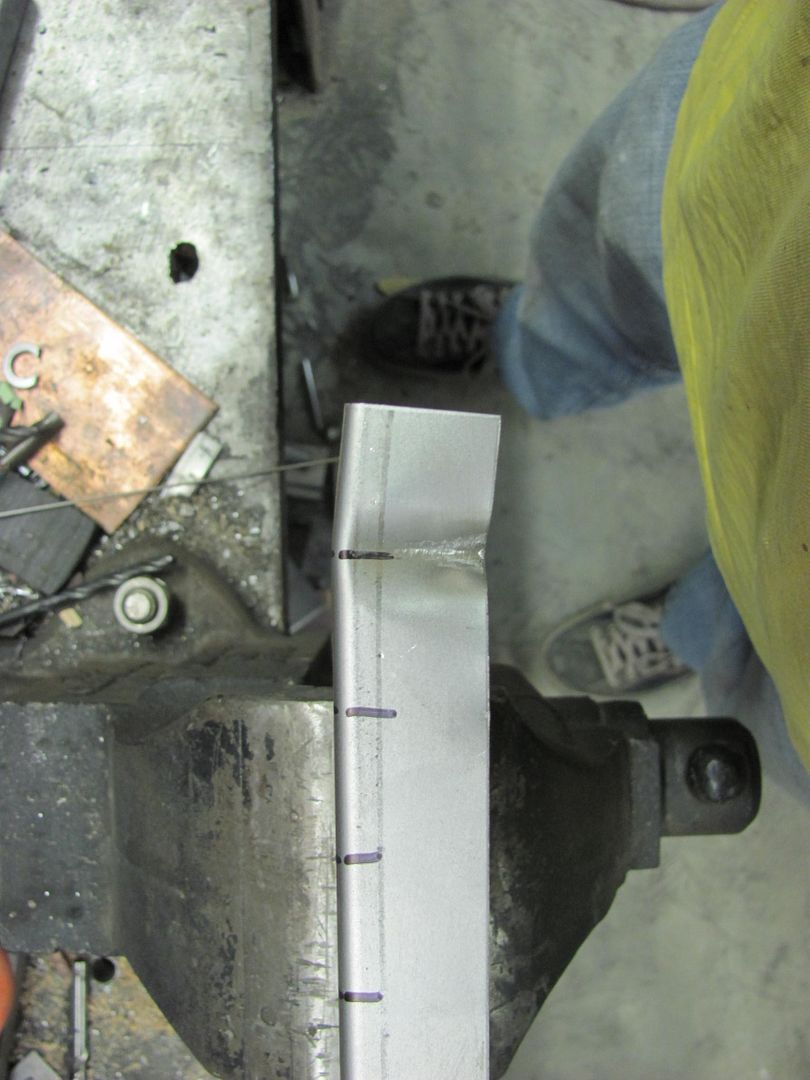
Our new patch panel is bent up with about a 1" flange. Reference marks are placed one inch apart...


Picture013-2.jpg


Picture014-2.jpg


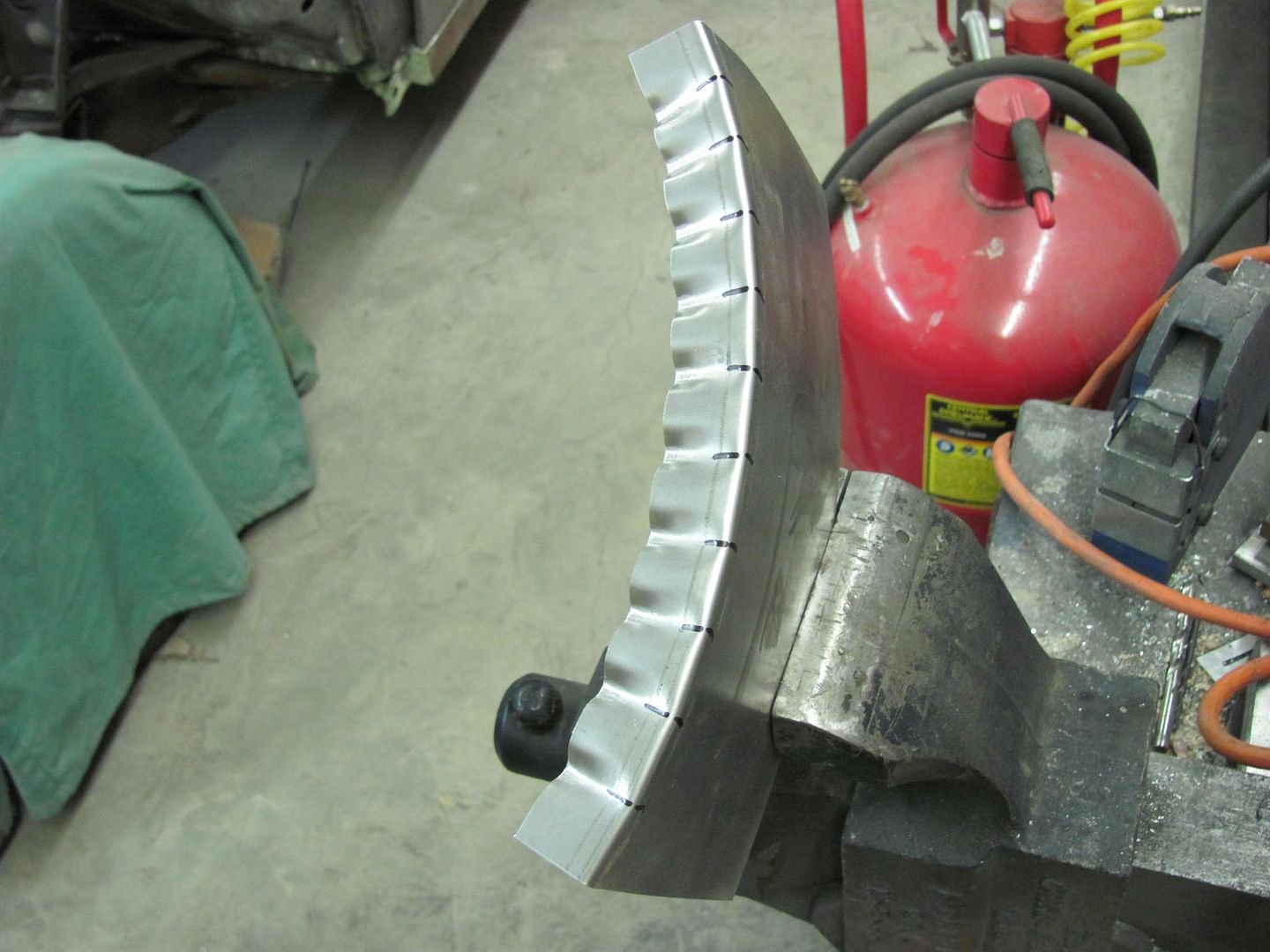
The first tuck shows how the radius starts to form. Slide the parallel fingers all the way against the bent panel and then squeeze the jaw closed. This will help to get the same depth of tuck each time.


Picture015-1.jpg


Picture016-1.jpg


Picture017-1.jpg


Picture019-1.jpg


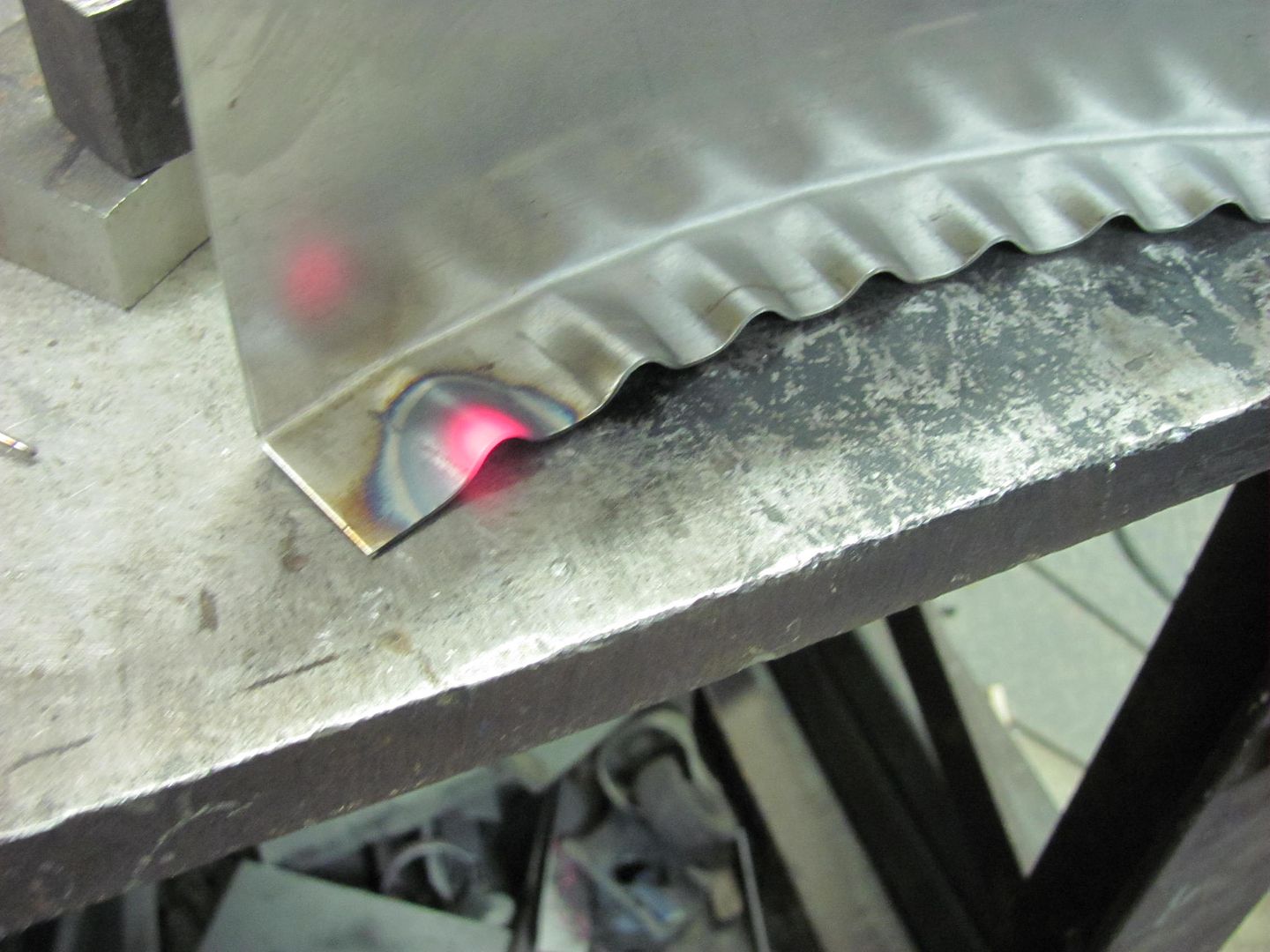
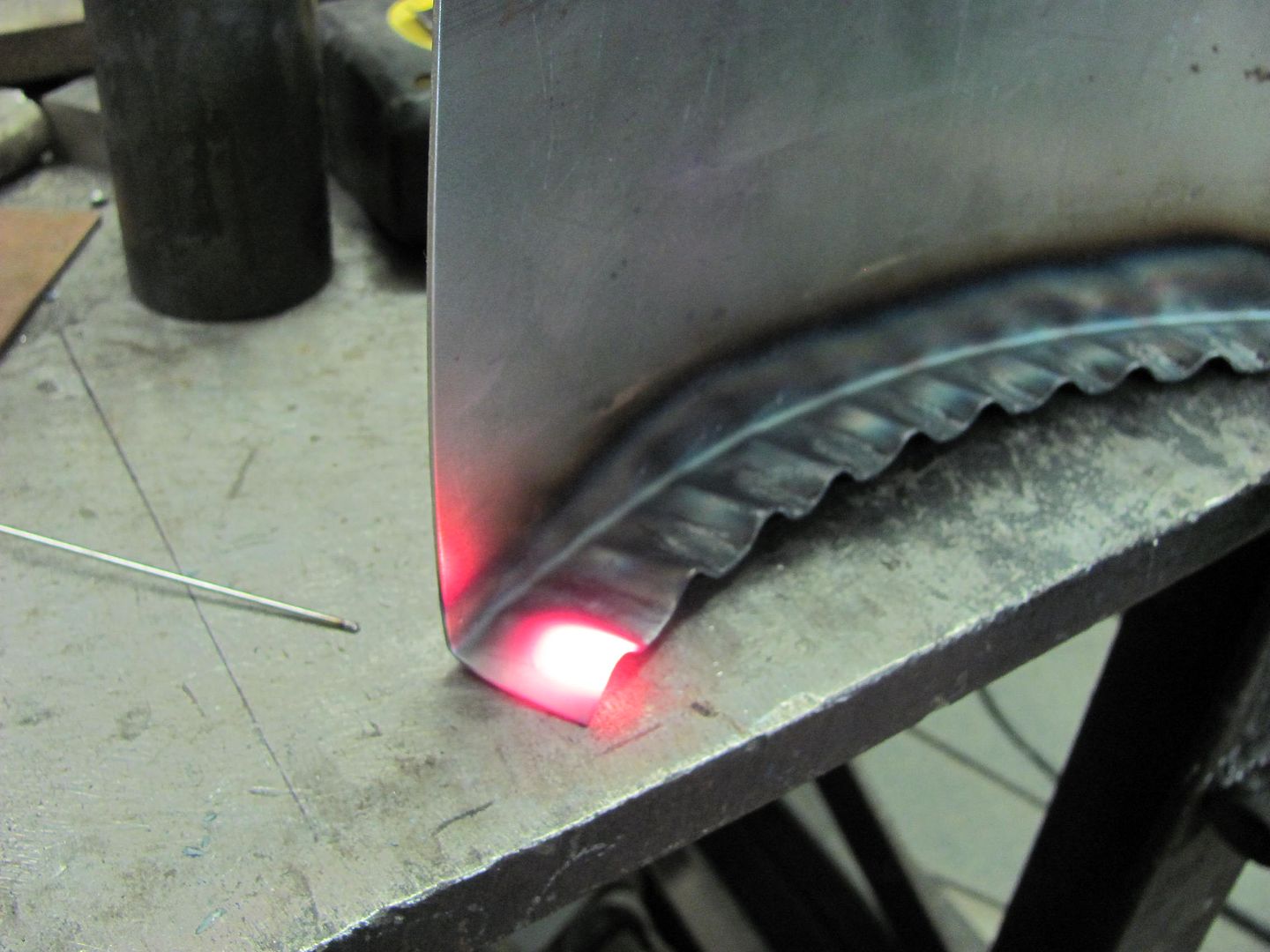
Where I used an O/A torch, you should also be able to accomplish similar results with a hand held propane torch. (use what you have that works)


Picture020-1.jpg


Heat up the raised portion of the first tuck until it glows nicely, then use a low crown body hammer (or suitable substitute) to flatten the tuck back into the flange. Repeat for the remaining tucks...


Picture021-1.jpg


Picture022-1.jpg


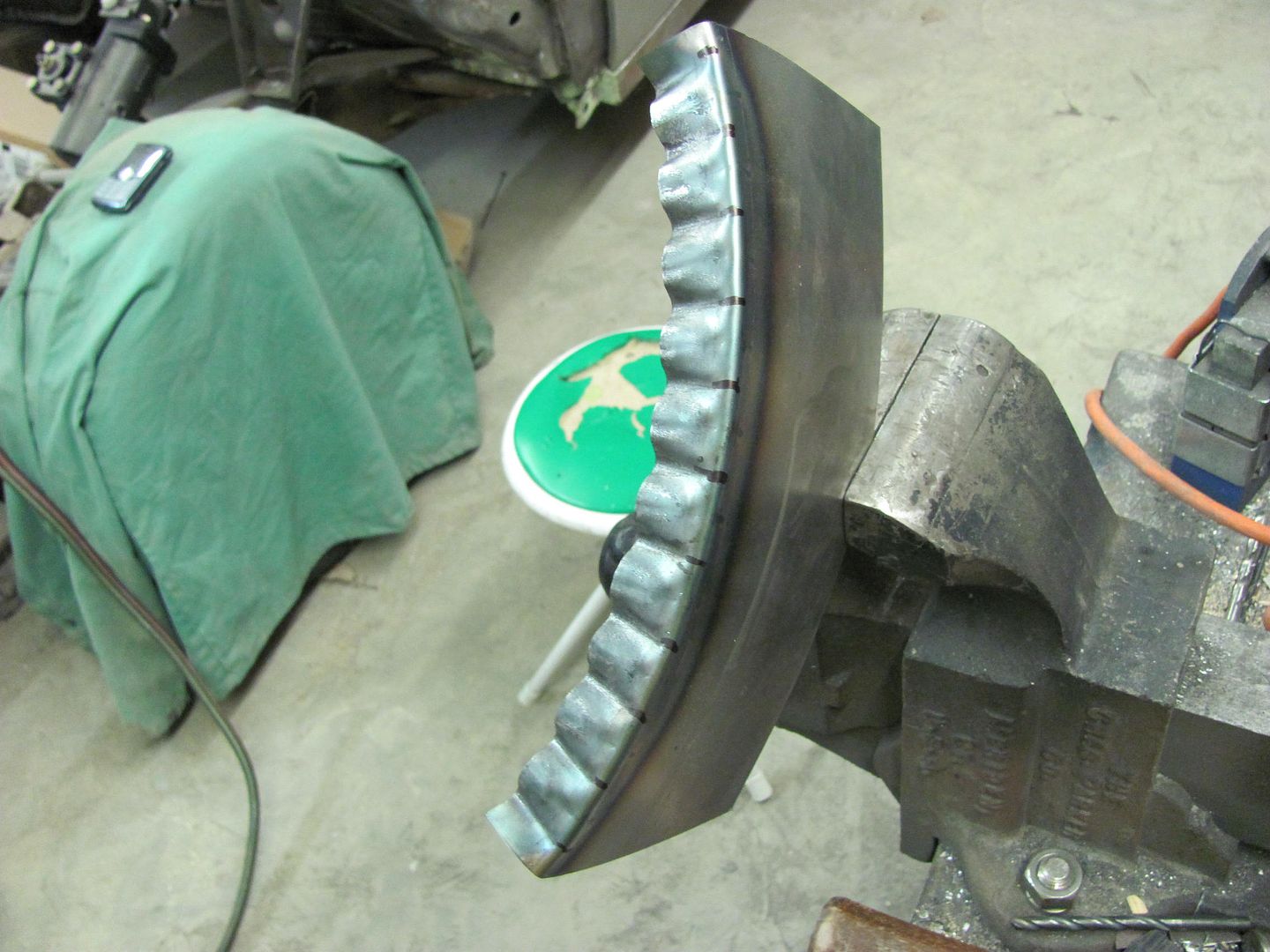
You can see we have a nice consistent radius, but likely it is not enough. Mark the next set of reference marks in between the first ones, just to stagger the shrink area to a new portion of the flange that has not been shrunk yet..


Picture025-1.jpg


Picture026-1.jpg


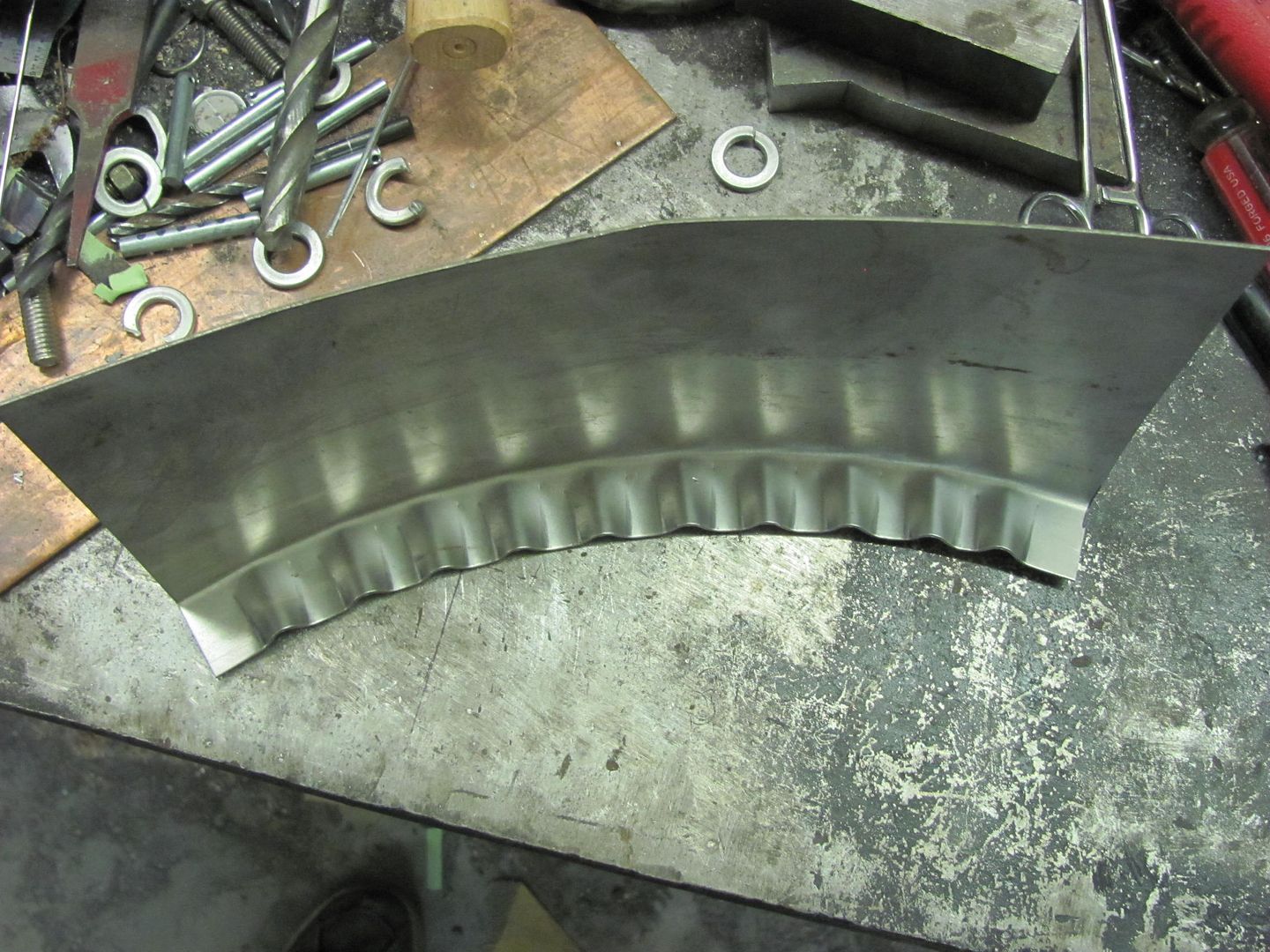
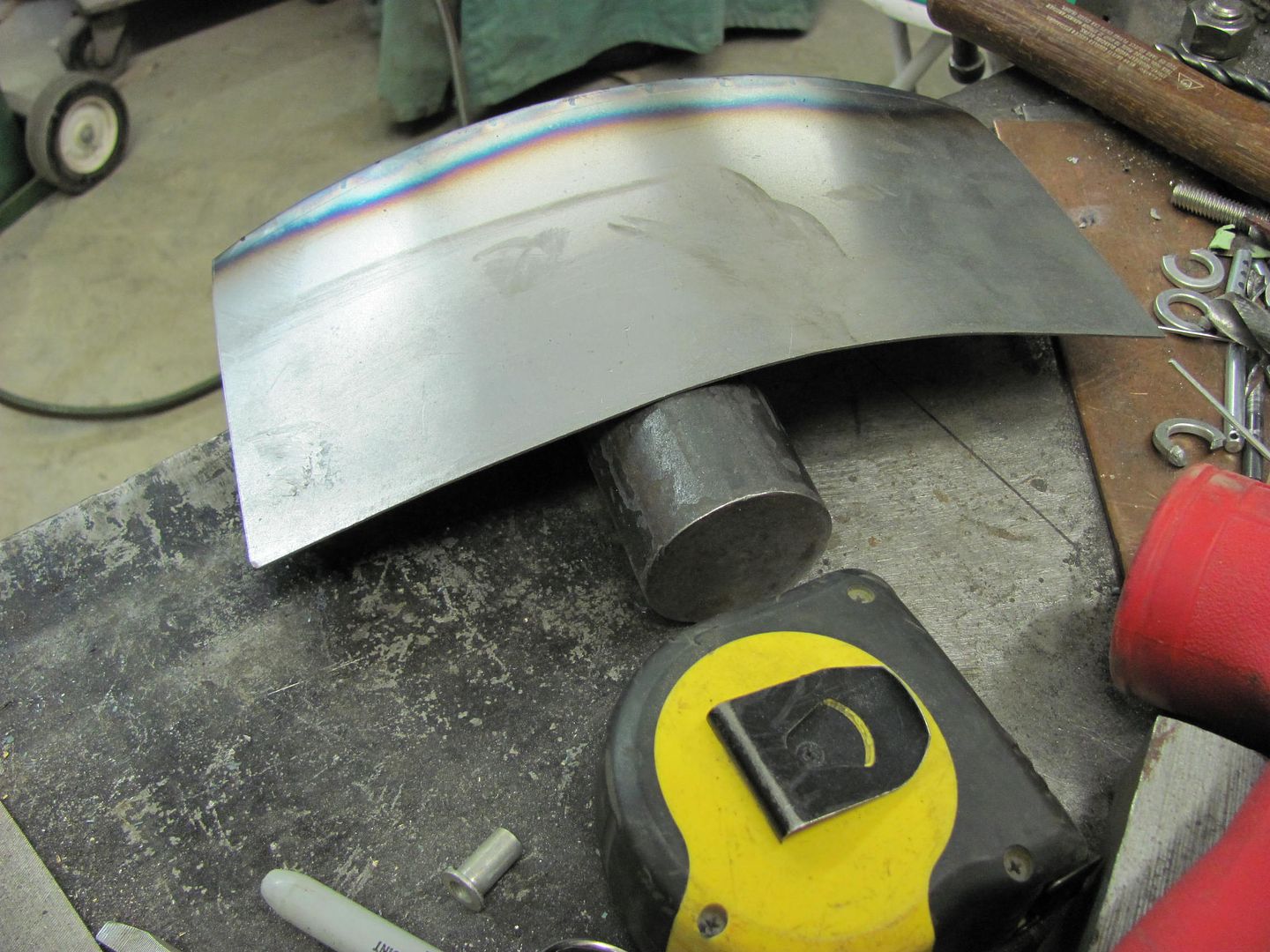
Where our flange is starting to form a radius, the outer edge has a tendency to remain flat. Rolling across a nice round piece of pipe while holding down gently on the edges will help (or whatever is handy....I will not be held liable for repurcussions from using stuff from your wife's kitchen..)


Picture027-1.jpg


Repeat the process of heating and hammering the tucks....


Picture032-1.jpg


Picture033-1.jpg


Picture034-1.jpg


Depending on how wavy the flange gets, you may have to go past the radius you are looking for to allow for flattening the flange


Picture035-1.jpg


....and a comparison of the first and second, repeat as neccessary until you reach the radius you need.


Picture022-1.jpg


Picture033-1.jpg
 
Last edited:

shocksystems

Well-known member
Joined
Mar 17, 2007
Messages
497
Location
Ipswich, MA USA
This part isn't exactly welding patch panels, but may come in handy just the same. For those that may need to form up some patch panels but don't have those shrinker/stretchers at your disposal, here's a how-to on tuck shrinking.

.................

Simply awesome. Thanks so much for posting this. I learned something today :thumbup:

Cheers!

Jim
 
Last edited:

z28toz06

Well-known member
Joined
Nov 30, 2005
Messages
1,012
Location
Connecticut
As most people have a mig in their home shop, I think you'll quickly find that the tighter your **** joint is, the less chance you have of blowing holes. Next, your heat setting used should be determined by the obtaining of a full penetration weld when welding the dots. If you don't get a full penetration weld, and it just looks like the bead is sitting on top of the metal, your heat is not sufficient. By the time you grind the welds down there will be little holding your patch in and a year or so of road vibration will undo all of your hard work. Now, if you do find you are still blowing holes, before turning down the heat, increase the wire feed. It's like this, if you have enough heat to perform the weld but not enough filler going in, somethings gotta give, hence a blowout. The less the gap, the less the chance of a blowout. Wider gap = more weld filler = more heat = more shrinking = more hammer and dolly work in the end. As far as the TIG welder, they seem to be even more prone to blowing out holes (yes, I have both), and for the novice welder, a very tight gap is almost a neccessity.


MP&C you are amazing. Nice work and amazing patience.
 

e-tek

Well-known member
Joined
Dec 19, 2007
Messages
10,690
Location
Saskatoon, SK
MP&C you are amazing. Nice work and amazing patience.

Patience?! I'd have that much patince if I was getting paid by the hour too!! :bounce:

Here's a question: What ever happend to the OP??:wtf::bounce: Poor guy got a lesson alright - in how well we all can hijack a thread!!!
 

Cebby

Well-known member
Joined
Jul 17, 2005
Messages
310
Location
Pittsburgh, PA
Any tips for welding the underside of door sills? I have some rust that needs to be repaired before the car will pass inspection (PA).

These are in an area that I can't get to the backside. Should I just use a magnet across the body and patch to keep them flush until tacked?

I've not done any appreciable amount of sheet metal work before.

This thread has been a great read.
 

Denominator

Well-known member
Joined
Oct 25, 2006
Messages
204
Location
Hamar, Norway
I'm in the middel of a resto project on a K5, and I get werry inspired by all these pics.
But one thing makes me think. Many of my weld in panels are not accessible from the back side. No matter what I do of prep work on the back side of the panels there will be exposed metal where I weld and around the weld. My friend, that now more about this then me, tells me that there are NO permanent fix for a weld like this, the rust will come back at some point no matter what. Any truth to this or a way to avoid it?
 

e-tek

Well-known member
Joined
Dec 19, 2007
Messages
10,690
Location
Saskatoon, SK
Any tips for welding the underside of door sills? I have some rust that needs to be repaired before the car will pass inspection (PA).

These are in an area that I can't get to the backside. Should I just use a magnet across the body and patch to keep them flush until tacked?

I've not done any appreciable amount of sheet metal work before.

This thread has been a great read.

In this case you need to cut out the affected area, treat the metal inside (POR 15, Eastwood Rust Encapsulator), then use a weld-through primer on any joined pieces.

I'm in the middel of a resto project on a K5, and I get werry inspired by all these pics.
But one thing makes me think. Many of my weld in panels are not accessible from the back side. No matter what I do of prep work on the back side of the panels there will be exposed metal where I weld and around the weld. My friend, that now more about this then me, tells me that there are NO permanent fix for a weld like this, the rust will come back at some point no matter what. Any truth to this or a way to avoid it?

When a piece is cut out, it's imperative to do what you can to treat any rust and/or bare metal. I like a rust encapsulator (POR15, Eastwood) for coating any rust. As well, you need to use a weld-through primer to coat any bare metal around the area to be welded. These are high Zinc or Copper sprays that stay put when welded on.

If you have rust, you generally gain access to the back when it's cut out. But in some rare instances there are times when that is just not possible. Then you would be correct - and as the song says: Rust never sleeps!:wtf::bounce:
 

davin24

Active member
Joined
Mar 3, 2008
Messages
44
wow just beatiful I learned more by reading this thread than in class the last month!!!
 

gordsgarage

Well-known member
Joined
Oct 15, 2010
Messages
78
Location
Canada
My hat is off to you Robert. Thanks for posting the panel fabrication. Quite often brains will take you further then the equipment.

Gord
 

speed bump

Well-known member
Joined
May 28, 2008
Messages
6,317
Location
Butte Montana
That tucking tool makes me think of an issue of Hot Rod from about 6 months ago. The guys they interviewed made a couple out of HF ladies foots and square tubing.
 

PCO6

Well-known member
Joined
Dec 25, 2008
Messages
4,573
Location
Newmarket, Ontario
Here's a little different type of patch panel. I took a panel beating course many years ago and our project was to build a "mini fender" that covered most of the basics of a making a real fender. I built the attached by hammer welding the joints and using as little filler rod as possible. The goal was to use none. It started out as a peice of sheet metal and a 3/16" rod. The fender is about 16" long by 6" wide and I have about 1" inch of filler rod in it. I screwed up!:)

I started by shearing the sheet metal into a top and side peice. The top was rolled to form the curved shape of the fender. I cut the side with aviation shears. The next step was to radius the sides of each peice to form half of the crown of the fender. That is where it was to be welded. The radius was formed by using a hammer and dolly. After more hand shearing and filing, the 2 peices were ready to be **** welded together. That was done by using an oxy acetelene torch with a very fine flame. Basically I tack welded the peices at about 1" intervals using nothing but the torch. The gaps were then welded with a torch only and hammered and dollied as I went.

The reason for using no filler rod is that finishing off the crown of the fender would be done with an English wheel. The problem with filler rod in a **** weld is that filler rod knicks the wheels because it's harder that the sheet metal.

The last step was to wire the edge and I hand formed that. I basically measured the circumference of the rod then scribed a line parallel to the edge of the fender as a guide. I then gently tapped the sheet metal over the rod and brought it in as tightly around the rod as I could.

Sorry I don't have any "action" shots. I'm not working on any auto body projects right now. I have used this technique on several cars that I restored and once you get the hang of it hammer welding without filler rod is a very satifying type of welding. It can't be used in all cases though as you definitely need access to both sides of the panel.
 

Attachments

  • DSC_0292.jpg
    DSC_0292.jpg
    135.2 KB · Views: 218
  • DSC_0289.jpg
    DSC_0289.jpg
    134.6 KB · Views: 254
  • DSC_0285.jpg
    DSC_0285.jpg
    142 KB · Views: 249
  • DSC_0284.jpg
    DSC_0284.jpg
    139.6 KB · Views: 258
Last edited:

IONH

Well-known member
Joined
Feb 12, 2010
Messages
2,043
Location
Central Massachusetts
This thread is a good read, been subscribed for a while. Hope this isn't too much of a hijack.

Just a couple days ago I welded my first body panel. I actually cut the bottom of one fender off (by the door) and welded another lower fender to the first. I had an overlap of about 1/2" as I thought it'd be easier to weld an overlap than a **** weld would be. By the way, I'm using a Mig welder with Argon/CO2 mix and thinner non-flux cored wire (I want to say around .023 size but I could be wrong).

Anyway, the first weld was literally awesome. I said to myself, "why do people complain about welding thin sheet metal, this first weld was awesome!". I had done about 1.5" and it was literally great and the penetration was perfect. Of course, it went downhill from there. Started blowing holes and melting the top layer.

I suspect it was because the sheets which I originally had directly touching the second had separated after the first weld. Do you think this is the case for the weld getting progressively worse as I moved across the line?
 

jktruck150

Well-known member
Joined
Oct 19, 2009
Messages
835
Location
Outskirts of Jackson, MS.
I learned more in the past 15 minutes reading this thread then I have in the past year of messing with small engines and cheap junk engines!! Thank you for continuing the education of us all, and keep it up!
 

lilredex

Well-known member
Joined
Apr 29, 2006
Messages
5,956
Location
Toronto
I'm in the middel of a resto project on a K5, and I get werry inspired by all these pics.
But one thing makes me think. Many of my weld in panels are not accessible from the back side. No matter what I do of prep work on the back side of the panels there will be exposed metal where I weld and around the weld. My friend, that now more about this then me, tells me that there are NO permanent fix for a weld like this, the rust will come back at some point no matter what. Any truth to this or a way to avoid it?

My solution to protecting non accessible panels is a simple one, as follows.

Cut up some wax toilet seals* and disolve them with varsol in a jar. Then mix with (used OK) ATF to get either a "creeping" mixture or something more clinging. I use a siphon type blow gun to spray this stuff into the hidden areas. A small inconspicuous 1/2" dia. hole works for me.

I have a Dodge van that was leaking rusty water onto the driveway, every time it rained, from the drain holes provided for, in the front fenders. The rain that gets in the fresh air vent grille, below the windshield, drains out at the bottom of the front fenders. So if you have a similar van be sure to keep those drain holes open. Anyway, this was driving me nuts and making a huge mess, so I drilled a hole in the front door post and shot some of that wax mixture in there............problem solved.

Whenever these vans are undercoated, they omit those front fenders 'cause the air going into the van through the vent stinks for a while, and I guess they want no complaints.

* Used to believe those toilet seals were bee's wax but have been informed they are made from some kind of petroleum based material.
 
To avoid these ads, REGISTER NOW!
Top Bottom