To avoid these ads, REGISTER NOW!

Snap-on or Williams wrench size tolerance?

Formerjeeper

Well-known member
Joined
May 10, 2019
Messages
378
Location
Cincinnati, OH
I was using a 16mm Williams USA ratcheting wrench the other day and the open end slipped on a 16mm nut on a Mercedes without cranking on it too hard. Thought it was strange so got the calipers out and the 16mm open end is actually 16.5mm.

Any of the other wrenches in the set are not more than 0.25mm larger than their labeled size.

I also measured some Proto and Gedore 16mm wrenches I have and they are about 16.2mm

Could anyone that has Snap-On or Williams USA let me know what their 16mm actually measures? Wondering if this is a defect I should exchange or if it's within tolerances.

I'll take some photos and add to this post.

Thanks
 
To avoid these ads, REGISTER NOW!

Dave455

Well-known member
Joined
Mar 19, 2013
Messages
5,847
Location
Sussex, England
I can tell you, from my vast collection of reference materials (well, the back of the Stahlwille catalogue actually) that the spec for a 16mm wrench is 16.05mm to 16.27mm so yours is well out of spec.

Stahlwille don’t say which spec they quote, but it’s probably DIN or ISO, and I doubt they are much different. ANSI might be different, but not by that much.

Has the wrench spread? Maybe measure the base and tips of the jaws and see if they are different.
 

VolvoRyan

Well-known member
Joined
Dec 29, 2019
Messages
1,339
Location
Kentuckiana, USA
Gotta be a defect. I have a full set of Snap-On wrenches from the 1980's with 30 years of flat rate on them. They're still tighter than a new import wrench.

-Ryan
 

Samuel D

Well-known member
Joined
Apr 9, 2019
Messages
644
I can tell you, from my vast collection of reference materials (well, the back of the Stahlwille catalogue actually) that the spec for a 16mm wrench is 16.05mm to 16.27mm so yours is well out of spec.

Stahlwille don’t say which spec they quote, but it’s probably DIN or ISO, and I doubt they are much different.
They do say in a footnote: “DIN 475/2 series 1 and ISO 691”. So I guess DIN and ISO have the same tolerances in this regard.
 

Noworries

Banned
Joined
Dec 8, 2019
Messages
230
Location
Southern California
Because I'm bored I took a handful of wrenches and a 3/4" bolt clamped in a vise and checked "travel". I used the box end of these wrenches and scientifically measured by eyeballing total wrench movement. I used 6 wrenches, both US and import and ranging in age of 2 years to over 50. Heres what I found:

1/4" total "wiggle room"
SnapOn GOEX 240
Stanley 89-669
Huskey no part no.

5/16" total wiggle
Pittsburgh long reach, no part no
Barcalo Buffalo no part no

3/16" total wiggle
Craftsman -VV-44701

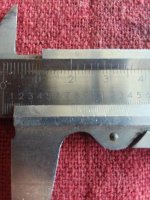
The caliper showes the bolt head measurment.

Like I said I was bored.
 

Attachments

  • 20200826_141736.jpg
    20200826_141736.jpg
    146.7 KB · Views: 55
  • 20200826_141933.jpg
    20200826_141933.jpg
    95.6 KB · Views: 47

Samuel D

Well-known member
Joined
Apr 9, 2019
Messages
644
Because I'm bored I took a handful of wrenches and a 3/4" bolt clamped in a vise and checked "travel". I used the box end of these wrenches …
The box (ring) end of modern spanners has convex engagement surfaces that press against the flats of the fastener, deforming tool and fastener elastically until the initial line contact has an appreciable area. If there is a bit more clearance between tool and fastener, this merely moves the initial line of contact a little farther along the convex surface. Being smoothly convex, that makes no difference.

This almost totally renders concern about fit with ring spanners moot (I say almost because a slacker fit does tend to cause contact on the flat slightly farther from the corner, meaning at a fractionally smaller radius from the axis of rotation, so the force causing torque acts on an infinitesimally shorter lever and therefore must be slightly higher for a given torque. Barely worth talking about).

It is the open end where fit is critically important to torque capacity without permanent damage to tool or fastener. Stahlwille is very good here. Unfortunately I have seen spanners whose makers have claimed DIN compliance while not meeting the DIN tolerances listed at the back of the Stahlwille catalogue. It happens.
 

MJK

Well-known member
Joined
May 21, 2018
Messages
737
Location
Tucson, AZ
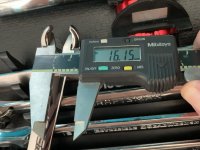
My 16mm SO line wrench measures 16.15mm across the flats

Also:
Facom 467 combo 16.15mm
Craftsman USA combo 16.14mm
 
Last edited:
To avoid these ads, REGISTER NOW!

MJK

Well-known member
Joined
May 21, 2018
Messages
737
Location
Tucson, AZ
Sounds pretty good, but where in the jaws and how are you measuring this?

Diagonally, using the inside measurements of a Mitutoyo digital caliper.

(easiest way to get consistency, and you can see if there is spread)
 

Attachments

  • m.jpg
    m.jpg
    98.5 KB · Views: 82

Samuel D

Well-known member
Joined
Apr 9, 2019
Messages
644
Diagonally, using the inside measurements of a Mitutoyo digital caliper.

(easiest way to get consistency, and you can see if there is spread)
Very good.

I don’t have metric Snap-on spanners but an OEX200B to hand (5/8" short combination spanner). The jaws measure about 16.05 mm with your technique, using a Mitutoyo vernier calliper instead of a digital.

That’s about the middle of the 15.98–16.15 mm tolerance listed at the back of the Stahlwille catalogue for the 5/8" size (which Stahlwille describes as “ANSI B 18.2.1 + ASME/ANSI B 18.2.2”).

Would be nice to hear whether Formerjeeper has checked if the Williams jaws have plastically (permanently) spread and which spanner we’re talking about here. What size was the nominally 16 mm nut when measured? I’m also curious why he or she was using an open-ended spanner on it and what “without cranking on it too hard” means in terms of torque. I try very hard to avoid putting decent torque into an open-ended spanner. They’re a bad tool for that, because they act on only two corners of the fastener instead of six, have necessarily more clearance than is ideal for torque, and incur the constant risk of slipping or elastic jaw spreading.

Too often on YouTube and in person I see open-ended spanners used optionally. They should be seen as specialist hard-access tools, not something to grab first. Of course they’re fine for spinning on or off a loose fastener over the (very low) prevailing torque.
 

ssdave

Banned
Joined
Apr 11, 2015
Messages
2,913
Location
Eastern Oregon
Some open end data:

OEX-16M stubby: 16.15
OEXM 16B stubby: 16.21
VOM 1618 open end 16.10
OEXM160 16.21
Proto SCVM16A 16.41 - not a fair comparison, this is ASD jaw
Proto 1216M 16.15
SK 88316 16.23
 
Last edited:

ssdave

Banned
Joined
Apr 11, 2015
Messages
2,913
Location
Eastern Oregon
So another one out of spec, whether from the factory or because of wear or deformation. It’s pretty common in my experience.

Actually, that wasn't a fair measurement on my part. The wrench is new, but it is ASD, so has the notches on each side, and non-parallel geometry. A simple caliper measurement doesn't evaluate the fit and how it works.
 
OP
F

Formerjeeper

Well-known member
Joined
May 10, 2019
Messages
378
Location
Cincinnati, OH
Would be nice to hear whether Formerjeeper has checked if the Williams jaws have plastically (permanently) spread and which spanner we’re talking about here. What size was the nominally 16 mm nut when measured? I’m also curious why he or she was using an open-ended spanner on it and what “without cranking on it too hard” means in terms of torque. I try very hard to avoid putting decent torque into an open-ended spanner. They’re a bad tool for that, because they act on only two corners of the fastener instead of six, have necessarily more clearance than is ideal for torque, and incur the constant risk of slipping or elastic jaw spreading.

I don't think the jaws spread, I think they were just too wide and let the nut round slightly. I'll measure the nut this evening. The open end was because I didn't have clearance to slip a box end or socket on the nut. Agree on not putting a lot of torque on an open ended wrench.
 

Noworries

Banned
Joined
Dec 8, 2019
Messages
230
Location
Southern California
The box (ring) end of modern spanners has convex engagement surfaces that press against the flats of the fastener, deforming tool and fastener elastically until the initial line contact has an appreciable area. If there is a bit more clearance between tool and fastener, this merely moves the initial line of contact a little farther along the convex surface. Being smoothly convex, that makes no difference.

This almost totally renders concern about fit with ring spanners moot (I say almost because a slacker fit does tend to cause contact on the flat slightly farther from the corner, meaning at a fractionally smaller radius from the axis of rotation, so the force causing torque acts on an infinitesimally shorter lever and therefore must be slightly higher for a given torque. Barely worth talking about).

It is the open end where fit is critically important to torque capacity without permanent damage to tool or fastener. Stahlwille is very good here. Unfortunately I have seen spanners whose makers have claimed DIN compliance while not meeting the DIN tolerances listed at the back of the Stahlwille catalogue. It happens.

And that is why I used wrenches spanning 50+ years. Having made my living using tools often in the presence of the customer, I am a firm believer in tools have specific uses. Using a flat tip as a prybar or an open end wrench to torque a manifold bolt then gripe the tool failed is silly and looks unprofessional .. (not that op did this!) Flipping a wrench over to get a better position is begging for trouble. Again not that op did this!
Is there an accepted "industry standard" din, iso, ansi that states wrench/socket tolerance?
 

Downwindtracker 2

Well-known member
Joined
Jun 13, 2019
Messages
1,715
Location
BC
Years back we got a bunch of Blackhawk tools at clearance prices, a factory dump at our local tool store. Made in USA tools. I picked up a nice shiny 1/2" combination. A lot nicer than that old Maple Leaf I had been using all those years. One it's first jobs was to adjust a machine. We use square heeded set screws as adjusting jack screws. Of times things don't move too easily . The jaws spread, but here is the kicker, I was able to bend them back in a big 6" Record vise. JUNK
 
To avoid these ads, REGISTER NOW!
Top Bottom