
You are using an out of date browser. It may not display this or other websites correctly.
You should upgrade or use an alternative browser.
You should upgrade or use an alternative browser.
Where are you guys buying your lights?
- Thread starter Bradc1989
- Start date
ClappedOutBport
Well-known member
- Joined
- Mar 30, 2016
- Messages
- 998
Home Depot Led fixtures have been dreadfully awful for me, don't do those.
Stuart in MN
Well-known member
Take a look at the two sticky threads at the top of the electrical section - they go into depth on what fixtures to use and how to arrange them.
sparky 1971
Well-known member
The only good thing about the box store shop lights is that they plug in. That way, when they fail, and they will sooner than later, you can unplug it, throw it away and hang another in under 10 minutes. I bought four different styles from Menards for my shop, just to be my own guinea pig. One failed within a week, one has the center section out within two months. The other two are doing ok, but they are in the wood shop and very rarely get turned on. The rest of the lights are different styles of led tubes I installed in old florescent fixtures. Those are fantastic.
vipersnvettes
Member
Amazon
DJF3
Well-known member
Go visit you local electrical wholesaler. They will usually have better lights that the big box stores. Plus you may be supporting a local business.
nadogail
Well-known member
Mine came from Home Depot, the best thing I can say about them is that they were inexpensive.
Jakemedic
Well-known member
I purchased from https://www.primelights.com. I got the BOLT 3 light. Not the cheapest, but should preform amazingly. Haven't taken them out of the box yet, but will within the next month. They did a free layout using their product. My ceiling is going to go up next.......
Innovate1
Well-known member
I went with strip lights with LED line voltage tubes. When (it may be a while but it's when not if) the lights go out I can just replace the bulbs.
txvwnut
Well-known member
I bought mine from prinelights.com and have been really happy with them. Had one bulb failure and the warrantied it with no issues. They're kinda pricey but I believe in you get what you pay for.
16again
Well-known member
Pro Lighting. I dealt with Gary.
www.Prolighting.com
www.Prolighting.com
curliejones
Active member
- Joined
- Aug 19, 2013
- Messages
- 34
In sync with what sparky 1971 said, I built a shop six years ago and wired switches to four square boxes mounted on rafters and ceiling joists. I plugged in all my overhead fixtures in hopes that led lighting would become more affordable. In the meantime, the lumens per watt is almost as good from my t-8 fluorescent lights as the advertised (cheap) led shop-lights. I bought some decent 4 ft fixtures (2Xs 32W) and rebuilt several 4 ft troffers that hold 4 bulbs Xs32W each. I spent about $35 each on the troffers and painted the inside of the reflector with silver-chrome paint. New ballasts, new tombstones, new bulbs, removed diffusers and boy do they ever shine. I probably average only two long days a week, but nothing has failed in six years. Should things (other than bulbs) need replacement, I'll be asking this same question??? Who has a DECENT LED replacement??
All my fixtures in my garage are Lithonia from HD. They are 8' four bulb fixtures, but there are also a few 4 foot fixtures due to location.
I bought strip lights and put in regular fluorescent bulbs. Then I made the switch to direct replacement LEDs. I've replaced a couple of the cheaper bulbs I first used and 1 ballast in the 10-11 years they have been in.
I'm happy with them and will be putting them in the garage addition when it's time.
I bought strip lights and put in regular fluorescent bulbs. Then I made the switch to direct replacement LEDs. I've replaced a couple of the cheaper bulbs I first used and 1 ballast in the 10-11 years they have been in.
I'm happy with them and will be putting them in the garage addition when it's time.
oldwino
ALLIANCE MEMBER
Felt LED shop lights from Costco. Usually around $20.00 but occasionally on sale for $15. Had them 4+ years, used several hours a day without a flicker
TuxThePenguin
Well-known member
Pretty much any light is fine.
The cheap $10-to-$15-on-sale Commercial Electric Home Depot lights are completely fine. That's what I buy. when I replace lights in my house I buy the cheap Home Depot ones. Right now I have a 2-for-$15 LED light pack in my online cart waiting for me to get enough other stuff into the order to get free shipping. Have used similarly cheap lights many times. Always work absolutely fine.
I'm a snob with cars, hand tools, power tools, computers, a/v equipment, and many other things.
But lights? ????????????????????
???????????????????????
Just buy some cheap LEDs****. They will work fine as long as you don't want to do things like put them on a dimmer (the cheapest LED stuff won't dim - either at all, or it will flicker)
**** As long as it's warm color temperature at least cool/"daylight" bulbs are the worst.
The cheap $10-to-$15-on-sale Commercial Electric Home Depot lights are completely fine. That's what I buy. when I replace lights in my house I buy the cheap Home Depot ones. Right now I have a 2-for-$15 LED light pack in my online cart waiting for me to get enough other stuff into the order to get free shipping. Have used similarly cheap lights many times. Always work absolutely fine.
I'm a snob with cars, hand tools, power tools, computers, a/v equipment, and many other things.
But lights? ????????????????????
???????????????????????
Just buy some cheap LEDs****. They will work fine as long as you don't want to do things like put them on a dimmer (the cheapest LED stuff won't dim - either at all, or it will flicker)
**** As long as it's warm color temperature at least
cool/"daylight" bulbs are the worst.I swapped my fluorescent T12 fixtures for Lithonia T8 LEDs from HD. They're smaller and very bright.
I switched over because the ballasts in the old T12s were failing and from what I've read, fluorescents are slowly being phased out. Apparently T12s are no longer being made, though you can still find them. I didn't want to keep putting money into old technology.
The Lithonia lights work well in my two car garage. I wired four of them to be plugged into ceiling outlets. It's as bright as a summer afternoon in there now.
Edit: I'll stand corrected since in another thread regarding shop lights it was said that T12 fluorescents are still being made to some degree. I would still go with LED though.
I switched over because the ballasts in the old T12s were failing and from what I've read, fluorescents are slowly being phased out. Apparently T12s are no longer being made, though you can still find them. I didn't want to keep putting money into old technology.
The Lithonia lights work well in my two car garage. I wired four of them to be plugged into ceiling outlets. It's as bright as a summer afternoon in there now.
Edit: I'll stand corrected since in another thread regarding shop lights it was said that T12 fluorescents are still being made to some degree. I would still go with LED though.
Last edited:
Ceiling height will be a major factor in what type of lights you need to choose. Strip lights are good up to 10-12 ft. Anything higher will be better with a highway.
A highbay can be wired with a cord or flexible conduit. Strip lights are best mounted to the ceiling and hard wired.
Best part about a strip light is there will always be parts available. I can get original parts or a retrofit kit for led tubes that fit strip lights from the '50's. I think that will be the same many years from now. It's just a metal channel with sockets.
A highbay can be wired with a cord or flexible conduit. Strip lights are best mounted to the ceiling and hard wired.
Best part about a strip light is there will always be parts available. I can get original parts or a retrofit kit for led tubes that fit strip lights from the '50's. I think that will be the same many years from now. It's just a metal channel with sockets.
mustangcrazy77
Well-known member
I used 6 150W, 21750 Lumen LED high bay's shown here....
https://greenlightdepot.com/product...-tempered-glass-ul-dlc?variant=14911428591659
These are dimmable if you run a low voltage wire. Yes, they do have a UL stamp. Here are some pics of how they look.


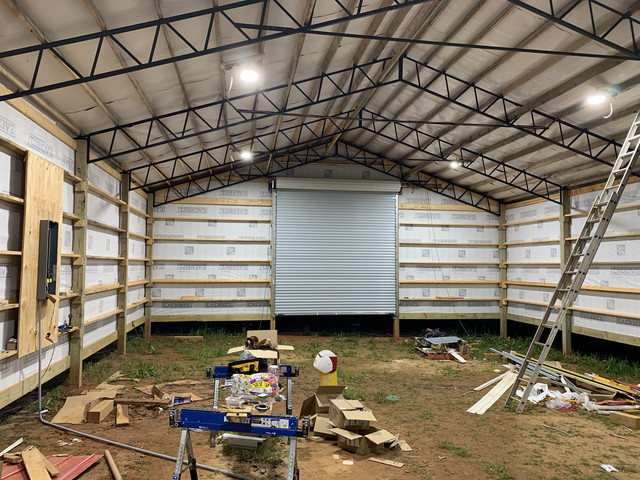
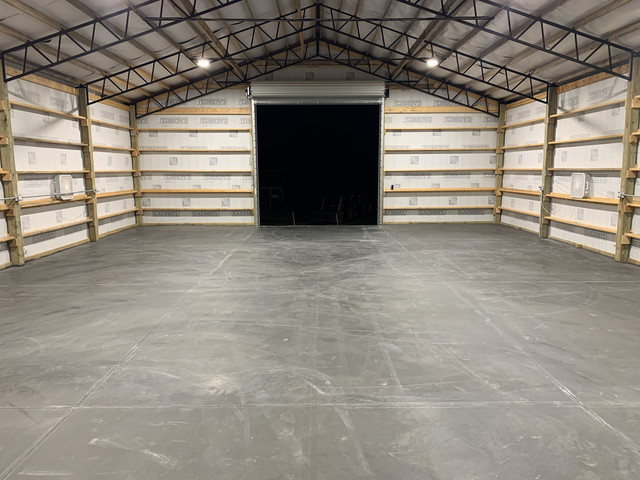
I specifically choose 4k as lighting that is more blue tends to give me headaches.
As a reference, my barn is 1800 square feet and the lights are mounted ~14ft up.
The lighting is spot on in this picture. It's pitch black outside, and the illumination is more than adequate.
https://greenlightdepot.com/product...-tempered-glass-ul-dlc?variant=14911428591659
These are dimmable if you run a low voltage wire. Yes, they do have a UL stamp. Here are some pics of how they look.
I specifically choose 4k as lighting that is more blue tends to give me headaches.
As a reference, my barn is 1800 square feet and the lights are mounted ~14ft up.
The lighting is spot on in this picture. It's pitch black outside, and the illumination is more than adequate.
Last edited:
Ceiling height will be a major factor in what type of lights you need to choose. Strip lights are good up to 10-12 ft. Anything higher will be better with a highway.
A highbay can be wired with a cord or flexible conduit. Strip lights are best mounted to the ceiling and hard wired.
Best part about a strip light is there will always be parts available. I can get original parts or a retrofit kit for led tubes that fit strip lights from the '50's. I think that will be the same many years from now. It's just a metal channel with sockets.
This is my exact thought on using strip lights. I mounted my on some 3/4" blocks using them as stand-offs. It allows for any build up heat from the ballast to radiate out with the air gap. Maybe this is the reason I virtually have no issues with ballasts or bulb life.
curliejones
Active member
- Joined
- Aug 19, 2013
- Messages
- 34
This is my exact thought on using strip lights. I mounted my on some 3/4" blocks using them as stand-offs. It allows for any build up heat from the ballast to radiate out with the air gap. Maybe this is the reason I virtually have no issues with ballasts or bulb life.
The blocks are a great idea! Sheetrock (if any) might be able to offer protection to the sheathing above, but the blocks protect the ballast itself. In one of my main work areas, I mounted five 2-bulb shop lights between the joists that support the loft above. I used hooks and hung the lights on short chains where the fixture bottoms are even with the joist bottom. Since there’s only 8 ft. of clearance in this area, I bought clear plastic tubes to help protect the bulbs.
curliejones
Active member
- Joined
- Aug 19, 2013
- Messages
- 34
I used 6 150W, 21750 Lumen LED high bay's shown here....
https://greenlightdepot.com/product...-tempered-glass-ul-dlc?variant=14911428591659
These are dimmable if you run a low voltage wire. Yes, they do have a UL stamp. Here are some pics of how they look.
I specifically choose 4k as lighting that is more blue tends to give me headaches.
As a reference, my barn is 1800 square feet and the lights are mounted ~14ft up.
The lighting is spot on in this picture. It's pitch black outside, and the illumination is more than adequate.
145 That's a good return per Watt. 145 Lumens per watt. Many of the inexpensive shop lights are below 100 and hardly any better than 32W fluorescent tubes, not giving much incentive to change.
For my 10 foot ceilings, despite being from HD I really like these

: https://www.homedepot.com/p/Commerc...VFInICh1tuA87EAQYASABEgJnfvD_BwE&gclsrc=aw.ds
Sent from my iPhone using Tapatalk
: https://www.homedepot.com/p/Commerc...VFInICh1tuA87EAQYASABEgJnfvD_BwE&gclsrc=aw.ds
Sent from my iPhone using Tapatalk
Attachments

mustangcrazy77
Well-known member
145 That's a good return per Watt. 145 Lumens per watt. Many of the inexpensive shop lights are below 100 and hardly any better than 32W fluorescent tubes, not giving much incentive to change.
Yes, I’m super pleased. I almost went down the road of installing a buttload of shop strip lights...but the ease of installing these and the output won me over. Plus the fit they budget.
Thanks for all the replies, a lot of good info here. I’m going with 10’ ceilings so I’ll likely go the high bay route, lots more options with those anyways. We did the retro fits from t8 to led tubes at a place I worked a few years ago. I think that will also be my best bet for ease of changing when one goes out. I prefer my shop lighting white, towards the blue side, something about the orange/yellow light is hard for me to work in, although is what I prefer for in my home. Once again thanks for the info and other little tips to think about
DJF3
Well-known member
Thanks for all the replies, a lot of good info here. I’m going with 10’ ceilings so I’ll likely go the high bay route, lots more options with those anyways. We did the retro fits from t8 to led tubes at a place I worked a few years ago. I think that will also be my best bet for ease of changing when one goes out. I prefer my shop lighting white, towards the blue side, something about the orange/yellow light is hard for me to work in, although is what I prefer for in my home. Once again thanks for the info and other little tips to think about
I might be mistaken, but isn't this counter intuitive? 10 ft is not a high ceiling. High bay lighting may be too bright, too much glare, or not enough diffusion.
Metallitubby
Well-known member
Pro Lighting. I dealt with Gary.
www.Prolighting.com
Same here. I have yet to receive my lights, but with all of the users here that have ordered from them, I don't think I'll have an issue.
curliejones
Active member
- Joined
- Aug 19, 2013
- Messages
- 34
One thing I considered for my shop was "tiered" lighting. I have different levels of light available to me depending on the tasks at hand. My workbenches all have overhead directed track lighting (all now have led reflector bulbs), in addition to general lighting from hanging T8 fluorescent fixtures. The most used lighting, however, are white ceramic fixtures that hold reflectors and accept a standard base bulb (E26, I believe). They are also outfitted with a cage to protect the bulbs from breakage since I started out with CFL 23W bulbs (mercury?). I have since switched to LED bulbs (A19 shape) in the ceramic fixtures. My shop is not only a woodworking shop, but, like many DIY folks living rurally, it houses "everything in the world" to keep up a house, travel trailer, and fix lawn and garden equipment for a large homeplace. I have two fixtures near each entrance and two in each of the other building corners. Each fixture holds an LED bulb that provides enough light to go find, fetch, etc. It's a little more to wire in initially, but when you are in and out working on things you may consider that burning 50 Watts total and leaving the lights on when your hands are already full a great convenience. My T8 fluorescent fixtures (30 bulbs X 32 Watts per) are on four different switches and provide great light when woodworking; they're just not always needed. All the fluorescent fixtures plug in to four-square boxes so they can easily be replaced if /when necessary. I had only one corner of the shop where the switch turned on power to both ceramic fixtures and two four-bulb troffers. I recently separated the two lighting systems with a remote controller (think Christmas lights) and that worked fine. I always buy the 13A or 15A rated remotes and have had my small dust collector on one for five years with no issues.
VtecGSR95
Well-known member
My neighbor had some high bay LED's from Rural King and they were extremely bright! I went and put 12 on layaway as to not lose them during my build.
Fast forward 3 months......I realize they only have a 30 day warranty! Went to Menards, got their version of the same light (Patriot Lighting High bay) for same price ($99.99+11% rebate) and it comes with a 5 year warranty.
My wife went into Rural King to take mine off layaway......and found our Rural King had pulled them off the shelf due to a recall from the Mfr!
So far the Menards lights are fantastic. No complaints here......but with anything, time will tell the real story.
Fast forward 3 months......I realize they only have a 30 day warranty! Went to Menards, got their version of the same light (Patriot Lighting High bay) for same price ($99.99+11% rebate) and it comes with a 5 year warranty.
My wife went into Rural King to take mine off layaway......and found our Rural King had pulled them off the shelf due to a recall from the Mfr!
So far the Menards lights are fantastic. No complaints here......but with anything, time will tell the real story.
curliejones
Active member
- Joined
- Aug 19, 2013
- Messages
- 34
Ceiling height will be a major factor in what type of lights you need to choose. Strip lights are good up to 10-12 ft. Anything higher will be better with a highway.
After digging around on several websites, there seems to be an in-between category. While highbay lights are recommended in the range of 20-40 ft (above the floor), there is such a thing as "lowbay" lights that are intended for the 12 to 20 ft range. One other consideration for LED fixtures and / or bulbs is the "beam angle" or some call it "beam spread". Since led bulbs and strip lights are usually directed downward, the angle makes quite a difference in coverage, (think workbench height vs distance to floor). This could /should make a difference on fixture spacing. I use a lot of track lighting in my home and became familiar with beam angle when considering all the different bulb classes, e.g. spot, flood, narrow flood, etc. I find it best when they simply state the angle from a bulb.
curliejones
Active member
- Joined
- Aug 19, 2013
- Messages
- 34
I might be mistaken, but isn't this counter intuitive? 10 ft is not a high ceiling. High bay lighting may be too bright, too much glare, or not enough diffusion.
Yes. Highbay is usually 20-40 ft. There's also "low bay" lighting for 12-20 ft
The manufacturers aren't really using the term lowbay much anymore.
Highbays can usually be had with wide distribution that works well down to 12-14' ceiling heights.
This is what I’ve noticed. There seems to be very few options for lights labeled as “low bay” . The walls will be 10’ so I could hang them from short chains from the ceiling to get Them more in their effeciancy range. I’ve been in shops with 8’ walls and high bays out of a factory and I didn’t think the distribution was that bad
recountryman
Well-known member
- Joined
- Apr 20, 2013
- Messages
- 115
For my 30x50 metal building I order 12 of these HYPERLITE 5000K LED UFO High Bay Lights 100W Coollight 14,000lm. Going with a pattern that I got using the Dialux program using 4 rows of 3.