To avoid these ads, REGISTER NOW!

How to run wires into main panel?

jonness

Active member
Joined
Feb 26, 2017
Messages
32
Location
Olympia, WA
I'm getting ready to run power from my house to my detached garage. I'm using 2 AWG copper underground 130' using 2" conduit.

I'm not sure what the best way to get the wire into the house load center is?

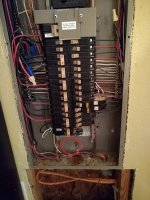
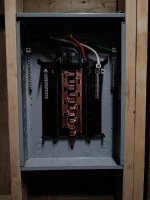
I plan on drilling a hole in the siding and fitting a 2" PVC LB conduit body from the outside. But I'm not sure what to do on the inside of the wall. Should I come in from below the panel and use another 2" LB body on the inside of the wall and then a short piece of conduit into the knockout on the bottom of the panel. Or should I go directly into one of the 2" knockouts in the back of the panel?

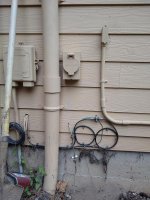
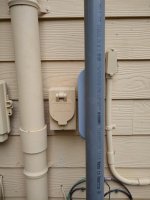
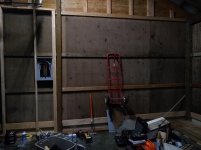
Note, the space on the wall on the outside of the house limits exactly where I can place the LB body. (please see attached images)

Thanks!
 

Attachments

  • InsidePanel.jpg
    InsidePanel.jpg
    43.9 KB · Views: 236
  • OutsideOfHouse.jpg
    OutsideOfHouse.jpg
    112.3 KB · Views: 200
  • UpperPanel.jpg
    UpperPanel.jpg
    121.7 KB · Views: 217
  • LowerPanel.jpg
    LowerPanel.jpg
    126.6 KB · Views: 215
To avoid these ads, REGISTER NOW!

Noltz

Well-known member
Joined
Mar 10, 2020
Messages
377
Location
Ontario, Canada
LB through the foundation, short section of conduit, LB up, short piece of conduit into the bottom center of the LC. Make sure to order the correct threaded coupler to get 2" conduit into that LC hole. Looks like it's a 2"/ 1½" but make sure. Then you can feed it from that empty cavity.
 

wyliesdiesels

Well-known member
Joined
Aug 14, 2012
Messages
20,011
Location
Modesto, CA
LB cannot be buried inside the wall.

Why #2 cu? What size feeder/breaker are you using?

#2 cu is most likey overkill at 130’ for the avg shop with one person...

What loads will you have?
 

sparky 1971

Well-known member
Joined
Oct 9, 2018
Messages
7,971
Location
Central Iowa
I think I would take the slack out of the 10/3 and 12/3 and move them over so they come in the right hand side of the panel bottom. The 10/3 already does, just take the extra foot and a half of wire out of the stud bay. You could then LB into the bottom of the panel, but you will have to have an access for the LB and that may look stupid. I would get a 12"X12"X4" juction box, set it so it's flush with the finished wall and close to the floor so you will miss the pvc 90 outside. Pull the cable loose outside, you can put it back later. ****** into the panel from it and LB into the back. A 12X12 will allow you to screw it to the stud on the left, but right hand side will be far enough over to utilize the 2" knockout already pulled out of the bottom of the panel. Come into the back of the box from the outside towards the bottom and on the left (facing the box from the inside). That way, you have a nice, easy bend to get the wire into the panel. Put the sheetrock back and you are good to go.

A 10X10 box would work just fine with the #2 wire, but for an angle pull through a box, it has to be 6X the size of the conduit. 2"X6=12 and the last thing you need is some by the book inspector making you change it. You could easily fit everything in a 1-1/2" conduit and use a 10X10 box.

As stated above, #2 CU is probably overkill, but it's your money and you can spend it however you like.
 
OP
J

jonness

Active member
Joined
Feb 26, 2017
Messages
32
Location
Olympia, WA
LB cannot be buried inside the wall.

Why #2 cu? What size feeder/breaker are you using?

#2 cu is most likey overkill at 130’ for the avg shop with one person...

What loads will you have?

The buildings are 130' apart. Panel to panel is about 145'. I will be using a 100 amp breaker in the house panel to feed a 100 amp panel in the garage. I figure the air compressor, heater, and table saw (all 240v) could potentially run simultaneously. In addition, my wife keeps talking about her next car being electric (probably 4 years out).

The work to dig the trench was a nightmare. It's more like an underground spring running downhill from the garage to the house. I could have had a drier trench, but it would have added 50' to the run. I almost went that way but read that a lot of conduit eventually fills with water. THWN-2 should mitigate this.

I also read not to use a short sweep 90 degree elbow for the horizontal to vertical transition into the house because they make pulling the wire too difficult. I'm not sure if this matters when running #2 wire through 2" conduit? But I have a weed burning torch, so, tomorrow, I'll experiment with bending a sch. 80 pipe filled with sand and see if I can make a wider sweep.

So far, it's been a real back-breaking experience learning what not to do. Thus, I REALLY appreciate having others input. At times, I've felt over my head, but I'm currently pretty confident I'll eventually make it through an inspection. :)
 

wyliesdiesels

Well-known member
Joined
Aug 14, 2012
Messages
20,011
Location
Modesto, CA
The buildings are 130' apart. Panel to panel is about 145'. I will be using a 100 amp breaker in the house panel to feed a 100 amp panel in the garage. I figure the air compressor, heater, and table saw (all 240v) could potentially run simultaneously. In addition, my wife keeps talking about her next car being electric (probably 4 years out).

The work to dig the trench was a nightmare. It's more like an underground spring running downhill from the garage to the house. I could have had a drier trench, but it would have added 50' to the run. I almost went that way but read that a lot of conduit eventually fills with water. THWN-2 should mitigate this.

I also read not to use a short sweep 90 degree elbow for the horizontal to vertical transition into the house because they make pulling the wire too difficult. I'm not sure if this matters when running #2 wire through 2" conduit? But I have a weed burning torch, so, tomorrow, I'll experiment with bending a sch. 80 pipe filled with sand and see if I can make a wider sweep.

So far, it's been a real back-breaking experience learning what not to do. Thus, I REALLY appreciate having others input. At times, I've felt over my head, but I'm currently pretty confident I'll eventually make it through an inspection. :)

Even with it being 145', #2 cu is overkill. I ran the numbers and at 100a load, the VD would be 2.3% at the panel.

With what you listed, I bet you could get by with 90a and #2 AL.... If you wanted the full 100a, then you could go with #3 CU, if your wallet doesnt care :pimpflash, or #1 AL to go easy on the wallet :rocker:.
 

mike93lx

ALLIANCE MEMBER
Joined
Dec 9, 2013
Messages
37,519
Location
Richmond, VA
The buildings are 130' apart. Panel to panel is about 145'. I will be using a 100 amp breaker in the house panel to feed a 100 amp panel in the garage. I figure the air compressor, heater, and table saw (all 240v) could potentially run simultaneously. In addition, my wife keeps talking about her next car being electric (probably 4 years out).

The work to dig the trench was a nightmare. It's more like an underground spring running downhill from the garage to the house. I could have had a drier trench, but it would have added 50' to the run. I almost went that way but read that a lot of conduit eventually fills with water. THWN-2 should mitigate this.

I also read not to use a short sweep 90 degree elbow for the horizontal to vertical transition into the house because they make pulling the wire too difficult. I'm not sure if this matters when running #2 wire through 2" conduit? But I have a weed burning torch, so, tomorrow, I'll experiment with bending a sch. 80 pipe filled with sand and see if I can make a wider sweep.

So far, it's been a real back-breaking experience learning what not to do. Thus, I REALLY appreciate having others input. At times, I've felt over my head, but I'm currently pretty confident I'll eventually make it through an inspection. :)

Any wire that is rated for underground use is fine in a wet conduit, since underground conduit is a wet location.

You could have run xhhw and MHF as alternatives, at 1/3 the cost.

Regardless, #2 will go through 2" without much difficulty. Have someone pushing/feeding and someone pulling. You can get a string through in seconds using a plastic bag, Mason line and a shop vac. Then pull through the pull rope, then your wire.
 
OP
J

jonness

Active member
Joined
Feb 26, 2017
Messages
32
Location
Olympia, WA
I think I would take the slack out of the 10/3 and 12/3 and move them over so they come in the right hand side of the panel bottom. [...] I would get a 12"X12"X4" juction box, set it so it's flush with the finished wall and close to the floor so you will miss the pvc 90 outside. [...] You could easily fit everything in a 1-1/2" conduit and use a 10X10 box.

I was going to drop down to 1-1/2 conduit but couldn't find any sch-80 at Home Depot for the 90 degree ends of the run. I'm also going to use sch-80 under the driveway. So it looks like I'll stick with the 2" and the 12" junction box (BTW, your suggestions are brilliant--thanks!)

I bent a practice piece of sch-40 using a Harbor Freight torch. I was pretty careful and still managed to discolor the pipe. It looks like easy does it is the key.

Next I'll try it on a 10' piece of sch-80.
 

Attachments

  • PracticeBend.jpg
    PracticeBend.jpg
    147.5 KB · Views: 128
To avoid these ads, REGISTER NOW!
OP
J

jonness

Active member
Joined
Feb 26, 2017
Messages
32
Location
Olympia, WA
Even with it being 145', #2 cu is overkill. I ran the numbers and at 100a load, the VD would be 2.3% at the panel.

With what you listed, I bet you could get by with 90a and #2 AL.... If you wanted the full 100a, then you could go with #3 CU, if your wallet doesnt care :pimpflash, or #1 AL to go easy on the wallet :rocker:.

Yeah, I'm thinking 90a would have been fine. Lesson learned, as I already bought the wire from wireandcableyourway.com. I'll chalk it up to the cost of learning the hard way instead of asking questions before-hand.

Even with the steep cost of learning the hard way, I feel pretty good about it. Prior to deciding to do it myself, I got a couple of bids. The electricians made a big deal out of running copper wire and using a panel with a copper bus. Nearest I can tell, both outfits bid the job at about $500/hr. + inflated material costs (estimates were vague). One of the companies was so nice, they offered $150 off if I chose not to have their work inspected. At any rate, I felt somewhat forced to DIY. :)
 

mike93lx

ALLIANCE MEMBER
Joined
Dec 9, 2013
Messages
37,519
Location
Richmond, VA
Once you get it all done, I bet you'll find your estimate for time used in your calc was very understated.

Either way, good to learn how to DIY
 
OP
J

jonness

Active member
Joined
Feb 26, 2017
Messages
32
Location
Olympia, WA
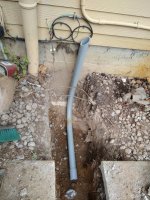
I bent the 90 degree pipe, and it turned out great. The pipe is running close to the middle of the panel. Can I cut my own hole in the load center in the area indicated by the red circle in the first photo and run directly into the back of the panel? I read that the NEC doesn't disallow cutting your own holes. But I want to make sure there isn't something I'm overlooking prior to cutting a large hole in the back of the panel.

The second photo shows the location of the LB if I were to drill a hole there. (disregard the conduit pipe. I'm leaning it there just to hold the LB in place while I take the photo).
 

Attachments

  • LowerPanelDrill.jpg
    LowerPanelDrill.jpg
    126.8 KB · Views: 153
  • OutsideLBLocation.jpg
    OutsideLBLocation.jpg
    79.8 KB · Views: 125

sparky 1971

Well-known member
Joined
Oct 9, 2018
Messages
7,971
Location
Central Iowa
Yeah, just make sure you don't get the hole overlapping the "dimple" where the factory mounting hole is. If you do, the conduit connector won't mate up to the back of the panel.
 

yatg

Well-known member
Joined
Aug 16, 2019
Messages
2,802
Location
Southern Oregon
Put a knockout plug cover into the hole in the bottom of the panel.

When you come into the panel with the male adapter, it'll need a bushing.
 
OP
J

jonness

Active member
Joined
Feb 26, 2017
Messages
32
Location
Olympia, WA
I finally got some time to work on this again. I finished running the underground conduit, ran the wire to the detached garage, and mounted the sub panel. I'm going to use 1/2" EMT for the circuits within the garage. I would like to run:

Conduit 1:
Circuit 1: 3 120v receptacles on ridge beam fed by switch for LED overhead lights.
Circuit 2: 2 exterior 120v motion sensing lights using round pancake boxes (non-switched).

Conduit 2:
Circuit 1: 4 outlets nearest the panel leading around the perimeter of the garage.
Circuit 2: 4 additional outlets further from the panel leading around perimeter of garage.

Conduit 3:
Circuit 1: 240v 30 amp receptacle.

When I have two circuits in one conduit run, do I have to splice both circuits at every box, or can I feed the wires to be used further down the run through the box unspliced?

Can I run the conduit along the horizontal 2 x 4's in the walls, or do I need to frame the walls prior to running the conduit?
 

Attachments

  • GaragePanel.jpg
    GaragePanel.jpg
    69.2 KB · Views: 107
  • GarageWallCeiling.jpg
    GarageWallCeiling.jpg
    72.5 KB · Views: 102
  • GarageWall.jpg
    GarageWall.jpg
    71.4 KB · Views: 95
Last edited:

teamextreme

Well-known member
Joined
Aug 10, 2013
Messages
867
Location
Lakewood, CO
No requirement to splice both ckts at each box, you can just pull the wire through. I would leave a loop in case you want to use that ckt in the box though. You can run the conduit however you want in the walls. Your choice would depend on convenience of running the conduit not any code requirement. Is it easier to do it before or after the walls are up?
 
To avoid these ads, REGISTER NOW!
Top Bottom