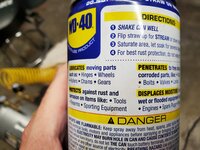
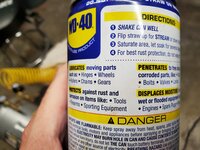
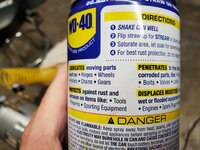
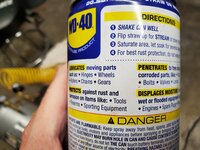
Formulation
WD-40's formula is a trade secret, and has not changed over the years, according to historian Iris Engstrand.[3]
To avoid disclosing its composition, the product was not patented in 1953, and the window of opportunity for patenting it has long since closed.[7]
WD-40's main ingredients as supplied in aerosol cans, according to the US Material Safety Data Sheet information,[14] and with the CAS numbers interpreted:[15]
45-50 % low vapor pressure aliphatic hydrocarbon (isoparaffin)
<35% petroleum base oil (non hazardous heavy paraffins)
<25% aliphatic hydrocarbons (same CAS number as the first item, but flammable)
2-3% carbon dioxide (propellant)
The UK (and EU) formulation is stated[16] according to the REACH regulations:
60-80% hydrocarbons C9-C11 n-alkanes, iso-alkanes, cyclics <2% aromatics
1-5% carbon dioxide
The Australian formulation is stated [17] as
50-60% Naphtha (Petroleum), hydrotreated heavy
<25% Petroleum Base Oils
<10% Naphtha (petroleum), hydrodesulfurized heavy (contains: 1,2,4-Trimethyl benzene, 1,3,5-Trimethyl benzene, Xylene, Mixed Isomers)
2-4% Carbon Dioxide
In 2009, Wired published an article with the results of gas chromatography and mass spectrometry tests on WD-40, showing that the principal components were C9 to C14 alkanes and mineral oil.[18]
https://en.wikipedia.org/wiki/WD-40