To avoid these ads, REGISTER NOW!

The Vintage New Britain and Associated Thread!

To avoid these ads, REGISTER NOW!

LesserSon

Well-known member
Joined
Feb 7, 2016
Messages
5,107
Location
PA USA
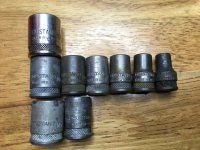
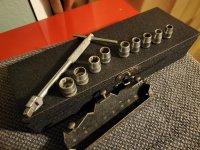
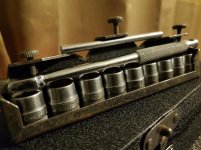
I picked up eight 1/4dr Mustang sockets at the Sunday flea mkt. splotchy with varying remaining cad plating. Missing a 6pt 1/4” (MM608).
I was sure I had at least one already, but it turned out to be a 3/8dr 12pt 1/2” (MB1216) in chrome.
 

Attachments

  • 0FB053D8-791A-4A90-A795-28E84779BBE5.jpg
    0FB053D8-791A-4A90-A795-28E84779BBE5.jpg
    153.5 KB · Views: 22
  • C0E559C1-F63C-4220-A680-811673EBF722.jpg
    C0E559C1-F63C-4220-A680-811673EBF722.jpg
    153.4 KB · Views: 29

3baygarage

Well-known member
Joined
Sep 1, 2013
Messages
12,053
Location
SW Florida/from Buffalo,NY
You have to love all the different variations by New Britain. Brand, finish, mechanism/handle, etc..


This bottom Husky ratchet is a new surprise. I expected it to be 1/4” drive like the other in the photo. Nope, it’s 9/32” drive.

Not long ago, found the 9/32” to 1/4” Husky adapter and thought that’s pretty neat. Didn’t realize NB made anything in 9/32 drive.

They are:

1/4” ratchet CM41G.
9/32” ratchet CX41
9/32”f to 1/4”m adapter CX81G

attachment.php


attachment.php


9/32-1/4

attachment.php


CX81G

attachment.php


attachment.php


attachment.php


The 9/32 is a tad longer.

attachment.php
 

Attachments

  • 910EC603-EA29-4374-9A98-5B0B9FE15D07.jpg
    910EC603-EA29-4374-9A98-5B0B9FE15D07.jpg
    149.3 KB · Views: 291
  • A0BF8CFD-0D10-4D4E-844F-100BB7553018.jpg
    A0BF8CFD-0D10-4D4E-844F-100BB7553018.jpg
    150.2 KB · Views: 295
  • 3858D628-6C82-4FB5-80E2-7B1A4EB86BB1.jpg
    3858D628-6C82-4FB5-80E2-7B1A4EB86BB1.jpg
    150.3 KB · Views: 297
  • 92220F04-4874-422D-BE2B-E99551EF9737.jpg
    92220F04-4874-422D-BE2B-E99551EF9737.jpg
    151.3 KB · Views: 297
  • 434AD0E2-128A-4852-A7BD-0EA0609CCCC2.jpg
    434AD0E2-128A-4852-A7BD-0EA0609CCCC2.jpg
    148.6 KB · Views: 296
  • F12A43CF-8EF3-478F-A108-8DF1BA28F564.jpg
    F12A43CF-8EF3-478F-A108-8DF1BA28F564.jpg
    147.8 KB · Views: 297
  • 7D8F481F-7417-44CA-B6D2-239650057022.jpg
    7D8F481F-7417-44CA-B6D2-239650057022.jpg
    148.2 KB · Views: 299
Last edited:

Shelbylex

Well-known member
Joined
Jan 20, 2018
Messages
3,142
Location
MA
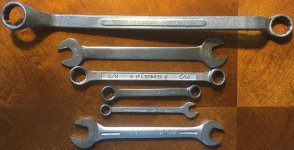
Not sure how old it is, but got this NDF50 recently (2nd one from the bottom) For some reason camera put it a little out of focus...
 

Attachments

  • Wrenchess.jpg
    Wrenchess.jpg
    149.5 KB · Views: 32

r_olson_06

Well-known member
Joined
Feb 12, 2012
Messages
4,157
Location
SD
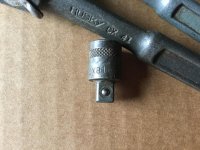
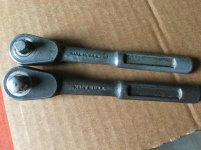
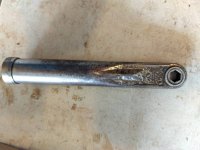
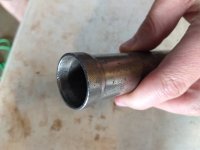
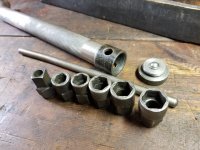
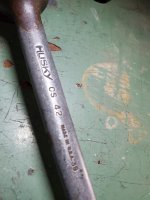
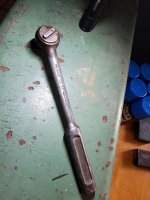
Not sure if this is the place for this. Found this husky wrench a. Few weeks back and it has a hollow handle. Not sure if it is an attachment? Anyone seen or know of these?
IMG_20200809_142600966.jpegIMG_20200809_142603768.jpegIMG_20200809_142609118.jpegIMG_20200809_142617055.jpeg

Looking for a Round Beam Plomb 1068 Double Box End Wrench
 

r_olson_06

Well-known member
Joined
Feb 12, 2012
Messages
4,157
Location
SD
Pretty cool. You store sockets in handle I think.
That was my guess on the Garage Sale thread, OTG, kinda like the Bog and the Edgar Guthard Billmont jobbies. But the end is not threaded for a cap.
Didn't click until now. I didn't think of it as a drive tool but now I understand [emoji1787]. I was thinking fixed size wrench.

Looking for a Round Beam Plomb 1068 Double Box End Wrench
 

Private Lugnutz

Well-known member
Joined
Mar 30, 2012
Messages
30,921
Location
The Authentic Jersey Shore
Well that answers the question of the cap. There is none. According to the patent, the bore in the handle takes an extension with five sockets slipped over it and the last socket is beveled to be a closure. Now I'm curious to see one with all the pieces. I'm trying to imagine how that works.

By contrast, the Billmont ratchet has a threaded cap.

Off to check out how the Bog version works...
EDIT: I guess "version" is a little misleading, since the Bog tool is a spinner or driver, not a ratchet. It has a cap that presses on. Todd's linked here.
 

Attachments

  • Billmont 6.jpg
    Billmont 6.jpg
    151 KB · Views: 33
Last edited:

Oldtuleguy

Well-known member
Joined
Nov 4, 2017
Messages
10,470
Litton marketed a version much later called the pocket socket
 

Attachments

  • EM0990.jpg
    EM0990.jpg
    43.3 KB · Views: 35

fightintxag

Member
Joined
Aug 10, 2020
Messages
12
Location
TX
What do the resident experts think of this?
https://www.ebay.com/itm/151770080481

Nothing is stamped on them except "USA." The seller seems to have a lot of them for sale, listed as "open box." I'm inclined to think they're genuine NB, Kilness-patent, USA-made ratchets that someone found in a bin somewhere. Who knows why NB didn't put any branding on them.

But what makes me a little nervous is this seller also somehow has a bunch of those Stanley/Husky thumbwheel, tri-wing style ratchets that are deceptively stamped "USA," but probably aren't. These also are listed as "open box." https://www.ebay.com/itm/161689748689

Hmmm...

So was there ever a Chinese or even Taiwanese version of these produced, after Stanley Black & Decker entered the Husky/Blackhawk picture?
 
Last edited:

fightintxag

Member
Joined
Aug 10, 2020
Messages
12
Location
TX
Thanks, I think I'll take a chance and see how it compares to my NBM 35.

I did go back through this thread trying to capture what Powderkeg has said about potential NHT/Stanley production.

On 1/19/2015, he first added these "unbranded" ratchets to the list of names under which NB ratchets were sold. He separately suggested that NHT and/or Stanley might've made these ratchets under 3 specific brands. Apparently, at least at the time, he didn't think the unbranded USA ratchets were NHT/Stanley produced.
You can add to the brand list:

Crescent
Litton
NBM
OTC
SP 45
Thorsen
"unbranded" (marked "USA" only)

Also, taking a SWAG that a limited number of Kilness design ratchets were produced either by National Hand Tool when they acquired the remnants of New Britain after the liquidation, or by Stanley briefly after acquiring NHT:

Master Mechanic
JS
Proto Challenger

On 03/01/2015, pauls_workshop submitted a post (maybe quoting Powderkeg, but from where?) suggesting that a ratchet branded as a Proto Challenger led him to question how many might've been actually made by Stanley.
My latest find (a Kilness patent Proto Challenger) also causes me to question how many might have actually be produced by Stanley after they acquired some of the remains of New Britain. And assuming Stanley did produce at least a few ratchets/brands using the Kilness patent, why did they stop using it? - Powderkeg

On 07/04/2015, Powderkeg reiterated that some of the later ratchets might've been made by NHT or Stanley. He doesn't suggest in this post which brands. And no one seems to have ever suggested that some might've been made overseas.
That's 30 brands, counting "unbranded" as a brand. As I said before, I think at least a few of these weren't actually produced by New Britain, but by either National Hand Tool, after they acquired the remnants of NB, or by Stanley, after they acquired NHT.

I just wondered because, if Stanley did make the unbranded "USA" ratchets, we know they were being deceptive with "USA" markings on Husky ratchets in that time period. On the other hand, AFAIK, those tri-wings had never been produced in the USA; even the Craftsman versions in the 70s were from Taiwan. Meanwhile the Kilness ratchets had always been US made. So if NHT or Stanley made any Kilness ratchets, it might be doubtful that they would've moved the tooling overseas, or set up new tooling in an overseas facility, just to shut down the line within a couple of years.
 
Last edited:

NoUserName

Member
Joined
Aug 25, 2019
Messages
24
Location
Kingman, Arizona
Here are two Husky CB-46 quick release ratchet. The top ratchet has the plastic spinner and is a 45 tooth. The bottom one is a 60 tooth ratchet with metal spinner. That is the only way to tell the difference in tooth count as New Britain never made a different number designation for the quick release ratchet.

16145077847_9816eee46a_z.jpg


16145078017_e24aeb4621_z.jpg

I have the Penncraft 3679, identical to the NB-46 and the CB-46 that you have with the thumb wheel. It wasn't working correctly so I disassembled it and found an inner spring (one long arm and one shorter) sitting it a crater underneath the internal faceplate on the mechanism. So I took that all apart and can't figure out where that spring sits or if something's missing. Any chance that you have a picture or two of the innards of one of those ratchets you have? Please?
 

MShaw

Well-known member
Joined
Mar 2, 2015
Messages
1,016
Location
York, Pa.
The polishing and finishing around the head of the ratchet looks nicer than what I remember the New Britain production looking like. I'm betting on a reproduction.
 
To avoid these ads, REGISTER NOW!

fightintxag

Member
Joined
Aug 10, 2020
Messages
12
Location
TX
The polishing and finishing around the head of the ratchet looks nicer than what I remember the New Britain production looking like. I'm betting on a reproduction.
It's definitely got more polishing and smoother chrome. Here's some pictures of it next to an NBM-35 ratchet. A few observations:
  • When I got it, it rattled noticeably if you shook it. After lubing it with grease (it was totally dry inside), it doesn't rattle nearly so much--but still a little bit. My NBM-35 doesn't rattle when shaken. I think this is because of the different selector cap design, which seems to have more clearance where it engages the selector mechanism.
  • You can see how much smoother and nicer the chrome is compared to the old NBM.
  • The head is also shaped a little differently, with a bit of a teardrop where the head meets the handle.
  • The neck of the handle and the knurled grip are slightly larger in diameter. You can probably see this best when looking at the end of the handles. I know that when Craftsman ratchets and wrenches first went overseas, they grew considerably, presumably because Chinese steel required more material to achieve the same strength. Not sure if the increased size of this "USA" ratchet might mean it was forged in China and only assembled in the USA.
  • The internal mechanism seems identical with the NBM. I took them apart and compared the pawls, and other than a little wear on the NBM, I couldn't see any difference at all.
fDfy2gT.jpg

http://i.imgur.com/fDfy2gT.jpg

1rBeVUC.jpg

http://i.imgur.com/1rBeVUC.jpg

SMSoGZv.jpg

http://i.imgur.com/SMSoGZv.jpg

jI0hTB2.jpg

http://i.imgur.com/jI0hTB2.jpg

BNA7o5p.jpg

http://i.imgur.com/BNA7o5p.jpg

eOUhv9D.jpg

http://i.imgur.com/eOUhv9D.jpg
 
Last edited:

fightintxag

Member
Joined
Aug 10, 2020
Messages
12
Location
TX
I have the Penncraft 3679, identical to the NB-46 and the CB-46 that you have with the thumb wheel. It wasn't working correctly so I disassembled it and found an inner spring (one long arm and one shorter) sitting it a crater underneath the internal faceplate on the mechanism. So I took that all apart and can't figure out where that spring sits or if something's missing. Any chance that you have a picture or two of the innards of one of those ratchets you have? Please?
The coil of that spring sits in the "crater" with the arms extending upwardly. The long arm pokes up through the slot in the "internal faceplate" and then goes up through small hole in the selector. The short arm of the spring pokes up through the small hole in the "internal faceplate" only.

Maybe this image will help. I wish I'd taken pics while it was further apart for you.
3nio7hl.jpg

http://i.imgur.com/3nio7hl.jpg

If you can put the spring on the "internal faceplate" with the short arm in the small hole and the long arm going up through the slot, the spring tension will hold itself in place. Then you can position the faceplate on the carrier, with the spring's coil dropping down into the "crater."

Next, get the internal faceplate tab opposite the spring to engage between the tabs on top of the pawl. Of course, the pawl has a spring under it. So, you'll have to hold things fairly tight with one hand at this point because the spring behind the pawl and the spring behind the internal faceplate are working against each other, wanting to knock everything out of alignment, until you get the e-clip back in place.

Now, put the selector over the top of the internal faceplate, with the long arm of the spring in the selector's hole. You'll probably have to rotate the selector so that the arm (with dimple pointed upwardly) drops down on the carrier in the open space above the pawl, where the carrier doesn't have the ridges. Continue to hold all this together while you reinstall the e-clip.
 
Last edited:

3baygarage

Well-known member
Joined
Sep 1, 2013
Messages
12,053
Location
SW Florida/from Buffalo,NY
Your ratchet does have a nice finish as Mshaw said. It is a bit beefier as you mentioned. Reproduction though, idk about that. It would be hard for any of us to prove it was or was not made overseas. Looks like the classic Kilness mechanism.

When OTG says late models, yes, tri-wing, and spinner wheel heads, and those with metal push button selectors that may have fallen under that Stanley lawsuit years ago. They have the look and finish of an import ratchet. Craftsman, Blackhawk, K-D, Master Mechanic, Martin, Husky, others. Who really knows what was going on. If you know the ratchets, they all look the same. :lol:

See link.
https://www.ftc.gov/sites/default/files/documents/cases/1999/06/stanleyworkscmp.htm
 

NoUserName

Member
Joined
Aug 25, 2019
Messages
24
Location
Kingman, Arizona
The coil of that spring sits in the "crater" with the arms extending upwardly. The long arm pokes up through the slot in the "internal faceplate" and then goes up through small hole in the selector. The short arm of the spring pokes up through the small hole in the "internal faceplate" only.

Maybe this image will help. I wish I'd taken pics while it was further apart for you.
WMsZN6A.jpg


If you can put the spring on the "internal faceplate" with the short arm in the small hole and the long arm going up through the slot, the spring tension will hold itself in place. Then you can position the faceplate on the carrier, with the spring's coil dropping down into the "crater."

Next, get the internal faceplate tab opposite the spring to engage between the tabs on top of the pawl. Of course, the pawl has a spring under it. So, you'll have to hold things fairly tight with one hand at this point because the spring behind the pawl and the spring behind the internal faceplate are working against each other, wanting to knock everything out of alignment, until you get the e-clip back in place.

Now, put the selector over the top of the internal faceplate, with the long arm of the spring in the selector's hole. You'll probably have to rotate the selector so that the arm (with dimple pointed upwardly) drops down on the carrier in the open space above the pawl, where the carrier doesn't have the ridges. Continue to hold all this together while you reinstall the e-clip.

Thank you very much for writing this up for me, I really appreciate it. It sounds like I had it together properly BUT it looks like I'm in trouble because there's no spring under the pawl. I was very slow and methodical about disassembling this unit so I don't know where it could've gone but it evidently popped out somehow. I thought it was odd that the pawl had no spring or ball bearing behind it like all the other ratchets I've opened up. The crater spring, for lack of a better term, was initially sitting completely down in the crater so I had to remove the quick release spring to remove the internal face plate to retrieve it and reset it in place. I think unless I can find a similar spring, I'm pretty much out of luck. It's too bad too because this one is really clean. Did the pawl also have a ball bearing somewhere that allowed it to glide from side to side? Presumably it would be set in the spring opening or something to that effect?
 

fightintxag

Member
Joined
Aug 10, 2020
Messages
12
Location
TX
Thank you very much for writing this up for me, I really appreciate it. It sounds like I had it together properly BUT it looks like I'm in trouble because there's no spring under the pawl. I was very slow and methodical about disassembling this unit so I don't know where it could've gone but it evidently popped out somehow. I thought it was odd that the pawl had no spring or ball bearing behind it like all the other ratchets I've opened up. The crater spring, for lack of a better term, was initially sitting completely down in the crater so I had to remove the quick release spring to remove the internal face plate to retrieve it and reset it in place. I think unless I can find a similar spring, I'm pretty much out of luck. It's too bad too because this one is really clean. Did the pawl also have a ball bearing somewhere that allowed it to glide from side to side? Presumably it would be set in the spring opening or something to that effect?
It's ALMOST certain that yours did not have a ball bearing under the spring. I say "almost" because I have an old 60-tooth 3/8-drive Champion Plugmaster flexhead made by NB, and it has a ball bearing under the pawl. The hole for the pawl spring is much deeper than in any of my other Kilness-design ratchets. It actually breaks through in the "crater" area. Maybe this was a manufacturing defect, and the fix was to add the ball bearing because the pawl spring was sitting too deep to work? Or maybe some of the very early production used a ball bearing, and they later figured out they didn't need it and eliminated it as a cost-saving measure? In any event, chances are you only need a pawl spring for your ratchet.

Next time I have one apart, I'll measure the free height of the spring. You should have an idea of the diameter you'll need to fit in the hole. Maybe you could find something that works at an Ace hardware store. You might even be able to pull a coil spring out of a click-pen and cut it down to work.
 

NoUserName

Member
Joined
Aug 25, 2019
Messages
24
Location
Kingman, Arizona
It's ALMOST certain that yours did not have a ball bearing under the spring. I say "almost" because I have an old 60-tooth 3/8-drive Champion Plugmaster flexhead made by NB, and it has a ball bearing under the pawl. The hole for the pawl spring is much deeper than in any of my other Kilness-design ratchets. It actually breaks through in the "crater" area. Maybe this was a manufacturing defect, and the fix was to add the ball bearing because the pawl spring was sitting too deep to work? Or maybe some of the very early production used a ball bearing, and they later figured out they didn't need it and eliminated it as a cost-saving measure? In any event, chances are you only need a pawl spring for your ratchet.

Next time I have one apart, I'll measure the free height of the spring. You should have an idea of the diameter you'll need to fit in the hole. Maybe you could find something that works at an Ace hardware store. You might even be able to pull a coil spring out of a click-pen and cut it down to work.

I appreciate that. I'm almost starting to think though that mine might be slightly different as the long arm/short arm spring appears to belong in the crater, as you mentioned, but there is no crater or any kind of knock out for a pawl spring. I'll have to take it apart again and double check and maybe I'll snap some pictures and post them here to see what you think.
 

Private Lugnutz

Well-known member
Joined
Mar 30, 2012
Messages
30,921
Location
The Authentic Jersey Shore
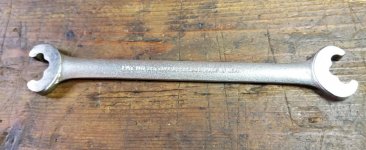
Picked up this flank style open end wrench this morning at the flea market.

attachment.php


attachment.php


attachment.php


attachment.php


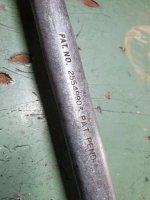
These can also be seen with the same patent numbers on the flip side of identical NB-era wrenches marked Blackhawk, a brand they owned at that time.

The first patent (granted Mar 9, 1954) refers, a little oddly, not to a wrench opening, but to an "Angle Plate and Clamp Device" that uses the exact same principle. The second patent (granted Aug 3, 1954) belongs to a Swiss dude, Fritz Diebold, for the opening that NB used on the wrench sets they advertised as their "Nutmaster" series.

Diebold's patent cites a French patent, 770,360, granted June 25, 1934, to Christophe Marie Jean Emil. Curiously, the patent for the Kelsey-Hayes "Loc-Rite" flank wrench opening, granted to ingenious tool inventor Frank Kavalar (of Cam-Loc fame) in 1964, cites a different French patent, 1,033,792, April 1953. I have never been able to determine which, if either of these, is the patent for the Peugeot Freres (translation: Peugeot Brothers) Surpans (translation: "on flank") wrenches.

Chicken-and-egging these various flank wrenches is a seemingly endless rabbit hole.

You could go back to Snap-on's "Simplex" opening in 1929.

But you could also go back to Williams (Amborn patent 956,259) "Ratcho" opening in 1910.

I'll probably never complete this set. I should've just left it behind! :)
 

Attachments

  • 20200906_100215.jpg
    20200906_100215.jpg
    148.8 KB · Views: 325
  • 20200906_100219.jpg
    20200906_100219.jpg
    150.2 KB · Views: 318
  • 20200906_100210.jpg
    20200906_100210.jpg
    147.5 KB · Views: 326
  • 20200906_100203.jpg
    20200906_100203.jpg
    152.8 KB · Views: 325

Oldtuleguy

Well-known member
Joined
Nov 4, 2017
Messages
10,470
An early round head husky
 

Attachments

  • 20200908_093853.jpg
    20200908_093853.jpg
    87.6 KB · Views: 16
  • 20200908_093902.jpg
    20200908_093902.jpg
    98.5 KB · Views: 22
  • 20200908_093918.jpg
    20200908_093918.jpg
    78.5 KB · Views: 22
  • 20200908_093921.jpg
    20200908_093921.jpg
    92 KB · Views: 28

ForrestT

Well-known member
Joined
Nov 15, 2019
Messages
866
Location
Waldo
It's definitely got more polishing and smoother chrome. Here's some pictures of it next to an NBM-35 ratchet. A few observations:
  • When I got it, it rattled noticeably if you shook it. After lubing it with grease (it was totally dry inside), it doesn't rattle nearly so much--but still a little bit. My NBM-35 doesn't rattle when shaken. I think this is because of the different selector cap design, which seems to have more clearance where it engages the selector mechanism.
  • You can see how much smoother and nicer the chrome is compared to the old NBM.
  • The head is also shaped a little differently, with a bit of a teardrop where the head meets the handle.
  • The neck of the handle and the knurled grip are slightly larger in diameter. You can probably see this best when looking at the end of the handles. I know that when Craftsman ratchets and wrenches first went overseas, they grew considerably, presumably because Chinese steel required more material to achieve the same strength. Not sure if the increased size of this "USA" ratchet might mean it was forged in China and only assembled in the USA.
  • The internal mechanism seems identical with the NBM. I took them apart and compared the pawls, and other than a little wear on the NBM, I couldn't see any difference at all.
Dwp52qa.jpg

I61RT7m.jpg

yF9p5H8.jpg

o8YJspT.jpg

wfJqC13.jpg

OzdLpao.jpg


Your USA ratchet is a New Britain design. I have one. I believe the handle in the new one is slightly longer than the original. I can’t say for certain the maker, but I was told the USA marked ones were contract production and most likely made for government or military. I got mine in a set that included the ratchet and a set of SK metric sockets that were government surplus that were packed together in a welded clear non descript plastic.


Sent from my iPhone using The Garage Journal mobile app
 

fightintxag

Member
Joined
Aug 10, 2020
Messages
12
Location
TX
Your USA ratchet is a New Britain design. I have one. I believe the handle in the new one is slightly longer than the original. I can’t say for certain the maker, but I was told the USA marked ones were contract production and most likely made for government or military. I got mine in a set that included the ratchet and a set of SK metric sockets that were government surplus that were packed together in a welded clear non descript plastic.


Sent from my iPhone using The Garage Journal mobile app
Interesting. Thanks for posting.
 

fightintxag

Member
Joined
Aug 10, 2020
Messages
12
Location
TX
I appreciate that. I'm almost starting to think though that mine might be slightly different as the long arm/short arm spring appears to belong in the crater, as you mentioned, but there is no crater or any kind of knock out for a pawl spring. I'll have to take it apart again and double check and maybe I'll snap some pictures and post them here to see what you think.
I disassembled a 3/8 Penncraft with QR tonight, and I believe you're right. There was no spring under the pawl in my ratchet. I took some pictures of the disassembly, so hopefully this helps you get yours back together and working again.

Mechanism removed, but still assembled. The first thing I removed was the "safety pin" looking spring that sits flat on top. This spring is the one that pushes the pawl outward, with one of the tangs extending down through the "internal faceplate" to press against the back of the pawl.
JYv49Xo.jpg

http://i.imgur.com/JYv49Xo.jpg

There is no e-clip in this design. The QR spring is what retains the "internal faceplate." Because it's only spring-loaded (instead of fixed in place with an e-clip), you can lift the internal faceplate up slightly and pull the pawl out from under the faceplate. Once the pawl is out of the way, you can see that there is no spring or spring seat hole.
7qWbvCn.jpg

http://i.imgur.com/7qWbvCn.jpg

Here's a top view of the same stage of disassembly. You can see that the tabs on the pawl are completely captured by openings in the faceplate. The pawl is spring-loaded by the safety-pin spring, which allows the elimination of the pawl spring under the pawl.
2O1tt5x.jpg

http://i.imgur.com/2O1tt5x.jpg

The QR plunger can lift straight out, if it's aligned with the slots in the faceplate.
feymR3P.jpg

http://i.imgur.com/feymR3P.jpg

The faceplate can then lift off. Note the spring's orientation with the long leg extended up through the faceplate's curved slot. The short leg extends up through the small hole in the faceplate. Here are all the parts arranged (right-to-left) in the order I removed them.
4Re0LUf.jpg

http://i.imgur.com/4Re0LUf.jpg

Hope this helps!
 
Last edited:

Private Lugnutz

Well-known member
Joined
Mar 30, 2012
Messages
30,921
Location
The Authentic Jersey Shore
...which I don't ever remember glancing at in any NB catalog. I wonder when they were made.

EDIT:

They're not listed or shown in the 1940 New Britain or the 1948 NONE BETTER catalog.

They are listed and shown in the 1950 New Britain catalog, which I have rarely paged through before.

So, probably a late 40's innovation. I noticed the PAT PEND marking on the flip side.

They were cool when they were Bridgeport, and they're still cool as NB, LS! :lol:
 
Last edited:

LesserSon

Well-known member
Joined
Feb 7, 2016
Messages
5,107
Location
PA USA
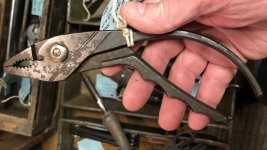
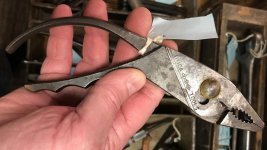
It was kind of weird. The vendor was so struck by them, saying he’d never seen them before, I thought he wasn’t going to let me buy them. But I know I have seen lighter-weight, red-painted-handle knockoffs elsewhere, and (I think) even at the same vendor!
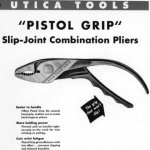
They so resembled the Utica version (even the diagonal edge of the cheek), I thought that’s what they might be, but the rust removal told a different tale. I still sort of expected the model number to match, but not in the 1963 catalog (Utica), at least.
attachment.php

Really, they have to be Utica-made. The pattern is identical. My photo shows them in the wider position, but they look exactly like the Utica illustration.
attachment.php

A-ha! D142867...applied 4Dec1944, granted 13Nov1945 to Eugene L Johnson Jr of Utica NY design patent, with Utica Drop Forge as assignee. The finger bulges aren’t present in the patent illustration...I would guess they were added prior to production, from an earlier (and maybe expired) design patent.
So, late WWII.

EDIT - Here is a Utica 550-8 example - also marked “pat applied for,” so Dec44-Nov45. Just a little nore pitted than I wanted for $20, so they stayed where I found them. I may change ny mind (usually after it’s too late).
attachment.php
 

Attachments

  • E9645185-A6E8-48C2-9EBC-F5F59DBE4BF4.jpeg
    E9645185-A6E8-48C2-9EBC-F5F59DBE4BF4.jpeg
    64.6 KB · Views: 250
  • 4E4574E5-D54A-477D-9CBE-02CB47A16D57.jpeg
    4E4574E5-D54A-477D-9CBE-02CB47A16D57.jpeg
    32.9 KB · Views: 238
  • F6EEA416-9ECF-4125-B22B-5A5F1102D132.jpg
    F6EEA416-9ECF-4125-B22B-5A5F1102D132.jpg
    136 KB · Views: 78
  • 7A0D5EDC-649D-41F7-B537-17FA49E9D90C.jpg
    7A0D5EDC-649D-41F7-B537-17FA49E9D90C.jpg
    140.8 KB · Views: 7
Last edited:

NoUserName

Member
Joined
Aug 25, 2019
Messages
24
Location
Kingman, Arizona
My apologies, I just now checked back and saw your post, I don't get alerts to replies sent to my email though I wish I could get that set up to do so.
A tremendous thank you for doing this disassembly, photography and write-up for me! This is the correct ratchet and yours looks like it has the spring in the round crater as mine did. I was confused when I opened mine up because that spring just kind of sits in there loosely and it didn't look right. I had mine completely disassembled as yours is and I tried getting that spring in different positions because I was convinced that it couldn't be correct and no matter what I tried, the ratchet still didn't function. I'm going to pull mine apart, hopefully tomorrow, and use your pictures as a guide and hopefully will get this figured out. I'll report back and let you know how it went. Again, I'm sincerely grateful for you taking the time to do this, now I'll know if I've got it all the parts in the right place or if something's fatally wrong with it and can stop racking my brain once and for all!

===========

I disassembled a 3/8 Penncraft with QR tonight, and I believe you're right. There was no spring under the pawl in my ratchet. I took some pictures of the disassembly, so hopefully this helps you get yours back together and working again.

Mechanism removed, but still assembled. The first thing I removed was the "safety pin" looking spring that sits flat on top. This spring is the one that pushes the pawl outward, with one of the tangs extending down through the "internal faceplate" to press against the back of the pawl.
JYv49Xo.jpg

http://i.imgur.com/JYv49Xo.jpg

There is no e-clip in this design. The QR spring is what retains the "internal faceplate." Because it's only spring-loaded (instead of fixed in place with an e-clip), you can lift the internal faceplate up slightly and pull the pawl out from under the faceplate. Once the pawl is out of the way, you can see that there is no spring or spring seat hole.
7qWbvCn.jpg

http://i.imgur.com/7qWbvCn.jpg

Here's a top view of the same stage of disassembly. You can see that the tabs on the pawl are completely captured by openings in the faceplate. The pawl is spring-loaded by the safety-pin spring, which allows the elimination of the pawl spring under the pawl.
2O1tt5x.jpg

http://i.imgur.com/2O1tt5x.jpg

The QR plunger can lift straight out, if it's aligned with the slots in the faceplate.
feymR3P.jpg

http://i.imgur.com/feymR3P.jpg

The faceplate can then lift off. Note the spring's orientation with the long leg extended up through the faceplate's curved slot. The short leg extends up through the small hole in the faceplate. Here are all the parts arranged (right-to-left) in the order I removed them.
4Re0LUf.jpg

http://i.imgur.com/4Re0LUf.jpg

Hope this helps!
 

Isaiah6113

Well-known member
Joined
Oct 4, 2013
Messages
158
Location
Oshawa, ON
Greetings all,

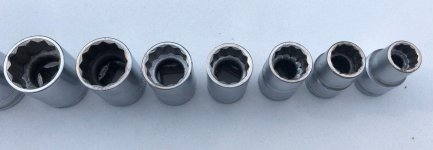
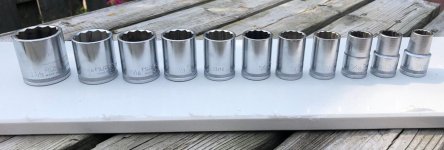
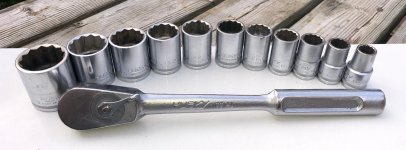
Picked up these fellows the other day. An older set of Husky sockets along with a Husky CS 41 ratchet. The largest socket is 1-1/8", then down to 1" and evenly after that to 7/16. All are in great shape, although the 1/2 has seen some use.

It was all reasonably clean, there was some rust in a couple of sockets. In the past someone went at the top of the ratchet with a Scotch-Brite or wire wheel. The chrome is gone, but I smoothed it out a little with my buffer and some green compound. Disassembled and cleaned.

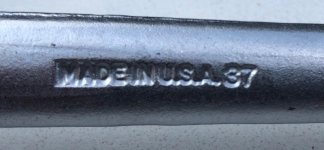
Any idea of the Born On Date for the ratchet? The back reads "Made In U.S.A. 37" if that helps. Any rough dates for the sockets? They are all numbered as CT12XX, there are no "=" or "-" before or after the socket number. Quite happily paid $30.

Thanks for looking,

Matthew
 

Attachments

  • Husky-Sockets-Inside-1.jpg
    Husky-Sockets-Inside-1.jpg
    80.2 KB · Views: 24
  • Husky-Sockets-Inside-2.jpg
    Husky-Sockets-Inside-2.jpg
    74.3 KB · Views: 24
  • Husky-Sockets-Line-up-1.jpg
    Husky-Sockets-Line-up-1.jpg
    102.7 KB · Views: 32
  • Husky-Ratchet-37.jpg
    Husky-Ratchet-37.jpg
    111.9 KB · Views: 31
  • Husky-Sockets-Full-2.jpg
    Husky-Sockets-Full-2.jpg
    131.5 KB · Views: 31
  • Husky-Sockets-Full-1.jpg
    Husky-Sockets-Full-1.jpg
    116.9 KB · Views: 51

Oldtuleguy

Well-known member
Joined
Nov 4, 2017
Messages
10,470
1950ish or so. That set is in good shape. Here is a 30s midget set.
 

Attachments

  • 20201015_215253.jpg
    20201015_215253.jpg
    159.5 KB · Views: 45
  • 20201015_215302.jpg
    20201015_215302.jpg
    137.5 KB · Views: 43
  • 20201015_215312.jpg
    20201015_215312.jpg
    81.2 KB · Views: 42
  • 20201015_215457.jpg
    20201015_215457.jpg
    110.8 KB · Views: 40
  • 20201015_215546.jpg
    20201015_215546.jpg
    159.3 KB · Views: 44
  • 20201015_215639.jpg
    20201015_215639.jpg
    150.6 KB · Views: 46
  • 20201015_215019.jpg
    20201015_215019.jpg
    155.2 KB · Views: 39
To avoid these ads, REGISTER NOW!
Top Bottom