To avoid these ads, REGISTER NOW!

Sidewalk trip hazard repair

stickshift

Well-known member
Joined
Nov 16, 2011
Messages
1,236
Location
northeastern US
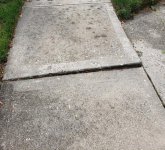
I've got a few small trip hazards where a section of sidewalk is higher/lower at the expansion joint where it meets adjacent section. Pic below shows the largest of the trip hazards, it's where sidewalk meets driveway apron.

Not worth replacing the sidewalk or mudjacking it, I don't think. I've seen a couple of competing products on Youtube. Anyone have experience with either of these products? Other options?

TrowelPave:
Adhesives Technology:
 

Attachments

  • 2020-09-18 14.12.25_cropped.jpg
    2020-09-18 14.12.25_cropped.jpg
    133.3 KB · Views: 156
To avoid these ads, REGISTER NOW!

nadogail

Well-known member
Joined
Jan 23, 2009
Messages
32,032
Location
Coronado, CA
In my city, Pedestrian safety on the sidewalks is insured by inspections by the city and they have a contractor grind them as needed.
 

Ray-CA

Well-known member
Joined
Jan 6, 2007
Messages
3,452
Location
San Diego CA
City we used to live in just painted bright orange stripes on each side of the expansion joint. They didn't grind it down or make any other attempt to correct it. Just paint.....

Ray
 

Bent Handle

Well-known member
Joined
Oct 23, 2016
Messages
201
Location
Iowa
Lol, just a can of spray paint and a tripping hazard. 6” angle grinder with a removable shield is a great tool to fix that problem.
 

Lassen Forge

Well-known member
Joined
Apr 26, 2014
Messages
15,374
Location
The romantic hills of central Umbria, Italy,
First, you need to find out WHY that side of the slab popped up. Roots, soggy ground, gremlins, ?? Only then can you determine what your course of action is.

You can grind it down, and taper it to mix. OR

Get a pavement breaker and break the slab out and repour once you fix the underlyig issues that caused the slab to pop.

I'd also rent a concrete saw and re-cut the spaces between slabs - let them float and settle. IF at that point your slab is rocking, then Mudjacking is appropriate. Otherwise you'll just make the problem worse by floating the slab even higher than it is. And looking at the picture, I'd say that's going to be a bit of work if that's where you're going.
 

joey1320

Well-known member
Joined
Jun 14, 2015
Messages
1,813
Location
NE Ohio
First, you need to find out WHY that side of the slab popped up. Roots, soggy ground, gremlins, ?? Only then can you determine what your course of action is.

You can grind it down, and taper it to mix. OR

Get a pavement breaker and break the slab out and repour once you fix the underlyig issues that caused the slab to pop.

I'd also rent a concrete saw and re-cut the spaces between slabs - let them float and settle. IF at that point your slab is rocking, then Mudjacking is appropriate. Otherwise you'll just make the problem worse by floating the slab even higher than it is. And looking at the picture, I'd say that's going to be a bit of work if that's where you're going.


Just grind and paint.
:thumbup:
 
OP
S

stickshift

Well-known member
Joined
Nov 16, 2011
Messages
1,236
Location
northeastern US
Thanks guys, grinding does sound easier. Maybe a diamond masonry cutting blade to cut a bevel and reduce the amount of grinding necessary. Then hit it with a diamond grinding wheel to widen out the bevel.

Just grind and paint.
:thumbup:
Paint? Do tell. One of the off putting things about grinding is how obviously mismatched the exposed aggregate looks next to the concrete surface.
 

MoonRise

Well-known member
Joined
Nov 5, 2010
Messages
4,031
Location
NJ
The FIX is to find out why the slab(s) shifted.

That also involves removing at least one of the slabs (or slab pieces).

Then proper prep underneath (remove tree roots if needed, etc), remove 'loose' dirt as needed, compact things down firmly, form out for the needed replacement slab, put in the proper gravel layer, compact the gravel (in "lifts"), pour new concrete slab.

Orange paint on the raised lip doesn't remove the trip hazard.

Grinding the raised lip is a lipstick-on-a-pig approach. Doesn't actually FIX anything, and depending on how much you grind off, that thin part is likely to just crack relatively quickly.

If the existing slab is in good condition otherwise, you could try to cut the control joints and carefully try to lift the entire slab piece out, then fix the ground issue(s) that caused the slab to rise/sink in the first place, then compact everything down firmly, then put gravel in and compact that, and then try to put the removed slab piece back in place (kind of like setting a big paver).

IMHO. :beer:
 
OP
S

stickshift

Well-known member
Joined
Nov 16, 2011
Messages
1,236
Location
northeastern US
check with your local non big box store rental yard, I bet they have a sidewalk grinder for this job.
Good idea. Local HD has a concrete grinder. $150 + tax for 4 hours, so quite a bit more than buying cutting and grinding wheels for my angle grinder, but I guess this will be much faster?

Downside might be it grinds a larger area than I really need for these small height differences between sections.
 

Retroman

Well-known member
Joined
Jan 21, 2018
Messages
1,364
Location
Mojave Desert
I guess you guys have never ground much concrete? Its a slow process and it gets very slick when wet.
I can't believe a city would paint out the trip hazard this is the worst option, you have now acknowledged that you are aware of a hazard and did nothing to fix it that's an easy lawsuit to win.

Take it out back to the closet joint and re-pour it.
 

Git

Well-known member
Joined
May 18, 2008
Messages
6,894
Location
S Cal
I recently bought one of these grinding wheels for my 4" grinder and was really surprised how much material it would take off. For $12 - what do you have to loose? Read the reviews

https://www.amazon.com/gp/product/B07SJ3XVCR/?tag=atomicindus08-20

attachment.php
 

Attachments

  • Tri -  1282.jpg
    Tri - 1282.jpg
    151.3 KB · Views: 536

finn

Well-known member
Joined
Mar 27, 2005
Messages
16,332
Location
The UP, God's country
Price out mud jacking. I had a patio and a couple sections of sidewalk done a number of years ago.

The cost was negligible at the time.
 

duneslider

Well-known member
Joined
Jan 20, 2013
Messages
2,267
Location
Riverton, Utah
In my area the required park strip trees generally are the biggest cause of the lips forming. The city checks them and once they get bad enough they grind them down. I suspect after enough time and grinding they will have to break up sections and repour.

Doesn’t take long to grind a lip down with a cup wheel. I’m much more safe in my older years than when I was younger, I recommend a dust mask, face shield, and hearing protection. Hearing aid before 40 says I’m not as tough as I thought I was.


Sent from my iPhone using The Garage Journal mobile app
 

matt_i

Well-known member
Joined
Mar 14, 2008
Messages
10,741
Location
SE Michigan
I would saw then breakout the one piece at the top of the picture at the control joint and repour it.

Sure its going to have a dip in there but at sub $5 per bag, paying a dude $200 just to show up with his mudjacking setup is a non starter to me.

If you grind you are going to chew up valuable N95 PPE and end up looking like casper the friendly ghost....


Im WAGging 36" x 48" x 4" thick. Probably less than that but its 4 cubic ft. Aprox 7 bags of ready mix. $35 in materials, borrow the mixer from someone who has it sitting around doing nothing, rough screed and broom it and then roll out some cold ones for the work crew. :beer:
 
Last edited:

jkuro

Well-known member
Joined
Apr 28, 2009
Messages
552
X2 what MoonRise said. Also pouring one new section of sidewalk would be much cheaper than renting a $150.00 grinder.
 
OP
S

stickshift

Well-known member
Joined
Nov 16, 2011
Messages
1,236
Location
northeastern US
I would saw then breakout the one piece at the top of the picture at the control joint and repour it.

Sure its going to have a dip in there but at sub $5 per bag, paying a dude $200 just to show up with his mudjacking setup is a non starter to me.

If you grind you are going to chew up valuable N95 PPE and end up looking like casper the friendly ghost....

Im WAGging 36" x 48" x 4" thick. Probably less than that but its 4 cubic ft. Aprox 7 bags of ready mix. $35 in materials, borrow the mixer from someone who has it sitting around doing nothing, rough screed and broom it and then roll out some cold ones for the work crew. :beer:
Each "square" (between control joints) is ~4', so ~4'x4'. To flatten all the lips/trip hazards, I'd have to cut down the control joints and breakout 4 of these 4'x4' sections. To pour new concrete such that the edges line up with existing sidewalk, I'd have to chop out some tree root. Sounds like a lot of work and end result is zero lips, but obviously mismatched squares (new vs old).

I can cut and grind for ~$30 in cutting and grinding wheels. PPE isn't an issue as I have a respirator, ear pro, eye pro. And I can run a shop vac near the grinder to maybe prevent this from being a suicide mission for my Dewalt grinder (or buy the cheapest HF grinder knowing it will go to grinder heaven after this job).
 
Last edited:
To avoid these ads, REGISTER NOW!

CraigStu

Well-known member
Joined
May 22, 2014
Messages
4,044
Location
Blacksburg, Va
Cheaper? Well I guess if you already own the wheel barrow or other mixing container, the wood for the form, etc. And have used concrete before. Me, I'd pick the best grinding blade I can find and go for it. Git already showed a $12 one so I'd start there.
 

MoonRise

Well-known member
Joined
Nov 5, 2010
Messages
4,031
Location
NJ
... To pour new concrete such that the edges line up with existing sidewalk, I'd have to chop out some tree root...

Wait, you already KNOW that there are tree roots causing at least some of the heaving?

And you still want to just grind down some of the raised edge(s) and think that doing so will 'fix' the problem?

:willy_nil

Cut the heaved sections at the nearest control joints, remove heaved section(s), actually FIX the ground-level issues (remove tree roots, excavate as needed to get to 'good' soil with NO organic materials, etc), compact the dirt well, form out for your replacement section(s), add gravel and compact it well (in lifts), pour concrete, screed and float and broom and edge the concrete. Done.

That is how you FIX heaved concrete.

One 4' x 4' x 4" section of concrete is 5 ft3. You'll need 9 80lb bags of concrete mix for that amount of slab (I'd call it 10 bags to allow for some slop or spillage or whatnot).

https://www.quikrete.com/calculator/main.asp

Add up how many sections, add up the bagged mix cost and then compare it to a "short load" of ready-mix concrete from a truck.

:beer:
 

rlitman

Well-known member
Joined
Oct 18, 2010
Messages
24,649
Location
Long Island
...Add up how many sections, add up the bagged mix cost and then compare it to a "short load" of ready-mix concrete from a truck.

:beer:

As another option, I know that one company near me has a truck that mixes as it supplies concrete, and you pay for what you take. Yeah, it's much more expensive than buying from a normal supplier by the yard, but when you're comparing it against mixing from bags, it makes sense.
 
OP
S

stickshift

Well-known member
Joined
Nov 16, 2011
Messages
1,236
Location
northeastern US
Wait, you already KNOW that there are tree roots causing at least some of the heaving?

And you still want to just grind down some of the raised edge(s) and think that doing so will 'fix' the problem?
Tree is gone. I guess in some years time, decomposition of the roots will cause the lifted section to sink, but that's a problem for another year. And if this happened and I needed to fill a depression to get sidewalk back to level, I suppose I could add some concrete + some kind of masonry adhesive.
 

Bert_

Well-known member
Joined
Dec 24, 2016
Messages
9,766
Location
NW Iowa
Wait, you already KNOW that there are tree roots causing at least some of the heaving?

And you still want to just grind down some of the raised edge(s) and think that doing so will 'fix' the problem?

:willy_nil

Cut the heaved sections at the nearest control joints, remove heaved section(s), actually FIX the ground-level issues (remove tree roots, excavate as needed to get to 'good' soil with NO organic materials, etc), compact the dirt well, form out for your replacement section(s), add gravel and compact it well (in lifts), pour concrete, screed and float and broom and edge the concrete. Done.

That is how you FIX heaved concrete.

One 4' x 4' x 4" section of concrete is 5 ft3. You'll need 9 80lb bags of concrete mix for that amount of slab (I'd call it 10 bags to allow for some slop or spillage or whatnot).

https://www.quikrete.com/calculator/main.asp

Add up how many sections, add up the bagged mix cost and then compare it to a "short load" of ready-mix concrete from a truck.

:beer:

Why not. The issue is the trip hazard. Grinding it down eliminates the problem. Sure you might have to do something again in 5 or 10 years but if you don't get it compacted well new concrete could settle and have the same problem. Cutting out and replacing it is a lot more work.
 

ssdave

Banned
Joined
Apr 11, 2015
Messages
2,913
Location
Eastern Oregon
Instead of just grinding, I use a diamond blade and a saw and cut numerous cuts about 1/4" to 1/2" apart, break off the fins and then grind. Speeds up the job and makes it easier. I make a bridge out of wood, with a slit to saw through. Straddle the joint with the bridge, set the depth, and make the cut. The bridge gets the taper right to match at each end of the displaced joint. By cutting and breaking out the "fins", you only have to cut/grind about 1/3 as much material away.

I've used a tapered bridge to do the same to make a tapered drainage channel where it is needed. You can spin a tapered bridge around a drain grate, and taper down to the drain.
 

Steve W.

Well-known member
Joined
Mar 27, 2019
Messages
1,260
Location
Southwest oHIo
My first question would be:

"Whose responsibility is it to maintain the quality of the sidewalk?"

Yeah, although it usually belongs to the city, they expect you to keep it shoveled in the winter.
But the question remains, ... who fixes it? :dunno:

.
 

Roadster J

Well-known member
Joined
Jan 9, 2005
Messages
123
Location
Allentown, PA
For ADA compliance, max vertical displacement between sidewalk panels is 1/4”.

Up to 1/2” vertical displacement, it can chamfer at 2h:1v.

Greater than 1/2” vertical displacement, it needs to be treated as a ramp at 12h:1v


Sent from my iPhone using The Garage Journal mobile app
 
OP
S

stickshift

Well-known member
Joined
Nov 16, 2011
Messages
1,236
Location
northeastern US
Instead of just grinding, I use a diamond blade and a saw and cut numerous cuts about 1/4" to 1/2" apart, break off the fins and then grind. Speeds up the job and makes it easier. I make a bridge out of wood, with a slit to saw through. Straddle the joint with the bridge, set the depth, and make the cut. The bridge gets the taper right to match at each end of the displaced joint. By cutting and breaking out the "fins", you only have to cut/grind about 1/3 as much material away.

I've used a tapered bridge to do the same to make a tapered drainage channel where it is needed. You can spin a tapered bridge around a drain grate, and taper down to the drain.
I had a different plan, but similar concept. I was thinking of using a diamond cutting wheel on my angle grinder to cut a bevel along the lip, which quickly gets rid a lot of material that I'd otherwise have to grind down. Then use diamond cup wheel to grind that bevel out wider and reducing slope of the bevel.
 
OP
S

stickshift

Well-known member
Joined
Nov 16, 2011
Messages
1,236
Location
northeastern US
My first question would be:

"Whose responsibility is it to maintain the quality of the sidewalk?"

Yeah, although it usually belongs to the city, they expect you to keep it shoveled in the winter.
But the question remains, ... who fixes it? :dunno:

.
My first question too. AHJ was clear on this, it's homeowner's responsibility.
 

rlitman

Well-known member
Joined
Oct 18, 2010
Messages
24,649
Location
Long Island
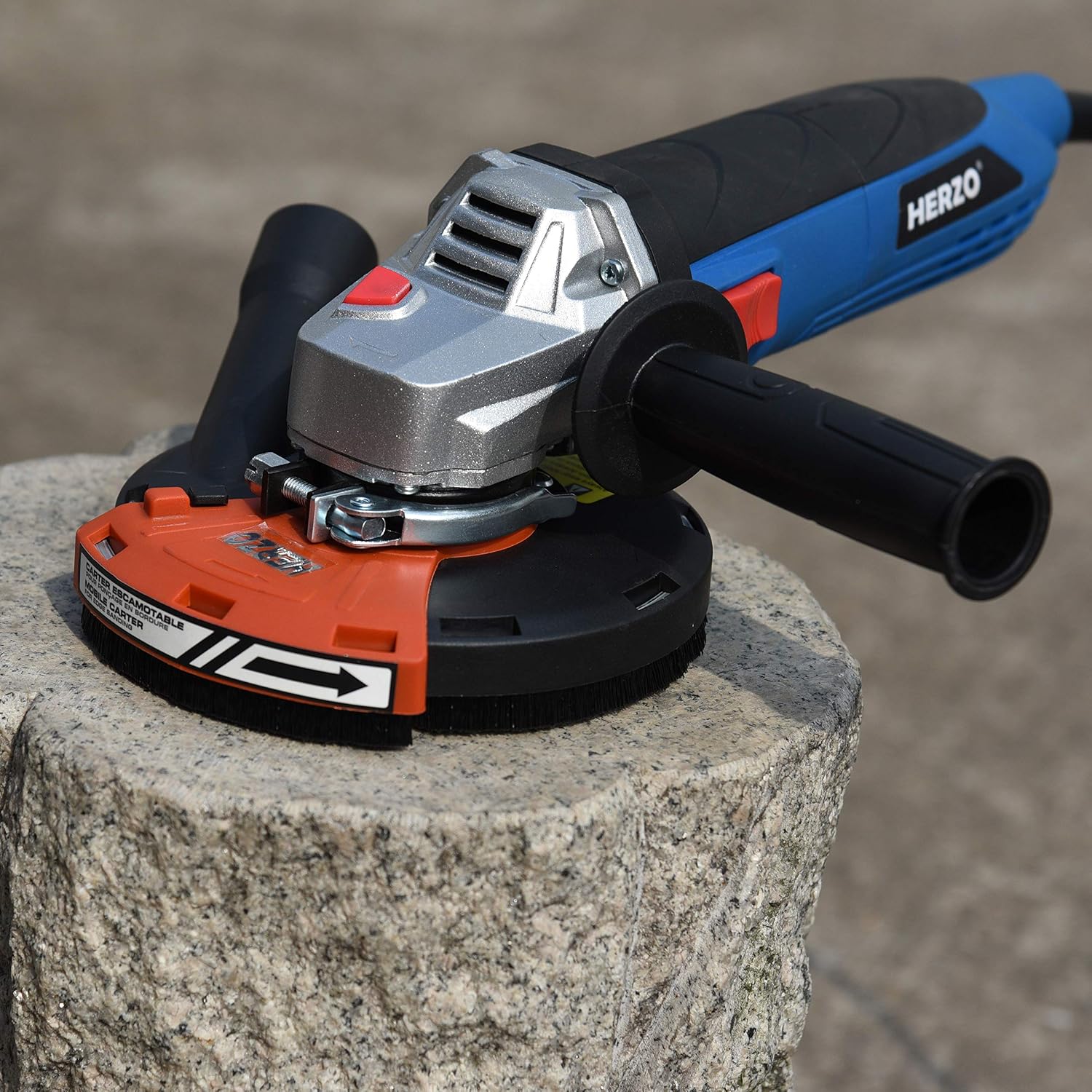
Learned something new today - there are dust collection shrouds designed for small angle grinders. For under $30, seems like a no brainer to minimize the otherwise ridiculous amount of dust that grinding will generate. Saves the grinder from an early death too.

https://www.amazon.com/dp/B01N7ONJUA/?tag=atomicindus08-20

91-iln1arnL._AC_SL1500_.jpg

That's one option. I've used one of those 4" diamond cup wheels on a cheap pneumatic grinder with a running hose. Wet grind with an electric grinder at your own risk, but if you have the air, wet grinding doesn't make all that much of a mess.
 
OP
S

stickshift

Well-known member
Joined
Nov 16, 2011
Messages
1,236
Location
northeastern US
That's one option. I've used one of those 4" diamond cup wheels on a cheap pneumatic grinder with a running hose. Wet grind with an electric grinder at your own risk, but if you have the air, wet grinding doesn't make all that much of a mess.
Have air, but not enough to run a pneumatic grinder. But good to know that's an option, thanks.
 

LS6 Tommy

Well-known member
Joined
Dec 27, 2013
Messages
26,162
Location
Northern NJ
Rent a concrete cutter, cut at the seam, lift the block, find out what heaved the sidewalk, fix, reset old block. I've done it at least 8 times.

Tommy
 
OP
S

stickshift

Well-known member
Joined
Nov 16, 2011
Messages
1,236
Location
northeastern US
As it turns out, I had to buy a diamond masonry cutting wheel for another job, so I'm halfway there on wheels needed to eliminate these lips/trip hazards.

Seems there are two styles of diamond cup grinding wheels:
71LG3qUf8uL._SL1500_.jpg


81icjeKGjFL._AC_SL1500_.jpg


Which would be better for this application? Also I notice a lot of these are made in 4", as opposed to 4-1/2". I have a 4-1/2" grinder. Does it make a difference which size wheel I get?
 
OP
S

stickshift

Well-known member
Joined
Nov 16, 2011
Messages
1,236
Location
northeastern US
if it's a sidewalk then it should be county or city problem, you can solve it with a phone call
Depends on jurisdiction. In my jurisdiction, it's in the code and I confirmed with AHJ that sidewalk maintenance and repair is homeowner responsibility. In a big city it is probably different.
 

Ray-CA

Well-known member
Joined
Jan 6, 2007
Messages
3,452
Location
San Diego CA
The City we lived in that just painted the hazard orange also required the street trees. In fact, you had a list of approved trees to choose from. Then, when the roots lifted the sidewalk, it was the homeowners responsibility to repair the sidewalk. But, it also required a permit and city approval. That's when the lawsuits started and several people were successful in getting the City to take responsibility for the sidewalk issue. So, the City started painting the trip hazard instead of repairing the problem.

Ray
 

sreeb

Well-known member
Joined
Jul 29, 2009
Messages
460
Location
SoCal
As it turns out, I had to buy a diamond masonry cutting wheel for another job, so I'm halfway there on wheels needed to eliminate these lips/trip hazards.

Seems there are two styles of diamond cup grinding wheels:
71LG3qUf8uL._SL1500_.jpg


Which would be better for this application? Also I notice a lot of these are made in 4", as opposed to 4-1/2". I have a 4-1/2" grinder. Does it make a difference which size wheel I get?

I have used one like the top one. It removed concrete surprisingly quickly. I wouldn't start by using a cutting wheel. Larger one probably cuts a little faster.
 
To avoid these ads, REGISTER NOW!
Top Bottom