To avoid these ads, REGISTER NOW!

Component ID help

Arne73

Well-known member
Joined
Mar 20, 2010
Messages
1,477
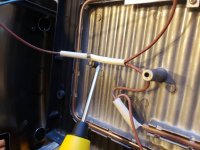
Does anyone recognize this electronic component? Its on the neutral side of a 1400W pannini press that until last night was working fine. The component reads open and when installed is attached to the bottom plate. Screwdriver is pointing at it in the picture.
I'm guessing that its a one time thermal device. It's so f*king small i can't make out the writing on it.
If anyone knows it would be helpful.20201126_150017.jpgImage%20(2).jpeg

Sent from my SM-G960U using The Garage Journal mobile app
 
To avoid these ads, REGISTER NOW!

wyliesdiesels

Well-known member
Joined
Aug 14, 2012
Messages
20,013
Location
Modesto, CA
since its on the bottom, a thermal fuse could be the case however im curious why the fuse would be on the neutral side and not on the hot side.
 

dogdog

Well-known member
Joined
Nov 15, 2011
Messages
12,711
another vote for thermal cutoff fuse... it's self resetting, but they do go bad. so check continuity when normal temp, and the contacts will open when it has reach it's designed temperature... it's about $1.50 item but you have to match temperature, amp and volt rating... it is very common in coffee makers , cheap motors etc.
 

Copymutt

Well-known member
Joined
Sep 3, 2016
Messages
3,390
Location
Colorado
Thermistor changes resistance w/ temperature to control temp. Thermofuse will be in power line or control line to open the circuit if overtemp.
 

Meursault74

Well-known member
Joined
Apr 1, 2019
Messages
21,975
Location
Southern California
Thermal cut off fuse..... Jump it out and see if the hot plate gets hot.


Yes, it's a thermal fuse.

If you remove it and connect the wires, you'll see if the rest of the system works, but be stand by to unplug if necessary if things get too hot.

I've replaced these in espresso machines and bathroom heaters. You'll need to match the temperature rating on the fuse. A magnifying glass is your friend.

When you replace it, don't solder it.......... it's a thermal fuse, you'll blow it.
 
To avoid these ads, REGISTER NOW!
OP
A

Arne73

Well-known member
Joined
Mar 20, 2010
Messages
1,477
Thank you all for the advice and the link.
This was the "one more thing" this week and I lost my patience with it, Google and the dead battery in my fluke.
I really appreciate the help.

Sent from my SM-G960U using The Garage Journal mobile app
 

Innovate1

Well-known member
Joined
Jul 28, 2014
Messages
4,288
Location
Illinois near St. Louis, Missouri
Yes, it's a thermal fuse.

If you remove it and connect the wires, you'll see if the rest of the system works, but be stand by to unplug if necessary if things get too hot.

I've replaced these in espresso machines and bathroom heaters. You'll need to match the temperature rating on the fuse. A magnifying glass is your friend.

When you replace it, don't solder it.......... it's a thermal fuse, you'll blow it.

What's a good way to connect these? Most are welded in place originally from what I have seen although some have crimp connections. I have thought about cutting off the crimp portion for a eyelet connector end but thinking the heat cycling may loosen it.
 

wyliesdiesels

Well-known member
Joined
Aug 14, 2012
Messages
20,013
Location
Modesto, CA
What's a good way to connect these? Most are welded in place originally from what I have seen although some have crimp connections. I have thought about cutting off the crimp portion for a eyelet connector end but thinking the heat cycling may loosen it.

The OPs has crimp connections but if you need it welded, get some high temperature solder...
 

dogdog

Well-known member
Joined
Nov 15, 2011
Messages
12,711
It really is supposedly mechanical connection only on these type of things, and not Solder.

for me.. I have a lot of those old school "I think" it's a 14-22gauge maybe even next size smaller... terminal (spade) connectors and lob off the connector end with a cutter and just used the crimped end to connect them back.
 
OP
A

Arne73

Well-known member
Joined
Mar 20, 2010
Messages
1,477
It really is supposedly mechanical connection only on these type of things, and not Solder.

for me.. I have a lot of those old school "I think" it's a 14-22gauge maybe even next size smaller... terminal (spade) connectors and lob off the connector end with a cutter and just used the crimped end to connect them back.
That's my plan. 240°C but I only want to do it once.

Sent from my SM-G960U using The Garage Journal mobile app
 

dogdog

Well-known member
Joined
Nov 15, 2011
Messages
12,711
That's my plan. 240°C but I only want to do it once.

Sent from my SM-G960U using The Garage Journal mobile app

that would dependent on the life of your component and how you crimp those components. adding solder... I am not sure why manufacture don't use them .. or if a mechanical one ever came off because of mechanical things.

this is the pic I have from the Drill press motor I wanted to make my motor reversible thread way back then, sorry I don't have the pic of the coffee maker I fix same way.

https://www.garagejournal.com/forum/showthread.php?t=361242


attachment.php
 

Innovate1

Well-known member
Joined
Jul 28, 2014
Messages
4,288
Location
Illinois near St. Louis, Missouri
A lot of these are spot welded into place in the equipment manufacture process. It happens very quickly so as to not overheat the part. Most of us don't have a spot welder so not easy to do. I have also thought of using the crimp part of a connector...
 

Innovate1

Well-known member
Joined
Jul 28, 2014
Messages
4,288
Location
Illinois near St. Louis, Missouri
You can solder it if you clamp a big hemostat on the lead to act as a heat sink.

True. You could also use needle nose pliers with a large rubber band on the handles to keep it holding on the lead or a vice grip set to very low force. Basically you want some large piece of metal between the soldering iron and the device to block the heat.
 

dogdog

Well-known member
Joined
Nov 15, 2011
Messages
12,711
You can solder it if you clamp a big hemostat on the lead to act as a heat sink.

True. You could also use needle nose pliers with a large rubber band on the handles to keep it holding on the lead or a vice grip set to very low force. Basically you want some large piece of metal between the soldering iron and the device to block the heat.

I don't think the problem is the heat during the soldering. It usually don't damage components that easily when done properly. Unless you leave the iron there for a longer time than necessary. those components that are expose to heat and mechanical vibration requires mechanical joint for some reason. I don't know what.
 
To avoid these ads, REGISTER NOW!
Top Bottom