To avoid these ads, REGISTER NOW!

Antique Electric Motor

spongerich

Well-known member
Joined
Apr 17, 2010
Messages
2,339
Location
Monroe, NY
Anyone here into antique electric motors?

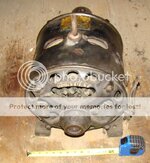
I've got a Century Electric 2HP motor that was in my barn when I bought my house. It's marked as Frame type P7, Serial# 10116 The patent dates are 1899 and 1903. I've searched a bit and found a little info that leads me to believe that it's pre-1910 based on the fact that it's labeled 104v.

Does anyone know how to identify the manufacture date?

I'm not really sure what to do with it. I'd restore it, but I really don't have a use for a 150 lb 2HP giant motor... If I can figure out what it's worth, I'll probably sell it.

century1.jpg

century2.jpg

century4.jpg
 
To avoid these ads, REGISTER NOW!

Zrexxer

Well-known member
Joined
Jan 23, 2007
Messages
5,058
Location
Pflugerville, TX
If I can figure out what it's worth, I'll probably sell it.
Hate to say it, but unless you can find someone who just really needs that motor for a particular machine restoration, its value is gonna be directly proportional to how much the copper in it weighs.
 
OP
S

spongerich

Well-known member
Joined
Apr 17, 2010
Messages
2,339
Location
Monroe, NY
Can you elaborate on the 104 V power component? How does this dictate early 20th century?

Adam


Around the turn of the century, power was delivered at lower voltages, IIRC 90-100v was typical. This was partly because of propaganda from Edison and other proponents of DC power. In an effort to make home electricity seem less dangerous, AC power was delivered at a voltage similar to Edison's DC system.

Once AC power became the standard, the voltage standards were ramped up to provide more current.

From what I've seen, 104V seems to have been superseded by 110v right around 1910.
 
To avoid these ads, REGISTER NOW!

Aberdale

Well-known member
Joined
Mar 13, 2009
Messages
1,380
Location
Ohio
I've got a similar motor, but a 5hp version. It was hooked up to a feed grinder that I bought a few years ago. I'm not sure what to do with mine either, but I've kept it thinking the right application might come along some day.

It's a heavy old booger.

Dale
 

Storoit

New member
Joined
Jun 9, 2018
Messages
3
Location
Orlando, FL
I just love this old piece. The guys who built this stuff in the early days certainly had a great design eye. If it were mine, I’d restore it and sit it on the floor in my living room! Bound to get the “Wow! Look at the old motor!” comment every time.
Or, after restoring it, just set it in your shop so all your shop buddies will do the same! And someday, when you least expect it, you’ll need a 2 hp motor. It would probably run on 120v without any problem. Problem is the nameplate says it draws 24 amps - that’s a lot. At 120 the amp draw would be a little less, but still, 20 is a lot.
 

Handyfarmer

Well-known member
Joined
Dec 20, 2014
Messages
316
Location
in the high plains of Colorado
NO expert here,
But what I can find and have read, Con edison, in the beginning they had a TWO phase generation system, the phases were at 90 degrees to each other, and 4 wires were used, (no ground or neutral), 4 wires each of the two phase were individually generated, some times in the same unit and some times by connecting a generator at 90 degrees to each other and by two separate machines on the same shaft,

and with that said I found this this morning, after reading the post,
https://books.google.com/books?id=W...QAQ#v=onepage&q=104 volt single phase&f=false

can not copy to post, but talks about separating the "TWO phase" to achieve 104 volts,

208 volts can be achieved, by utilizing two of the lines off a THREE phase star configured system utilizing two of the hot leads make a SINGLE phase 208,

(my understanding is) only in a few very rare Original systems dating back to 1900's is there comercial Two phase,

many people say two phase when they are talking about 240 volts using the two hot wires in a single phase system, as in residential wiring, the system is not two phase but single phase with split winding in the middle of it, and that middle tap is grounded and bonded with the neutral and have of the phase is on one side and half on the other side, not two phases, but one phase that is halved, 120 + 120 = 240
 

DocsMachine

Well-known member
Joined
Sep 16, 2006
Messages
1,941
With the flat belt pulley on it, it might be woodworking related.

-Might, indeed, but it's equally likely it was for metalworking as well, as back at the turn of the century, nearly all machines- and that includes washing machines :D - were run on some kind of flat belt.

Something like that could very well have been found bolted to the wall near a good-sized 16" lathe, bolted to the floor near a 21" 'camelback' drill press, or hung over the top of a horizontal mill.

As for value, things like that in good working condition have some small bit of collectors' value- there are those that like to restore and display them, like nearly any other antique.

But the collectors' value will be limited to your local area, because the shipping weight of such a thing would far exceed its value. Basically you could probably ask about $100 for it, maybe $200 to the right guy, but no more.

Doc.
 

redmondjp

Well-known member
Joined
Nov 25, 2014
Messages
2,318
Location
Redmond, WA
Something like that could very well have been found bolted to the wall near a good-sized 16" lathe, bolted to the floor near a 21" 'camelback' drill press, or hung over the top of a horizontal mill.

That's what I was thinking as well - this would be perfect for one of those vintage drill presses, which still seem to be out there (usually selling sans motor). That is, if you never plan on moving the thing again!
 

6PTsocket

Well-known member
Joined
Mar 12, 2014
Messages
4,593
When did it go to 120v?
It snuck up. I have seen equipment marked 110, 115, 117, and 120. For good measure the line always above 120 here. Uless they have changed the Japanese are at 100 volts. The rest of the world seems to be at 220 50 hz

Sent from my SM-G900V using Tapatalk
 

Oregon rock crusher

Well-known member
Joined
Jun 28, 2016
Messages
1,938
Location
West of Salem
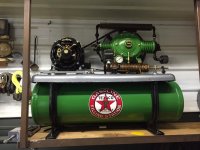
Here is a similar restored Century motor in use on an early flat belt drive Wayne compressor. It's wired single phase 220v and is very smooth running. Ed.
 

Attachments

  • IMG_0560.jpg
    IMG_0560.jpg
    140 KB · Views: 51
  • IMG_0558.jpg
    IMG_0558.jpg
    135.5 KB · Views: 52

RonBPalmer

New member
Joined
Nov 10, 2023
Messages
1
I have this motor on a LANDIS Shoe Repair Lathe that we bought old and used in 1983. It uses old style wide flat leather belts. It works just fine.
 

neophyte

Well-known member
Joined
Apr 23, 2012
Messages
10,028
Location
Pennsylvannia
NO expert here,
But what I can find and have read, Con edison, in the beginning they had a TWO phase generation system, the phases were at 90 degrees to each other, and 4 wires were used, (no ground or neutral), 4 wires each of the two phase were individually generated, some times in the same unit and some times by connecting a generator at 90 degrees to each other and by two separate machines on the same shaft,

and with that said I found this this morning, after reading the post,
https://books.google.com/books?id=WaQvAAAAYAAJ&pg=PA153&lpg=PA153&dq=104+volt+single+phase&source=bl&ots=FIm9KARFyf&sig=YE7a5B_yZ9IL2WvYK6cXURrEEp4&hl=en&sa=X&ved=2ahUKEwi9_rDTq7rcAhVs6YMKHYpeBjMQ6AEwGnoECAoQAQ#v=onepage&q=104 volt single phase&f=false

can not copy to post, but talks about separating the "TWO phase" to achieve 104 volts,

208 volts can be achieved, by utilizing two of the lines off a THREE phase star configured system utilizing two of the hot leads make a SINGLE phase 208,

(my understanding is) only in a few very rare Original systems dating back to 1900's is there comercial Two phase,

many people say two phase when they are talking about 240 volts using the two hot wires in a single phase system, as in residential wiring, the system is not two phase but single phase with split winding in the middle of it, and that middle tap is grounded and bonded with the neutral and have of the phase is on one side and half on the other side, not two phases, but one phase that is halved, 120 + 120 = 240
Genuine Two Phase power is still used in a few cities, in older buildings.
Philadelphia is one, and PECO (The Philadelphia Electric Company) will still supply the Two Phase power, although usually thru transformers now.
I’ve been told older industrial buildings in parts of New York City (Maybe Brooklyn or Queens ?) also had genuine Two Phase power, or at least they did into the 1970s or 1980s.
Electricians unfamiliar with the Two Phase tend to blow motors etc. up.
Hartford Connecticut supposedly still has Two Phase systems as well, and there were other cities that used it.
 
To avoid these ads, REGISTER NOW!
Top Bottom