Well, I have been pondering something and hopefully someone will help me find the answer. Virtually every type of puller be it wheel, bearing, axle, hub, or puller of any type has course threads. If the puller had fine threads the tool would take much less effort. Think about the young mechanic attempting to remove a ball joint with little more than a hammer and a half inch ratchet. If the threads were fine this may slow down the process a bit but it would be a lot easier for him. Yes I do understand the possibilities of threads being crossed, but I believe with the technology we have, and brilliant minds this would be an easy obstacle to overcome. A small 3/8 impact could remove and install the ball joint in short order. This is all hypothetical at this juncture. Anyway I hope other members will chime in with some good solid criticism and possibly meaningful advise.Ken

You are using an out of date browser. It may not display this or other websites correctly.
You should upgrade or use an alternative browser.
You should upgrade or use an alternative browser.
Course Thread/Fine Thread
- Thread starter Kenskip1
- Start date
course threads are stronger . fine threads would have to have a larger diameter to have the same strength
Schurkey
Well-known member
1. Any decent puller uses Acme threads, not the typical coarse/fine thread. Show me a puller that uses standard bolt thread, I'll show you a poorly-engineered puller.
https://en.wikipedia.org/wiki/Trapezoidal_thread_form

2. Fine thread is stronger than coarse thread.
https://www.nord-lock.com/insights/bolting-tips/2010/choose-fine-or-coarse-thread-bolts
https://en.wikipedia.org/wiki/Trapezoidal_thread_form
2. Fine thread is stronger than coarse thread.
https://www.nord-lock.com/insights/bolting-tips/2010/choose-fine-or-coarse-thread-bolts
Size for size, a fine thread is stronger than a coarse thread. This is both in tension (because of the larger stress area) and shear (because of their larger minor diameter).
Last edited:
1. Any decent puller uses acme threads, not the typical coarse/fine thread. Show me a puller that uses standard bolt thread, i'll show you a german puller.
That's M16x1.5 on the left there.

Attachments
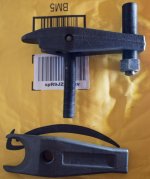
course threads are stronger
Fairly certain its the opposite. What you lose in the individual strength of each thread you gain in the increased displacement of pressure over a larger surface contact area. Most high torque fasteners (head bolts) or strength critical fasteners (chassis bolts) I can think of are fine thread. Thinking about it most of my fairly expensive pullers are fine thread too.
The only benefit to course threads is that they're faster(cheaper) to manufacture, are quicker to assemble, and harder to cross thread.
hmm, won't a fine thread pull out easier than a course? ok, I'm wrong I guess
kbeefy
Well-known member
My Balancer/PS pullers are fine thread.
My BJ Presses are course threads.
I have replaced many of them. Theres a dead one on the bench right now. Snap On BJP1. Died changing a dodge D60 ball joints. Put the new matco press on it and it did the job.
My BJ Presses are course threads.
I have replaced many of them. Theres a dead one on the bench right now. Snap On BJP1. Died changing a dodge D60 ball joints. Put the new matco press on it and it did the job.
kbeefy
Well-known member
hmm, won't a fine thread pull out easier than a course? ok, I'm wrong I guess
Fine thread provides much more surface area. It's much stronger. Just make sure your using 6-10 threads for the job, 1-2 threads will strip all the time.
hmm, won't a fine thread pull out easier than a course? ok, I'm wrong I guess
I'd think having more threads engaged would give it more overall strength and reduce the force on each individual thread.
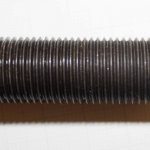
The forcing screw on the right is M20x1.5. Coarse thread M16 is usually a 2.0 mm pitch. Coarse M20 is usually a 2.5mm pitch. From the picture I attached the bolts bent (and the nut's face deformed) before the threads failed – don't lend your expensive tools to ******* monkeys (a.k.a. friends).
Wamsutta
Well-known member
Pullers are often used in dirty environments. Not everybody keeps their puller threads clean. Fine threads would clog up way too fast.
Schurkey
Well-known member
I blew-up the photo. The bent stud is probably "metric" Acme-style thread. Seems to have the pronounced flat area between threads. The angle of the photo is bad, I can't tell about the other screw.That's M16x1.5 on the left there.
Look at that Snap-On BJ press forcing screw. Almost guaranteed to be Acme thread. Or at least, it was originally. If it's been replaced with a bolt thread forcing screw, no wonder it broke.My Balancer/PS pullers are fine thread.
My BJ Presses are course threads.
I have replaced many of them. Theres a dead one on the bench right now. Snap On BJP1. Died changing a dodge D60 ball joints. Put the new matco press on it and it did the job.
dr_clyde
Well-known member
A fine thread is stronger, but the threads themselves are more fragile and prone to damage/cross thread/galling and other issues. A properly cut thread of most any pitch of the right depth is usually stronger than the fastener. When the thread is used to transmit motion or repeated loosening and tightening cycles, you start to see square and trapezoid threads, as they are very DURABLE, as well as accurate. Acme threads are rarely used to tighten a fastener, but are commonly used to move machine components or in precision applications like ball screws. Coarse threads are easier to cut, cheaper to cut, and generally are sufficient for most fasteners.
That said, my Matco puller set uses a common 5/8 fine thread and I’ve never had any issues with the threads. It is actually pretty handy, as I can easily make my own pullers and tap them with a common tap.
That said, my Matco puller set uses a common 5/8 fine thread and I’ve never had any issues with the threads. It is actually pretty handy, as I can easily make my own pullers and tap them with a common tap.
kbeefy
Well-known member
Side note. Even your sturdy garage vise is course thread. Could you imagine how tight you could get it if it was fine thread?
Yes. The force multiplication would be immense. Which is why it's not done. Standard is probably close to 10 to 1 x length of handle. Enough for most jobs.
kbeefy
Well-known member
Look at that Snap-On BJ press forcing screw. Almost guaranteed to be Acme thread. Or at least, it was originally. If it's been replaced with a bolt thread forcing screw, no wonder it broke.
Surely standard/Acme thread. Still all original. Regularly cleaned and lubed during the job it failed at. We'll be getting a new one soon.
I blew-up the photo. The bent stud is probably "metric" Acme-style thread. Seems to have the pronounced flat area between threads. The angle of the photo is bad, I can't tell about the other screw.
The forcing screw seems to be bent as well (although it's less pronounced). Add the camera to the list of expensive broken things (stuck aperture follower = max aperture all the time). But yeah that doesn't quite fit into a metric thread gauge. Whatdaya know.
Replacement screws are about $30 a pop and someone else with the same (broken) tool is trying to DIY a replacement. Unfortunately nothing else fits where this does, god bless those Bavarians.
Attachments

Schurkey
Well-known member
Yep. Even if the thread PITCH is the same, the thread FORM may not be.
That's why I included a sample of the Acme thread form in my first post.
That's why I included a sample of the Acme thread form in my first post.
Fine thread is typically standard on pullers and slide hammers. 5/8 -18 is very common. Fine thread has a larger minor diameter than coarse in the same mean diameter . In a properly designed bolted joint, or a puller, there are enough threads engaged so that the screw will fail in tension before the threads strip. Which is why fine is most often used.
seber
Well-known member
Strength of thread is dependent on shear area. Since coarse threads have a greater depth of cut they have a greater shear area. That is why fine threads are NEVER used for aluminum or cast iron. They lack sufficient pull out strength.
matt_i
Well-known member
Strength of thread is dependent on shear area. Since coarse threads have a greater depth of cut they have a greater shear area. That is why fine threads are NEVER used for aluminum or cast iron. They lack sufficient pull out strength.
This is the exact point that most people miss. ^
There are two factors. The UNF has a bigger minor diameter so theoretically "its a stronger bolt". But the thread crests, internal and external are weaker, so how that helps is counterbalanced. It seems like more threads "share" the load but in reality its just one or two. So if only two are doing most of the work and they fail its then onto two others, and so on. Must have a medium to high strength base material to compensate as Seber mentioned.
On a UNF thread the helical ramp is set at a lower angle if you "unwrapped" it from the OD. This means greater mechanical advantage in developing clampload via torque.
Bottom line: always oversize your forcing screw if making a homemade screw thread press.
Yep. Even if the thread PITCH is the same, the thread FORM may not be.
That's why I included a sample of the Acme thread form in my first post.
Welp the other guy posted a picture of the M16-1.5 threaded rod he bought next to the screw and damn if it didn't look identical. So I went down to the hardware store and bought an M16-1.5 nut which threaded on perfectly (until I got to the bent part).
Shadows aside it sure looks like a standard 60° DIN thread.
Strength of thread is dependent on shear area. Since coarse threads have a greater depth of cut they have a greater shear area. That is why fine threads are NEVER used for aluminum or cast iron. They lack sufficient pull out strength.
Mitsubishi, Toyota, Honda.... use fine thread bolts into aluminum. Not sure what you work on.
seber
Well-known member
Mitsubishi, Toyota, Honda.... use fine thread bolts into aluminum. Not sure what you work on.
I spent my entire working life designing production machinery. The Japanese is metric threads. They wouldn't be caught dead using SAE fine.
Leaflessshadetree
Well-known member
I spent my entire working life designing production machinery. The Japanese is metric threads. They wouldn't be caught dead using SAE fine.
Never came across fine pitch metric threads?
Fine pitch threads (both SAE and metric) are often used in high vibration applications.
joe_padavano
Well-known member
course threads are stronger .
Sorry, no. Do the math on available parent metal area for each in a given bolt diameter. All high strength MIL-SPEC bolts are fine thread. All high strength bolts we use in the aerospace industry are fine thread.
bob15
Well-known member
I spent my entire working life designing production machinery. The Japanese is metric threads. They wouldn't be caught dead using SAE fine.
I guess you missed the memo that metric has: coarse, fine and extra-fine threads.
bob15
Well-known member
Fine vs coarse thread....read what the industry says:
https://www.nord-lock.com/insights/bolting-tips/2010/choose-fine-or-coarse-thread-bolts/
https://katofastening.com/article/coarsevsfine.html
https://www.accuratescrew.com/thread-series/
https://www.holo-krome.com/resources.html
https://www.nord-lock.com/insights/bolting-tips/2010/choose-fine-or-coarse-thread-bolts/
https://katofastening.com/article/coarsevsfine.html
https://www.accuratescrew.com/thread-series/
https://www.holo-krome.com/resources.html
Jeff95TA
Well-known member
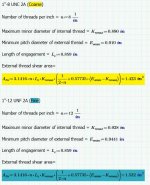
I just happened to be doing some calcs for work that included bolt calcs and had it in front of me.
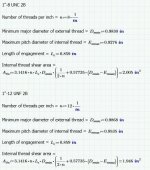
Here's a comparison of the thread shear area for a 1"-8 UNC coarse and 1"-12 UNF fine thread bolt, both with the same height hex nut. The fine thread has more thread shear area. It also has higher shear and tensile areas.
Here's a comparison of the thread shear area for a 1"-8 UNC coarse and 1"-12 UNF fine thread bolt, both with the same height hex nut. The fine thread has more thread shear area. It also has higher shear and tensile areas.
Attachments


Last edited:
Lets do math and play mechanical engineer. We're designing a small engine with 3/8 head bolts. 2B female threads in an A356 block. For a design criteria we'll assume thread failure in the aluminum block at the pitch diameter.
For 3/8-16 UNC-2B, the nominal pitch diameter is .347". the thread shear area, per thread, at the pitch diameter is :
pi*.347*(1/16)*.5= .034in^2 per thread
for 1" engagement, the total shear area for the female thread is
.034*16=.544in^2
For 3/8-24 UNF-2B the nominal pitch diameter is .350". The thread shear area, per thread, at the pitch diameter is:
pi*.350*(1/24)*.5=.023in^2 per thread. Yay, coarse thread wins? Not yet- there are 1.5X as many for given length for this example.
For 1" engagement (the number doesn't matter if you use the same for both) the total shear area for the 3/8-24 female thread is
.023*24= .552in^2
So, the 3/8-24 has slightly more engagement shear area- it's NOT weaker. Yeah, only 1.5% difference, so why use fine threads? Because the bolts are stronger.
3/8-16 tensile stress area=.078 in^2
3/8-24 TSA= .088 in^2.
That's 12.8%. May not seem like a lot, but for a 150ksi ultimate strength bolt:
3/8-16= 11,700 lbf strength
3/8-24=13,200lbf strength
That's a huge difference for the same size fastener. It equates to 13% more clamping force, which is why fine thread bolts are often used for cylinder head bolts. Even into aluminum blocks.
For thread engagement, we want the bolt to fail before the threads strip. The reason is the threads might just start to strip and we may not notice and it could fail later. For 3/8-24 into A356 (20700 psi shear strength)
20700*.023=467 lbf shear per single thread
13200/467=28 threads minimum engaged, or 1.17" of engagement. It'd be good to increase this by 1.25X if possible.
For 3/8-16 UNC-2B, the nominal pitch diameter is .347". the thread shear area, per thread, at the pitch diameter is :
pi*.347*(1/16)*.5= .034in^2 per thread
for 1" engagement, the total shear area for the female thread is
.034*16=.544in^2
For 3/8-24 UNF-2B the nominal pitch diameter is .350". The thread shear area, per thread, at the pitch diameter is:
pi*.350*(1/24)*.5=.023in^2 per thread. Yay, coarse thread wins? Not yet- there are 1.5X as many for given length for this example.
For 1" engagement (the number doesn't matter if you use the same for both) the total shear area for the 3/8-24 female thread is
.023*24= .552in^2
So, the 3/8-24 has slightly more engagement shear area- it's NOT weaker. Yeah, only 1.5% difference, so why use fine threads? Because the bolts are stronger.
3/8-16 tensile stress area=.078 in^2
3/8-24 TSA= .088 in^2.
That's 12.8%. May not seem like a lot, but for a 150ksi ultimate strength bolt:
3/8-16= 11,700 lbf strength
3/8-24=13,200lbf strength
That's a huge difference for the same size fastener. It equates to 13% more clamping force, which is why fine thread bolts are often used for cylinder head bolts. Even into aluminum blocks.
For thread engagement, we want the bolt to fail before the threads strip. The reason is the threads might just start to strip and we may not notice and it could fail later. For 3/8-24 into A356 (20700 psi shear strength)
20700*.023=467 lbf shear per single thread
13200/467=28 threads minimum engaged, or 1.17" of engagement. It'd be good to increase this by 1.25X if possible.
seber
Well-known member
Lets do math and play mechanical engineer. We're designing a small engine with 3/8 head bolts. 2B female threads in an A356 block. For a design criteria we'll assume thread failure in the aluminum block at the pitch diameter.
For 3/8-16 UNC-2B, the nominal pitch diameter is .347". the thread shear area, per thread, at the pitch diameter is :
pi*.347*(1/16)*.5= .034in^2 per thread
for 1" engagement, the total shear area for the female thread is
.034*16=.544in^2
For 3/8-24 UNF-2B the nominal pitch diameter is .350". The thread shear area, per thread, at the pitch diameter is:
pi*.350*(1/24)*.5=.023in^2 per thread. Yay, coarse thread wins? Not yet- there are 1.5X as many for given length for this example.
For 1" engagement (the number doesn't matter if you use the same for both) the total shear area for the 3/8-24 female thread is
.023*24= .552in^2
So, the 3/8-24 has slightly more engagement shear area- it's NOT weaker. Yeah, only 1.5% difference, so why use fine threads? Because the bolts are stronger.
3/8-16 tensile stress area=.078 in^2
3/8-24 TSA= .088 in^2.
That's 12.8%. May not seem like a lot, but for a 150ksi ultimate strength bolt:
3/8-16= 11,700 lbf strength
3/8-24=13,200lbf strength
That's a huge difference for the same size fastener. It equates to 13% more clamping force, which is why fine thread bolts are often used for cylinder head bolts. Even into aluminum blocks.
For thread engagement, we want the bolt to fail before the threads strip. The reason is the threads might just start to strip and we may not notice and it could fail later. For 3/8-24 into A356 (20700 psi shear strength)
20700*.023=467 lbf shear per single thread
13200/467=28 threads minimum engaged, or 1.17" of engagement. It'd be good to increase this by 1.25X if possible.
You have confused shear area with contact area. Shear area is the outside diameter of the thread minus the inside diameter X PI X length of engagement. Since coarse threads have a greater depth of thread, they automatically have a greater shear area.
As to all mil spec high strength bolts being fine thread, I can't say but all my machinery used grade 8 coarse thread hex cap screws unless something special was needed.
Last edited:
Jeff95TA
Well-known member
You have confused shear area with contact area. Shear area is the outside diameter of the thread minus the inside diameter X PI X length of engagement. Since coarse threads have a greater depth of thread, they automatically have a greater shear area.
As to all mil spec high strength bolts being fine thread, I can't say but all my machinery used grade 8 coarse thread hex cap screws unless something special was needed.
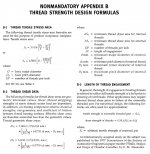
I'm sorry, but you're wrong. Coarse threads do not have a greater shear area. You have to consider the minimum pitch diameter of the external thread and the maximum minor diameter of the internal thread. Your formula doesn't calculate thread shear area.
Look at my post a few posts up. Those are the equations for the thread shear of an external thread from ASME B1.1, "Unified Inch Screw Threads".
And MIL spec fasteners are covered by MIL-S-1222 Rev. H. A lot of the spec references the ANSI/ASME specs.
edit: I attached the page from the ASME spec (same as used in Machinery's Handbook).
Attachments
Last edited:
bob15
Well-known member
You have confused shear area with contact area. Shear area is the outside diameter of the thread minus the inside diameter X PI X length of engagement. Since coarse threads have a greater depth of thread, they automatically have a greater shear area.
As to all mil spec high strength bolts being fine thread, I can't say but all my machinery used grade 8 coarse thread hex cap screws unless something special was needed.
You might want to try reading the links I posted and learn something.
Here a bit from a manufacturer:
The potential benefits of fine threads are:
Size for size, a fine thread is stronger than a coarse thread. This is both in tension (because of the larger stress area) and shear (because of their larger minor diameter).
Because of the smaller pitch, they allow finer adjustments in applications that need such a feature.
Fine threads can be more easily tapped into hard materials and thin-walled tubes.
Fine threads require less torque to develop equivalent bolt preloads.
Fine threads have less tendency to loosen since the thread incline is smaller and hence so is the off torque.
And from another manufacturer:
Fine threaded bolts are stronger than the corresponding coarse threaded bolts of the same hardness. This is in both tension and shear due to the fine threaded bolts having a slightly larger tensile stress area and minor diameter.
Fine threads have less tendency to loosen under vibration due to their having a smaller helix angle than coarse threads. Fine thread Locking Insert grip coils are more flexible than coarse thread insert corresponding size grip coils, and are less likely to take a set under vibration conditions.
Fine threads because of their finer pitch allow for finer adjustments in those applications that need this characteristic.
Fine threads can be more easily tapped into difficult to tap materials, and thin walled sections.
Fine threads require less tightening torque to develop equivalent preloads to the corresponding coarse thread bolt sizes.
Jeff95TA
Well-known member
This thread is educational, and entertaining
Not so sure about the latter. I could show you a picture of my daughter's eyes glazing over when I ramble about stuff. She jokingly flips through my "Machinery's Cookbook" as if it was interesting just to mock me.
Another point not yet mentioned is that rolled threads are stronger than cut threads. It's likely that when you are comparing puller prices some of the more expensive ones have been made using rolled threads and then hardened. If you're planning to replace a damaged forcing screw diy style it would be wise to use a grade 8 bolt or similar high strength type bolt.
Disclaimer: I'm not a machinist, just have read about threads in past, mostly in the "Machinist's Handbook".
Disclaimer: I'm not a machinist, just have read about threads in past, mostly in the "Machinist's Handbook".
bwringer
Well-known member
I, for one, would be happy if manufacturers would permanently stop using vague **** like "course", "fine", and "extra-fine" and simply precisely designate the actual damn thread pitch. Takes less room, even.
seber
Well-known member
Sorry, no. Do the math on available parent metal area for each in a given bolt diameter. All high strength MIL-SPEC bolts are fine thread. All high strength bolts we use in the aerospace industry are fine thread.
You have confused shear area with contact area. Shear area is the outside diameter of the thread minus the inside diameter X PI X length of engagement. Since coarse threads have a greater depth of thread, they automatically have a greater shear area.
As to all mil spec high strength bolts being fine thread, I can't say but all my machinery used grade 8 coarse thread hex cap screws unless something special was needed.
You might want to try reading the links I posted and learn something.
Here a bit from a manufacturer:
The potential benefits of fine threads are:
Size for size, a fine thread is stronger than a coarse thread. This is both in tension (because of the larger stress area) and shear (because of their larger minor diameter).
Because of the smaller pitch, they allow finer adjustments in applications that need such a feature.
Fine threads can be more easily tapped into hard materials and thin-walled tubes.
Fine threads require less torque to develop equivalent bolt preloads.
Fine threads have less tendency to loosen since the thread incline is smaller and hence so is the off torque.
And from another manufacturer:
Fine threaded bolts are stronger than the corresponding coarse threaded bolts of the same hardness. This is in both tension and shear due to the fine threaded bolts having a slightly larger tensile stress area and minor diameter.
Fine threads have less tendency to loosen under vibration due to their having a smaller helix angle than coarse threads. Fine thread Locking Insert grip coils are more flexible than coarse thread insert corresponding size grip coils, and are less likely to take a set under vibration conditions.
Fine threads because of their finer pitch allow for finer adjustments in those applications that need this characteristic.
Fine threads can be more easily tapped into difficult to tap materials, and thin walled sections.
Fine threads require less tightening torque to develop equivalent preloads to the corresponding coarse thread bolt sizes.
No argument that fine threaded bolts are stronger than coarse. But that does not address the problem of shear in the parent material.
bob15
Well-known member
No argument that fine threaded bolts are stronger than coarse. But that does not address the problem of shear in the parent material.
It is no different, fine thread, higher shear. Read the links I posted.
Jeff95TA
Well-known member
No argument that fine threaded bolts are stronger than coarse. But that does not address the problem of shear in the parent material.
It is no different, fine thread, higher shear. Read the links I posted.
It does make a difference. The coarse internal threads have a larger shear area than fine internal threads, which can be an issue if you have a lower strength parent material. If the bolt and parent material are the same, the external thread is going to be the limiting case, and a fine threaded joint will be stronger.
Attachments
Last edited:
Schurkey
Well-known member
Rolled threads are indeed stronger than cut threads.Another point not yet mentioned is that rolled threads are stronger than cut threads. It's likely that when you are comparing puller prices some of the more expensive ones have been made using rolled threads and then hardened. If you're planning to replace a damaged forcing screw diy style it would be wise to use a grade 8 bolt or similar high strength type bolt.
Disclaimer: I'm not a machinist, just have read about threads in past, mostly in the "Machinist's Handbook".
Nobody cuts threads in a production environment any more. It's cheaper to roll them; at least for sizes under one inch. One exception to this is the crappy, horrible three-foot lengths of "All-Thread" found in the dusty back row of the hardware store--about Grade One in terms of strength.
As far as "rolled threads and then hardened", ARP makes a big deal out of their process which is to harden the steel, THEN roll the threads.