To avoid these ads, REGISTER NOW!

New table saw owner, what are necessities?

OP
T

ThatSickRip

Well-known member
Joined
May 23, 2017
Messages
763
Thinking Ive got a LOT of research and reading to do still before even unboxing it (if I dont return it). Theres terms/names being slung around that I dont even know what they are yet :(
 
To avoid these ads, REGISTER NOW!

PelicanPines

ALLIANCE MEMBER
Joined
Apr 30, 2014
Messages
38,144
Location
New Jersey, USA, Earth, My own reality
Stay concerned when using a table saw... don't be scared tho. Be smart. From what I'm reading here.

NEVER WEAR work gloves
USE a push stick or those grippers...
Always utilize the riving knife... (it helps prevent kickback)
NEVER use the FENCE with a miter gauge. USE one or the other.
Wear eye protection

Uncle was a cabinet maker for 60+ years... I have been using a table saw for 45+ years...

Total OH **** kickbacks between both of us... uhm... two
Total loss of fingers ZERO
Total cuts to fingers ONE (uncle) (he was doing a complicated angle miter on edge) blade hit his thumb as he pushed the last bit thru the blade. (shoulda used a push stick)
 

tarmy

Well-known member
Joined
May 28, 2014
Messages
4,713
Location
Nor Cal
One of the old sayings that my shop teacher always said...was to ALWAYS look at the blade...your brain will not let you put your fingers in the blade...

Not sure if true...but I always have 100% focus on my task when that blade is spinning...period.
 

CTyankee

Well-known member
Joined
Jan 13, 2013
Messages
3,803
Location
CT
Thinking Ive got a LOT of research and reading to do still before even unboxing it (if I dont return it). Theres terms/names being slung around that I dont even know what they are yet :(

With all the fingers you read about flying around, it's not surprising a novice would have concerns. But don't let it deter you, table saws can be operated safely following basic precautions.

Use a blade guard, a push stick and a splitter and you eliminate almost all of the serious injury potential. I'd wager most injuries happen to more "seasoned" users who become too comfortable trying to work too quickly and cut corners.
 

dwcon1431

Active member
Joined
Jun 1, 2017
Messages
31
With all the fingers you read about flying around, it's not surprising a novice would have concerns. But don't let it deter you, table saws can be operated safely following basic precautions.


Use a blade guard, a push stick and a splitter and you eliminate almost all of the serious injury potential. I'd wager most injuries happen to more "seasoned" users who become too comfortable trying to work too quickly and cut corners.
Ditto that!

Sent from my SM-A102U using Tapatalk
 

C lectric

Well-known member
Joined
Mar 25, 2011
Messages
78
Location
Canada
You have been given good advice so far.

I would add hearing protection especially if you are doing a lot of cutting. My saw does not sound loud but when using it for a time the drone of the saw gets to me. ALso cutting some materials are actually hard on the ears. These saws are not as quiet after a while as you think.


Don't be put off by all the warnings. Just really pay attention to what you are doing, THINK about what will happen if you lose control of the part you are going to cut. Saw blades can grab parts and throw them at you with a lot of force.

The all to often thought that ""it will be OK this time"" is an invitation to a problem even if all it does is wake you up and runi what you were doing.

To give them their due the tools, even the hand tools, need some respect and learning to avoid damage to yourself, the tool or the part you worked so hard at to get to where you goofed.

I always put the blade down, when finished, as carbide tips are expensive for a moments carelessness. In my case the saw table also serves as part of the work surfaces.

Warn others to NOT just open the door and yell. That yell could startle you into doing something that you will rue. Get it across to them without, yelling yourself, even a sign.

My wife knows if I am doing something to simply wait. If important then flick the lights ONCE quickly which will signal me, and then wait untill I have finished what ever I am doing.


Enjoy your saw. Look in the magazine racks as often the mags. will have suggestions that are very worthwhile.
 

MarvinBerry

Well-known member
Joined
Oct 21, 2018
Messages
817
Location
Enchantment under the sea - NJ
Thinking Ive got a LOT of research and reading to do still before even unboxing it (if I dont return it). Theres terms/names being slung around that I dont even know what they are yet :(

Honest question have you ever used a power saw before? What kinda projects are you working on?

Don't let us scare you too much. Table saw isnt inherently dangerous but it is one of the saws that commands the most respect and attention to what your doing.

And yeah, my shop teacher cut his fingers off doing something he told us to never do!
 

coleman10

Well-known member
Joined
Nov 12, 2012
Messages
871
Location
Fort Lauderdale, FL
One of the old sayings that my shop teacher always said...was to ALWAYS look at the blade...your brain will not let you put your fingers in the blade...


Not sure if true...but I always have 100% focus on my task when that blade is spinning...period.


I’m just getting started myself, and that’s what I do. I never take my eyes off that blade. The moment I do, I have no idea where my fingers are in relation to it.

I knew a guy who was using his table saw when his wife walked into the garage and called out to him. He looked up at her for a split second. When he looked down, he saw all the blood and two fingers on the table. Thankfully they were able to reattach them, but he lost a lot of function in his index finger.

I bought two Grippers and like those because you can put downward and sideways pressure at the same time and your hand is away from the blade.

I remember years ago when I was a kid, my dad said he’d never own a table saw because they were too dangerous. He was more comfortable with a radial arm saw. I tend to think he didn’t want his curious kids around a table saw as a safety precaution.
 

ddawg16

Well-known member
Joined
Jul 11, 2008
Messages
21,005
Location
S. California
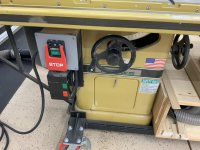
Here are some ideas...including a safety switch. If something ever binds...or wants to fly at you and you can’t let go...a knee will shut it down...

9008E451-524A-4202-95EB-AE2BF2707539.jpg

CC3F43E6-FE72-43B9-B448-A84AB8120492.jpg

4F37F673-07AB-4BC0-ADCF-7F1BCDF59E5F.jpg

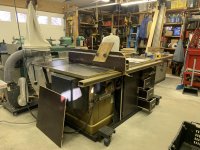
Nice addition to your saw....I did something similar. I'm using the Ryobi 3000...but it doesn't look as good as yours

The best addition was an old butcher block island top a neighbor was getting rid off. It doubles as both a wood working table and outfeed.
 

Attachments

  • IMG_20170812_103154294.jpg
    IMG_20170812_103154294.jpg
    156 KB · Views: 24
  • TableSawOutfeed.jpg
    TableSawOutfeed.jpg
    109.5 KB · Views: 25
  • IMG_20200322_130258281.jpg
    IMG_20200322_130258281.jpg
    84.8 KB · Views: 24

ddawg16

Well-known member
Joined
Jul 11, 2008
Messages
21,005
Location
S. California
Honest question have you ever used a power saw before? What kinda projects are you working on?

Don't let us scare you too much. Table saw isnt inherently dangerous but it is one of the saws that commands the most respect and attention to what your doing.

And yeah, my shop teacher cut his fingers off doing something he told us to never do!

Key topic.....what do you want to do?

See it as a 'solution looking for a problem'.

Understand what the table saw is.....a great tool for making long straight accurate cuts....something you're not going to do well with a circular saw.

My Ryobi does a great job doing compound miter cuts....but so does my sliding compound miter saw. The slider is a lot faster.

There are lots of ways to trim a board down to a specific width....but nothing beats the table saw for that task. You can cross cut a board with the table saw...but the compound miter saw is going to do it quicker and easier.

Right tool for the right job.

If you like woodworking....well, it's kinda like stamp collecting....it gets expensive...but so much more rewarding.
 
To avoid these ads, REGISTER NOW!

RKA

Well-known member
Joined
Jun 9, 2010
Messages
1,744
Location
NJ
Table saw can be replaced with a track saw...and miter saw...and router, but sometimes it’s a more time consuming workflow. Especially if you have smaller stock that needs to be milled. And each of those tools also has the capacity to take a finger. You have to learn to use the tool safely, no way around it. I’ll second the suggestion to take a Woodcraft class, but I wonder if that’s still going on with covid. All the forum advice and YouTube videos are great, but some people just need that hands on instruction.

Another option is sawstop. But as I said above, you still have to learn to use the tool safely or it can still hurt you. It does add another layer of safety, but it’s a secondary layer imho.

And just to echo advice given above, avoid distractions, stop if you think something is sketchy, stop if you feel too much resistance, stop if you catch yourself being in a hurry, stop if you’re tired, stop if you catch yourself thinking “one more quick cut”. Be very disciplined when using your tools. As with most injuries in my life, had I needed that advice, an injury could have been avoided. Many were. But I currently have a broken toe because I was in a hurry to get onto a conference call after wrapping up a discussion with a contractor. Tripped over a nail gun...I don’t blame him, I knew better. I was thankful my stupidity didn’t result in a nail getting fired as well.
 

ROBZ71LM7

Well-known member
Joined
Aug 5, 2009
Messages
96
Location
Louisville, KY
1) Ensure blade is aligned with miter slot
2) Ensure fence is aligned with blade, if off a couple thou the back should open up
3) Use zero clearance inserts
4) Keep blade at low height
5) Position yourself to the side of saw with good stable footing
6) Always use the riving knife when ripping
7) Use TWO (2) push sticks-I prefer 18". Cannot emphasize this enough your hands should not come anywhere near the blade. The picture of the guy using the sawstop earlier in this thread is what you DON'T want to do.
8) Use feather boards when you can

If I'm holding two push sticks (I can do everything with them) there is no reason for my hand to ever come near the blade.
 

Davefr

Well-known member
Joined
Jan 7, 2010
Messages
11,849
Location
OR
Make some sacrificial fences and blade inserts. Think about adding an outfeed roller extension.

I've also found that waxing the table is helpful. It makes the work slide smoothly which leads to safety and also protects the table.

Offset your stance when ripping in case of kickback

Calibration is critical. Use a high end machinist square to ensure blade is parallel to fence and truly perpendicular to table at the 0 degree stop. Don't trust the printed scale or stops for 45 degrees, etc. Use the 45 degree end of the combo machinist square or protractor. Calibrate the mitre gauge also.

81cL4RGmUQL._SL1500_.jpg
 

justanengineer

Well-known member
Joined
Apr 5, 2011
Messages
7,722
Location
Motor City
Keep the tablesaw, it’s a very handy tool to have. Many woodwackers would actually say it’s the centerpiece of the wood shop. My point above was simply to recognize that it is one of the more dangerous tools you’ll own, right up there with chainsaws. Having grown up in a sawmill I’m very comfortable using both but still do second guess and analyze everything I do for safety improvements. I’m not a morbid person and honestly don’t even care for horror movies, but when someone shares that they were hurt I want to know why and how to prevent the issue. There’s a lot of books on saw usage and jigs to make in most every public library plus online, unfortunately there isn’t much on safety beyond others’ stories.


Sent from my iPhone using Tapatalk
 
OP
T

ThatSickRip

Well-known member
Joined
May 23, 2017
Messages
763
Honest question have you ever used a power saw before? What kinda projects are you working on?

Don't let us scare you too much. Table saw isnt inherently dangerous but it is one of the saws that commands the most respect and attention to what your doing.

And yeah, my shop teacher cut his fingers off doing something he told us to never do!

Miter saws and circular saws, but never used a table saw, or anything beyond what I listed saw wise. Project (for now) are smaller type things: redoing fireplace mantle, shelf/table system for behind the couch, things like that. Nothing extensive or needing of longer cuts (yet). Im sure after those are completed, I will come up with more projects, but Im not even close to any of the types of projects the members here do. Im literally a straight up rookie when it comes to woodworke besides using the circular and miter saw for making a raised bed garden.
 
OP
T

ThatSickRip

Well-known member
Joined
May 23, 2017
Messages
763
Thank to all the guys for the positive feedback and advice. Too many to quote, but thank you all :D
 

Spacey_G

Well-known member
Joined
Dec 31, 2015
Messages
492
A table saw is a far more useful and productive tool than the alternatives. It's worth it (and not all that difficult) to learn how to use it safely. Lots of good advice in this thread already.

I would add a couple of points that are a little less concrete but still important. Before you make any cut, visualize how it will go, where the workpiece and off cut will go, where your body and hands will be positioned, etc. You don't want to be scrambling to adjust mid-way through a cut. And if you ever approach a cut and just don't have a good feeling about it, stop and figure out a safer way to do it.

Table saws can be used safely. The accidents you hear about are not inevitable. But it takes discipline, awareness, and the right state of mind.
 

jives

Well-known member
Joined
Jan 4, 2013
Messages
2,812
Location
Central NY
The categories of comments here break down into safety and usefulness. All are good, but depending on your situation, not all are absolutely necessary. For usefulness, everything starts with understanding and setting up the trueness of the blade and fence.

As for safety, everything first starts with attitude. Every time. Second are technique and push sticks. Safety guards are nice, but are not substitutes for 1 and 2. If you do a lot of smaller cuts, safety guards may get in the way of vision and control. A lot of the TV guys claim that the guards are off for TV purposes. I don't really buy it. If the viewer cannot see what is going on, then neither can the operator.
 

Voi

Well-known member
Joined
Oct 10, 2010
Messages
5,151
Location
Western South Dakota
I started to skim over this thread last night but barely got into it.

Get a dial gauge if you don't have one & build a basic sled for it that runs on the supplied miter gauge. Use it to check that blade is parallel to miter slot & that fence is parallel to or slightly toed out from blade.

I would recommend building a simple double runner cross cut sled. It's easy to get obsessed with including every idea you see on YouTube but start with a simple one & see how you use it before getting fancy with your next one.

Don't go crazy with the cross cut capacity of the sled but do make it have more capacity than any miter saw you may have so it's at least useful. My first had just over 24" capacity.
 

Renegade1LI

Well-known member
Joined
Mar 11, 2018
Messages
5,024
Location
long island ny
A lot of really good advice has been given here, safety is very important, but it shouldn't be scary. Take the time to set up the saw, half the fun of using it is setting it up, I love making jigs & fixtures. One of the first things my father taught me was to make a good set of feather boards & a quality aux fence. When the feather boards are set up correctly they become a guard between your hand & the blade while controlling your work piece & preventing kick back, use one on the fence & one in the miter slot. Always keep the push stick on the back side of the fence & do a dry run of your set up. You want to be able to grab the push stick or hit the off switch without taking your eye off the blade, practice & patience. I have recently added a stock feeder which really improved safety & cut quality as it completely covers the blade, good luck.
 

Attachments

  • IMG_0473.jpg
    IMG_0473.jpg
    155.6 KB · Views: 15
  • IMG_0716.jpg
    IMG_0716.jpg
    139.8 KB · Views: 14

Miss the Pontiacs

Well-known member
Joined
Nov 7, 2016
Messages
16,538
Location
Saskatchewan Canada
This will be your first saw of many others to come. I still have my 10” Craftsman that I bought 40 years ago. Was going to upgrade it but as I said there are many other saws that you will likely purchase.
I borrowed my FIL’s RAS many years back. He made me read the manual first before lending it to me. Likely a good idea.
Safety glasses, no gloves. I wear a T Shirt or at least have my sleeves rolled up past my elbows.
I have taken my guard off.:scared: I know not a good idea! But I always double check my fence with a full sized square before cutting.
Have a magnetic ended measuring tape for measuring my fence to blade cuts.
Good quality and sharp blades, also push sticks, feather boards, dado blades. Sacrificial extended fence board, dust broom.
If cutting sheets of plywood by yourself, a well constructed extended work surface for support of before and after cut.
I built a catch all for my sawdust with a connection for my vac. New dust collection in my future. Nice to have a semi clean work area.
I have attached my saw blade removal wrenches and a dedicated Phillips screw driver on an old landline Q cord that is attached to a clip on my saw. Doesn’t get lost or misplaced that way.
Good luck, let us know when you buy your next motorized saw. I bet it will be a Slider. I bought years ago a 10” compound mitre. Same blade as my table saw thought that was a good idea until my 12” Slider came along.
:lol_hitti
 
To avoid these ads, REGISTER NOW!
Top Bottom