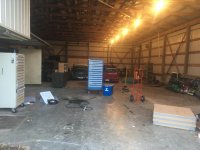
I thought I would post my research and experiences with lighting my 50x80x14 metal-sided pole barn outbuilding for others to use as this site has been very helpful for me.
First, a little about the building. The purpose of the building is essentially a large detached garage. I will be storing and working on vehicles and equipment in this space, so I wanted it lit reasonably well (~90 fc.) There are four 16x12 overhead doors on openers (essentially, large double garage doors) on one of the sidewalls and the floor is a 4" concrete slab. I have 200 amp service to the outbuilding coming directly off of the utility pole 50' away at the insistence of the power company engineer, rather than the 90-100 I originally requested.
I decided on standard 8' tandem T8 fluorescents as my light source after a lot of research here and looking at numerous installations of various types of fixtures. The exact fixture I used was the H. E. Williams model 76 strip light that the local electric supply house carries. These have the Advance Centium 120-277 volt normal (0.88) ballast factor instant start ballasts. Lighting is approx 90 fc with all fixtures on. The reasons I decided on this setup:
1. I excluded HID interior lighting due to the prolonged warm-up time and restrike time.
2. Screw-in bulbs were ruled out as it would have either taken an enormous number of them for adequate lighting, or it would have led to terrible glare using high-lumen bulbs like LED corn lamps or deformable lamps.
3. I ruled out all of the highbay fixtures except for T8 fluorescent and the 1'x2' 10,000-12,000 lumen linear LED highbays with frosted lenses due to glare. The more compact linear LED highbays and all of the UFO lights I saw were just painful to have in my field of vision at the relatively low mounting height I was using.
4. I ruled out integrated linear LED strips as they cost about twice as much for a similar output fixture compared to what linear fluorescent or LED-ready strips with tubular LED lamps cost. They also are generally not reusable/repairable if anything malfunctions while the tubular fixtures are fixable.
5. I ruled out T12 fluorescents because the performance of slimline 75 W T12s is very bad in unheated buildings in the winter (the previous owner had installed some in an outbuilding I had owned elsewhere in the past) and T12HOs have largely disappeared from the market.
6. I ruled out the T8 and LED highbays as it is much easier to mount and wire strips. Strips can be screwed directly into the bottom chord of trusses, wired directly with NM cable, and the fixture can be used as a junction box or raceway. Highbays cannot be directly surface mounted and require a separate junction box and either conduit for a pendant mount, or AC or flex cable and a plug for chain or standoff bracket mount. Also, the cost of highbays ranged from somewhat more (6 lamp T8 highbays) to significantly more (LED highbays) than strip fixtures. Also, the lensed LED highbays were noted by others to collect bugs and I didn't want to mess with emptying bugs out of fixtures multiple times per year.
7. The decision between tubular LEDs in LED-ready fixtures vs. T8 fluorescents was the hardest decision. I ended up going with T8 fluorescents primarily as I wanted some uplight to reduce the cave effect that tubular LEDs in strips give as the driver blocks quite a bit of uplight. (I have one fixture in my current workshop converted this way after the cheap ballast died.) I have also used T8 fluorescents in grid troffers in a previous house and also linear T8s in my current basement workshop and have been happy with them so it was sticking with a known quantity that I knew I would be happy with. Yes, I will be up on a ladder more often with the T8s than LEDs but my experience is that it will be a rare occurrence. For example, I have had to replace exactly one of 44 bulbs in my current workshop since I installed T8 fixtures there five years ago.
8. I decided on 8' tandem fixtures with four 4' bulbs compared to two-bulb 8' fixtures or two-bulb 4' fixtures as this reduced the amount of wiring by half compared to 4' fixtures but didn't require the use of the grossly more unwieldy 8' bulbs.
9. I decided on these specific 8' tandem T8 fixtures as they are a noticeably higher quality fixture than the stuff sold at the big box stores and weren't that much more expensive. They are 22 ga steel and have Advance normal ballast factor 120-277 volt instant start ballasts, and are made about an hour and a half down the road from my outbuilding. These are noticeably better than the Metalux box store units I currently have in my basement and were much nicer to assemble and install.
I wanted about 90 fc which led me to get 50 fixtures according to a couple of computer modeling programs. It is a 10x5 setup with fixtures starting on the first truss inboard of the end walls and then a column of five fixtures on every other truss. The outboard end of the fixture on each end of the trusses is 2' inboard of the sidewalls and there is 18" between fixtures inboard of that. If you are wondering how I hung these 8' long fixtures, I used a 12' stepladder and two light-duty tie down straps. I hooked one strap to itself around the truss and slid the far end of the fixture through the hole so the strap would hold the fixture about 3" below the truss. I then hooked the other strap to itself around the truss and fixture on the near end of the fixture so the fixture hung just below the truss. This left both of my hands free to align the near end of the fixture to the measured mark on the truss and screw it into the truss.
I decided to use two 20 A 240 volt circuits to power the lights. This is not a residential building therefore voltages over 120 V are allowable. The ballasts support running at that voltage and using 240 volts instead of 120 halves the number of switches required, the number of home runs back to the breaker panel, and most importantly, renders voltage drop across the fairly long wire runs (about 160 feet at the longest) a moot point. The power consumption of half of the fixtures was 2800 watts which given the 80% rule for continuous loads was right at the maximum for 14 ga, so I put in 12 to give myself a little wiggle room. I put the "odd numbered" columns of lights on one switch and the "even numbered" columns on another. I did not use discrete zones of lights as I always seemed to want to go into the "other" zone in areas I have had that were wired this way and then had to turn the other switch on too. I do see myself only turning on one of the two switches in this building just to pop in and get something as the entire building is lit but not at 100%.
I am very happy with the results. The lights fired off just fine at 25 degrees the other day and that's about as cold as it gets here. The layout is nice and even, there are no shadows or glare. The only downside I get is the expected significant FM radio interference from the Class A ballasts. This isn't really an issue as I mostly listen to AM which is pretty much unaffected, and they also do not interfere with a cell phone either.
First, a little about the building. The purpose of the building is essentially a large detached garage. I will be storing and working on vehicles and equipment in this space, so I wanted it lit reasonably well (~90 fc.) There are four 16x12 overhead doors on openers (essentially, large double garage doors) on one of the sidewalls and the floor is a 4" concrete slab. I have 200 amp service to the outbuilding coming directly off of the utility pole 50' away at the insistence of the power company engineer, rather than the 90-100 I originally requested.
I decided on standard 8' tandem T8 fluorescents as my light source after a lot of research here and looking at numerous installations of various types of fixtures. The exact fixture I used was the H. E. Williams model 76 strip light that the local electric supply house carries. These have the Advance Centium 120-277 volt normal (0.88) ballast factor instant start ballasts. Lighting is approx 90 fc with all fixtures on. The reasons I decided on this setup:
1. I excluded HID interior lighting due to the prolonged warm-up time and restrike time.
2. Screw-in bulbs were ruled out as it would have either taken an enormous number of them for adequate lighting, or it would have led to terrible glare using high-lumen bulbs like LED corn lamps or deformable lamps.
3. I ruled out all of the highbay fixtures except for T8 fluorescent and the 1'x2' 10,000-12,000 lumen linear LED highbays with frosted lenses due to glare. The more compact linear LED highbays and all of the UFO lights I saw were just painful to have in my field of vision at the relatively low mounting height I was using.
4. I ruled out integrated linear LED strips as they cost about twice as much for a similar output fixture compared to what linear fluorescent or LED-ready strips with tubular LED lamps cost. They also are generally not reusable/repairable if anything malfunctions while the tubular fixtures are fixable.
5. I ruled out T12 fluorescents because the performance of slimline 75 W T12s is very bad in unheated buildings in the winter (the previous owner had installed some in an outbuilding I had owned elsewhere in the past) and T12HOs have largely disappeared from the market.
6. I ruled out the T8 and LED highbays as it is much easier to mount and wire strips. Strips can be screwed directly into the bottom chord of trusses, wired directly with NM cable, and the fixture can be used as a junction box or raceway. Highbays cannot be directly surface mounted and require a separate junction box and either conduit for a pendant mount, or AC or flex cable and a plug for chain or standoff bracket mount. Also, the cost of highbays ranged from somewhat more (6 lamp T8 highbays) to significantly more (LED highbays) than strip fixtures. Also, the lensed LED highbays were noted by others to collect bugs and I didn't want to mess with emptying bugs out of fixtures multiple times per year.
7. The decision between tubular LEDs in LED-ready fixtures vs. T8 fluorescents was the hardest decision. I ended up going with T8 fluorescents primarily as I wanted some uplight to reduce the cave effect that tubular LEDs in strips give as the driver blocks quite a bit of uplight. (I have one fixture in my current workshop converted this way after the cheap ballast died.) I have also used T8 fluorescents in grid troffers in a previous house and also linear T8s in my current basement workshop and have been happy with them so it was sticking with a known quantity that I knew I would be happy with. Yes, I will be up on a ladder more often with the T8s than LEDs but my experience is that it will be a rare occurrence. For example, I have had to replace exactly one of 44 bulbs in my current workshop since I installed T8 fixtures there five years ago.
8. I decided on 8' tandem fixtures with four 4' bulbs compared to two-bulb 8' fixtures or two-bulb 4' fixtures as this reduced the amount of wiring by half compared to 4' fixtures but didn't require the use of the grossly more unwieldy 8' bulbs.
9. I decided on these specific 8' tandem T8 fixtures as they are a noticeably higher quality fixture than the stuff sold at the big box stores and weren't that much more expensive. They are 22 ga steel and have Advance normal ballast factor 120-277 volt instant start ballasts, and are made about an hour and a half down the road from my outbuilding. These are noticeably better than the Metalux box store units I currently have in my basement and were much nicer to assemble and install.
I wanted about 90 fc which led me to get 50 fixtures according to a couple of computer modeling programs. It is a 10x5 setup with fixtures starting on the first truss inboard of the end walls and then a column of five fixtures on every other truss. The outboard end of the fixture on each end of the trusses is 2' inboard of the sidewalls and there is 18" between fixtures inboard of that. If you are wondering how I hung these 8' long fixtures, I used a 12' stepladder and two light-duty tie down straps. I hooked one strap to itself around the truss and slid the far end of the fixture through the hole so the strap would hold the fixture about 3" below the truss. I then hooked the other strap to itself around the truss and fixture on the near end of the fixture so the fixture hung just below the truss. This left both of my hands free to align the near end of the fixture to the measured mark on the truss and screw it into the truss.
I decided to use two 20 A 240 volt circuits to power the lights. This is not a residential building therefore voltages over 120 V are allowable. The ballasts support running at that voltage and using 240 volts instead of 120 halves the number of switches required, the number of home runs back to the breaker panel, and most importantly, renders voltage drop across the fairly long wire runs (about 160 feet at the longest) a moot point. The power consumption of half of the fixtures was 2800 watts which given the 80% rule for continuous loads was right at the maximum for 14 ga, so I put in 12 to give myself a little wiggle room. I put the "odd numbered" columns of lights on one switch and the "even numbered" columns on another. I did not use discrete zones of lights as I always seemed to want to go into the "other" zone in areas I have had that were wired this way and then had to turn the other switch on too. I do see myself only turning on one of the two switches in this building just to pop in and get something as the entire building is lit but not at 100%.
I am very happy with the results. The lights fired off just fine at 25 degrees the other day and that's about as cold as it gets here. The layout is nice and even, there are no shadows or glare. The only downside I get is the expected significant FM radio interference from the Class A ballasts. This isn't really an issue as I mostly listen to AM which is pretty much unaffected, and they also do not interfere with a cell phone either.
Attachments


Last edited: