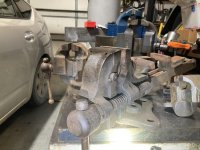
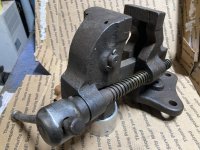
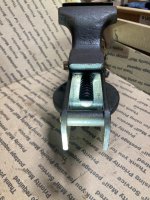
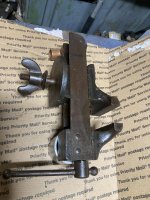
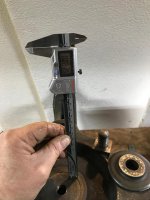
Gandy dancers bar, there's differnt styles of bars they danced with.
lol I had to google Gandy dancer to figure out what you were talking about. so you think it may be a replacement for what originally came with the vise or that was how it was made?

Gandy dancers bar, there's differnt styles of bars they danced with.
Rmnewcom, I have a similar beast at work, where it was most likely bought new. I was always wondering what it was! If it's the same 6 1/4" jawed vise as yours, I can get some more shots and dimensions of the handle, if you're interested.
va.grouseman, Fierljeppen: great historical info on these beasts.
I can tell by looking at your vise that it’s a very early model, probably late 1800’s.I believe that Prentiss simply didn’t mark their first generation vises. The original Prentiss vises didn’t have model numbers, they were sold by description.Thanks Smitty. I know there's been a lot of discussion regarding these un-marked Prentisses, but any definitive answers?
Why no markings?
Were they manufactured by Prentiss, or contracted out?
Are they budget (as in less robust) models compared to the marked Prentisses?
Do they have any definitive designations?
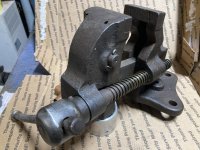
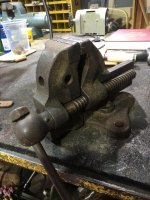
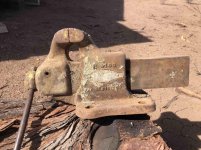
Another small vise I'm happy to have: An Athol number 10. Quick release/adjust. 2-1/8" jaws
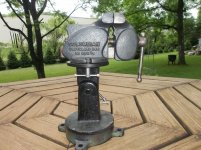
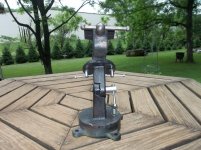
It's on a swivel base that I've not seen before. I rather doubt it was originally on this tilt/swivel base.
Does anyone recognize the base?
My Cheney No.10 in the background.
PierceA

My personal favourites are very old or unusual vises, so I probably won't keep these 3.
I'd be saying they all class as keepers over here. How oft are you likely to drop on *any* swivel jaw, especially, across here? The Parkinson's, for example, are harder to find than rocking horse turds.
 , Dannyr.---You're probably a lot luckier than you think snagging those particular vises.---Once you unload them you'll probably have sellers remorse.
. We-e-ell - doesn't take a lot of persuading by you and fretters - so bang goes the 'one in one out' rule I agreed with myself. But I have arranged to donate some others to a local museum, when this Covid eases, so maybe then I'll be able to buy some big fellas again (the rule doesn't apply to 'baby' sized vises).
Oh and how old is the Athol no.93?
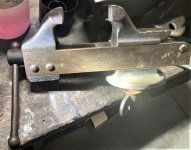
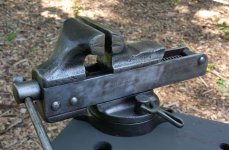
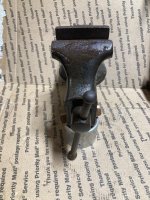
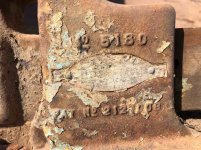
Images of an odd side screw or offset vise. Not a single marking on it. Well made and has the original pipe jaw. There is one of these shown earlier in this very long thread, a few years ago I think. But it too has no markings that I remember..
It would be REALLY cool if one of the brochure and advertising gurus here could find an ad for this vise. !!





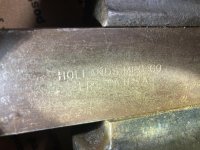
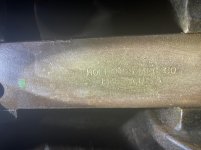
Below images of what I thought was another 'no name' vise. But a week or so ago I was rearranging the pile to make room for more acquisitions, and the light caught the side of this vise just right and I saw a hint of lettering. Some scotchbrite and here it is: This no name is actually a Hollands vise.. I cannot find this Hollands vise in the Spreadsheet.
So: Kevin, let me know if you want more dimensions and a weight..
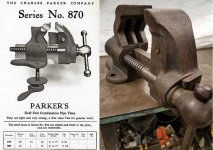
That is a really nice find! It's a rare Bonney patent no. 357,306 combination vise. The patent is all about the swiveling front jaw, which is still intact on your vise.
Although this was originally mfg. by Bonney, it eventually became a Charles Parker vise. Your vise looks all Bonney to me.
.
Fierljeppen:
Thanks for the welcome! Is that your only one? Do you have any duplicates? Are there any others in our small club of Franklin owners?
Fierlj and Pierce. Since both your Hollands are swivel base, I'd say the one with the under-bench wing nut is older, and the one with the bolt down base is newer. Catalog pages if available and dated would verify this.
Fierljeppen:
Thanks for the welcome! Is that your only one? Do you have any duplicates? Are there any others in our small club of Franklin owners?
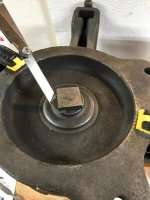
Hey PierceA: I took a look at this last night. You don't have to ask me twice to take something apart! First I found that there was about 35-40 thousands of clearance left when the bolt was tight (first pic). This was repeatable: if I backed the bolt off, it would still come to a dead stop each time, giving the same clearance. So then I removed the bolt, cast washer, and swivel plate to see what was going on.
After wiping off everything, I reinstalled the base plate and clamped down (if not clamped, the spring from the locking pin will push the plate from the body). At this point I was confused (it happens) because the center locating boss on the body was about .020" DEEPER than the swivel base (2nd pic). This would mean that, with the bolt fully tightened against the washer, that the swivel should lock up and not turn. However, I knew I had repeatable .035"-.040" clearance.
So, I reinstalled the bolt without the washer and it came to a dead stop again. Prentiss limited the bolt travel by having the end of the bolt make contact at the bottom of the blind hole. A peek into the blind bolt hole revealed what looks like lead (3rd pic). At time of manufacture, they must have devised a way to "set" the base plate clearance this way.
CRS: Thanks for posting yours. We’ve got at least 3 members now...you, me, and fierljeppen. And 3 different sizes. We could meet up and have a family reunion some day.
Fierljeppen: Could you please share your Franklin history?