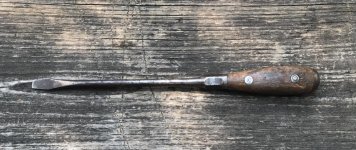
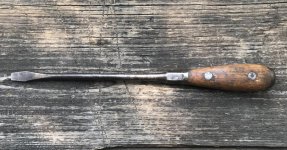
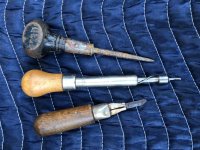
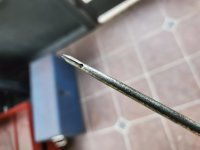
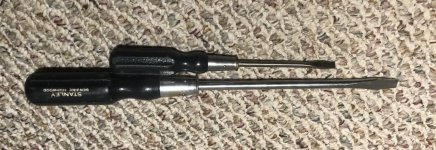
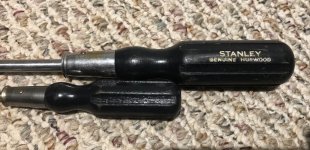
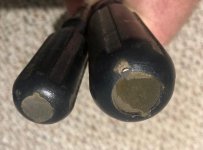
What is the OAL? And what is the length of just the blade (from the tip to the ferrule) and the diameter of the tip? The federal specs for a wartime stubby that was used by many technical branches was 4" OAL, 1-3/4" blade, and 1/4" width.
Yes, I cracked that mystery several years ago.
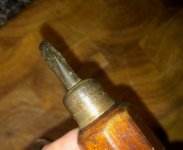
Androck Phillips head screwdrivers like the one Don is showing have shown up in the UK and elsewhere in the ETO and also in the US for many years and became a WWII collectors' choice, especially for Dodge 1/2 Ton 4 x 4 trucks, and later, for GMTK's, as a somewhat questionable alternative with questionable provenance for Vlchek screwdrivers of the same type. Questionable because there was no substantive information or evidence other than them showing up in surplus lots, and, as Mintgrun alluded to, the fact that the name "Androck" is found on antique and vintage kitchen utensils (spatulas, strainers, sieves, sifters, wisks, etc). Putting two and two together, I tracked it down to a brand name of the Washburn Company, which was largely converted into a defense production plant during WWII. Products included tent slips, tent pegs, and can openers, but also bomb parts (arming wires), and of course, tools, including a $53,000 contract with the US Army Ordnance Dept in late 1942 into 1943. ORD owned the tracked and wheeled vehicle maintenance role and they bought tools for that responsibility as spares for on-board toolkits that the vehicle OEM's were supplying as well as equipping rear echelon depot maintenance shops.
EDIT: They are somewhat rare. I have only found a few in the wild.
Private Lugnutz; What is the OAL? And what is the length of just the blade (from the tip to the ferrule) and the diameter of the tip? The federal specs for a wartime stubby that was used by many technical branches was 4" OAL said:Apologies for the tardiness in replying these specs. I have been out of pocket for a few days.....
OAL on the USAC screwdriver is 3-3/4" and the blade length is 1-3/8" long.


You will have to excuse me, couldn't resist. It was a period of time I was working on a bunch of knifes.......
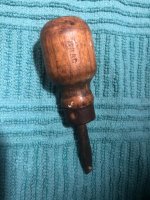
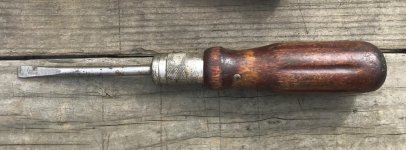
That’s in really great condition. Did you replicate the wood handle or did you find it in close to that condition and just clean it up?
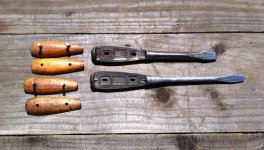
I have the same screwdriver but it was soaked in black oil and/or had endured a lifetime of dirty greasy hands.
Soaking in lacquer thinner overnight seems too harsh.
I know, I know .... not vintage, and not nearly as **** as some of these vintage tools. But, I do love these drivers. I did sneak some vintage **** into the picture though![]()
What is the **** hood on which these screwdrivers rest?
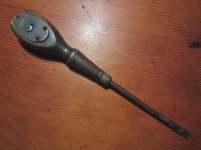
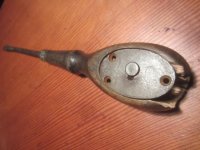
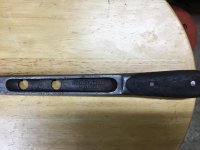
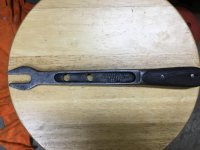
Not a screwdriver,but this is where my Perfect Handle search led me. Anybody know details of this sweet thing? Its got serious strength in the side beams. The holes have to have a purpose.


The holes have to have a purpose.
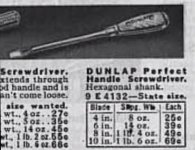
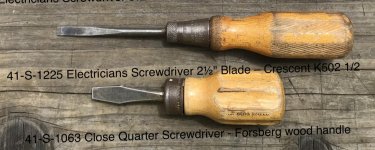
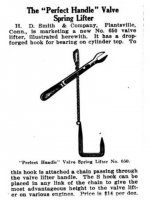
Here's an ad (see Pic 1) to illustrate what Leg is referring to, Heavymetal. Where did you find it? Is it possible to go back to the source to see if there was a chain and hook somewhere in the same lot that nobody had associated with the handle? It would be worth the effort. It's one of the hardest of the dozen or so different tools that H.D. Smith made after the original screwdriver to take advantage of the "Perfect Handle" design, adding it in 1911. I would love to add one to my collection (see Pic 2) one day. Nice find.Valve spring compressor missing the chain and 'C' hook.
42: I was wondering after thinking about your wood handle replacement did you maybe cut the wood a and just pin it in place? wouldn't it be a bit easier to make wood a bit oversized and sand it down on a belt grinder or hand sand so you don't get any gaps or do you think that would scratch up the metal too much?
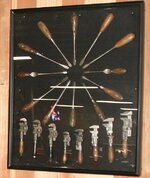
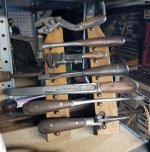
Thanks. Those are all H.D. Smith.LUG: that is one cool method of displaying some cool old wood handled tools!!
The holes are not for rivets, they're for the chain to pass through. I've never used one, but it looks like the hook was meant to go over the cylinder head. Flat head. Valves in the block. That's where the leverage came from. I imagine the forked piece on the end of the shank was for the valve head. Picture a valve spring compressor with wide solid C shape, that have a lever. Those screwed tight. This one looks like it adjusted by pulling more chain through. Definitely looks awkward. But a cool piece to own. And, as I said, along with the Triple Lever machinists' screwdriver at the bottom of my display, and the "S" adjustable wrench at the top, hard to find!drivesitfar said:so i guess the holes were for rivets since his tool had a wood handle? my real question is how in the heck would you use that tool on an engine? (not that you need to know or that I really care that much, but it seems awkward at best)