To avoid these ads, REGISTER NOW!

HVAC is Hurting My Head!

bczygan

Well-known member
Joined
Nov 4, 2009
Messages
22,002
Location
DETROIT! Arsenal of Scrappers
So I'm going to school for HVAC.

First course.

We've gone through basic AC systems and on to refrigerants.

Subcooling and superheat are kicking my ***.

And making my head hurt.

Maybe I should have studied the chapter on gasses a little better.

Bill
 
To avoid these ads, REGISTER NOW!

American Locomotive

Well-known member
Joined
Jan 8, 2017
Messages
10,958
Location
Rhode Island
Maybe this well help:

- A refrigerant's boiling point (the temperature at which it boils and turns into a gas) depends on its pressure. So at a certain pressure, the gas and liquid boiling off *SHOULD* be at a certain temperature.

- Superheat is literally measuring how much hotter the refrigerant vapor is compared to what it theoretically should be at the given suction pressure. Imagine you boil water - the steam coming off is 212 degrees. Now take that steam, put it through a pipe over a fire. Its temperature will go up. It is now "superheated" over what it normally would be.

A really high superheat indicates the liquid is boiling off before the end of the evaporator, a really low superheat means you're pushing too much liquid into the evaporator and it's making it all the way to the end. Ideally you want the last little bit of liquid to be boiled off by the end of the evap.


Subcooling is the exact opposite. At a certain pressure, the refrigerant will condense back into a liquid at a certain temperature. Subcooling is measuring how much colder the refrigerant is that it normally would be at whatever the condensing pressure is.
 

Ralf11

Well-known member
Joined
Feb 29, 2016
Messages
2,275
PV = nRT

and the n and R don't matter unless you want a number out the other end

all ya need, really
 

monkeyspanners

Well-known member
Joined
May 28, 2013
Messages
419
Location
Oxford, UK
Imagine a pan of water on a stove, the water is subcooled (water below its boiling point).

Turn the heat on and the steam rising from the pan is superheated water (water above its boiling point)

In refrigeration and AC systems we alter the boiling point (and condensing point) by altering the pressure which is where it can get confusing!
 

theoldwizard1

Well-known member
Joined
Feb 22, 2011
Messages
43,173
Location
SE MI
We've gone through basic AC systems and on to refrigerants.

Subcooling and superheat are kicking my ***.

And making my head hurt.

Don't let it get you down ! Just know how to properly measure them and then look at the gauges to know if you have the system properly filled !

I have avoided getting into HVAC because DECENT tools are expensive ! A Yellow Jacket (brand) gauge set is about $150 (get the longer hoses). Then you have "special" adapters/couplers that make life easier. You might need a sniffer or at least UV glasses.

A GOOD vacuum pump is going to be over $200 !

If you are going to be working on home systems, add a "micron" (deep vacuum) gauge.


Of course, I have not mentioned anything about "recovery" equipment. And if you are working on both automotive and residential you will need multiple gauge sets (R134A, R410a, R-1234yf).
 

theoldwizard1

Well-known member
Joined
Feb 22, 2011
Messages
43,173
Location
SE MI
I don't know what the teacher is expecting of your class, but I'm guessing it probably involves learning some principles of thermodynamics.

The first issue with heating and cooling and thermodynamics is What is Hot and Cold ? If you grew up in the tropics, 60F would be cold. If you grew up in the arctic, 60F might be hot !

"Hot" and "Cold" are just terms we apply to the amount of "heat energy" an item has.

When you are heating or cooling something you typically have another object that is above/bellow the desired temperature.

Think about this. When you are boiling water on an electric stove, you actually cooling the heating element !
 
Last edited:

karoc

Well-known member
Joined
Dec 19, 2017
Messages
2,002
Location
Hemphill Tx
Sub cooling is your liquid line, super heat is your suction line and don't forget your discharge super heat. There are also some youtubes on this which will help out. Your better cls with be at your Carrier Supply house,Trane supply house etc. Community Colleges are good but most of those are taught by a person who has ac company. So they may know how to work on systems but some may have little harder time teaching. But your in door and that's a plus
 

DenisG

Well-known member
Joined
Jul 14, 2013
Messages
1,278
Location
Milwaukee
The first issue with heating and cooling and thermodynamics is What is Hot and Cold ? If you grew up in the tropics, 60F would be cold. If you grew up in the arctic, 60F might be hot !

"Hot" and "Cold" are just terms we apply to the amount of "heat energy" an item has.

When you are heating or cooling something you typically have another object that is above/bellow the desired temperature.

Think about this. When you are boiling water on an electric stove, you actually cooling the heating element !

Not sure how theoretical his class gets but academically; math, keeping track of units, understanding definitions are lots of things that can trip up students.
 
OP
B

bczygan

Well-known member
Joined
Nov 4, 2009
Messages
22,002
Location
DETROIT! Arsenal of Scrappers
I have a furnace to rehab and or install, fridges that need repair and automotive AC to fix.

But the real reason for studying it is that it has always seemed a black art to me.

And anything I don't understand is something I want to know how it works. And I want to be able to operate and manipulate and mess with it.

Electrical is a big part of this and I LOVE electrical. It's so mathematical.

Bill
 

ambenz

Well-known member
Joined
Dec 12, 2010
Messages
4,236
Location
NW Chicago Suburbs
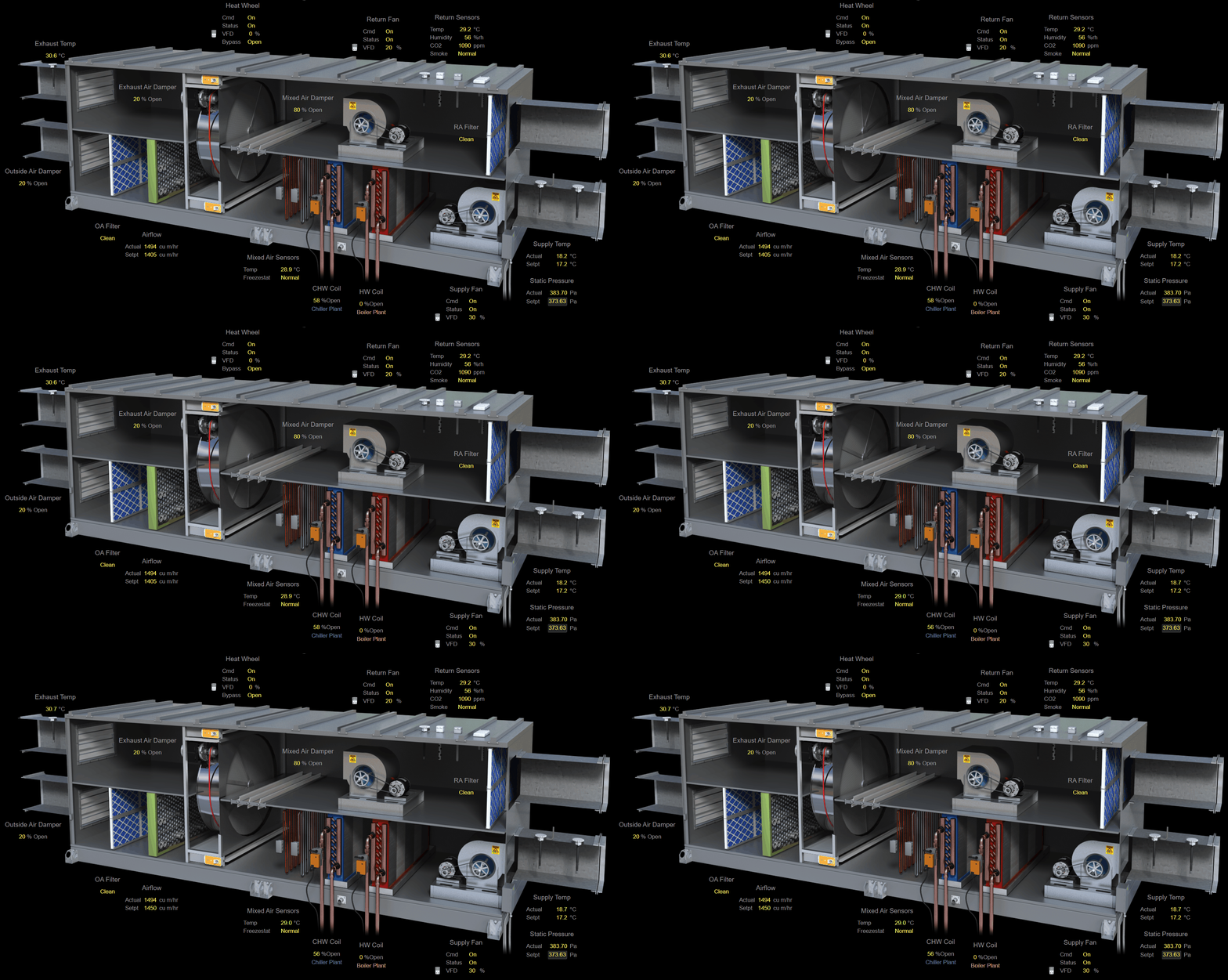
Wait until you get into the automation end of it! Talk about frying your brain!
I had to learn it at 48 yrs old...controlling a commercial building from your arm chair laptop is no easy feet to accomplish for the building engineer that wants YOU to make that happen!!!!
ahu_anim.gif


And when it fails...or doesn't accurately represent...at a critical corporate facility, and your "ON CALL!"
Hope you never have to feel that pressure....so glad I retired! LOL!!! :willy_nil
 

theoldwizard1

Well-known member
Joined
Feb 22, 2011
Messages
43,173
Location
SE MI
Not sure how theoretical his class gets but academically; math, keeping track of units, understanding definitions are lots of things that can trip up students.

True, but this should be all "practical"/"hands on" type stuff. Know how to do the measurements properly. The scales are on the gauges.

I forgot to mention before, you need a meter with a thermocouple !
 

ant.foste

Well-known member
Joined
Aug 14, 2016
Messages
403
Location
Maryland
Always remember, pressure tells only half the story. Must have temperatures and subsequent superheat and sub cooling. And don't ever forget about your discharge superheat! In my view from working on chillers and ice rink chillers at R22, R410a, & R134, discharge superheat is vital to compressor life.

Currently I'm a big fan of the Appion digital gauges. Quick and easy for getting very fast and real time SSH, DSH, & SC. Great tools, but their software ***** last time I checked. But luckily you don't need to use the software at all.
 

LS6 Tommy

Well-known member
Joined
Dec 27, 2013
Messages
26,162
Location
Northern NJ
PV = nRT

and the n and R don't matter unless you want a number out the other end

all ya need, really

WOW ! I never thought I would hear someone quote the Perfect Gas Law on GJ !

Nice stuff, altough it's pretty much never used in exactly that way in a practical manner for HVAC refirgerant charging.

Superheat and Subcooling are WAY overthought.

Superheat = refrigerant temperature above it's normal boiling point at a given pressure, OR, current temp - boiling point.

Subcooling = refrigerant temperature below it's normal condensing temp at a given pressure, OR, boiling point- current temp.

You adjust system charge for subcooling on thermostatic expansion valves and superheat on fixed metering devices, like cap tubes or accurators.

Tommy
 
To avoid these ads, REGISTER NOW!

theoldwizard1

Well-known member
Joined
Feb 22, 2011
Messages
43,173
Location
SE MI
same here, I'm planning to install new hvac unit this year.

Basics. Once the lines are installed, pump it down. This is where you need your micron gauge to measure how close you are to a perfect vacuum. Wait to see if the vacuum holds. Fill the system.

If you are using large containers of refrigeration, you will need a scale to measure how much you have added.
 

LS6 Tommy

Well-known member
Joined
Dec 27, 2013
Messages
26,162
Location
Northern NJ
Wait until you get into the automation end of it! Talk about frying your brain!
I had to learn it at 48 yrs old...controlling a commercial building from your arm chair laptop is no easy feet to accomplish for the building engineer that wants YOU to make that happen!!!!
ahu_anim.gif


And when it fails...or doesn't accurately represent...at a critical corporate facility, and your "ON CALL!"
Hope you never have to feel that pressure....so glad I retired! LOL!!! :willy_nil

This is the **** I "correct" on a dailty basis. BTW, I kinda know some dudes at AL...

Tommy
 

LS6 Tommy

Well-known member
Joined
Dec 27, 2013
Messages
26,162
Location
Northern NJ
Basics. Once the lines are installed, pump it down. This is where you need your micron gauge to measure how close you are to a perfect vacuum. Wait to see if the vacuum holds. Fill the system.

If you are using large containers of refrigeration, you will need a scale to measure how much you have added.

I'll say it yet again. YOU CANNOT USE VACUUM TO LEAK CHECK. Run your lineset. Pressurize to 150 Psig with dry nitrogen. If it holds for 24 hours, break the nitrogen charge with whatever refrigerant your system uses. THEN pull your vacuum. Triple evacuate. Take it down to about 500 microns (or less), then blank it off and do a decay test. If the vacuum doesn't drop more than 300 microns above the starting measurement for an hour, you're good to charge the system.

Tommy
 

Jking24

Well-known member
Joined
Feb 27, 2018
Messages
258
If you want a cheap way to get some hands on. get yourself a cheap set of r134 gauges and a thermal gun grab a vehicle with functioning ac throw your gauges on let the system run and monitor pressures and temps. Than take some card board and restrict the air flow to the condenser and monitor its influence on temps and Guage pressure. Mind your engine coolant temp and keep the high side below 350 and you won't hurt a thing but you can see alot
 

BD1

Well-known member
Joined
Mar 18, 2007
Messages
4,602
Location
north side
I'll say it yet again. YOU CANNOT USE VACUUM TO LEAK CHECK. Run your lineset. Pressurize to 150 Psig with dry nitrogen. If it holds for 24 hours, break the nitrogen charge with whatever refrigerant your system uses. THEN pull your vacuum. Triple evacuate. Take it down to about 500 microns (or less), then blank it off and do a decay test. If the vacuum doesn't drop more than 300 microns above the starting measurement for an hour, you're good to charge the system.

Tommy


Test at 150 PSI ?? We test all our large systems of 410A at 500 PSI.
Some manufacturers recommend 600 PSI.


Sent from my iPhone using Tapatalk
 

LS6 Tommy

Well-known member
Joined
Dec 27, 2013
Messages
26,162
Location
Northern NJ
Test at 150 PSI ?? We test all our large systems of 410A at 500 PSI.
Some manufacturers recommend 600 PSI.

I should have specifed that was for 134A... I just finished a pump replacement on a lab grade refrigerator, so that number was fresh in my head. :thumbup:

Tommy
 

mrobins297aaa

Well-known member
Joined
Sep 20, 2010
Messages
3,283
Location
south east michigan
Super heat is any sensible change in temperature of the refrigerant.

In a ideal world at the evaporator, as a example, liquid refrigerant entering with a 41 deg liquid temp should be leaving the evaporator as a 41 deg gas, no sensible change in temperature.
As the liquid travels thru the evaporator it is changing state to a gas and doing the one thing that makes the system work, it's absorbing heat without getting any warmer, once all the liquid is boiled away the refrigerant can't absorbed any more heat without getting warmer it self and from that point on you super heating the refrigerant .

It works the same way in the condenser only it enters as a gas and condenses back to a liquid giving up all the latent heat that it absorbed in the evaporator, once it has changed state back to a liquid, any additional cooling of the refrigerant from the condenser fan is sub cooling the refrigerant.

once you understand how the system works you'll be able to tell when something is not right.

couple of things to keep in mind your high side gas temperature needs to be above the outside ambient temperature for the unit to cool, something that's easy to check at start up, if it's the same or lower your under charged.

in the old days of the 6 seer units that was the way we set the charge 30-35 deg gas temperature above the ambient ie 80 deg day outside , add gas until the high side gas temp was about 110 deg.

after super heat came along in the 80's we set the charge by that , the gas temperatures ran only about 20-25 deg above ambient.
after you do a few hundred of residential units you kind of know where your at right after start up.

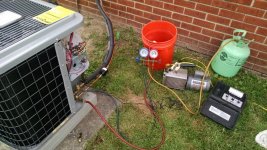
Buy yourself a good vacuum pump and change the oil often.
take some time and learn how to solder.

also when you have the line sets run and extending out thru the outside wall hook the suction line up first as it's the hardest to work with, you can cut the suction line and just slide the condenser up to it.

this is the last ac I did for a friend 4 years ago, we were just about to start it up and I looked at him and said "you know if this thing don't start were **** out of luck"
he bought the unit ten years ago and just never put it in lol

sorry for such a long post.
 

Attachments

  • IMG_20170707_174946391.jpg
    IMG_20170707_174946391.jpg
    155.9 KB · Views: 28

LS6 Tommy

Well-known member
Joined
Dec 27, 2013
Messages
26,162
Location
Northern NJ
Super heat is any sensible change in temperature of the refrigerant.

In a ideal world at the evaporator, as a example, liquid refrigerant entering with a 41 deg liquid temp should be leaving the evaporator as a 41 deg gas, no sensible change in temperature.
As the liquid travels thru the evaporator it is changing state to a gas and doing the one thing that makes the system work, it's absorbing heat without getting any warmer, once all the liquid is boiled away the refrigerant can't absorbed any more heat without getting warmer it self and from that point on you super heating the refrigerant .

It works the same way in the condenser only it enters as a gas and condenses back to a liquid giving up all the latent heat that it absorbed in the evaporator, once it has changed state back to a liquid, any additional cooling of the refrigerant from the condenser fan is sub cooling the refrigerant.

once you understand how the system works you'll be able to tell when something is not right.

couple of things to keep in mind your high side gas temperature needs to be above the outside ambient temperature for the unit to cool, something that's easy to check at start up, if it's the same or lower your under charged.

in the old days of the 6 seer units that was the way we set the charge 30-35 deg gas temperature above the ambient ie 80 deg day outside , add gas until the high side gas temp was about 110 deg.

after super heat came along in the 80's we set the charge by that , the gas temperatures ran only about 20-25 deg above ambient.
after you do a few hundred of residential units you kind of know where your at right after start up.


Superheat is an increase of refrigerant temperature above it's saturation temperature, not just any increase in sensible temperature.

Metering device type dictates whether you charge to supeheat or subcooling, it's not a one fits all approach. Been done that way LONG before the 80's. Superheat is used to charge fixed metering devices and subcooling for TXVs.

That being said, increasing subcooling will increase system capacity .5% for each 1°F of subcooling. That's how a bigger condenser and a larger refrigerant charge capcity incresases efficiency.

It's also advisable to rough charge comfort cooling to inside conditions (suction pressure) than outside conditions (condenser pressure). Set your superheat or subcooling after that.

All of that goes out the window with criticially charged systems (like mini splits) where the refrigerant is weighed in.

Tommy
 
Last edited:

mrobins297aaa

Well-known member
Joined
Sep 20, 2010
Messages
3,283
Location
south east michigan
Superheat is an increase of refrigerant temperature above it's saturation temperature, not just any increase in sensible temperature.

Metering device type dictates whether you charge to supeheat or subcooling, it's not a one fits all approach. Been done that way LONG before the 80's. Superheat is used to charge fixed metering devices and subcooling for TXVs.

That being said, increasing subcooling will increase system capacity .5% for each 1°F of subcooling. That's how a bigger condenser and a larger refrigerant charge capcity incresases efficiency.

It's also advisable to rough charge comfort cooling to inside conditions (suction pressure) than outside conditions (condenser pressure). Set your superheat or subcooling after that.

All of that goes out the window with criticially charged systems (like mini splits) where the refrigerant is weighed in.

Tommy

yeah I agree with that actually when I re-read the post the next day I knew that was incorrect and for what ever reason i didn't change it.

In regards to my post on superheat I did not mean it in the context of one size fits all or that it was just developed in the 80's what I meant was it was the first time that we started using it to set the charge, I guess i also should have stated that 99.9% of the units we were installing were using fixed metering devices not TXV. I guess I should have clarified that.

Also when your installing these units on a regular basis and your in and out of the wholesale house all the time talking with there people and manufacturers rep's you know what's going on and how other people are doing installs, I just remember with advent of the advertised seer ratings on these units the rep's were saying that the old way was out and from now on we should be using the superheat method for charging.

i stand by everything else I said in my original post, unless of course you'd like to argue about whether the suction line shouldn't be hooked up first...lol

sorry if I misled anyone but I was just trying to give a laymans description of how the system works.
 
Last edited:

mrobins297aaa

Well-known member
Joined
Sep 20, 2010
Messages
3,283
Location
south east michigan
I'll say it yet again. YOU CANNOT USE VACUUM TO LEAK CHECK. Run your lineset. Pressurize to 150 Psig with dry nitrogen. If it holds for 24 hours, break the nitrogen charge with whatever refrigerant your system uses. THEN pull your vacuum. Triple evacuate. Take it down to about 500 microns (or less), then blank it off and do a decay test. If the vacuum doesn't drop more than 300 microns above the starting measurement for an hour, you're good to charge the system.

Tommy

In a lot of ways the oldwizard is more correct on the way these systems are being installed in the field then you are.

I know what you posted is right out of the book, but nobody installing residential AC's is pressurizing these systems with nitrogen for 24 hrs on a 4 to 5 hr job. Heck these guys are out there installing these systems without even having a nitrogen tank on the truck and there brazing these joints.

here's fast forward on one of our installs: set the evaporator,run the lineset (with a hi side filter dryer) hook up the condenser,start the pump,shut the pump off after ten minutes to see if it holds, start the pump for another 45 minutes, hook up the 240v,condensate,low voltage, shut the pump off, wait ten minutes if it holds open the service valves and fill the system, start the system, run the system for at a hour to get close to design conditions inside, set the manufacturers superheat requirements........done, oh yeah get paid lol

leaks? what leaks? once the manufacturers did away with pre charged line sets and flared fittings we never had any leaks.
 

LS6 Tommy

Well-known member
Joined
Dec 27, 2013
Messages
26,162
Location
Northern NJ
In a lot of ways the oldwizard is more correct on the way these systems are being installed in the field then you are.

I know what you posted is right out of the book, but nobody installing residential AC's is pressurizing these systems with nitrogen for 24 hrs on a 4 to 5 hr job. Heck these guys are out there installing these systems without even having a nitrogen tank on the truck and there brazing these joints.

here's fast forward on one of our installs: set the evaporator,run the lineset (with a hi side filter dryer) hook up the condenser,start the pump,shut the pump off after ten minutes to see if it holds, start the pump for another 45 minutes, hook up the 240v,condensate,low voltage, shut the pump off, wait ten minutes if it holds open the service valves and fill the system, start the system, run the system for at a hour to get close to design conditions inside, set the manufacturers superheat requirements........done, oh yeah get paid lol

leaks? what leaks? once the manufacturers did away with pre charged line sets and flared fittings we never had any leaks.

Post deleted as my original response would just cause unnecessary friction.


Tommy
 
Last edited:

karoc

Well-known member
Joined
Dec 19, 2017
Messages
2,002
Location
Hemphill Tx
When I use to run roads neither myself nor other guys who work for other companys use nitrogen. Have to keep in mind that this is what AC guys do for living and its not a hobby. When you have about 10 calls in your hand and you are having to replace a condenser plus all your other calls using nitrogen just takes to much time. Using mirror you check your welds,then pull vacuum and wait few minutes see if it holds. Then shoot some gas in lines then check for leaks again with bubbles. Keep in mind that your talking about 5-10lbs of freon that is not much. Now if your working on commercial system yea your using nitrogen in the 125 lb cylinders cause your talking about systems that hold say from 100 lbs on up. So with that amount of freon your not talking about pocket change, leaving a leak could be costly.
 

LS6 Tommy

Well-known member
Joined
Dec 27, 2013
Messages
26,162
Location
Northern NJ
Tommy if I said something that upset you, I'm sorry that was not my intent

No, you didn't. Not at all. After I re-read what I posted I realized it might have been misinterpreted as me being unnecessarily harsh towards you, that's all. :thumbup:

Tommy
 
Last edited:
To avoid these ads, REGISTER NOW!
Top Bottom