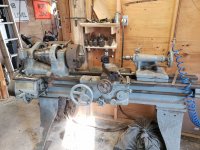
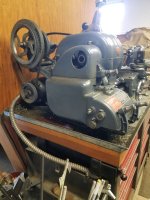
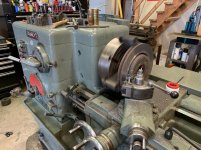
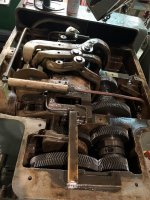
I got my Atlas QC42 (10" swing, 24" between centers, quick change gearbox) in 1983. It had been abused and the bed was sway-backed. Lead screw was totally worn out, as were many of the gears. Fortunately, the quick change gearbox was all serviceable, and the worn parts were still available from Clausing. I sent the bed to a grinding outfit in Portland, OR and they did a great job, taking almost no material off the sides, and much less than I expected off the top and bottom of the ways.
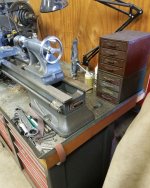
I took a Craftsman workbench and threw away the pressboard top. I took two pieces of plywood subfloor and glued them together. I trimmed the edges with thin fir strips, and had the local HVAC shop make a chip pan from 22 gauge galvanized sheet steel. We doubled the edges to provide strength and also to make a rounded edge. The seams were soldered to keep any oil from seeping through. I modified the bench to use adjustable feet so I could make up for any tilt or uneven area in the floor. I used a floor flange and a piece of 1/4" pipe to make a socket for the lamp to swivel.
I'm very happy with the result. I've been using it for 35+ years with no problems. I added the plywood back when I moved it behind a parked car. No chips make it over the plywood, and if I keep the drawers closed, I don't get any chips in them. The chip pan extends out enough to protect the drawer area.
Ball-bearing slides would be welcome on some of the drawers. I keep the spare chucks in one drawer, and it doesn't move easily. Some of the other drawers are also overloaded from tooling.
I put a 3/4 HP motor on it during the rebuild. I think this is a good size for the Atlas/Craftsman lathes with 3/8" thick ways. The availability of small carbide insert tooling with formed chip breakers has reduced the power needed to turn steel parts. This has reduced the temptation to up the power on this lathe. I have a later Atlas 12" model (one of the last made) with 1/2" thick ways, and it came with a 1 HP 3-phase motor from the factory, and I think that this is the maximum power for the design of the headstock and gear train.
The QC42 has come in handy for odd jobs lately. My son wanted to cut a spiral slot in a tube for a project, so we put together a gear train for 2 TPI. He turned the spindle by hand and laid out the spiral with a Sharpie. He then cut the groove with an abrasive wheel on a Dremel tool. Last month I shortened a couple of piston pins for a Briggs & Stratton engine by 1/8" by using a cut off wheel in a "poor man's tool post grinder." It is an air die grinder that I made a mount for that clamps it in an Aloris-style tool holder.
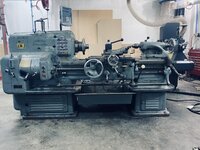
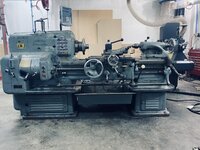
My Atlas 12" is used for larger projects and where the added horsepower is needed. The cross-slide feed graduations are much easier to read, as well.
I acquired a Clausing (Atlas-branded) 12x36 that is much heavier duty and has a 1-1/4" spindle bore (vs. the 3/4" bore of the older lathes), but it is on a poor bench that takes up too much space. I'll have to make a new stand for it before it gets used much. I'll post that one when it is ready to go.