To avoid these ads, REGISTER NOW!

Would You Trust a 40yr Old Tank After Hydrotest?

SynViks

Active member
Joined
Oct 20, 2020
Messages
25
Location
PDX
I'm currently having a horizontal 1980s Campbell Hausfeld 30 gallon tank pressure tested by a local fire extinguisher outfit. Tag says certified in 1980, working pressure specified as 165 psi, shell thickness is ~0.114 per my memory.

I've been able to look inside and saw a lot of large scale(?) chunks and general rust, and perhaps oil. Unsure. I washed the inside with simple green, then let it sit over night with evapo-rust which had some positive effect... hard to know how much scale is still stuck to the bottom.

The tech doing the test is going to test to double the stated working pressure on the tank for 30 seconds. He said if the tank yields at all during that time the pressure will drop and it'll fail the test.

The main question is: if this tank passes the test, should I use it? I'm unfortunately very limited space wise, and only have enough room for a 30 gallon. The compressor will likely live under the work bench, which means if it failed catastrophically it might take me out in the process.

There's always the possibility of paying a few hundred for a newer compressor and cannibalizing the tank (I would mount my SB703 with a 3hp motor), but money is tight and I only paid 40 dollars for the Hausfeld.

Any and all advice would be much appreciated. Thanks!
 
To avoid these ads, REGISTER NOW!

chevy302dz

Well-known member
Joined
Jan 12, 2005
Messages
953
Location
NE
If it passes without issue use it, that's the whole reason for having it professionally tested.
 

Kev442

Well-known member
Joined
Jan 15, 2009
Messages
5,386
Location
Wi
You can always lower the max pressure down for an extra margin of safety too. My oldest tank is set to 125 psi now.
 

foghorn1966

Well-known member
Joined
Aug 18, 2012
Messages
228
Location
N. Alberta
A new press safety valve & it will be good. Maybe feed a length of chain through one of the larger ports in the side (Piece of threaded rod to keep the end of the chain from falling in) for the trip home. Chain rattling will scour off the bigger rust scale. I've replaced lots of rusted out & cracked tanks in field facilities where I used to work. Only leaked didn't catastrophically fail.
 

Blue98GT

Well-known member
Joined
Mar 20, 2012
Messages
60
I wouldn't put one near where I work all the time. Besides the noise from it cycling, it seems like an unnecessary hazard.

 
OP
S

SynViks

Active member
Joined
Oct 20, 2020
Messages
25
Location
PDX
I guess my big concern is I won't know if the tank is pushed past its fatigue limit when tested. If it is, then it might be rendered more unsafe than before(?).
 

subroc

Well-known member
Joined
Apr 22, 2017
Messages
781
Location
Dover, NH
I guess my big concern is I won't know if the tank is pushed past its fatigue limit when tested. If it is, then it might be rendered more unsafe than before(?).

????

Then why test it?

If you don't trust the tank, you test it. If you don't trust the test, why test? Further, why spend money on the test if you are not going to trust the result?

I did want to add that you will know that. If the tank fails it is pushed past its fatigue limit. If it doesn't, it isn't. Double working pressure is a substantial risk factor and is more than sufficient for a home or shop compressor.
 
Last edited:

GeoBruin

Well-known member
Joined
May 5, 2018
Messages
3,746
I guess my big concern is I won't know if the tank is pushed past its fatigue limit when tested. If it is, then it might be rendered more unsafe than before(?).
A true hydrostatic test will specifically test to see if the tank permanently deforms when subjected to pressure. The tank will expand when under pressure, but if it contracts to its original volume when depressutized, it will have demonstrated that there is no plastic deformation.

This is different than a "pressure test" in which the vessel is simply pressurized to a point some factor beyond the rating on the tank and as long as the tank doesn't fail catastrophically, it it is said to "pass".

Beware rhe latter.
 
OP
S

SynViks

Active member
Joined
Oct 20, 2020
Messages
25
Location
PDX
Well the test is stupid cheap (only 35 dollars).

I'm inclined to trust the result. I'm not experienced with compressors, so was wondering if, given what I've outlined, it's wise to trust the proof test. Based on most of your input, it sounds reasonable.

Beware rhe latter.

Per my conversation with the person who'll conduct the test, it sounds like they'll pressurize it to test pressure and it must hold for 30 seconds. If it does, it passes the test. I'm assuming they can check for deformation during that testing interval (if pressure drops the inner volume has increased), but I don't think they have a way of checking to see if the tank returns to its original volume (for a tank this big anyway).
 
Last edited:

subroc

Well-known member
Joined
Apr 22, 2017
Messages
781
Location
Dover, NH
A true hydrostatic test will specifically test to see if the tank permanently deforms when subjected to pressure. The tank will expand when under pressure, but if it contracts to its original volume when depressutized, it will have demonstrated that there is no plastic deformation.

This is different than a "pressure test" in which the vessel is simply pressurized to a point some factor beyond the rating on the tank and as long as the tank doesn't fail catastrophically, it it is said to "pass".

Beware rhe latter.

What do you mean by this as it relates to testing a compressor tank?
 
To avoid these ads, REGISTER NOW!

mike93lx

ALLIANCE MEMBER
Joined
Dec 9, 2013
Messages
37,742
Location
Richmond, VA
It doesn't matter if we would all trust it.

If you can't get there, scrap it before spending the $35. Is it worth your peace of mind?
 

FTG-05

Well-known member
Joined
Oct 11, 2012
Messages
1,541
Location
TN
A true hydrostatic test will specifically test to see if the tank permanently deforms when subjected to pressure. The tank will expand when under pressure, but if it contracts to its original volume when depressutized, it will have demonstrated that there is no plastic deformation.

This is different than a "pressure test" in which the vessel is simply pressurized to a point some factor beyond the rating on the tank and as long as the tank doesn't fail catastrophically, it it is said to "pass".

Beware rhe latter.

The only way to do a true hydro test as you discuss in your first paragraph is to submerge the tank in a closed water tank, baseline the volume of the outer water tank, pressurize the test tank, then measure the after test volume. $10 says that's not what's happening here.

I used to hydro test high pressure tanks for a fire equipment company years ago (CO2, scuba tanks etc). The test wasn't about if the test tank would hold pressure (like is being discussed here) but measuring the ductility of the tank under test. If the tank doesn't return to specific % of it's original volume it failed and was condemned. We only hydro-tested high pressure tanks; low pressure tank (e.g. dry chemical fire ext. tanks) were simply pressure tested.

Of all the tanks I hydro tested (hundreds if not thousands) I can count on one hand the number that failed - usually AL scuba tanks. Sucked having to to tell someone that their $$$$ tank was now DOA. On the other hand, I was constantly amazed at how many 20's, 30's and 40's-era tanks passed successfully.
 

theoldwizard1

Well-known member
Joined
Feb 22, 2011
Messages
43,216
Location
SE MI
The only way to clean rust/scale out of a steel tank is add clean gravel or assorted nuts and bolts and roll it around for a couple of hours.
 

GeoBruin

Well-known member
Joined
May 5, 2018
Messages
3,746
In another thread someone cautioned against using evaporust because it would leave an oily residue which could get oil in the airlines. Not good for blasting/painting but probably not a problem if that's not what you plan to use it for.
 

mike93lx

ALLIANCE MEMBER
Joined
Dec 9, 2013
Messages
37,742
Location
Richmond, VA
In another thread someone cautioned against using evaporust because it would leave an oily residue which could get oil in the airlines. Not good for blasting/painting but probably not a problem if that's not what you plan to use it for.

Evaporust is water based. How would it leave an oily residue?
 

cedgo

Member
Joined
May 22, 2019
Messages
18
Location
backyard
As long as your relief valve is good, compressor tanks don't explode.
They just develop pin holes and leak.
 

Lassen Forge

Well-known member
Joined
Apr 26, 2014
Messages
15,312
Location
The romantic hills of central Umbria, Italy,
If they pass the hydrotest they're good to go - that's the purpose of the hydrotest, to make sure your tank is still safe and serviceable.

If you're really worried, get a flexible wand borescope,pull the fittings and look around inside, but that sign off and stamp saying your tank passed puts the hydrotester at liability if it grenades... they generally do NOT fake a hydrotest for that reason.

NOW - once it HAS been hydrotested, if you decide to descale the inside of the tank for whatever reason, then you will need to get it re-hydro'd, as you have removed material from the inside of the tank, changing the structural dimensions of the tank walls.

BTW - I am a certified aboveground tank inspector (one of my cool side jobs); one thing that I note is when you get corrosion deficits on the inside of a tank (using an ultrasound), there are calculations you do to assure the tank has the structural integrity to hold the load they were designed for. If not, the tank is repaired or condemned, similar to a pressure vessel... which is why you kind of don't want to just willy-nilly go abraiding the inside of your tank and assume all is still OK.
 

subroc

Well-known member
Joined
Apr 22, 2017
Messages
781
Location
Dover, NH
I have no clue as to the long term detrimental effect, if any, of some residual Evaporust being left behind.

That said, won't the hydro, by default, rinse the inside of the tank thereby removing any residual Evaporust that remains?
 

subroc

Well-known member
Joined
Apr 22, 2017
Messages
781
Location
Dover, NH
As long as your relief valve is good, compressor tanks don't explode.
They just develop pin holes and leak.

As a general matter, I agree with this. 2 things have to go wrong to over pressurize a compressor. The upper limit has to fail to shut the machine off and the relief valve has to fail. Clearly many have seen images of failed compressors floating around the internet. Who can argue with the visual evidence. But, rarely do we know the entire story or even if the description of events or how it happened is true.

The OP should take whatever cautions and risks he is comfortable with based on what he has in front of him and any information provided here and anywhere else he can get it. Don't let anyone talk you into something that seems less than safe or out of some caution you want to take. Everyone has their own risk tolerance.

Good luck
 
OP
S

SynViks

Active member
Joined
Oct 20, 2020
Messages
25
Location
PDX
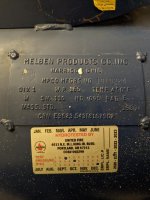
An update: got my tank back from the extinguisher company. It passed a 350psi pressure test, and they slapped a sticker on it. Remarked that it looked pretty good inside.

After that, I feel pretty comfortable using it.
 

Attachments

  • PXL_20210323_065254634.jpg
    PXL_20210323_065254634.jpg
    91.4 KB · Views: 29
To avoid these ads, REGISTER NOW!
Top Bottom