To avoid these ads, REGISTER NOW!

How did I blow fuse in multimeter?

reader2580

Well-known member
Joined
Dec 31, 2014
Messages
14,646
Location
Minneapolis, MN
I was using my multimeter to measure 24 volt DC when it quit reading. I took it apart and the fuse was blown.

Why would the fuse just blow when I didn’t short anything? Of course, I don’t have a 10 amp glass fuse.
 
To avoid these ads, REGISTER NOW!

dogdog

Well-known member
Joined
Nov 15, 2011
Messages
12,711
did you set it in AMP measuring mode, I have blown a few cheap HF meters when not paying attention, The lead actually went to flames in my case. But that was my fault...
 

American Locomotive

Well-known member
Joined
Jan 8, 2017
Messages
11,155
Location
Rhode Island
The fuse is only across the current range ports. A DMM will still read voltage/ohms even with a blown fuse. You had your DMM probes in the wrong ports and shorted your meter directly across your 24v.
 
OP
R

reader2580

Well-known member
Joined
Dec 31, 2014
Messages
14,646
Location
Minneapolis, MN
I hadn’t changed the position of the leads from when it was working to when it stopped. It definitely does not read voltage now. There are actually two fuses, but have no idea if second one is blown.

I will get a couple of new fuses tomorrow and hope it never happens again. I have used this multimeter for years without issue.
 
OP
R

reader2580

Well-known member
Joined
Dec 31, 2014
Messages
14,646
Location
Minneapolis, MN
A Green Lee digital multimeter I bought quite a few years back. I was using it and it started reading 0.00 on everything. I went to a known good 12 volt battery and nothing so I opened it up and the clear glass fuse is obviously blown.
 

Kaizen

Well-known member
Joined
Jan 9, 2015
Messages
6,949
Location
New England
A Green Lee digital multimeter I bought quite a few years back. I was using it and it started reading 0.00 on everything. I went to a known good 12 volt battery and nothing so I opened it up and the clear glass fuse is obviously blown.


Fuses wear out.


Sent from my iPhone using Tapatalk
 

Citation

Well-known member
Joined
Jan 20, 2016
Messages
3,268
Location
Indy
Can you post the meter model number?
In general a blown fuse only affects current measurement ranges. If your probes are in the correct jacks (gnd and DCV, not A or mA-some meters combine mA and DCV) it should measure voltage even if the fuses are bad.

Reality check, if you put the meter in ohms/continuity mode does it show open circuit/infinite resistance when the probes are apart and very low (say under 2 ohms) when you touch the others together? You might have damaged probe wires.
 
To avoid these ads, REGISTER NOW!
OP
R

reader2580

Well-known member
Joined
Dec 31, 2014
Messages
14,646
Location
Minneapolis, MN
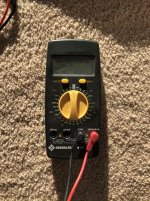
It is a Greenlee DM-60. I suspect I have a bigger issue after looking at things closer. The blown 10 amp fuse looks to be for amps only so that would not affect voltage. There is a .315 amp (315 ma) fuse also, but I have no way to know if that fuse is blown.

I have attached pictures including one of the leads attached. I may just have to buy a new multimeter.
 

Attachments

  • IMG_0172.jpg
    IMG_0172.jpg
    150.5 KB · Views: 48
  • IMG_0171.jpg
    IMG_0171.jpg
    150.1 KB · Views: 64
Last edited:

kaffine

Well-known member
Joined
Dec 13, 2009
Messages
3,610
Location
Henderson, NV
Looks like there is a bad solder joint on the metal jumper for the common lead.

If you put it on resistance/continuity and it shows open when the leads are shorted you can then take the red lead and touch the metal jumper if it starts reading that is likely your issue. If not you can use continuity function to see if you can find an open trace.
 

Citation

Well-known member
Joined
Jan 20, 2016
Messages
3,268
Location
Indy
It is a Greenlee DM-60. I suspect I have a bigger issue after looking at things closer. The blown 10 amp fuse looks to be for amps only so that would not affect voltage. There is a .315 amp (315 ma) fuse also, but I have no way to know if that fuse is blown.

I have attached pictures including one of the leads attached. I may just have to buy a new multimeter.

The small fuse is for the mA range only. I would suggest checking for bad continuity. It's possible the place where the jacks go into the circuit board are bad (you could hit them with a warm soldering iron just in case). I could also see it being a damaged probe wire. You could check that with some raw wire shoved into the jacks then check continuity again if it failed with the probe wires. If it's not the probe wires then it probably is the meter. Lot's of discussions on that topic.
 
OP
R

reader2580

Well-known member
Joined
Dec 31, 2014
Messages
14,646
Location
Minneapolis, MN
I think there is something fundamentally wrong with this multimeter. Continuity works, but no voltage even with a new fuse.

Now I am going probably to spend hours searching for a digital multimeter and trying to get one in the next day or two. I called Fluke and they had no idea on country of origin for their multimeters.
 
OP
R

reader2580

Well-known member
Joined
Dec 31, 2014
Messages
14,646
Location
Minneapolis, MN
I meant to say I am probably going to spend hours looking for a digital multimeter made in the USA. The "made in the USA" part is what will make the search take hours.
 

Citation

Well-known member
Joined
Jan 20, 2016
Messages
3,268
Location
Indy
I think there is something fundamentally wrong with this multimeter. Continuity works, but no voltage even with a new fuse.

Now I am going probably to spend hours searching for a digital multimeter and trying to get one in the next day or two. I called Fluke and they had no idea on country of origin for their multimeters.

I think with Fluke the 170 series and 80 series and higher are made in US. The 110 series and lower China.

If money is no object I love the Fluke 87.

If money is an object but you want something that is still really great, get a Brymen meter (Brymen is the OEM for most Greenlee stuff). In general I think the Brymens are every bit as good as Fluke except Brymen doesn't have Fluke's touch hold function (the 110 series Flukes also don't have it which is one of the reasons why I don't care for them). Touch hold it a great feature. It works like this, turn it on, touch your probes to what ever you are measuring. When the reading is stable the meter beeps. Remove your probes, read the screen. It basically lets you get a measurement without looking at the screen while fiddling with the probes. No idea why Brymen doesn't have that feature since Metrix and Agilent have offered it (with a different name due to trademarks).

Anyway, for a basic meter I really like the UniT UT210E clamp meter (must be the E model). It's a small, handy clamp meter that allows you to measure DC amps by clamping the meter around a wire. They are $40-50 on line. They aren't perfect. If you want to use the meter on the bench they are awkwardly shaped (it's a clamp meter after all). They don't have the ability to measure temperature with a temp probe.

The EEVBlog liked the AN8008 meters (lots of Chines brands) for around $30. Not a high end meter and the input protection is not acceptable for measuring things like the wires coming into your shop but if you are just doing automotive stuff it should be fine.

Most of what I have was deals off ebay. If you wait you might find something like an old Fluke 8025 or 27 (basically the same meter) for under $50. Those are old military/heavy industry meters. The one I have in the garage has a sticker that said the warranty expired when Bush was in office... H, not W. They are truly designed to last! They aren't fancy, they are about the size of a brick (not kidding). They have touch hold.
 

Citation

Well-known member
Joined
Jan 20, 2016
Messages
3,268
Location
Indy
I meant to say I am probably going to spend hours looking for a digital multimeter made in the USA. The "made in the USA" part is what will make the search take hours.

Nope, that part is easy... but expensive. Just buy a Fluke 170 series, 80 series, 27/28 series or an older 23/70 series that looks like a box. Fluke's less expensive stuff (not that any of it is cheap) is made in China. I think basically all other non-bench meters are made outside of the US.
 
To avoid these ads, REGISTER NOW!
Top Bottom