To avoid these ads, REGISTER NOW!

Improper AC wiring?

andyvh1959

Well-known member
Joined
Feb 15, 2020
Messages
2,621
Location
Green Bay WI
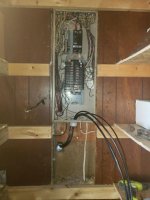
See the attached picture of my 1973 CH Load Center. Some time back someone installed Central Air, and the wires from the Load Center to the AC box exit the panel at the bottom right and go through the garage wall. I feel I need to rewire that for a couple reasons:
1. The wire is a 10/2-G, so the black AND the white both go to the 30amp duplex breaker, but the white wire is not re-colored red.
2. There is no neutral from the AC box to the neutral bus bar. Only a a ground wire to the ground bus bar.
3. The 10/2 wire is not properly stapled to the wall stud.

I assume an electrical inspector would make me correct these issues even though I never did them to begin with. The inspector is coming later this month to review and approve my new sub panel connection of this load center.

Oh, odd thing too. The Cutler Hammer panel has enough slots on the door for an additional six breakers. But, there is only enough power bus to allow for three additional breakers. Seems odd that the power bus is not long enough to allow for the additional breaker spaces. I also found two breakers in the panel, each with two blacks coming from the breaker. On one of them, a black wire is not sufficiently tight under the screw. There is one unused 15 amp breaker, so I'll wire a circuit to that. I can also add one more single breaker, in addition to the 100 amp duplex breaker going in for the sub panel, so I can add another 15 amp breaker. Then all the circuits in this messy looking panel will be wired to individual breakers.
 

Attachments

  • 1973 Load Center.JPG
    1973 Load Center.JPG
    64.9 KB · Views: 220
To avoid these ads, REGISTER NOW!

Bert_

Well-known member
Joined
Dec 24, 2016
Messages
9,915
Location
NW Iowa
Requiring the white to be re-identified is a fairly recent requirement.

There is an absolutely no need for a neutral to the AC not sure why you think they should have ran one.

It should be stapled but that's a fairly minor issue.

Why would the inspector make you change these things? He's there to inspect what you are installing not the whole house...
 

Norcal

Well-known member
Joined
Mar 16, 2008
Messages
13,792
Just to add to the previous comments the front of a panel can be used for more then one model of panel, it just can vary from type, make, & manufacturer.
 
OP
A

andyvh1959

Well-known member
Joined
Feb 15, 2020
Messages
2,621
Location
Green Bay WI
I just assumed any circuit needs a neutral. How is a 30amp duplex circuit to an AC compressor any different "neutral wise" than say a 15 amp outlet circuit?
 

Bert_

Well-known member
Joined
Dec 24, 2016
Messages
9,915
Location
NW Iowa
I just assumed any circuit needs a neutral. How is a 30amp duplex circuit to an AC compressor any different "neutral wise" than say a 15 amp outlet circuit?

You're 15 amp outlet is 120v. An AC condenser uses only 240v. So no need for a neutral.

Some things like a stove or dryer use both 120 and 240 that's why they need a neutral.
 

mrVanagon

Well-known member
Joined
Jul 21, 2015
Messages
108
Location
Belleville, IL, USA
Can't the wire color issue be resolved by wrapping a piece of electrical tape on the white wire every few inches or ever coloring it with a sharpie?
 

Norcal

Well-known member
Joined
Mar 16, 2008
Messages
13,792
Can't the wire color issue be resolved by wrapping a piece of electrical tape on the white wire every few inches or ever coloring it with a sharpie?

It was compliant when originally installed, but a Sharpie®, or taping it will work.


To the OP, why wasn't the conduit entry brought into into the back of the panel on the right side? Lots of room to do it, but what is on the back side of the wall is not shown. If that was possible to do it would make a much cleaner install, because as configured it's not going to be easy to do correctly, since a LB is not compliant, the only thing I can think of is a short section of 4X4, or 4X6, gutter "wireway", mounted vertically to bring the existing conduit into the back of the gutter, & ****** the other end into the bottom of the panel, but that has some bugs too.
 
OP
A

andyvh1959

Well-known member
Joined
Feb 15, 2020
Messages
2,621
Location
Green Bay WI
Thanks everyone. The only possible issue the inspector could have is the wire for the AC compressor isn't stapled to the wall outside of the panel. Even though it wasn't my work that did it that way, the inspector may ding me for it and make me correct it. I did find installation diagrams for an central air compressor wiring and it showed two load lines and a ground line, no neutral. So it's good that way.

Took a bit of work but now I have the sub panel cables fully in conduit from the sub panel all the way into the load center, so I'm good there. There were no knockouts on the back of the panel for me to come in that way, and outside of the garage wall the conduit comes up the wall not in position to line up with that corner of the load center.

I have to some wiring rerouting to do in the panel just to clean it up, and get rid of some doubled up neutrals on the bus bar, and two breakers that each feed two circuits. So when I straighten that all up I'll also color code the white wire to the 30 amp duplex breaker for the AC compressor.
 
OP
A

andyvh1959

Well-known member
Joined
Feb 15, 2020
Messages
2,621
Location
Green Bay WI
Ignorance, about the only way I can say it. I assumed a 220v circuit is always wired with a neutral, just like other circuits. Come to find that had I done a bit more research I'd have found its just an older style wiring system. Proof that us DIY types don't know it all, obviously. Which is why relying on brighter minds and experts on forums like this one, avoids mistakes made.

So that got me thinking, learning about the older standard versus the newer standard for something like a classic 3-prong 30 amp circuit:
https://www.how-to-wire-it.com/wire-a-dryer-outlet.html
where the difference now is a 4-prong 30 amp circuit:
https://www.how-to-wire-it.com/wire-a-dryer-cord.html

In my attached garage, about 18 years ago I had added a 3-prong 30 amp "dryer" outlet for my air compressor or MIG welder. The air compressor came with the older style 30 amp 3-prong plug, and the welder had the same style plug that my dad had wired up when he worked at Miller Electric back in the early 80s.

So this brings up yet more questions, in my new detached garage, I can wire the 30 amp outlets with the old style 3-prong. But should I wire the welder and air compressor with the newer style circuit which includes a neutral wire? If I do that, I'll also have to make sure the air compressor and welder both have a separate neutral and frame ground connection. No problem there, I can update the wiring for each when I move them to the new detached garage. Comes down to is one safer than the other and more to current code.
 
Last edited:
To avoid these ads, REGISTER NOW!

Bert_

Well-known member
Joined
Dec 24, 2016
Messages
9,915
Location
NW Iowa
Ignorance, about the only way I can say it. I assumed a 220v circuit is always wired with a neutral, just like other circuits. Proof that us DIY types don't know it all, obviously. Which is why relying on brighter minds and experts on forums like this one, saves another DIY ****.

Now that got me thinking, learning about the older standard versus the newer standard for something like a classic 3-prong 30 amp circuit:
https://www.how-to-wire-it.com/wire-a-dryer-outlet.html

In my attached garage, about 18 years ago I had added a 3-prong 30 amp "dryer" outlet for my air compressor and MIG welder. The air compressor came with the older style 30 amp 3-prong plug, and the welder had the same style plug that my dad had wired up when he worked at Miller Electric back in the early 80s. So this brings up another question, in my new detached garage, should I wire the welder and air compressor with the newer style circuit which includes a neutral wire?

That three prong 30 amp plug your referencing does have a neutral. What it doesn't have is a ground. Both the 10-30 and 10-50, dryer and range receptacles, have two hots and a neutral.

I'm not aware of anything other than a dryer that ever came with a 10-30. Welders used to come with 10-50's but that's really because it was the only 50 amp plug available at the time. Neither one is the right plug for anything in the shop.
 
OP
A

andyvh1959

Well-known member
Joined
Feb 15, 2020
Messages
2,621
Location
Green Bay WI
Well, my Millermatic35 MIG welder manual, from 1975, shows the welder wiring as the old three prong "dryer" style:
 

Attachments

  • Welder wiring.pdf
    95.3 KB · Views: 26

Norcal

Well-known member
Joined
Mar 16, 2008
Messages
13,792
Ignorance, about the only way I can say it. I assumed a 220v circuit is always wired with a neutral, just like other circuits. Come to find that had I done a bit more research I'd have found its just an older style wiring system. Proof that us DIY types don't know it all, obviously. Which is why relying on brighter minds and experts on forums like this one, avoids mistakes made.

So that got me thinking, learning about the older standard versus the newer standard for something like a classic 3-prong 30 amp circuit:
https://www.how-to-wire-it.com/wire-a-dryer-outlet.html
where the difference now is a 4-prong 30 amp circuit:
https://www.how-to-wire-it.com/wire-a-dryer-cord.html

In my attached garage, about 18 years ago I had added a 3-prong 30 amp "dryer" outlet for my air compressor or MIG welder. The air compressor came with the older style 30 amp 3-prong plug, and the welder had the same style plug that my dad had wired up when he worked at Miller Electric back in the early 80s.

So this brings up yet more questions, in my new detached garage, I can wire the 30 amp outlets with the old style 3-prong. But should I wire the welder and air compressor with the newer style circuit which includes a neutral wire? If I do that, I'll also have to make sure the air compressor and welder both have a separate neutral and frame ground connection. No problem there, I can update the wiring for each when I move them to the new detached garage. Comes down to is one safer than the other and more to current code.

In countries where 220V is used it is a line to neutral load, but in North America, 208V, or 240V, is a line to line load.
 

Innovate1

Well-known member
Joined
Jul 28, 2014
Messages
4,326
Location
Illinois near St. Louis, Missouri
Some breakers are rated for double wires. As I understand it they will be labeled for that. Some people seem to worry about it but I have never understood the concern - as long as both wires are tight it isn't going to cause a dangerous situation.

As for the door having more slots than the panel can fit breakers for it's likely the door is used for multiple models with different length bus bars.

You could have come in the back. There may not be a knockout so you may have had to use a hole saw but one like the feed wires would have worked. Bottom entry is ok - just more bends.
 

wyliesdiesels

Well-known member
Joined
Aug 14, 2012
Messages
20,253
Location
Modesto, CA
Well, my Millermatic35 MIG welder manual, from 1975, shows the welder wiring as the old three prong "dryer" style:

that is NOT a dryer plug (10-30p) it is a stove plug (10-50p) and is outdated. the NEMA 10 plugs do NOT have a ground pin. they are old

use a nema 6-50p and r
 

exranger06

Well-known member
Joined
Aug 9, 2015
Messages
1,686
Location
CT
240V circuits, whether they are "old style" or new, do NOT need a neutral wire. Period! Neutral wires are used for 120V circuits ONLY.

The reason electric stoves and clothes driers need a neutral is because they are NOT just 240V; they are 240V/120V. On a stove for example, the heating elements run on 240V. But other stuff, such as the light bulb inside the oven, and the clock and cooking timer, run on 120V. The neutral wire is there so it can power the stuff that runs on 120V.

On a clothes drier, same deal: heating element runs on 240V. The motor that spins the drum runs on 120V. It may have a light bulb inside and/or electronics that run on 120V. Hence the need for a neutral.

Any appliance that uses ONLY 240V (such as a compressor or welder) does NOT need a neutral wire! Even if you did run a neutral wire to them, there'd be no place to actually connect it to anything!
 
OP
A

andyvh1959

Well-known member
Joined
Feb 15, 2020
Messages
2,621
Location
Green Bay WI
Here is a picture of the cord for my Millermatic 35 welder, 1975 vintage. It is the original cord for the welder installed by Miller. Has worked with no issues since the 70's, here are the specs from the owners manual:

So in my new garage I'm thinking to upgrade the outlet for the welder to a style to use an adapter cord/plug and install the much later code 30 amp outlet instead of using the old style 30 amp outlet. Any reason not to use this style of outlet for this cord? Or should I use a different style better suited to a 30 amp?

https://www.amazon.com/dp/B08CXF3N2S/?tag=atomicindus08-20
 

Attachments

  • 20210511_141459[1].jpg
    20210511_141459[1].jpg
    77.4 KB · Views: 31
  • MM35 specs.JPG
    MM35 specs.JPG
    77.7 KB · Views: 15
Last edited:

Bert_

Well-known member
Joined
Dec 24, 2016
Messages
9,915
Location
NW Iowa
Here is a picture of the cord for my Millermatic 35 welder, 1975 vintage. It is the original cord for the welder installed by Miller. Has worked with no issues since the 70's, here are the specs from the owners manual:

So in my new garage I'm thinking to upgrade the outlet for the welder to a style to use an adapter cord/plug and install the much later code 30 amp outlet instead of using the old style 30 amp outlet. Any reason not to use this style of outlet for this cord? Or should I use a different style better suited to a 30 amp?

https://www.amazon.com/dp/B08CXF3N2S/?tag=atomicindus08-20

That's a 6-50. It's the current type 50A 240v plug. It is pretty much the standard welder plug.

That plug has never been allowed for a dryer.
 
OP
A

andyvh1959

Well-known member
Joined
Feb 15, 2020
Messages
2,621
Location
Green Bay WI
Thanks Bert. You beat me to it. I just moved this question to a separate post thinking I'd get more responses.

But your answer convinces me to wire in the current proper outlets in my detached garage and use the adapter cord to plug in my welder rather than wire in the old style outlet.
 

Bert_

Well-known member
Joined
Dec 24, 2016
Messages
9,915
Location
NW Iowa
Thanks Bert. You beat me to it. I just moved this question to a separate post thinking I'd get more responses.

But your answer convinces me to wire in the current proper outlets in my detached garage and use the adapter cord to plug in my welder rather than wire in the old style outlet.

What adapter are you talking about? Your picture shows a 6-50. That is the correct outlet still today. Most welders come with the same plug that you pictured
 
To avoid these ads, REGISTER NOW!
Top Bottom