To avoid these ads, REGISTER NOW!

Help understanding how much electrical capacity I have

Grogg

Active member
Joined
Mar 18, 2020
Messages
42
Location
Vienna, Ontario, Canada
Greetings Garage Journal!

I recently bought my first house/shop/property. Its so awesome I'm going to need the help of the internet's best collection of garage enthusiasts to fully utilize it!

First on the list is understanding my electrical layout a bit better. I have a 200A 347V 3 phase service that enters in the detatched shop building. My shop used to be a woodworking business that seems like it had a lot of 3 phase goodies. Here's a shot of the electrical room to give you an idea:

20210531_232736 - Copy.jpg

My house is a separate building to the north of the shop. All of the 240V/120V single phase power runs in a conduit buried underground that goes between the house basement and the shop electrical room. The power is provided by a 25 kVA isolation transformer (bottom one in the electrical room picture). Here's the data plate:

20210531_232715 - Copy.jpg

The shop's single phase 240V/120V is provided by the bottom 15 kVA transformer:
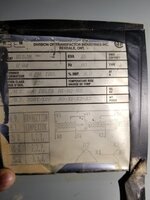
20210531_232656 - Copy.jpg

I tried a few calculators off of Google and ended up with numbers that didn't really make sense to me, so I appeal to the experts. How much single phase 240V capacity do I have?

Thanks in advance!
 
To avoid these ads, REGISTER NOW!

Lightning rod

Well-known member
Joined
Dec 1, 2012
Messages
283
Location
Toronto , Ontario
looks like you have
(1) 600v line to line 3ph coming into your shop (incoming power not known without further info)
(2) disconnect#1 feeds your house (Tx on the floor) with 25 KVA
it does this by using 600v L-L (two legs of the incoming power) and transformer them to 120/240v
that means your house breaker panel will have 100a double breaker as the main breaker

(3) the wall mounted transformer is a 15 KVA , 600VL-L from disconnect #2 transforming to 208Vl-l 3ph-
Y- connected.You can also get 120V line to neutral in this configuration. Can't tell what this feeds.

(4) the other disconnects seem to be connected to 600 V LL 3ph. is their any other Transformers in the shop
at the end of the 600V disconnects or to they directly connect to machines ?

I assume the Siemens panel is the main disconnect for the 600V bus (long thing under the the disconnects)
but don't know for sure without looking at the wires going in and out of your shop wall

what does the nameplate say on the Siemens panel ? nameplate on bottom left ?

hope this helps
 

walta

Well-known member
Joined
Jan 13, 2017
Messages
2,312
Location
Dutzow Missouri
The first question that comes to my mind, is the shop going to be a commercial enterprise or a hobby shop?

In most places commercial power is generally billed on a different price scheme that cost more. If you have a commercial space moving the home to a separate residential service could pay for itself over time.

If you will have a hobby shop it seems to my getting home insurance for a property with a “high voltage” service if they understood it was present.

Is there any 600 volt equipment currently installed or in your plans? If not you may want to consider having the service changed to a 208 3 phase.


Walta
 

TRWham

Well-known member
Joined
Aug 11, 2017
Messages
1,961
Location
East Cobb County, Georgia
...

Is there any 600 volt equipment currently installed or in your plans? If not you may want to consider having the service changed to a 208 3 phase.


Walta

Not really an issue given that the transformers are there to provide 240 split phase for the residence and 208/120 for the shop.
 

walta

Well-known member
Joined
Jan 13, 2017
Messages
2,312
Location
Dutzow Missouri
Not really an issue given that the transformers are there to provide 240 split phase for the residence and 208/120 for the shop.


I am not saying the current system is unsafe or unworkable just that to consider if it is a smart move to keep it at this point in time if he has no equipment that requires 600 Volts and is unlikely need 600 V in the future.

Consider that 600 volts could be seen as a liability in a residential property.

It is possible his insurance company could decide someday that a 600 volt electric service is an unacceptable risk on a residential policy.


Walta
 

TRWham

Well-known member
Joined
Aug 11, 2017
Messages
1,961
Location
East Cobb County, Georgia
Looks like he has 600 V service with customer owned transformers. There is no 600 V past the electrical room so working on the electrical system in the house or shop is no different than any other 240 or 208 V system.
 

mike93lx

ALLIANCE MEMBER
Joined
Dec 9, 2013
Messages
37,647
Location
Richmond, VA
Looks like he has 600 V service with customer owned transformers. There is no 600 V past the electrical room so working on the electrical system in the house or shop is no different than any other 240 or 208 V system.
It is still on the property and could pose an insurance risk, plus equipment in the electrical room might need work at some point.

I would still get rid of it. In an industrial setting, sure it makes sense. In a hobbies shop and residential setting, none at all, IMO
 
OP
G

Grogg

Active member
Joined
Mar 18, 2020
Messages
42
Location
Vienna, Ontario, Canada
Thank you everyone for the replies! I really appreciate it. I kept having to go back and grab more/different pictures as the questions came in!
looks like you have
(1) 600v line to line 3ph coming into your shop (incoming power not known without further info)
(2) disconnect#1 feeds your house (Tx on the floor) with 25 KVA
it does this by using 600v L-L (two legs of the incoming power) and transformer them to 120/240v
that means your house breaker panel will have 100a double breaker as the main breaker

(3) the wall mounted transformer is a 15 KVA , 600VL-L from disconnect #2 transforming to 208Vl-l 3ph-
Y- connected.You can also get 120V line to neutral in this configuration. Can't tell what this feeds.

(4) the other disconnects seem to be connected to 600 V LL 3ph. is their any other Transformers in the shop
at the end of the 600V disconnects or to they directly connect to machines ?

I assume the Siemens panel is the main disconnect for the 600V bus (long thing under the the disconnects)
but don't know for sure without looking at the wires going in and out of your shop wall

what does the nameplate say on the Siemens panel ? nameplate on bottom left ?

hope this helps
This was very helpful, thanks! To answer 3 - this transformer feeds the workshop + apartment attached to the workshop, and it seems to only be providing 240V (120V over neutral x2) 1ph. Here's a better shot of that transformer and the panel it connects to:
shop 240 1ph panel.jpg

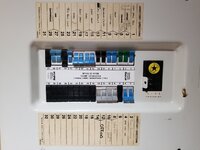
Here is a close up shot of the panel itself, I'm reasonably sure that this panel doesn't provide 208Y 3ph. I do not have any plugs anywhere in the shop that provide anything other than 240V or 120V 1ph.

shop 240 1ph panel close up.jpg

To answer 4 - those are almost all 600LL 3ph, one says its 480V. They all did connect to machines directly, but those machines were gone 3 owners ago:
shop 3 phase distribution.jpg

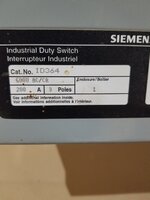
The Siemens panel is the main disconnect, nameplate here:
shop incoming main power disconnect.jpg

That gets fed from an underground cable which comes up via conduit, into that disconnect box. Then that disconnect goes to the electrical meter on the other corner of the wall, and the output of the meter goes via conduit into the 3ph bus bar:
shop outside meter.jpg

The small conduit to the right of the tall one is the output of the 25kVA transformer to the household 240V 1ph. You're correct again... it appears I have a 100 amp double breaker main panel in the house:

house panel close up primary.jpg

That also feeds a secondary panel, which has a 100A main breaker but is fed from a 40A breaker on the primary panel... that has to get changed:

house panel close up scondary.jpg

The first question that comes to my mind, is the shop going to be a commercial enterprise or a hobby shop?

In most places commercial power is generally billed on a different price scheme that cost more. If you have a commercial space moving the home to a separate residential service could pay for itself over time.

If you will have a hobby shop it seems to my getting home insurance for a property with a “high voltage” service if they understood it was present.

Is there any 600 volt equipment currently installed or in your plans? If not you may want to consider having the service changed to a 208 3 phase.


Walta

Thanks for your replies! This will be my hobby shop. Thankfully, my power is billed as residential becuase the intended use (i.e., whether or not they can tie your usage to a business tax #) matters for the delivery, not the phase/voltage.

I did tell my insurance about the electrical - there was no concerns on their side. If I make a change to my electrical panel without an electrician sign off... whether its the 3ph bus bar or a panel inside the house... its the same in their eyes. All work has to be done according to code.

There is a piece of 600LL equipment in my future - an air compressor, and I will likely install dust filtration/ventilation based on a 3ph motor in the future. My brother in law is an electrician, I have consulted him for guidance every step of the way before putting a multimeter on anything on the 3ph side.

You all need to take into account that the OP is in Canada!
They may or may not have the same Voltages as the US does.

It is apparently different than 600V 3ph in the US :)

its actually 600L

600 loonies

Haha - I'm sure that's what my power bill would be if I found a way to burn up more than 100A of my incoming service...
 

mike93lx

ALLIANCE MEMBER
Joined
Dec 9, 2013
Messages
37,647
Location
Richmond, VA
Having a 40a breaker feeding a panel with a 100a main is fine, at least in the US. It only needs to be changed if the 40a feed is not sufficient for the downstream needs
 
To avoid these ads, REGISTER NOW!

jeepxj

Well-known member
Joined
Mar 2, 2008
Messages
17,876
what do the transformers say on their plates? just cause the plate says 600v rating doesnt mean its 600v inside
 

Mr. T

Well-known member
Joined
Sep 4, 2013
Messages
636
Location
Central PA
whatever you do, get someone competent to work on that. 600V (and 480v) is not a DIY voltage...
So if you are competent, is it not still DIY? I mean, I’d do it myself.

All kidding aside, Wyliesdiesels is correct in his intent. If you’re asking this place, you probably shouldn’t be working on the 600V end of things yourself.

That being said, it’s a pretty cool setup if you’re into that type of thing. It’s also old. As in, “that stuff looks old.” Be careful and make sure that you know (not think that you know) what you’re doing when working on it. Sometimes older work might have some things that were “made to work” but aren’t proper.

As a final note: Congrats on being a home owner. One of the down sides of that is you have to pay to fix things. That’s an industrial voltage. Be prepared to pay industrial prices for your electrical work.
 

Lightning rod

Well-known member
Joined
Dec 1, 2012
Messages
283
Location
Toronto , Ontario
Hi Grogg

thanks for the extra pics

nice shop you have

so to answer your original question, what capacity do you have?

your total incoming power based on your Siemens panel nameplate is ;

for 3ph power ,P=(square root of 3)xVxA , therefore

P=1.73X200X600 = 207,846 va or 207.8 kVA

thats hefty for residential/hobby shop

congrats. good luck in your future hobbies
 

Bert_

Well-known member
Joined
Dec 24, 2016
Messages
9,753
Location
NW Iowa
Hi Grogg

thanks for the extra pics

nice shop you have

so to answer your original question, what capacity do you have?

your total incoming power based on your Siemens panel nameplate is ;

for 3ph power ,P=(square root of 3)xVxA , therefore

P=1.73X200X600 = 207,846 va or 207.8 kVA

thats hefty for residential/hobby shop

congrats. good luck in your future hobbies
That might be a little misleading. I mean the switch and the wire can do that much but I doubt the utility transformer would support that for a very long time. It would be interesting to know but I bet it's not over 75kva.

It's still a lot. 200A at 600v would be like 900A at 240v single phase.
 

Lightning rod

Well-known member
Joined
Dec 1, 2012
Messages
283
Location
Toronto , Ontario
Bert
yes, a possibility and yes it would be nice to check for sure

Grogg indicated his BIL is an Electrician. Hopefully he can confirm our assumptions based on nameplate data
 
OP
G

Grogg

Active member
Joined
Mar 18, 2020
Messages
42
Location
Vienna, Ontario, Canada
what do the transformers say on their plates? just cause the plate says 600v rating doesnt mean its 600v inside
Bert
yes, a possibility and yes it would be nice to check for sure

Grogg indicated his BIL is an Electrician. Hopefully he can confirm our assumptions based on nameplate data

Forgive my ignorance here - the sticker on the outside that I posted above is all of the info that is on the outside of the transformer. Would I find the nameplate data inside the transformer somewhere? I'm not going to pop the transformer panels off and put my tongue on the terminals to suss the voltage out :D But, there is a lot of sawdust still inside them from when the shop was used for woodworking. I did some digging on the manufacturer's website that suggested powering them down to clean dust out every so often. I could snap pictures if I do that.

All kidding aside, Wyliesdiesels is correct in his intent. If you’re asking this place, you probably shouldn’t be working on the 600V end of things yourself.

That being said, it’s a pretty cool setup if you’re into that type of thing. It’s also old. As in, “that stuff looks old.” Be careful and make sure that you know (not think that you know) what you’re doing when working on it. Sometimes older work might have some things that were “made to work” but aren’t proper.

As a final note: Congrats on being a home owner. One of the down sides of that is you have to pay to fix things. That’s an industrial voltage. Be prepared to pay industrial prices for your electrical work.
Thank you! :) I don't plan to work on the 600V side of things without consulting a professional. I have a friend in film and lighting who used to wire up 3ph tow motors and such, I've heard the horror stories and near misses. I want to keep my heart beat un-altered by high voltage discharge.

Hi Grogg

thanks for the extra pics

nice shop you have

so to answer your original question, what capacity do you have?

your total incoming power based on your Siemens panel nameplate is ;

for 3ph power ,P=(square root of 3)xVxA , therefore

P=1.73X200X600 = 207,846 va or 207.8 kVA

thats hefty for residential/hobby shop

congrats. good luck in your future hobbies
Thanks Lightning Rod, appreciate it :) If you ever take a drive to check out the beach at Port Burwell, I'm directly on the road in. Feel free to PM me if you want to check out the shop over a cold bevvy!

I think you have A LOT a of power available to you!
I figured - I wanted to quantify how much "A LOT" is :LOL:

I have nothing intelligent to say other than you have to keep the area in front of panels CLEAR.
That sounds like intelligent advice to me!

Once again, I really appreciate everyone's replies and advice!
 

jeepxj

Well-known member
Joined
Mar 2, 2008
Messages
17,876
you posted a nameplate of the disconnect switch not the transformer. im still not buying that you have 600v. show us the motor plates on the equipment connected to the "600v" disconnect.
 

Bert_

Well-known member
Joined
Dec 24, 2016
Messages
9,753
Location
NW Iowa
you posted a nameplate of the disconnect switch not the transformer. im still not buying that you have 600v. show us the motor plates on the equipment connected to the "600v" disconnect.
He already posted transformer nameplates that show 600v primary.
 

TRWham

Well-known member
Joined
Aug 11, 2017
Messages
1,961
Location
East Cobb County, Georgia
This seems to be a hybrid commercial/residential installation in Canada, so it is not at all surprising that he has 600 V service. I would guess the location is pretty rural.
 

couch67

Well-known member
Joined
Mar 18, 2016
Messages
1,404
Location
Ontario Canada
Welcome to the forum. While you are at it I would consider changing out those Federal Pioneer panels. The stab-lok breakers have a history of failing to trip when overloaded, causing bad things to happen. Did you get an inspection when you bought? I'd be surprised the inspector would not have mentioned this. I would at a minimum take the panel covers off and inspect the branch wires for any signs of previous overheating.
 
OP
G

Grogg

Active member
Joined
Mar 18, 2020
Messages
42
Location
Vienna, Ontario, Canada
Thanks for that couch67 - I did get an inspection and the inpector didn't mention them as an issue.

I did as you suggested and popped the panel off to check for any wires that looked hot in any way - nothing, all bare copper is still bright and all wire jacket inside the box is undistorted and original colour.

I had thought to perhaps replace them if breakers were hard to find but I haven't even looked into that yet.
 
To avoid these ads, REGISTER NOW!
Top Bottom