Hello all,
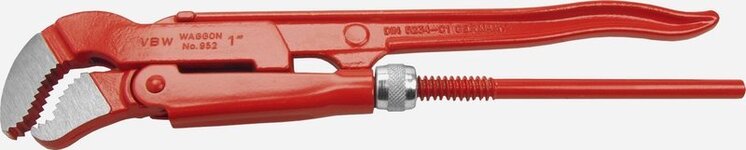
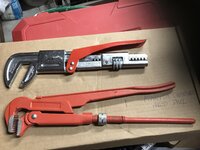
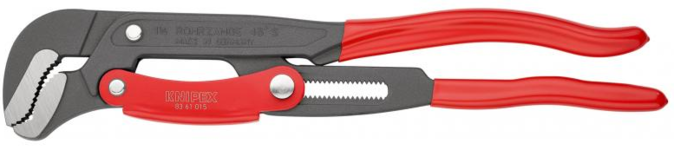
I'm intrigued by the so-called Swedish pipe wrench, which I've recently learned of (likely thanks to this forum!). I've noticed that it's commonly available with different jaws, but my search-engine-fu is struggling to turn up much practical info on the uses of each jaw. I suspect that this info may just be common knowledge in regions where the Swedish pipe wrench is commonplace, or perhaps readily apparent upon use. I'd appreciate if those with experience using them would share their insight.
So far, the best info I found is the German Wikipedia page ( https://translate.google.com/translate?sl=auto&tl=en&u=de.wikipedia.org/wiki/Rohrzange ). It seems to say there are essentially two characteristics: jaw angle & jaw form. The jaw angle is roughly either 90 or 45 degrees, the latter known as a corner pipe wrench. The jaw form is one of A, B, or C (seemingly defined in DIN 5234). Form A has two flat jaw faces, form B has one flat and one "v"-shaped face, and form C is "s" shaped (ignoring tooth profile in all cases). For examples of 90-degree form A, see here: https://www.knipex.com/products/pipe-wrenches-and-water-pump-pliers/pipe-wrenches-90 , and for examples of corner-angled form C, see here: https://www.knipex.com/products/pipe-wrenches-and-water-pump-pliers/pipe-wrenches-s-type .
1) Is the info / my understanding above accurate?
2) What is the purpose of DIN 5234? Does it specify anything more than jaw shape?
3) Why does it seem that a 90-degree model is only available in form A?
The German Wikipedia page seems to goes on to say that form A is for gripping parallel faces (e.g. a hex nut), form C is for gripping round objects (e.g. a pipe), and form B is for gripping both. Additionally, the 90-degree variant benefits from always having both jaws directly across from each other regardless of how large the gripped object is, which is not the case with the corner variant (even though the jaws remain parallel).
4) Is the info / my understanding above accurate?
5) Does a truly conscientious professional own all forms and use each for specific tasks? Does a specification or work order ever stipulate the use of a particular form?
6) In practice, are there situations where an angle+form combination performs noticeably better or worse than the alternatives?
7) If you could only have one angle+form combination, which would it be?
It appears to me that Snap-on, Knipex & Harbor Freight may have the most market share of Swedish pipe wrenches in the American market. I notice that Snap-on's PWZ is exclusively 90-degree form A (though the PWZ5 upper does look v-shaped, would it qualify as form B if there aren't teeth on both sides?). Harbor Freight's single offering is also 90-degree form A. However, Knipex offers the 90-degree form A, corner-angled form A, and corner-angled form C (s-type). Should one construe this local availability (absent form B, common 90-degree form A) as an implicit answer to some of the questions above?
If you were wondering, I am considering buying a Swedish pipe wrench. Nonetheless, I am still genuinely curious about the answers to all the above, and some of it will help me make a selection.
Thanks in advance.
I'm intrigued by the so-called Swedish pipe wrench, which I've recently learned of (likely thanks to this forum!). I've noticed that it's commonly available with different jaws, but my search-engine-fu is struggling to turn up much practical info on the uses of each jaw. I suspect that this info may just be common knowledge in regions where the Swedish pipe wrench is commonplace, or perhaps readily apparent upon use. I'd appreciate if those with experience using them would share their insight.
So far, the best info I found is the German Wikipedia page ( https://translate.google.com/translate?sl=auto&tl=en&u=de.wikipedia.org/wiki/Rohrzange ). It seems to say there are essentially two characteristics: jaw angle & jaw form. The jaw angle is roughly either 90 or 45 degrees, the latter known as a corner pipe wrench. The jaw form is one of A, B, or C (seemingly defined in DIN 5234). Form A has two flat jaw faces, form B has one flat and one "v"-shaped face, and form C is "s" shaped (ignoring tooth profile in all cases). For examples of 90-degree form A, see here: https://www.knipex.com/products/pipe-wrenches-and-water-pump-pliers/pipe-wrenches-90 , and for examples of corner-angled form C, see here: https://www.knipex.com/products/pipe-wrenches-and-water-pump-pliers/pipe-wrenches-s-type .
1) Is the info / my understanding above accurate?
2) What is the purpose of DIN 5234? Does it specify anything more than jaw shape?
3) Why does it seem that a 90-degree model is only available in form A?
The German Wikipedia page seems to goes on to say that form A is for gripping parallel faces (e.g. a hex nut), form C is for gripping round objects (e.g. a pipe), and form B is for gripping both. Additionally, the 90-degree variant benefits from always having both jaws directly across from each other regardless of how large the gripped object is, which is not the case with the corner variant (even though the jaws remain parallel).
4) Is the info / my understanding above accurate?
5) Does a truly conscientious professional own all forms and use each for specific tasks? Does a specification or work order ever stipulate the use of a particular form?
6) In practice, are there situations where an angle+form combination performs noticeably better or worse than the alternatives?
7) If you could only have one angle+form combination, which would it be?
It appears to me that Snap-on, Knipex & Harbor Freight may have the most market share of Swedish pipe wrenches in the American market. I notice that Snap-on's PWZ is exclusively 90-degree form A (though the PWZ5 upper does look v-shaped, would it qualify as form B if there aren't teeth on both sides?). Harbor Freight's single offering is also 90-degree form A. However, Knipex offers the 90-degree form A, corner-angled form A, and corner-angled form C (s-type). Should one construe this local availability (absent form B, common 90-degree form A) as an implicit answer to some of the questions above?
If you were wondering, I am considering buying a Swedish pipe wrench. Nonetheless, I am still genuinely curious about the answers to all the above, and some of it will help me make a selection.
Thanks in advance.