To avoid these ads, REGISTER NOW!

Reducing OD without a lathe?

drummerdimitri

Well-known member
Joined
May 31, 2012
Messages
257
Location
Beirut, Lebanon
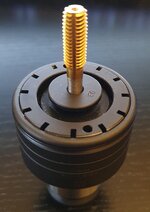
So I got myself some forming taps from the big rock candy mountain and unfortunately, a couple of them have ODs that are out of spec and would not fit in my tapping collet as they are both 6.25 mm in diameter when they should actually be 6 mm.

As I do not have a lathe, what would be the best way to go about reducing their shaft diameter with any kind of precision?

Was thinking of locking them in my drill's chuck and using low grit sand paper to get the job done but maybe there are better ways...

Keep in mind that the material is very hard (test at around 60 HRC).
 
To avoid these ads, REGISTER NOW!

Zewnten

Well-known member
Joined
Jun 11, 2017
Messages
1,841
Mount in a drill and grind on stationary grinder going slow, don't get them hot or dig in too hard and then polish up to whatever smoothness you want/need
 

Tools4Me

Well-known member
Joined
Jun 22, 2021
Messages
546
Clamp the drill into a bench vise somehow, so it stays secure and then use a metal sanding flap wheel on your angle grinder to sand the tap while it is being spun by the drill. Go slowly and maintain consistent light pressure and you should get a pretty decent result that will turn out way better than a bench grinder could ever accomplish. If you want a relatively nice final finish, use a 80 or finer grit flap wheel (or regular sand paper of a finer grit) partially wrapped around the tap shaft at the end to polish the surface up a bit.

As a side note, keep an eye on the temp of the tap when doing this. Sanding things down in this way will sometimes heat things up quite quickly. Don't be surprised if you need to take the tap out of the drill and dunk it in a little bit of water once or twice to keep the temp of the tap low enough so that you can always safely touch it with your bare fingers.
 

Tools4Me

Well-known member
Joined
Jun 22, 2021
Messages
546
taps wont be affected by sandpaper because they are hardened . sounds like they are 1/4" 6.25mm = 0.246 inches
They will sand down just fine. Most flap wheels and sandpaper use aluminum oxide based grit , and that's what most bench grinder wheels are also made out of. Many people regularly sharpen their HSS drill bits with their bench grinder without issue, so why would sanding down a HSS or carbon steel tap be any different?
 
  • Like
Reactions: Ign

Indexmill

Well-known member
Joined
Apr 12, 2013
Messages
1,414
Location
Central NC
I am pretty sure by putting the tap in a drill chuck & holding a pc of sandpaper to take off .25mm would be painstaking.
everyone is entitled to their opinion tho
Yea, really, Don't bother. It will just look like **** when you are done. Buy the right one.
 

Tools4Me

Well-known member
Joined
Jun 22, 2021
Messages
546
I am pretty sure by putting the tap in a drill chuck & holding a pc of sandpaper to take off .25mm would be painstaking.
everyone is entitled to their opinion tho
I'm not interested in arguing with you, I am responding for the other readers of this thread and the OP. It's not painstaking at all. 0.25mm in diameter is nothing. You are correct, it would be slower trying to do it with good quality bare sandpaper by hand and only the drill spinning (a couple minutes most likely), but it would only take about 20 seconds to a minute max with a flap wheel spinning in an angle grinder while the drill also spins (the much faster rpm of the angle grinder hitting the metal surface of the tap makes a huge difference). I grind hardened stell using this technique quite often. I never use my lathe for this sort of thing unless it's necessary.

If anyone reading this thread is still wondering if it works or not, just try it out for yourself. What do you have to lose?
 
To avoid these ads, REGISTER NOW!

The Cobbler

Super Moderator
Staff member
Joined
Oct 24, 2013
Messages
25,967
Location
Niagara Region, Ontario, Canada
nor am I arguing. I was replying to his post reference to gripping it in a chuck , use a low grit sandpaper to reduce the shank.
I read that as grasping the paper in hand and trying to take off .25 mm.
there's a big difference between that way & a flap wheel in an angle grinder
 

Tools4Me

Well-known member
Joined
Jun 22, 2021
Messages
546
nor am I arguing. I was replying to his post reference to gripping it in a chuck , use a low grit sandpaper to reduce the shank.
I read that as grasping the paper in hand and trying to take off .25 mm.
there's a big difference between that way & a flap wheel in an angle grinder
I understand now. The hand technique still works, but it would be slow. I thought you were originally implying the angle grinder technique I mentioned or any other sanding technique wouldn't work because "taps wouldn't be affected by sandpaper because they are hardened." That's how I read that. Flap wheels after all, are just layers of sandpaper arranged on top of each other.
 
OP
D

drummerdimitri

Well-known member
Joined
May 31, 2012
Messages
257
Location
Beirut, Lebanon
I will first try to have someone with a lathe do it for me and in case they want more than what the tap is worth, only then would I attempt some of the suggestions mentioned above. Most probably will me 3D printing a plastic nut to thread onto the forming side of the tap so that I can chuck it in my drill press safely and then use my dremel with a low grit sanding wheel to work my way up and down the base of the tap in an attempt to reduce it's OD as that seems to be the best option with the tools I have at my disposal.
 

Mechtech

Well-known member
Joined
Aug 13, 2011
Messages
236
Is calling the vendor and asking for correct replacements not an option? That would be my first step, second would be ordering the correct ones from a different vendor. Hand mods on taps never work very well of very long and I will only do it for an immediate one time use. (need it now emergency situation).
 

shawhite

Well-known member
Joined
May 28, 2014
Messages
1,519
Am I missing something here? Don’t thread forming taps need to centered in the equipment to not wobble while forming the threads. Either buy the right collet, have someone with a lathe turn it down or return the taps and get the correct size.
 

Forgottonia

Well-known member
Joined
Apr 20, 2021
Messages
808
Location
edge of Forgottonia
As I do not have a lathe, what would be the best way to go about reducing their shaft diameter with any kind of precision?

Was thinking of locking them in my drill's chuck and using low grit sand paper to get the job done but maybe there are better ways...

That might be the best way to evenly remove material evenly. Maybe use emery cloth instead of sand paper. Then again, you might not be able to wear away the hardened steel in your taps with just emery cloth or sand paper. Worth a try.
 

geartow

Well-known member
Joined
Apr 6, 2015
Messages
507
Location
ohio / pa border on I80
i am thinking the cheapest easiest way to do this ,is to purchase a larger tap driver . time is money and reducing the shank size on the taps so they are still squared is going to take time .
 
OP
D

drummerdimitri

Well-known member
Joined
May 31, 2012
Messages
257
Location
Beirut, Lebanon
So I decided to try and chuck the threaded end of the taps into my 4000 rpm cordless drill with a chuck with very low runout and used an angle grinder with a grinding disc to try to reduce the OD that way since I was only really able to remove 10 microns in about 15 minutes and at that rate, each tap would of taken 6 hours of work or so and to my surprise, after only about 5 minutes I was able to get the OD down to about 5.94 mm which ended up fitting into the tap-holder.

I wouldn't recommend doing this to tools that rely heavily on the concentricity of its shaft to get the job done as there was about a 0.2 mm delta between the thickest and thinnest parts of the tap's shaft after the job was done but since that doesn't affect the tap's performance and it worked flawlessly when I tried tapping a hole with it.

Just sharing this info in case someone else had a similar task to accomplish. Finish leave a lot to be desired but I couldn't care less as it gets the job done and that's all that matters!
 

Attachments

  • 20210701_194847.jpg
    20210701_194847.jpg
    331.6 KB · Views: 13
  • 20210701_195308.jpg
    20210701_195308.jpg
    225.8 KB · Views: 12

Tools4Me

Well-known member
Joined
Jun 22, 2021
Messages
546
For future reference, a flap wheel or flap disc would get you a much smoother and more even surface than you were able to achieve with a grinding disc. It's also a lot more forgiving, because flap wheels come in finer grits and they also have a natural give to them by design, so they work much better on spinning curved surfaces.

I'm glad it worked out for you, but be careful about doing it your way too often. The pretty rough looking surface of what I assume is a HSS tap will likely wear the grabbing surfaces inside your expensive collet noticeably faster than a smoother surface finish would.

For others reading this thread, I spent a couple minutes in the shop using a 600rpm drill press and an angle grinder with a 40 grit $1 flap disc to reduce the diameter of the left third of a spare hardened tool steel 0.486" diameter (~12.34mm) gauge pin I had laying around (see attached pic). It took less than a minute with the angle grinder to get the diameter reduced to 0.466" (~11.83mm), and then I kept the pin spinning and hit it with a small piece of 240 grit sandpaper for about 10 seconds and then hit it again with a piece of 400 grit sandpaper for about 10 seconds. That was it, and as you can see the reduced diameter of the left third is still nice and round with an almost equal smoothness to the original gauge pin's surface. I could have made it mirror smooth by continuing to sand it with smaller and smaller grit sandpaper, but there was no need for this type of a demonstration.100_9437.JPG
 
OP
D

drummerdimitri

Well-known member
Joined
May 31, 2012
Messages
257
Location
Beirut, Lebanon
For future reference, a flap wheel or flap disc would get you a much smoother and more even surface than you were able to achieve with a grinding disc. It's also a lot more forgiving, because flap wheels come in finer grits and they also have a natural give to them by design, so they work much better on spinning curved surfaces.

I'm glad it worked out for you, but be careful about doing it your way too often. The pretty rough looking surface of what I assume is a HSS tap will likely wear the grabbing surfaces inside your expensive collet noticeably faster than a smoother surface finish would.

For others reading this thread, I spent a couple minutes in the shop using a 600rpm drill press and an angle grinder with a 40 grit $1 flap disc to reduce the diameter of the left third of a spare hardened tool steel 0.486" diameter (~12.34mm) gauge pin I had laying around (see attached pic). It took less than a minute with the angle grinder to get the diameter reduced to 0.466" (~11.83mm), and then I kept the pin spinning and hit it with a small piece of 240 grit sandpaper for about 10 seconds and then hit it again with a piece of 400 grit sandpaper for about 10 seconds. That was it, and as you can see the reduced diameter of the left third is still nice and round with an almost equal smoothness to the original gauge pin's surface. I could have made it mirror smooth by continuing to sand it with smaller and smaller grit sandpaper, but there was no need for this type of a demonstration.100_9437.JPG

I'm sure a flap wheel would have done a better job for obvious reasons, however I didn't have any on hand so I just decided to piss with the **** I got.

Will definitely keep the flap wheel in mind for future jobs of similar nature thanks!
 
To avoid these ads, REGISTER NOW!
Top Bottom