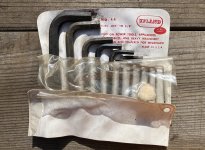
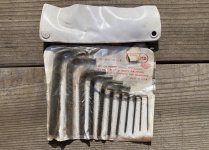
(first time I've seen this thread)
Me too!
looks like the most detailed information is in the comments on the "Progress is Fine" website (cited above.)
Agreed, including someone who purports himself to be the son and nephew of the founders.
The only thing I will add is that the name is kind of coincidentally and unintentionally self-referential to the nascent tool industry in the area - but centuries earlier. The town of Upland, near Chester, was settled by Swedish people (my wife grew up in Philly, but moved to nearby Tinicum, also settled by Swedish settlers, when she was 14), the name was derived from the Swedish area of Uppland, and it is from the place-name that the company derived its name.
But the term "upland forge" appears in many books on the history of charcoal forges, furnaces and hearths, in England and in the Mid-Atlantic States, especially Virginia, Maryland, and Pennsylvania, in the Colonial and Post-Revolutionary eras. Because half the labor and resources involved in making iron was concentrated first on making charcoal to fuel the forge, and the felling of trees for the source, hearths to burn the wood were notably located in upland areas. Rather than transport the trees or the charcoal, they co-located the forges. (Trees were felled in the winter, but not turned into charcoal until the summer, and the bushels produced and the duration of time it took to char a load of wood depended on the quality of the wood, the weather and the skill of the collier.) Because ironworks were such a primary concern for settlers, villages typically sprung up around them. There's a bog iron hearth very close to me called Allaire that has been preserved as a Living History display.
Anyway, sorry to drone on, it's just kind of interesting to me that Upland Forge has a sort of double meaning in this context. A modern company hot-forging tools with a name that suggests old-fashioned ironmaking.
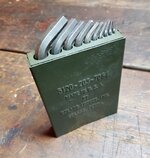
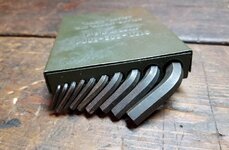
Oh, and I have this complete hex key set. FSN's with 11 digits date from 1953 to 1974.