To avoid these ads, REGISTER NOW!

Basement water :-(

Dh3256

Well-known member
Joined
Mar 19, 2018
Messages
1,139
Basement water during storms is common in my area, and a friend has this issue. I'm trying to help him decide how to address it.

He needs to put a cover on a window well that is filling up and reroute a downspout, but that will not completely solve his problem. He will need some kind of drain tile, french drain, etc. installed. There is at least one area where water is entering at the floor/wall joint, but most of the water is coming in through the concrete block basement wall.

I suggested a few options and am interested to hear if others have suggestions, comments, or experience with any of these:

1. Interior French Drain - too expensive for him to hire out, but he is willing to do the work. It's a LOT of work though. This is the approach he is considering.

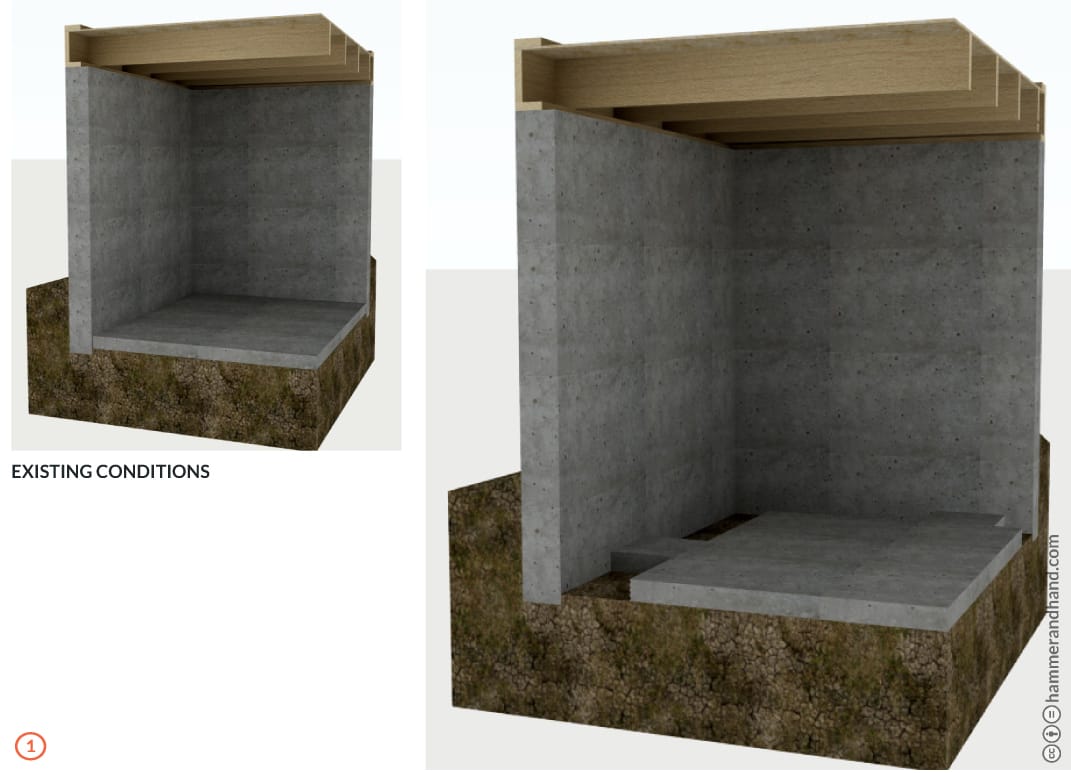
2. Above floor interior baseboard drain - basically it is like a baseboard molding that routes the water to a sump pump. Here is one option.

3. Use a concrete saw to cut a 2" v-groove around the room, connect the groove to the floor drain, and seal it with a plastic cover. Essentially a home made version of 2.

Thanks.
 
To avoid these ads, REGISTER NOW!
OP
D

Dh3256

Well-known member
Joined
Mar 19, 2018
Messages
1,139
If it's coming through the block wall I would think you need to address it from the outside, especially if in a area where frost damage could be an issue.
Unfortunately that is not a simple or easy solution in this case, there is a deck in that area that would have to be removed. That may be part of the issue, but we have verified that the ground under the deck is sloping away from the house.
 

Mike Folks

Well-known member
Joined
Feb 26, 2020
Messages
170
Location
Springfield Mo.
My late father fought a wet basement for years,until he thought "Enough".so he dug down around the concrete block wall of the house we had in Iowa, in the middle 50's to early 60's,and applied a tar like sealant,a lot of work,but the basement remained dry after all his work.
 

65ranchero

Well-known member
Joined
Dec 16, 2020
Messages
5,080
Location
Danville, VT left NJ forever
In my other house I had a lot of clay, the water would not be absorbed and after big rains it would seep (run into ) the basement through the very porous cinderblock walls. I stopped a lot of the seepage by coating it with UGL Dry lock It's expensive but it helped me a lot .
for the other walls of the basement I used some thing similar to this https://www.nationwidecoatings.com/pl/ultra-grip-dry-mix
by it in 5 gallon buckets add water and big stiff brushes, buy enough so you can have a painting party!
 

Pen & Wrench

Well-known member
Joined
Jan 12, 2015
Messages
658
Location
Huron, SD
If you can get the water to run away from the basement, that will help a lot. I always think a person should observe the water movement around a building during a heavy rain and observe where the water appears to be going. If it is just surface water, if you can get it to flow away from the house, that may help a lot, but if it is ground water coming up from below, then there may be quite a bit more to it.
 

firebirdparts

Well-known member
Joined
Jun 8, 2016
Messages
10,601
Location
Kingsport, TN
UGL is might easy compared to all the alternatives. FWIW. Plus it can't hurt. I had some guys come in and put on a rubberized basement paint one time, and that's done very well. I don't know what brand it was. But I don't really have a serious water problem.
 

GRivera

Well-known member
Joined
Mar 27, 2017
Messages
529
Location
20 mins south of Baltimore
Similar to what Mike Folks mentioned above - I had a leaky basement with the full size window well and adjacent block as the main source of problem. I manually excavated the area around window well 4' on each side and applied tar covered by a thick rubber membrane. It has been dry ever since going on 5 years now.
 

ptabatcher

Well-known member
Joined
Jun 26, 2021
Messages
181
Location
NE Ohio
Had something similar happen at my place. Lots of clay in the soil. During some particularly heavy rains, the water would pool into a window well and then eventually come into the house. The opposite side of the house developed a problem where the driveway met the house. A previous owner had the walls waterproofed on the inside about 4’ up the wall and dry lock on the rest. That part was fine.

Here was our line of attack:

  1. Re-grade the side of the house with the window-well issue. Basically created a swell/dry well. Will still get a lot of water but, it all stays away from the foundation on that side.
  2. Put a cover on the window wells to help divert some of the water.
  3. Put on oversized gutters. I have a colonial with a fairly steep room. Standard sized gutters were a joke. The oversized gutters helped.
  4. After all that, we still had some issues on the opposite side of the house. After getting quotes, discovered that the asphalt had pulled away from the house leaving a nice gap to for water to drain down. Plus, discovered that two of our 4 downspouts tied into the footer drains. Ended up having a company come in a cut out part of the driveway and excavate down to the footer. They replaced the drain tile (installed incorrectly in the 40’s but, not clogged), repaired some cracks in the wall and applied new waterproofing. While they were at it, I had them add exterior insulation and dimpled drain boards. The new tile fed into an exterior sump pump that they added.
After all that, no more problems. Basically what APEowner said. Steps 1-3 were cheap. I did all the work and we hired out the gutters. The basement wall… that was something that I would not have wanted to do myself. I didn’t want to rent an excavator and feel that there is some stuff in life I’d rather throw money at. It wasn’t cheap but, has solved our problem.

A neighbor of ours had a similar issue. The did the inside channels and had someone run a ton of PVC to redirect one of their downspouts under their deck and to the opposite side of the house.
 

DGersic

Well-known member
Joined
Mar 12, 2017
Messages
6,297
Location
DeKalb, IL
Basement water during storms is common in my area, and a friend has this issue. I'm trying to help him decide how to address it.

He needs to put a cover on a window well that is filling up and reroute a downspout, but that will not completely solve his problem. He will need some kind of drain tile, french drain, etc. installed. There is at least one area where water is entering at the floor/wall joint, but most of the water is coming in through the concrete block basement wall.

I suggested a few options and am interested to hear if others have suggestions, comments, or experience with any of these:

1. Interior French Drain - too expensive for him to hire out, but he is willing to do the work. It's a LOT of work though. This is the approach he is considering.

2. Above floor interior baseboard drain - basically it is like a baseboard molding that routes the water to a sump pump. Here is one option.

3. Use a concrete saw to cut a 2" v-groove around the room, connect the groove to the floor drain, and seal it with a plastic cover. Essentially a home made version of 2.

Thanks.

How old is the house? What’s there for drainage now?

I’m wondering if what’s there now is working, or has failed and should be repaired or replaced. How was it designed to work originally?

My house (1940s) had interior drain tile around the perimeter, connected to the sanitary sewer out to the city. When the sewer failed, I had it sleeved, which worked great but plugged off the drain tile connection. The next big rain, I had basement flooding.

The key to basement flooding is getting the water to go somewhere else. Preferably from outside or below, not in the basement.

In my case, the solution was a sump pump installed in the floor, connected to the drain tile. Then digging up the driveway to route 4” PVC in to the strip between the sidewalk and street. From there, a directional boring company ran 4” pipe under two neighbors yards to the nearest storm sewer. $20K later, no more wet basement in the rain.

A friend had no tile under his basement. He hired out having it installed. They cut the floor 12” from the wall, burried tile, installed a sump pit and pumps, and ejected it out to the end of his property. That, and routing the gutters to 4” PVC out to the end of the property, solved his problems.
 

Bretny

Well-known member
Joined
Jul 31, 2017
Messages
3,918
Location
Dutchess county NY
Unfortunately that is not a simple or easy solution in this case, there is a deck in that area that would have to be removed. That may be part of the issue, but we have verified that the ground under the deck is sloping away from the house.
There is no simple solution to this. Like Wrench97 said. Dig from the outside. Then dimple board and drains to daylight.

Water coming in through a block wall usualy means it's in the block. Block that's always wet will crumble..then your left replacing the foundation...then doing proper drainage.

I had a friend who noticed a crack horizontally in his basement wall but had a "beDry" sump system where they collect the water inside the building then pump it out. Turns out his foundation was crumbling. He spent about 40k fixing it and doing drainage. He also had a deck that needed to be removed.
 
OP
D

Dh3256

Well-known member
Joined
Mar 19, 2018
Messages
1,139
How old is the house? What’s there for drainage now?

I’m wondering if what’s there now is working, or has failed and should be repaired or replaced. How was it designed to work originally?

My house (1940s) had interior drain tile around the perimeter, connected to the sanitary sewer out to the city. When the sewer failed, I had it sleeved, which worked great but plugged off the drain tile connection. The next big rain, I had basement flooding.

The key to basement flooding is getting the water to go somewhere else. Preferably from outside or below, not in the basement.

In my case, the solution was a sump pump installed in the floor, connected to the drain tile. Then digging up the driveway to route 4” PVC in to the strip between the sidewalk and street. From there, a directional boring company ran 4” pipe under two neighbors yards to the nearest storm sewer. $20K later, no more wet basement in the rain.

A friend had no tile under his basement. He hired out having it installed. They cut the floor 12” from the wall, burried tile, installed a sump pit and pumps, and ejected it out to the end of his property. That, and routing the gutters to 4” PVC out to the end of the property, solved his problems.

House was built in the 1950's and it appears the kitchen was expanded to a larger footprint with a slab on footer addition over the prior kitchen bumpout.

There is a plastic drain pipe for that downspout, but when I connected it the problem got worse, so I am assuming the tile is broken or something like that. I suspect the addition disrupted whatever original drainage plan was in place.

I also think it may need more downspouts, there are only two on the back of the house, in the middle and at one end. I think I should add a downspout at the other end.

I am planning to route the downspout through pipe to empty downhill of the house. While starting this work yesterday I also noted there is a "hump" in the dirt under the deck, so I will pull a few deck boards and flatten that out to promote positive drainage.

I am also planning to slide plastic corrugated roofing panels under the deck by the house to cover the window well and divert water coming through the deck away from the house.

There is no simple solution to this. Like Wrench97 said. Dig from the outside. Then dimple board and drains to daylight.

Water coming in through a block wall usualy means it's in the block. Block that's always wet will crumble..then your left replacing the foundation...then doing proper drainage.

I had a friend who noticed a crack horizontally in his basement wall but had a "beDry" sump system where they collect the water inside the building then pump it out. Turns out his foundation was crumbling. He spent about 40k fixing it and doing drainage. He also had a deck that needed to be removed.
Oh, that doesn't sound good. Did not know concrete block would crumble when wet, always heard concrete is unaffected by water.

At this point I think the primary entry point is the window well, though in one area it appears to be seeping in the floor joint. When I drilled a test hole in the block in the wettest area, I did not get any water out, so I am hopeful it is not coming through the block.

Will try the downspout pipe, regrading, and adding a downspout first to see if that resolves the issues. Fortunately (?) we have been having unusually heavy storms for weeks, so I should be able to test it pretty soon :-(
 
OP
D

Dh3256

Well-known member
Joined
Mar 19, 2018
Messages
1,139
I found the source of the problem! The downspout on the end of the house was connected to a buried PVC pipe. After fixing the issues in the corner I was still getting water in, and it seemed to be coming in under the window well. I disconnected the end downspout and temporarily routed it into the yard, and that stopped the flooding in the basement, even during the hurricane this past week. I suspect that pipe was routed into the corner and had cracked, broken or separated.

Still a little trickle of water in a different nearby area, but it is below a wall with a window that is not flashed properly. I expect reflashing that window will fix that.
 

mikedodge

Well-known member
Joined
Jun 27, 2017
Messages
2,777
If the water is coming thru the wall there's a crack. If you don't fix it right from the outside it'll cause more damage.
 
OP
D

Dh3256

Well-known member
Joined
Mar 19, 2018
Messages
1,139
If the water is coming thru the wall there's a crack. If you don't fix it right from the outside it'll cause more damage.
It's seeping at the floor joint where the concrete block wall meets the concrete floor. This area is inset from a kitchen addition built over it, so there is a concrete slab above it that extends 5' or so beyond this wall. My guess is that water is getting in the incorrectly flashed window and seeping out the wall. I'll flash that window and watch it, there could be some other cause.
 

NothingNew

Member
Joined
Sep 15, 2021
Messages
19
8 tons of material moved and I have a dry basement (one that's located on a slope - in rainy Portland, Oregon).

I rebuilt the exterior French Drain; still wet. I then built an interior French Drain, following the steps outlined in the link. Now it's dry.

Lots of work, but a dry basement is gold.


SarcasticDwarf

Well-known member
Joined
Dec 30, 2009
Messages
236
Location
North Dakota
8 tons of material moved and I have a dry basement (one that's located on a slope - in rainy Portland, Oregon).

I rebuilt the exterior French Drain; still wet. I then built an interior French Drain, following the steps outlined in the link. Now it's dry.

If an exterior drain is installed and the basement walls are waterproofed...then where was the water coming from?
 
To avoid these ads, REGISTER NOW!

kelpaso1

MEMBER EMERITUS
Joined
Sep 28, 2009
Messages
3,962
Location
New Brunswick
Sounds like crappy engineering and design to put a house with a basement in that location. I now live in a house that is on a slab and no basement. Much better and warmer in the winter since I'm not heating basement walls and space.
 

NothingNew

Member
Joined
Sep 15, 2021
Messages
19
Maybe, but now I've got 400sqft of finished, dry storage, with plans to add a workshop on the other side of the basement.

I think I'm happy ;)
 

BombShelter

Well-known member
Joined
Nov 16, 2015
Messages
543
Location
State of Hockey
Do not buy a cove system for residential applications, this is best for areas where the floor is structural, like a parking ramp or elevator pit. The system has many flaws, one, it's flat, with no slope it cannot drain fully and it gets stinky, like wet, stinky dirt. They tend to be mold factories, which also smells and can be dangerous. It is usually screwed to the wall and the joints and holes connecting to the blocks are caulked, these will fail after a few years and need to be redone, hopefully you haven't covered it all with drywall.

The window well needs to be refreshed, spacing at the bottom, the sides caulked up, and it should extend a minimum of 12" past the bottom of the window so water does goes down and back up. Cover's rarely help, most homes have an overhang and this area next to the house doesn't get direct rain fall but sometimes they do.

Downspouts should be the larger 3" x 5" to keep up with the flow and not clog with leaves and seeds, the bottom elbow should be over 1.5' above grade to keep from freezing and also not slow down the flow. I'd have a long extension on it with the window so close.

Do not follow the instruction on Hammer & Hand, this is a recipe for a lot of bad things. A poured wall foundation should already have a drain tile system but even if it does, they are only good for water moving up, which tends to be rare, most water comes from the surface and if a poured wall has any cracks or the metal tie-rods rust, you’ll have water coming in from above floor level (that’s why drain-tile is not effective).

Dimple board, or any other plastic coverings used to divert water should never be used inside a home, this will turn into a mold factory, a really big one, the water issues should be solved not diverted like this. Most of the companies that did a lot of this in the 80’s are long gone.

Water is seen at the bottom because it’s the path of least resistance, poured walls have cold joints, usually without gasketing, and block walls fill up with water internally, it eventually pushes out through the bottom. Sometimes it moves through above-floor cracks and holes but not as much as through the floor/wall cove.

It would help to know what state you’re in, up here I’d use 6” dia minimum solid PVC drain pipe for the underground drain, anything smaller freezes in the fall and spring when you need it the most.
 
OP
D

Dh3256

Well-known member
Joined
Mar 19, 2018
Messages
1,139
It would help to know what state you’re in, up here I’d use 6” dia minimum solid PVC drain pipe for the underground drain, anything smaller freezes in the fall and spring when you need it the most.
The house is in Western Pennsylvania.

Rerouting the second downspout fixed most of the issue, but he is still getting some seepage at the bottom of the wall under the window well and an adjacent higher floor room off the basement. Dealing with the window did not seem to affect that. The foundation is concrete block.

We would appreciate any suggestions, an interior drain tile seems like a lot of work for what is now more seepage that water infiltration.
 

reader2580

Well-known member
Joined
Dec 31, 2014
Messages
14,516
Location
Minneapolis, MN
My parent's house had major basement water issues when they bought it. It had an interior drain tile. My father added an exterior drain tile and that solved all the water problems for the past 40 years.
 

Crabman

Well-known member
Joined
Dec 17, 2017
Messages
3,836
Location
Alexandria, VA/Dameron, MD
Our son and his wife had water in the basement and garage both. My first move is always to look hard at the gutters.

They had the small builder grade ones with the 2 x 3 downspouts, and they were not well laid out to get the water to the downhill side of the house. They had the 6 inch gutters with 3 x 4 downspouts installed and got all the downspouts on the correct side of the house. No more water in the garage or basement. No digging, etc.

Our daughter had a detached block garage that got wet. She calls me. I am like this is easy to see why. The garage was built into a hill sloping toward the front. Some ***** had installed the downspouts in the back on the uphill side so all the water could go right up against the side walls. Simple fix.

If you can direct the water away from the foundation, it should solve the problem, unless, as mentioned, it is a water table problem and it is coming up from below. Hard to judge that without knowing your approximate location. Our house in Maryland is on a creek which empties into the Chesapeake Bay (big creek, one of my neighbors lands his float plane on it) and the water table is very high so we have a sump pit with a pump in the crawl space which is pumping almost all the time.

Good luck solving this vexing problem.

Bruce
 

mikedodge

Well-known member
Joined
Jun 27, 2017
Messages
2,777
It still sounds like you've got a cracked foundation and that's where the water is coming from. You're keeping the inside dry but if a crack is the problem without fixing it it'll cause more foundation problems.
 

mcbooya

Member
Joined
Aug 27, 2020
Messages
6
Location
North Dakota
I did a DIY interior drain in my basement last year, it was a LOT of work but finally solved my issue. My main problem was hydrostatic pressure, not grading or downspouts, as my ground water level gets high enough it will then force through tiny cracks in the floor as well as the base of the poured walls. I have a 1960s concrete floor, clay soil, had exterior sump pump but that only protected about a 10-20' area due to the clay soil conditions not draining well. A neighbor had a crew out to keep adding exterior sump pumps where water would come in, and hes at 4 sump pits now. I would not do interior drain by myself again, I would hire some laborers to do the breaking and hauling out to get it done quicker and save my back, or maybe ask some concrete crews to do it in winter when they are slow, and set the pipe and sump pit myself. It was definitely a multi-weekend task.

I do have co-workers that have done the glue on baseboard drain channel, and that has worked for them for 20 years or so. It is completely sealed so no smell. But that would not work in my basement as I had water come in from all over, not just the bottom wall joint. Having the interior drain set alongside the footings / underneath the slab level has worked to keep the water level below the slab level.
 

Blue

Well-known member
Joined
Dec 15, 2005
Messages
1,115
Location
Northern Illinois
Good thread.

Others have already mentioned some of this, but to add:

- Walking around the house when there is a big rain is helpful. Any issues with the gutters or drainage should become more evident then. I had a downspout that was clogged with tons of leaves and debris. Didn't realize it until I saw all the water spilling over the top at that section of the gutter.

- Be suspect of any kind of buried pipe. Was helping some family members with their new house, and some of the drainage was routed to a pretty elaborate set of buried pipe. Pulled some of it up, and it was plugged with mud. It was the perforated kind, but no "sock" on the outside of it. I'm sure it probably worked for several years for the previous owner, but it had long since plugged up.
 
OP
D

Dh3256

Well-known member
Joined
Mar 19, 2018
Messages
1,139
It still sounds like you've got a cracked foundation and that's where the water is coming from. You're keeping the inside dry but if a crack is the problem without fixing it it'll cause more foundation problems.
Fortunately there are not any foundation cracks. After fixing the second downspout, most of the water is gone but a little is still coming in under the window well.
 
OP
D

Dh3256

Well-known member
Joined
Mar 19, 2018
Messages
1,139
Block that's always wet will crumble.
I'm curious what led to that conclusion, everything I have been able to find says concrete cures with water and is fine underwater. They have historically used concrete block for bridge piers in this area and they are constantly wet.

Please share more about where you have seen concrete block crumble.
 

round_corner

New member
Joined
Sep 20, 2021
Messages
1
Can I know the age of your house? Without knowing the source of water coming from, you will not be able to repair it. :)
 
Last edited:

jkuro

Well-known member
Joined
Apr 28, 2009
Messages
552
Put a drain in the window well . Tie it into the gutter or footer drain line
 
OP
D

Dh3256

Well-known member
Joined
Mar 19, 2018
Messages
1,139
Can I know the age of your house? Without knowing the source of water coming from, you will not be able to repair it.

We think his home was built in the 1950's

Put a drain in the window well . Tie it into the gutter or footer drain line

Good idea, but difficult to implement. With the deck in the way there is no good way to bury a pipe from the window well.

That window is under the deck so doesn't function well as a window. Considering replacing the glass block window with regular concrete block and filling in the window well.
 

BombShelter

Well-known member
Joined
Nov 16, 2015
Messages
543
Location
State of Hockey
Don't put a drain in your window-well, make sure the surround is properly attached to the wall with concrete screws or other mechanical attachments. Have 6" of space between the bottom of the window and the rocks, caulk the sides up. It's very rare to have water get into window wells unless they are not properly installed or maintained. Having a concentrated water flow like a downspout near them also needs to be addressed instead of digging to a footing system that may or most likey, not working.

Most homes before the 80's were built on nice, dry land with the water table 15'+ below the basement floor. A local pond or lake might help with an approximation. If you think you have a hydrostatic problem (water pressure from below), drill a hole through your basement floor and see, 95 times out of 100 you'll hit dry dirt. Most issues are from grade level moving down.
 

Firebrick43

Well-known member
Joined
May 12, 2015
Messages
14,024
Location
West central Indiana
Oh, that doesn't sound good. Did not know concrete block would crumble when wet, always heard concrete is unaffected by water.
Concrete block doesn't crumble just because its wet That particular poster is in NY. If the block is wet enough(interior cells filled with water) and the wall is either uninsulated or insulated on the inside, then the water in the cells will freeze, the water will expand, and it will bust the cells out.
 

Jackfre

Well-known member
Joined
Dec 26, 2010
Messages
4,410
Location
N CA
My basement in my MA home had water issues. When buying the place, as it had a walk out basement and was on a pretty slopped lot so I never gave water a thought. Big mistake! My walkout basement would hold 5” of water, Like you I was unable to dig up the front of the yard, but did rent a backhoe and put a foundation drain on the uphill side which ran to surface. I did paint the walls with the UGL paint. It made a big difference in comfort and lighting in the basement. I also had a wonky footing to slab joint on the front of the house, the deep section, so the floor and foundation joint showed in the deep corner. that is where the seepage originated. I took a little roto hammer to the bottom of the wall and ahipped away until I got to good concrete. I used the UGL plug material and filled the voids. A little here and a little there and before you know it you are so pissed off and exhausted that you settle for a tiny wet spot. the only satisfaction I got out of this was one day in a coffee shop a table full of old timers were sitting and my acquaintance at the table introduced me to the builder of my house. The builder immediately launched into a detailed description of the quality of my house. You know the old saw about giving them enough rope? Well ,I started at the foundation and by the time I got to the first floor he had enough and left. Not a lot of satisfaction, but i enjoyed it. So did his pals.
 
To avoid these ads, REGISTER NOW!
Top Bottom