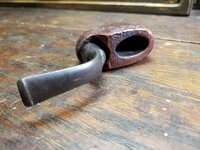
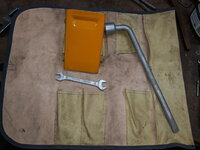
Thanks, but the business end looks like every countersink bit I’ve seen (which do vary in angle to accomodate different designs of flat head screws). The chamfering tool pics online show a blunt point, whereas countersink bits come to a fairly sharp point. In practice, I find boring the countersink first and then drilling a hole in its center makes a smoother countersink (less vibration and hopping) than dilling holes first and countersinking after. I mean in wood, which has uneven density, unlike metal.LS, that orange tool looks to me like a Lyman chamfering tool, used for reloading ammunition. If it's about 1/2" wide, even moreso - got to get over a .45ACP (among others...) case mouth.
EDIT - on second thoughts, they are essentially the same thing, and there are countersink bits with blunt points, or piloting points, etc. So it seems that whatever their proper name, chamfering brass casings is one use of such tools, and countersinking flat head screws is another.
Last edited: