To avoid these ads, REGISTER NOW!

110 or 220??

DJF3

Well-known member
Joined
Feb 15, 2020
Messages
186
Location
British Columbia, Canada
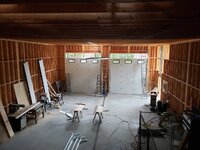
Just got my doors installed yesterday!! I have not run any power yet. I have the sub panel in, but that's it. The motors for the doors can be either 220 (4A) or 110 (8A).

I will be running a couple of 220 circuits for the future.

So, a couple of questions. Which is better and why? Should I run separate circuits for each motor?
 

Attachments

  • 20210908_191154.jpg
    20210908_191154.jpg
    410.3 KB · Views: 37
To avoid these ads, REGISTER NOW!

Theruse

Well-known member
Joined
Aug 12, 2012
Messages
341
Location
Maryland
If you know which brand of opener you will be using, go online to view the installation manual and see what they recommend.
 

American Locomotive

Well-known member
Joined
Jan 8, 2017
Messages
10,987
Location
Rhode Island
Negative.

Motor will run cooler.
Sorry that is not correct. The vast majority of dual voltage motors achieve the same efficiency at their high voltage and their low voltage, so it will not "run cooler" on 240v. The internal structure of single phase 120/240v motors is such that you have two identical "half" field windings. In 120v operation, the windings are in parallel, in 240v the windings are put in series.

Take a theoretical 120/240v motor rated at 10A/5A:
- In 120v mode, each "half winding" has 5A flowing through them. Since they're in parallel, the current at L1 would be 10A
- In 240v mode, each "half winding" also has 5A flowing through them. Since they're in series, the current at L1 is 5A.

So no matter which voltage configuration, the actual motor windings have the same current flowing through them. Thus the same efficiency and the same heat being generated.

The only time it might "run cooler" is if the wiring is not sized correctly, you'd have excessive voltage drop on 120v mode.
 
OP
D

DJF3

Well-known member
Joined
Feb 15, 2020
Messages
186
Location
British Columbia, Canada
Thanks for all the input. I decided to run one dedicated 20 amp 110V circuit. The number one main reason was to reduce space in the panel. I'm sure I have tons of room, but I just want to make sure.
 

Lassen Forge

Well-known member
Joined
Apr 26, 2014
Messages
15,312
Location
The romantic hills of central Umbria, Italy,
240 you will run half the amperage of 120 (the motor power is measured in Watts - which remain the same)... the cost is the space in your electrical panel. So for say a 1 HP motor (746 watts IIRC - don't hold me to that) is 6.21 amps at 120 Volts, and 3.1 amps at 240 volts... meaning you can run a smaller wire (per code - do NOT violate code!!!) using 240. (if you look at EU vs US wires, you'd be surprised at how thin they are, because their standard is 1ø 230V. )

(BTW, while Hz makes a difference with electronics and motors and whatnot (you can't generally run electronics from the US 60 Hz mains on the EU 50 Hz mains without liberating smoke like a Lucas Switch) it doesn't affect your wire size... irrelevant for this conversation, but just wanted to throw that in there...
 

Innovate1

Well-known member
Joined
Jul 28, 2014
Messages
4,289
Location
Illinois near St. Louis, Missouri
240 you will run half the amperage of 120 (the motor power is measured in Watts - which remain the same)... the cost is the space in your electrical panel. So for say a 1 HP motor (746 watts IIRC - don't hold me to that) is 6.21 amps at 120 Volts, and 3.1 amps at 240 volts... meaning you can run a smaller wire (per code - do NOT violate code!!!) using 240. (if you look at EU vs US wires, you'd be surprised at how thin they are, because their standard is 1ø 230V. )

(BTW, while Hz makes a difference with electronics and motors and whatnot (you can't generally run electronics from the US 60 Hz mains on the EU 50 Hz mains without liberating smoke like a Lucas Switch) it doesn't affect your wire size... irrelevant for this conversation, but just wanted to throw that in there...
You didn't take into account power factor and efficiency to get the currents. That will likely be about 60 - 75% for small induction motors and toward the low end for intermittent duty motors like on a garage door. So you need to nearly double your currents. Still, the 240V has half the current so less voltage drop and/or smaller wire (although for small motors like a GDO you may already be at the smallest size allowed.

Most home electronics these days have switching power supplies and can work from 120 or 240V, 50 or 60Hz. It makes a difference with MOTORS in most cases though and maybe some shop electronics. Best to just look on the name plate which will show what it is designed to work with.
 

dcg9381

Well-known member
Joined
Jun 20, 2018
Messages
11,796
Location
Austin, TX
Only "alternate" consideration I'd have is if I had backup power in the shop. I have several 3000-4000 watt generators that are 120V only. These are inverter generators that can be connected in parallel, but they only output 120V. We're eventually (perhaps sooner) going to put an interlock and generator inlet on the shop. Most of what I "have" to power in a power outage situation is 120V... Those doors are pretty tall, so maybe not easy to release, so if I had your setup, I'd need 240V to open the doors when power is out.

Everything else being equal, I'd wire the openers 240V too.
 

csp

Well-known member
Joined
Mar 23, 2010
Messages
5,720
Location
Franktown, CO
How many millions of residential garage door openers are out there on 120v and work perfectly for years and years and years. It's usually the circuit boards and carriage parts that are the problem sources.

The amp draw/efficiency/other arguments over a motor that runs for 30 second bursts a few times a day are entertaining I suppose.
 

mikedodge

Well-known member
Joined
Jun 27, 2017
Messages
2,819
Its not high amperage and not a load that's used a lot so use 110 and save that panel space for something else.
 
OP
D

DJF3

Well-known member
Joined
Feb 15, 2020
Messages
186
Location
British Columbia, Canada
I'll address several comments here. I ran 12/2 wire for the openers. I ran the wire into a receptacle box, and put plugs on the end of the wire coming from the openers. If I remember correctly, the openers pulled 8 amps each on 120, and 4 amps each on 240. 12/2 is good for 20 amps, so both openers running at the same time would pull 16 amps on 120.

I do not have back up power for the shop. If the power is out, there is a manual chain overide, however with the gear reduction it takes almost a minute to fully open a door. I don't think you could ever open one by hand. There is something in the opener that won't allow it. It's like an anti theft thing. I do not need locks on the doors because of this.

If I ever have to replace an opener, I don't think I would be able to find one at a big box store. These are large commercial jack shaft openers. So.....in the end I made the decision based on panel space even though I have more than enough room for now.
 

Attachments

  • J.png
    J.png
    41 KB · Views: 24

beemerphile

Well-known member
Joined
Jul 9, 2021
Messages
727
Location
Danielsville, GA USA
...I ran the wire into a receptacle box, and put plugs on the end of the wire coming from the openers.
These are large commercial jack shaft openers.
I'm not sure these would meet the permitted uses of SO cord under 400.7, especially as allowed in 400.7(A)(8). They are not hanging from a trolley like a residential opener.

'Appliances where the fastening means and mechanical connections are specifically designed to permit ready removal for maintenance and repair, and the appliance is intended or identified for flexible cord connection."

Not that anyone would ever call you out on it, but if you added the plugs, then you'd need to assure that the appliance is "intended or identified for cord connection". It would be hard to explain that a commercial jackshaft opener was "specifically designed to permit ready removal for maintenance and repair". I would hard-wire them for 120v with disconnects.
 
To avoid these ads, REGISTER NOW!

Terry D

Well-known member
Joined
Mar 25, 2015
Messages
2,202
Location
St. Louis, MO.
I'm not sure these would meet the permitted uses of SO cord under 400.7, especially as allowed in 400.7(A)(8). They are not hanging from a trolley like a residential opener.

'Appliances where the fastening means and mechanical connections are specifically designed to permit ready removal for maintenance and repair, and the appliance is intended or identified for flexible cord connection."

Not that anyone would ever call you out on it, but if you added the plugs, then you'd need to assure that the appliance is "intended or identified for cord connection". It would be hard to explain that a commercial jackshaft opener was "specifically designed to permit ready removal for maintenance and repair". I would hard-wire them for 120v with disconnects.
If the opener is manufactured and came with a cord, I see no reason by putting a plug on the end, that it would be a violation. I'm sure they didn't come with a plug because the opener is dual voltage. Plus having a plug and receptacle connection would eliminate the need for a service disconnect
 

beemerphile

Well-known member
Joined
Jul 9, 2021
Messages
727
Location
Danielsville, GA USA
...Plus having a plug and receptacle connection would eliminate the need for a service disconnect
Coming with a cord on it only meets one of the two tests - the other being its design for ready removal. But yes, if the plug and cord are allowed, the disconnect is not needed. And if it is hard-wired, GFCI is not needed. If the receptacle is not "readily accessible" then the CFGI will have to be at the breaker.
 

Terry D

Well-known member
Joined
Mar 25, 2015
Messages
2,202
Location
St. Louis, MO.
Coming with a cord on it only meets one of the two tests - the other being its design for ready removal. But yes, if the plug and cord are allowed, the disconnect is not needed. And if it is hard-wired, GFCI is not needed. If the receptacle is not "readily accessible" then the CFGI will have to be at the breaker.
Or a dead front GFCI mounted low
 

Norcal

Well-known member
Joined
Mar 16, 2008
Messages
13,765
I'm glad no one mentioned PVC airlines.
Thinking about doing part of the shop air in PVC.


Just kidding, over 30 years ago wanted to run air over close to the house while a trench was open, could not bring myself to toss some PVC in there so did nothing a about it. Now back to electrical topics.
 
OP
D

DJF3

Well-known member
Joined
Feb 15, 2020
Messages
186
Location
British Columbia, Canada
Sorry....I used 110 where I should have said 120. Rookie mistake. There is a sub panel in the building and I've already wired a 240V hoist, (or is it 220?;))

The openers did not come with any wiring. There are knockouts on the side of the housings. There was nothing in the instructions regarding hard wiring vs receptacles. There is a screw terminal strip inside the housing to attach wires to, very similar to the neutral and ground connections inside the electrical panel. I used 12/2 and put flexible conduit over the wire before adding the plugs. I'm not sure the conduit was necessary, since it's so high up.

Why would I need a GFCI protected circuit for this? I'm new at this electrical stuff. The openers are approx 14 ft off the floor, with the receptacles about a foot above that. The sit between the two doors near the top of the ladder that's in the picture. I don't have a picture of the openers installed.

This hasn't been inspected yet, I guess I will find out if it passes or not.
 

Attachments

  • 20210908_121152.jpg
    20210908_121152.jpg
    238.1 KB · Views: 18

Terry D

Well-known member
Joined
Mar 25, 2015
Messages
2,202
Location
St. Louis, MO.
All 120 volt receptacles in a garage are supposed to be gfci protected. Being up high no longer matters. If you area is under the 2020 NEC, then even the 240 receptacles need to be protected.

Edit: I did not realize you are in Canada
 

Innovate1

Well-known member
Joined
Jul 28, 2014
Messages
4,289
Location
Illinois near St. Louis, Missouri
All 120 volt receptacles in a garage are supposed to be gfci protected. Being up high no longer matters. If you area is under the 2020 NEC, then even the 240 receptacles need to be protected.

Edit: I did not realize you are in Canada
Realize you are in Canada but here what is often done is to put GFCI receptacle where it can be reached (rule is it has to be accessable without a ladder) and then run another higher receptacle from that. That's how I did my ceiling receptacle for a cord reel. Cheaper than a GFCI breaker. Also part of the reason I hard wired my light fixtures.
 

marinusdees

Well-known member
Joined
Oct 30, 2012
Messages
1,325
Location
Edgewood, Washington
Just got my doors installed yesterday!! I have not run any power yet. I have the sub panel in, but that's it. The motors for the doors can be either 220 (4A) or 110 (8A).

I will be running a couple of 220 circuits for the future.

So, a couple of questions. Which is better and why? Should I run separate circuits for each motor?
Neither is better, and there's no "why". Me with my pea brain would go 240 v every time. Don't ask me to explain it.
 
To avoid these ads, REGISTER NOW!
Top Bottom