To avoid these ads, REGISTER NOW!

Correct Mortar Over Natural Stone?

OverkillYJ

Well-known member
Joined
Aug 7, 2013
Messages
262
Location
Harleysville, PA
HI Garage Journal. Been a while.

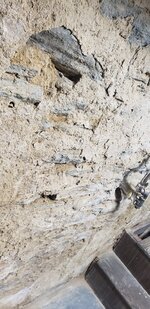
Across from my shop are bilco doors to go into my home basement. I have a natural stone foundation made out of brown garnet mica-schist (natural bedrock in the area). I keep parts and extra tools and things down there in my basement on shelving. I had moisture coming through finished walls that were there when I bought the home, so I just ripped them out and have this 100 year old mortar on the stone. I got all the loose stuff off scraping it with a shovel. It gets damp below the ground level when it rains hard an you can see dampness, and if it rains really hard water seeps through a couple of spots. There are no cracks in the foundation though, its just the way the natural stone is.

Here is my question. Does anyone know the best type of mortar or concrete I can coat all of this with? Do I need to remove the old mortar first? I figured I would coat it, then seal it in a paint made for foundations. If that's not the best way, please educate me. I have done pretty complicated masonry in the past with great success. I am here looking to get some second opinions before I go throwing concrete at this foundation to see what sticks. I have already taken care of the mold I found. have this large section cleaned up and ready to experiment on. Im trying to get this part nice, then continue on once I know what I need to do to finish the walls. This will make life in my shop so much better with way more room for extra parts, so please, share your knowledge with me.

Thanks for any help.20211012_155418.jpg
 
Last edited:
To avoid these ads, REGISTER NOW!

yeldogt

Well-known member
Joined
Jan 2, 2012
Messages
18,184
Are you in the city or is this a single with open walls outside?

Looks like good old Wissahickon schist ....

One of the big mistakes people make when restoring old buildings is to use Portland cement based mortar -- this can be especially problematic with many old bricks .. the mortar is harder than the brick and the bricks fail. The same can happen with stone ...

logically, when you where building in the late 1800's w/o machinery -- you used what was nearby. There were all kinds of quarries in and around Philadelphia and further north in bucks country that would bring stone down the Delaware canal. The quality of stone was also dependent on the house ... but, you did not used the best stuff for the foundation (especially for basic housing)

End of mini history lesson . For what you are doing .... IMO it really does not matter. I would be very surprised if whoever did that used anything other than a commercial Portland based product. What is holding the stone together depends on the time the building was built. And how much money they had. Portland cement while invented around 1850 --- still was not widely used especially in basic housing until around 1900 or even later. It was more money.

I recently had my project in Bucks County done and since it was mixed onsite we used a bit more lime for "stick" and dropped down the Portland a bit. In my case I exposed the outside down to the bottom and we coated the old stone and sprayed that green waterproof product. Inside the crawl slab was higher and we only had to do about 3' of it -- I spray foamed this side. While the outside was open we ran a pipe system to take any water away.

How solid is the product on there now? Often what happens -- the lime mortar just fails and turns to dust. Sometimes it was weak to begin with .... remember --- these houses were built with what was available. You could not call down to the sand wash and get a load of clean sand. I'm sure there are various levels of patch and different products used. The best you can do is to remove what is loose and patch and cover the failing spots ... make sure you have slope away from building and proper gutters / downspouts. Stopping water is very hard if there is a high water table ... If it's surface water coming down the wall -- fixing the failed spots will often work. You need to clean out the soft voids as well if thats where you see the water
 

Kaizen

Well-known member
Joined
Jan 9, 2015
Messages
6,948
Location
New England
Type N is probably best. Type S is used for structural stone work but N will be fine. I'm doing this on my exterior foundation that is fieldstone. I got one of these with a spade hammer bit and i'm taking it all out in sections and repointing all of it. If i hit it and it is solid i leave it alone. A shovel is not good enough. A hammer and chisel should be used to get all of the old stuff out. Just doing a veneer layer is not what i'd do. Also add adhesion liquid stuff to the mortar mix. I run the hose over the area to blast dust out and wet the stone before doing the mortar. Doesnt cost much besides time.


Did you fix or divert the water problem? Pics of outside of this wall would be helpful.
 

duneslider

Well-known member
Joined
Jan 20, 2013
Messages
2,272
Location
Riverton, Utah
You should remove anything that is loose and falling off. You should be using Hydraulic Cement for this. Type N and S will not stop water from coming in. Hydraulic cement is designed to stop water. Your local box store should have it but you should be able to find it in larger qty at a specialty place. I am sure it is quite common in your area.

I suspect in your area there is an organization for maintaining and restoring old/historic houses. It would be good to check with them and see what is done locally with the same stone you have.
 

yeldogt

Well-known member
Joined
Jan 2, 2012
Messages
18,184
You should remove anything that is loose and falling off. You should be using Hydraulic Cement for this. Type N and S will not stop water from coming in. Hydraulic cement is designed to stop water. Your local box store should have it but you should be able to find it in larger qty at a specialty place. I am sure it is quite common in your area.

I suspect in your area there is an organization for maintaining and restoring old/historic houses. It would be good to check with them and see what is done locally with the same stone you have.
Hydraulic is an expanding product -- it's used to fill around holes. It can be used as a spot mortar -- Have seen this used when people have huge stone outcroppings for part of a foundation. It's not a skim coat product.
 
To avoid these ads, REGISTER NOW!

yeldogt

Well-known member
Joined
Jan 2, 2012
Messages
18,184
You should remove anything that is loose and falling off. You should be using Hydraulic Cement for this. Type N and S will not stop water from coming in. Hydraulic cement is designed to stop water. Your local box store should have it but you should be able to find it in larger qty at a specialty place. I am sure it is quite common in your area.

I suspect in your area there is an organization for maintaining and restoring old/historic houses. It would be good to check with them and see what is done locally with the same stone you have.
N has 1/2 the Portland .... Portland is what gives it the strength.

The proper product to patch (point) old stone work is lime mortar .... google -- Limeworks.us. Tons of information ... I have taken a few of the workshops ... the pointing more than once.

Some of that old shale in foundations will weep water right through it
 

duneslider

Well-known member
Joined
Jan 20, 2013
Messages
2,272
Location
Riverton, Utah
https://www.thespruce.com/what-is-hydraulic-cement-uses-and-how-to-apply-845076

Hydraulic cement has a lot of uses and formulations. We don't really have a lot of stone foundations in my area so I am not saying this is a good idea but it certainly is used for this sort of purpose. Lime mortars are regularly used as coatings but they are not waterproof at all. I would still highly recommend someone with this sort of foundation contact a local historic preservation organization to discuss what is typically done for these situations in the area they live. I am positive this situation is common in a lot of homes in this individual's area. There is also a good chance some exterior drainage issues need to be addressed which might solve the issues too, then a lime mortar to cover the walls would make sense.
 
OP
O

OverkillYJ

Well-known member
Joined
Aug 7, 2013
Messages
262
Location
Harleysville, PA
Thank you for the help. I would have said Wissahickon Schist, but I didnt think anyone would know what that is. I am on the border of the city in a single family home. My house is basically dug into the schist bedrock. So it is partially built from the natural stone, and also set into the natural stone, if you understand what I mean. I have water seepage when it rains hard. Plan I have is to hydro cement where the floor meets the wall. The walls I scraped with a shovel, pry bar, and am going to shop vac it as well. I figured I would use a commercial sprayer to apply cement bonding agent. Then I want to skim coat the best mix.

So I guess Yeldogt, I am going to make a Type N mortar, but with lime? I can look up recipes if you dont have one, and I already have supplies. My house is way above the water table. My water issues seem to be the water running down the outside of my foudnation in the ground, then coming through a crack between the poured floor and the natural stone. Thats where I will hydrolic cement it, and I will follow your advice on the walls.

Only question I have., What is the green stuff you are talking about for waterproofing? I have a gallon of Drylock Foundation paint I was going to test after I skim coat. Is there a better way? Can I seal it, then skim coat?
 
OP
O

OverkillYJ

Well-known member
Joined
Aug 7, 2013
Messages
262
Location
Harleysville, PA
Are you in the city or is this a single with open walls outside?

Looks like good old Wissahickon schist ....

One of the big mistakes people make when restoring old buildings is to use Portland cement based mortar -- this can be especially problematic with many old bricks .. the mortar is harder than the brick and the bricks fail. The same can happen with stone ...

logically, when you where building in the late 1800's w/o machinery -- you used what was nearby. There were all kinds of quarries in and around Philadelphia and further north in bucks country that would bring stone down the Delaware canal. The quality of stone was also dependent on the house ... but, you did not used the best stuff for the foundation (especially for basic housing)

End of mini history lesson . For what you are doing .... IMO it really does not matter. I would be very surprised if whoever did that used anything other than a commercial Portland based product. What is holding the stone together depends on the time the building was built. And how much money they had. Portland cement while invented around 1850 --- still was not widely used especially in basic housing until around 1900 or even later. It was more money.

I recently had my project in Bucks County done and since it was mixed onsite we used a bit more lime for "stick" and dropped down the Portland a bit. In my case I exposed the outside down to the bottom and we coated the old stone and sprayed that green waterproof product. Inside the crawl slab was higher and we only had to do about 3' of it -- I spray foamed this side. While the outside was open we ran a pipe system to take any water away.

How solid is the product on there now? Often what happens -- the lime mortar just fails and turns to dust. Sometimes it was weak to begin with .... remember --- these houses were built with what was available. You could not call down to the sand wash and get a load of clean sand. I'm sure there are various levels of patch and different products used. The best you can do is to remove what is loose and patch and cover the failing spots ... make sure you have slope away from building and proper gutters / downspouts. Stopping water is very hard if there is a high water table ... If it's surface water coming down the wall -- fixing the failed spots will often work. You need to clean out the soft voids as well if thats where you see the water

Are you in the city or is this a single with open walls outside?

Looks like good old Wissahickon schist ....

One of the big mistakes people make when restoring old buildings is to use Portland cement based mortar -- this can be especially problematic with many old bricks .. the mortar is harder than the brick and the bricks fail. The same can happen with stone ...

logically, when you where building in the late 1800's w/o machinery -- you used what was nearby. There were all kinds of quarries in and around Philadelphia and further north in bucks country that would bring stone down the Delaware canal. The quality of stone was also dependent on the house ... but, you did not used the best stuff for the foundation (especially for basic housing)

End of mini history lesson . For what you are doing .... IMO it really does not matter. I would be very surprised if whoever did that used anything other than a commercial Portland based product. What is holding the stone together depends on the time the building was built. And how much money they had. Portland cement while invented around 1850 --- still was not widely used especially in basic housing until around 1900 or even later. It was more money.

I recently had my project in Bucks County done and since it was mixed onsite we used a bit more lime for "stick" and dropped down the Portland a bit. In my case I exposed the outside down to the bottom and we coated the old stone and sprayed that green waterproof product. Inside the crawl slab was higher and we only had to do about 3' of it -- I spray foamed this side. While the outside was open we ran a pipe system to take any water away.

How solid is the product on there now? Often what happens -- the lime mortar just fails and turns to dust. Sometimes it was weak to begin with .... remember --- these houses were built with what was available. You could not call down to the sand wash and get a load of clean sand. I'm sure there are various levels of patch and different products used. The best you can do is to remove what is loose and patch and cover the failing spots ... make sure you have slope away from building and proper gutters / downspouts. Stopping water is very hard if there is a high water table ... If it's surface water coming down the wall -- fixing the failed spots will often work. You need to clean out the soft voids as well if thats where you see the water
I replied to your comment on my other reply, but I somehow didnt reply to you and wanted to make sure you saw this.
 

yeldogt

Well-known member
Joined
Jan 2, 2012
Messages
18,184
It was common to build on the rock ... why not. The old rock was not going anyplace and from the point of view of the builders back then -- it was the best foundation. There was also no thought of the basement in those homes being used for anything ... the problem is that if you chop out the rock and build up -- there is no way to get proper water management on the outside of the wall. Proper water management starts outside ... that's where the perforated pipe goes at the footing ... or at the bottom of the wall when there is no footing.

Ideally -- you dig down on the outside. This is what I did -- we dug to the base of the wall. Patched and coated -- it looked like a rough stucco after. Then I had a guy coat the wall with spray elastic foundation spray (it's green). We did use cement -- but added more lime for some extra stick as it just seems to work better. The bottom of the trench was covered in fabric -- perforated pipe along the bottom w/ stone -- it's wrapped and more sone is added on top. Dirt on top ..... I did the same inside before the new slab was poured -- except we used spray foam on the inside and framed on top.

You need to see if you can address any of the outside water ? Is the leak only at where the original bedrock is ?

If that is the case -- you may be able to clean out the gap and try hydrolic as it will expand. That's the only place where it can work -- it needs a cavity to expand against.

All stone and block will hold moisture -- that's why we coat the outside of buildings. To stop it from getting to the foundation in the first place. The ability of an inside coating to work depends on the amount of water. Active water is hard to stop ... coatings like drylock will fail with active water.

The reason to stucco. Often in an old stone building -- the foundation mortar is failing. You can't just spray it -- the multi coats of the stucco process fill in the voids and stabilize the wall. When the foundation is solid -- it's often possible to point and just coat.

If I was you I would try and spot fix the problem areas and see how it goes before just covering everything -- that way you can tell if successful in getting active water fixed. The coatings are really to eliminate natural water/ moisture migration through the stone that raises the humidity
 
Last edited:

finn

Well-known member
Joined
Mar 27, 2005
Messages
16,383
Location
The UP, God's country
Surprised that nobody recommended using a latex based additive like that used for parging old walls. The stuff makes the application easier and seems to add flexibility to the mix to reduce future cracking.
 
To avoid these ads, REGISTER NOW!
Top Bottom